




Global Web Filtering Market
Market Size in USD Billion
CAGR :
% 
 USD
3.32 Billion
USD
9.96 Billion
2025
2033
USD
3.32 Billion
USD
9.96 Billion
2025
2033
 Forecast Period Forecast Period |
2026 –2033 |
 Market Size (Base Year) Market Size (Base Year) |
USD 3.32 Billion |
 Market Size (Forecast Year) Market Size (Forecast Year) |
USD 9.96 Billion |
 CAGR CAGR |
% |
| Major Markets Players |
|
Web Filtering Market Size
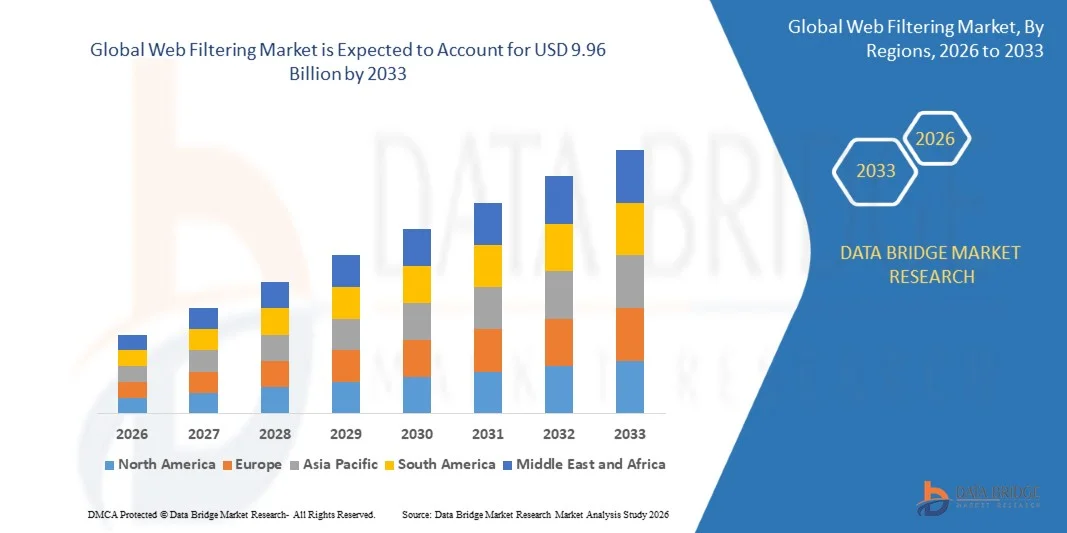
- The global web filtering market size was valued at USD 3.32 billion in 2025 and is expected to reach USD 9.96 billion by 2033, at a CAGR of 14.70% during the forecast period
- The market growth is largely fuelled by the increasing need for secure network environments, rising cyber threats, growing adoption of cloud-based solutions, and stringent regulatory compliance requirements across enterprises
Web Filtering Market Analysis
- The market is witnessing significant adoption across SMEs and large enterprises due to the growing demand for content control, malware prevention, and secure access management
- Advanced features such as AI-driven threat detection, real-time monitoring, and integration with existing IT infrastructure are driving enhanced adoption of web filtering solutions
- North America dominated the web filtering market with the largest revenue share of 38.5% in 2025, driven by rising cybersecurity concerns, stringent regulatory requirements, and increasing adoption of cloud-based security solutions.
- The Asia-Pacific region is expected to witness the highest growth rate in the global web filtering market, driven by expanding IT and telecom sectors, increasing investments in digital security infrastructure, government initiatives promoting cybersecurity, and rising adoption of cloud and SaaS-based security solutions.
- The Solutions segment held the largest market revenue share in 2025, driven by the increasing demand for robust security measures, real-time monitoring, and policy enforcement across enterprise and educational networks. Web filtering solutions often provide centralized control, threat intelligence integration, and seamless compatibility with existing IT infrastructure, making them a preferred choice for organizations seeking comprehensive protection
Report Scope and Web Filtering Market Segmentation
|
Attributes |
Web Filtering Key Market Insights |
|
Segments Covered |
|
|
Countries Covered |
North America
Europe
Asia-Pacific
Middle East and Africa
South America
|
|
Key Market Players |
• Cisco (U.S.) |
|
Market Opportunities |
• Increasing Adoption Of Cloud-Based Web Filtering Solutions |
|
Value Added Data Infosets |
In addition to the market insights such as market value, growth rate, market segments, geographical coverage, market players, and market scenario, the market report curated by the Data Bridge Market Research team includes in-depth expert analysis, import/export analysis, pricing analysis, production consumption analysis, and pestle analysis. |
Web Filtering Market Trends
“Rising Demand for Secure Network Environments”
• The growing focus on cybersecurity and safe internet usage is significantly shaping the web filtering market, as organizations increasingly seek solutions to protect against malware, phishing, and inappropriate content. Web filtering solutions are gaining traction due to their ability to enforce access policies, monitor traffic, and maintain compliance without disrupting productivity. This trend strengthens adoption across enterprise, education, and government sectors, encouraging vendors to innovate with advanced filtering technologies and threat intelligence
• Increasing awareness around data protection, regulatory compliance, and remote workforce security has accelerated the demand for web filtering solutions in corporate networks, cloud services, and educational institutions. IT administrators and security teams are actively seeking solutions that provide centralized control, real-time monitoring, and reporting, prompting providers to enhance functional capabilities and integration features
• Cybersecurity and compliance trends are influencing purchasing decisions, with organizations emphasizing regulatory adherence, secure browsing, and incident prevention. These factors are helping vendors differentiate solutions in a competitive market and build client trust, while also driving adoption of AI-enabled and cloud-based web filtering solutions
• For instance, in 2024, Cisco in the U.S. and Sophos in the U.K. expanded their web filtering offerings with AI-based threat detection and cloud-managed solutions for enterprises and educational institutions. These launches responded to increasing demand for secure and manageable network environments, with distribution across enterprise IT channels and cloud platforms. The solutions were marketed as advanced, reliable security tools, enhancing brand trust and customer retention
• While demand for web filtering solutions is growing, sustained market expansion depends on continuous innovation, cost-effective deployment, and maintaining performance against emerging cyber threats. Vendors are also focusing on enhancing scalability, ease of management, and AI-driven automation to balance security, efficiency, and user experience for broader adoption
Web Filtering Market Dynamics
Driver
“Rising Cybersecurity Concerns and Need for Regulatory Compliance”
• Increasing cyber threats, data breaches, and malware attacks are major drivers for the web filtering market. Organizations are adopting web filtering solutions to block malicious content, enforce internet usage policies, and maintain secure IT environments, supporting regulatory compliance and operational safety
• Growing adoption of cloud-based solutions and remote work infrastructure is driving market growth. Web filtering technologies help organizations manage access control, protect sensitive data, and ensure safe browsing for employees and students, strengthening cybersecurity posture
• IT and security teams are actively promoting web filtering solutions through implementation in enterprise networks, cloud platforms, and educational institutions. These efforts are supported by growing awareness of online threats and the need for continuous monitoring, prompting partnerships between vendors and clients for advanced deployment
• For instance, in 2023, Fortinet in the U.S. and Barracuda Networks in the U.K. reported expanded adoption of web filtering solutions among enterprises and schools. This expansion followed heightened cyberattack incidents and stricter regulatory requirements, driving repeat purchases and solution upgrades. Both companies also emphasized AI-powered detection and policy enforcement in marketing campaigns to build trust and credibility
• Although rising cybersecurity concerns support growth, wider adoption depends on cost optimization, user awareness, and seamless integration with existing IT infrastructure. Investment in cloud-based management, AI-driven threat intelligence, and endpoint compatibility will be critical for meeting global demand and maintaining competitive advantage
Restraint/Challenge
“High Implementation Costs and Limited Awareness in Developing Markets”
• The relatively high cost of web filtering solutions compared to basic security measures remains a key challenge, limiting adoption among price-sensitive organizations. Licensing fees, deployment complexity, and ongoing maintenance contribute to elevated costs
• Awareness of web filtering benefits remains uneven, particularly in developing regions where cybersecurity adoption is still emerging. Limited understanding of functional advantages restricts deployment across SMEs and educational institutions, slowing market penetration
• Integration and management challenges also impact market growth, as solutions must align with existing IT infrastructure, cloud services, and endpoint devices. Complex configuration, monitoring, and reporting requirements increase operational workload for IT teams
• For instance, in 2024, educational institutions and SMEs in India and Southeast Asia reported slower uptake due to higher costs and limited knowledge of web filtering benefits. In addition, lack of trained IT staff and cloud infrastructure posed deployment challenges, reducing solution visibility and adoption
• Overcoming these challenges will require cost-efficient deployment models, targeted awareness campaigns, and simplified management tools. Collaboration with IT service providers, security consultants, and regulatory bodies can help unlock long-term growth potential, while AI integration and cloud-based delivery will support scalable and effective adoption globally
Web Filtering Market Scope
The market is segmented on the basis of component, filtering type, deployment mode, organization size, and vertical.
• By Component
On the basis of component, the global web filtering market is segmented into Solutions and Services. The Solutions segment held the largest market revenue share in 2025, driven by the increasing demand for robust security measures, real-time monitoring, and policy enforcement across enterprise and educational networks. Web filtering solutions often provide centralized control, threat intelligence integration, and seamless compatibility with existing IT infrastructure, making them a preferred choice for organizations seeking comprehensive protection.
The Services segment is expected to witness the fastest growth rate from 2026 to 2033, driven by the rising need for managed security services, deployment support, and continuous system monitoring. Service offerings are particularly valued for their ability to reduce the operational burden on IT teams while ensuring timely updates and compliance, often serving as a primary mechanism for organizations to maintain secure and efficient web access.
• By Filtering Type
On the basis of filtering type, the market is segmented into DNS Filtering, URL Filtering, Keyword Filtering, File Type Filtering, and Others. The URL Filtering segment held the largest revenue share in 2025, owing to its effectiveness in blocking access to malicious or inappropriate websites while enabling granular control over user activity. URL filtering solutions often integrate with threat intelligence feeds, enhancing security for enterprises, educational institutions, and government organizations.
The DNS Filtering segment is expected to witness the fastest growth from 2026 to 2033, driven by its low-latency operation, cloud compatibility, and ability to prevent access to harmful domains before a connection is established. DNS filtering is increasingly adopted for its proactive protection and minimal impact on network performance, making it ideal for modern cloud and hybrid network environments.
• By Deployment Mode
On the basis of deployment mode, the web filtering market is segmented into Cloud and On-Premises. The Cloud segment held the largest market revenue share in 2025, fueled by the growing adoption of cloud computing, remote work environments, and the need for scalable, easily managed security solutions. Cloud-based web filtering often offers centralized policy management, real-time updates, and simplified integration with existing IT infrastructure, enhancing security for distributed teams.
The On-Premises segment is expected to witness the fastest growth rate from 2026 to 2033, driven by organizations seeking full control over sensitive data and customized deployment options. On-premises solutions are particularly preferred for regulatory compliance, high-security environments, and sectors that require localized network management.
• By Organization Size
On the basis of organization size, the market is segmented into Small and Medium-Sized Enterprises and Large Enterprises. The Large Enterprises segment held the largest revenue share in 2025 due to extensive IT infrastructure, high volumes of network traffic, and the critical need to protect sensitive organizational data. Large enterprises often deploy comprehensive web filtering solutions to enforce policies, manage threats, and ensure compliance across multiple locations.
The Small and Medium-Sized Enterprises segment is expected to witness the fastest growth from 2026 to 2033, driven by increasing awareness of cyber threats, cost-effective subscription-based solutions, and the need to protect distributed workforces. SMEs are adopting cloud-based web filtering to safeguard data while maintaining operational efficiency.
• By Vertical
On the basis of vertical, the market is segmented into Government, Banking, Financial Services, and Insurance, Manufacturing, IT and Telecom, Education, Healthcare, Retail, and Others. The BFSI vertical held the largest revenue share in 2025, fueled by stringent regulatory compliance requirements and the need to protect sensitive financial and customer data. Web filtering solutions in this vertical often provide advanced monitoring, reporting, and threat mitigation features, making them essential for secure operations.
The Education vertical is expected to witness the fastest growth rate from 2026 to 2033, driven by the increasing adoption of digital learning platforms, online classrooms, and the need to ensure safe internet usage for students. Educational institutions are implementing web filtering solutions to monitor content, prevent cyber threats, and maintain a productive learning environment.
Web Filtering Market Regional Analysis
• North America dominated the web filtering market with the largest revenue share of 38.5% in 2025, driven by rising cybersecurity concerns, stringent regulatory requirements, and increasing adoption of cloud-based security solutions.
• Organizations in the region highly value real-time threat detection, content control, and centralized policy management offered by web filtering solutions, ensuring secure network environments and compliance across enterprises and educational institutions.
• This widespread adoption is further supported by high IT infrastructure investment, a technology-oriented workforce, and growing remote work trends, establishing web filtering as a critical solution for both large enterprises and SMEs.
U.S. Web Filtering Market Insight
The U.S. web filtering market captured the largest revenue share in 2025 within North America, fueled by the rapid deployment of cloud security solutions and increasing cyberattack incidents. Organizations are prioritizing network security through real-time monitoring, URL and DNS filtering, and policy enforcement systems. The growing demand for managed security services, mobile workforce protection, and AI-powered threat detection is further driving market expansion. Moreover, integration with existing IT infrastructure and compliance with regulations such as HIPAA and CCPA is significantly contributing to market growth.
Europe Web Filtering Market Insight
The Europe web filtering market is expected to witness the fastest growth rate from 2026 to 2033, primarily driven by strict data protection regulations such as GDPR and the increasing adoption of digital workplace solutions. Rising cyber threats and the need for secure internet access across enterprises and educational institutions are fostering adoption. European organizations are also investing in cloud-based and AI-enhanced filtering solutions to streamline security management. The market is expanding across government, BFSI, and education verticals, with growing interest in scalable and efficient network security solutions.
U.K. Web Filtering Market Insight
The U.K. web filtering market is expected to witness the fastest growth rate from 2026 to 2033, driven by increasing digitalization, cloud adoption, and remote work infrastructure. Heightened concerns about cyber threats, phishing attacks, and inappropriate content are encouraging organizations to deploy comprehensive web filtering solutions. The U.K.’s robust IT ecosystem, combined with government initiatives promoting cybersecurity awareness, is expected to sustain market growth and accelerate adoption across enterprises and educational institutions.
Germany Web Filtering Market Insight
The Germany web filtering market is expected to witness the fastest growth rate from 2026 to 2033, fueled by growing awareness of cyber risks and the demand for advanced network security solutions. Germany’s highly developed IT infrastructure and emphasis on compliance with EU regulations promote web filtering adoption across large enterprises and government organizations. Integration with AI-based threat intelligence, cloud management, and endpoint monitoring is becoming increasingly prevalent, aligning with local organizations’ need for secure and efficient network protection.
Asia-Pacific Web Filtering Market Insight
The Asia-Pacific web filtering market is expected to witness the fastest growth rate from 2026 to 2033, driven by rapid digital transformation, increasing internet penetration, and the rise of SMEs in countries such as China, India, and Japan. Government initiatives supporting cybersecurity, alongside growing cloud and IT adoption, are propelling the need for secure network access. Furthermore, as APAC becomes a hub for IT service providers and cloud security solutions, affordability and accessibility are expanding, enabling wider adoption among enterprises, educational institutions, and public sector organizations.
Japan Web Filtering Market Insight
The Japan web filtering market is expected to witness the fastest growth rate from 2026 to 2033 due to the country’s advanced IT infrastructure, high internet penetration, and focus on secure digital workplaces. Japanese organizations prioritize threat mitigation, content monitoring, and compliance management, driving adoption of web filtering solutions. Integration with cloud platforms, AI-driven security, and IoT network monitoring is fueling growth. In addition, Japan’s aging workforce and emphasis on remote work security are likely to spur demand for user-friendly and reliable web filtering solutions across enterprises and educational institutions.
China Web Filtering Market Insight
The China web filtering market accounted for the largest market revenue share in Asia-Pacific in 2025, attributed to rapid digitalization, strong regulatory initiatives, and increasing cybersecurity awareness. China is one of the largest markets for cloud and AI-powered web security solutions, and adoption is growing across enterprises, educational institutions, and government organizations. The push towards smart offices, combined with the availability of cost-effective solutions and local IT service providers, are key factors driving market growth.
Web Filtering Market Share
The Web Filtering industry is primarily led by well-established companies, including:
• Cisco (U.S.)
• Symantec Corporation (U.S.)
• McAfee LLC (U.S.)
• Palo Alto Networks Inc. (U.S.)
• Fortinet Inc. (U.S.)
• Trend Micro Inc. (Japan)
• Forcepoint (U.S.)
• Sophos Ltd. (U.K.)
• Barracuda Network Inc. (U.S.)
• Zscaler Inc. (U.S.)
• Trustwave Holdings Inc. (U.S.)
• Iboss Tech Solutions Pvt. Ltd. (India)
• Webroot (U.S.)
• Interoute (U.K.)
• Titan HQ (Ireland)
• Virtela (U.S.)
• Netskope (U.S.)
• CensorNet (U.K.)
• Clearswift (U.K.)
• Wavecrest Computing (U.S.)
• Cyren (Israel)
• GFI Software (Malta)
• Untangle (U.S.)
• ContentKeeper Technologies (Australia)
• Kaspersky Lab (Russia)
Latest Developments in Global Web Filtering Market
- In November 2025, Cisco Systems (U.S.) announced a strategic partnership with a leading cloud service provider to enhance its web filtering solutions. The collaboration integrates advanced machine learning algorithms to improve real-time threat detection, identify malicious content faster, and reduce downtime for enterprises. This development strengthens Cisco’s product portfolio, boosts customer confidence, and positions the company as a leader in intelligent and adaptive cybersecurity solutions. The move also increases competitiveness against other market players, driving wider adoption of AI-driven web security
- In October 2025, Fortinet (U.S.) launched a new suite of web filtering tools specifically designed for small and medium-sized enterprises (SMEs). These solutions address the unique security needs of SMEs, offering real-time monitoring, content control, and simplified management. By targeting this growing segment, Fortinet expands its market presence and meets the rising demand for accessible, cost-effective cybersecurity solutions. The launch is expected to drive adoption of unified threat management platforms among smaller organizations
- In September 2025, Palo Alto Networks (U.S.) unveiled an AI-driven web filtering solution to significantly reduce false positives. The solution enhances user experience by accurately distinguishing between safe and malicious content while maintaining strong security standards. It represents a shift toward more intelligent, automated cybersecurity technologies, enabling enterprises to streamline operations and reduce manual oversight. This innovation sets new benchmarks in the industry and strengthens Palo Alto Networks’ position as a technology leader
- In June 2025, Zscaler (U.S.) appointed Kevin Rubin as CFO to oversee financial operations amid a 23% revenue expansion. This strategic leadership change aims to enhance organizational efficiency, support rapid growth, and strengthen investor confidence. Rubin’s appointment is expected to guide financial planning for scaling cloud-based web filtering services. It also prepares Zscaler to capitalize on emerging opportunities in AI-enhanced security solutions across multiple sectors
- In May 2025, Fortinet (U.S.) completed the acquisition of Lacework, integrating AI-powered cloud security analytics into its Unified SASE platform. The acquisition strengthens Fortinet’s cloud security capabilities by offering enhanced threat detection, automated monitoring, and predictive analytics. It enables the company to deliver more comprehensive, AI-driven security solutions to enterprises of all sizes. The move consolidates Fortinet’s competitive advantage in cloud-based web filtering and unified cybersecurity offerings
- In April 2025, Palo Alto Networks (U.S.) entered into acquisition talks for Protect AI, valued at USD 650–700 million, to bolster its AI-based threat protection stack. The acquisition aims to enhance proactive threat detection, automate security operations, and expand AI-driven network defense capabilities. This strategic investment is expected to strengthen Palo Alto Networks’ position in enterprise cybersecurity, offering clients more robust protection against evolving threats. It also reinforces the trend of integrating AI into advanced web filtering technologies
- In March 2025, Google (U.S.) completed its USD 32 billion acquisition of Wiz, the largest cybersecurity deal on record. The acquisition enhances Google Cloud’s security offerings, integrating advanced cloud-native threat detection and compliance capabilities. This enables businesses to deploy secure, reliable web and cloud applications with reduced risk. The deal positions Google as a key player in enterprise security and accelerates the adoption of AI-powered cloud web filtering solutions globally
- In August 2023, Meter Inc. (U.S.) introduced DNS security solutions in partnership with Cloudflare to boost performance and trust in web content filtering. The solution improves DNS-level threat detection, minimizes latency, and strengthens security for web applications. By enhancing the reliability of DNS filtering, Meter Inc. addresses growing cybersecurity concerns for enterprises and ISPs. This initiative is expected to drive adoption of scalable, cloud-based DNS security services across multiple sectors
- In June 2023, Palo Alto Networks (U.S.) launched an AI-powered URL filtering system offering live protection against hostile URLs. The development provides real-time monitoring, reduces exposure to phishing and malware attacks, and complements existing cybersecurity tools. The solution helps organizations maintain secure networks while minimizing operational disruptions. Its introduction strengthens the company’s competitive advantage and demonstrates a clear shift toward AI-driven web security solutions
- In May 2023, Microsoft (U.S.) introduced an AI-powered solution for web services, streamlining website development while integrating advanced security monitoring. The tool enables developers to deliver secure web applications more efficiently, with automated threat detection and content filtering capabilities. By embedding AI-driven security into web platforms, Microsoft helps organizations enhance productivity and compliance simultaneously. The launch reflects the growing trend of combining web development and cybersecurity into unified solutions
SKU-
Get online access to the report on the World's First Market Intelligence Cloud

- Interactive Data Analysis Dashboard
- Company Analysis Dashboard for high growth potential opportunities
- Research Analyst Access for customization & queries
- Competitor Analysis with Interactive dashboard
- Latest News, Updates & Trend analysis
- Harness the Power of Benchmark Analysis for Comprehensive Competitor Tracking
Research Methodology
Data collection and base year analysis are done using data collection modules with large sample sizes. The stage includes obtaining market information or related data through various sources and strategies. It includes examining and planning all the data acquired from the past in advance. It likewise envelops the examination of information inconsistencies seen across different information sources. The market data is analysed and estimated using market statistical and coherent models. Also, market share analysis and key trend analysis are the major success factors in the market report. To know more, please request an analyst call or drop down your inquiry.
The key research methodology used by DBMR research team is data triangulation which involves data mining, analysis of the impact of data variables on the market and primary (industry expert) validation. Data models include Vendor Positioning Grid, Market Time Line Analysis, Market Overview and Guide, Company Positioning Grid, Patent Analysis, Pricing Analysis, Company Market Share Analysis, Standards of Measurement, Global versus Regional and Vendor Share Analysis. To know more about the research methodology, drop in an inquiry to speak to our industry experts.
Customization Available
Data Bridge Market Research is a leader in advanced formative research. We take pride in servicing our existing and new customers with data and analysis that match and suits their goal. The report can be customized to include price trend analysis of target brands understanding the market for additional countries (ask for the list of countries), clinical trial results data, literature review, refurbished market and product base analysis. Market analysis of target competitors can be analyzed from technology-based analysis to market portfolio strategies. We can add as many competitors that you require data about in the format and data style you are looking for. Our team of analysts can also provide you data in crude raw excel files pivot tables (Fact book) or can assist you in creating presentations from the data sets available in the report.












