What is the Webbing Market Size and Growth Rate?
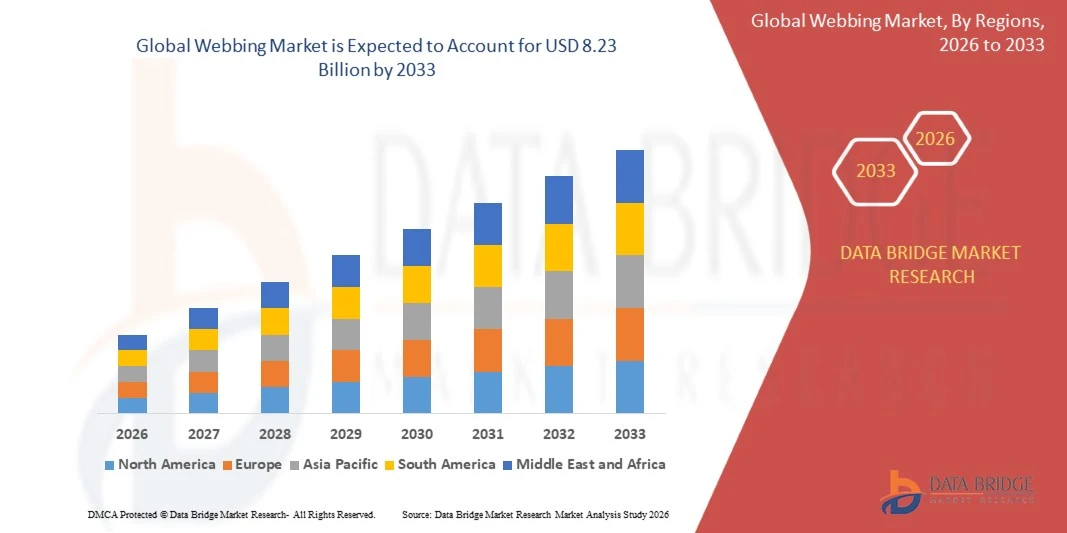
- As per Data Bridge Market Research analysis, the webbing market was valued at USD 4.83 billion in 2025 and is projected to reach USD 8.23 billion by 2033, growing at a CAGR of 6.90% from 2026 to 2033.
- The market is experiencing consistent growth driven by rising demand for durable and high-strength webbing materials, increasing automotive safety requirements, and expanding applications across industrial lifting, aerospace and defense, sporting goods, and outdoor equipment.
- The growing emphasis on vehicle occupant safety, combined with stricter workplace safety standards and increasing demand for lightweight, high-performance textile materials, is encouraging manufacturers to adopt advanced webbing solutions. Polyester and nylon webbing are widely used in seat belts, safety harnesses, cargo restraints, and protective equipment, supporting market expansion across transportation, industrial, and recreational applications.
Market Size & Forecast
- Global Market Value (2025): USD 4.83 Billion
- Expected Market Value (2033): USD 8.23 Billion
- Forecast CAGR (2026–2033): 6.90%
- Leading Region in 2025: North America
- Fastest Growing Region: Asia Pacific
What are the Major Takeaways of the Webbing Market?
- North America dominated the webbing market with the largest revenue share of 36.1% in 2025, supported by strong automotive manufacturing, advanced industrial safety standards, and growing demand for high-performance webbing products.
- Asia-Pacific is expected to be the fastest-growing region at a CAGR of 5.34% from 2026 to 2033, fueled by rapid industrialization, expanding automotive production, and rising demand for technical textiles across China, India, and Japan.
- The man-made segment led the market with a 85.0% share in 2025, driven by the superior strength, durability, abrasion resistance, and versatility of synthetic fibers.
- Natural materials are the fastest-growing material type, projected to register a CAGR of 4.0%, reflecting the surge in interest in biodegradable fibers and environmentally responsible textile products.
- The polyester segment dominated the product type category with a 46.56% revenue share in 2025, led by its high tensile strength, dimensional stability, abrasion resistance, and competitive cost.
- Flat webbing accounted for 59.68% of the market share in 2025, preferred by its versatility, ease of manufacturing, and suitability for a broad range of load-bearing and fastening applications.
- The military segment is the fastest-growing application category, with a CAGR of 5.75%, driven by defense modernization programs and increasing demand for durable, lightweight equipment
Report Scope and Webbing Market Segmentation
|
Attributes |
Webbing Key Market Insights |
|
Segments Covered |
|
|
Countries Covered |
North America
Europe
Asia-Pacific
Middle East and Africa
South America
|
|
Key Market Players |
|
|
Market Opportunities |
|
|
Value Added Data Infosets |
In addition to the insights on market scenarios such as market value, growth rate, segmentation, geographical coverage, and major players, the market reports curated by the Data Bridge Market Research also include import export analysis, production capacity overview, production consumption analysis, price trend analysis, climate change scenario, supply chain analysis, value chain analysis, raw material/consumables overview, vendor selection criteria, PESTLE Analysis, Porter Analysis, and regulatory framework. |
What is the Key Trend in the Webbing Market?
- Webbing manufacturers are increasingly adopting recycled fibers and sustainable production methods to reduce environmental impact while maintaining the strength, durability, and performance required for automotive, outdoor, and industrial applications.
- For instance, in June 2023, Powertex introduced lifting and lashing products made from recycled polyester, including webbing slings and trucker web lashings, supporting sustainable material adoption while reducing the environmental impact of industrial webbing applications.
- Recycled polyester and nylon webbing are gaining attention as brands seek traceable materials that support sustainability targets without compromising product performance.
- Manufacturers are expanding certified recycled-material portfolios to serve customers seeking durable straps, technical textiles, and environmentally responsible fastening solutions.
- For instance, in July 2025, Xiamen Jude Webbing renewed its Global Recycled Standard certification, reinforcing its commitment to recycled materials, supply-chain traceability, and environmentally responsible webbing production for outdoor, tactical, and industrial applications.
- As sustainability requirements become more prominent across textile supply chains, demand for recycled and responsibly manufactured webbing is expected to increase, encouraging further material innovation and investment in sustainable production.
What are the Key Drivers of the Webbing Market?
- The growing emphasis on automotive occupant safety and industrial worker protection is increasing demand for durable webbing used in seat belts, restraint systems, lifting slings, and fall-protection harnesses.
- For instance, in March 2025, India's Ministry of Textiles reported that the National Technical Textiles Mission had supported 168 research projects worth approximately INR 509 crore, promoting innovation in high-performance textiles used across automotive safety, protective equipment, and industrial applications.
- Automotive manufacturers, industrial equipment suppliers, and technical textile producers are incorporating high-strength webbing to improve safety, load restraint, and reliability across demanding applications.
- For instance, in August 2024, India's Ministry of Road Transport and Highways notified revised requirements for vehicle seat-belt assemblies and anchorages, strengthening safety compliance requirements and supporting demand for reliable automotive webbing used in occupant restraint systems.
- With stricter safety requirements and continued investment in technical textile research, demand for application-specific, high-performance webbing is expected to grow across automotive, construction, logistics, and protective equipment markets.
What Factors are Challenging the Growth of the Webbing Market?
- Webbing manufacturers face rising production costs due to fluctuations in polyester, nylon, and other synthetic-fiber prices, alongside energy, transportation, and processing expenses.
- For instance, in July 2024, The Indian Express reported that quality-control orders on polyester staple fibre and viscose staple fibre restricted access to affordable imported raw materials, with industry representatives stating that these fibres were at least 20% more expensive in India than international benchmarks, increasing costs and weakening the competitiveness of downstream synthetic textile manufacturers.
- These cost pressures can reduce profit margins, particularly for small and medium-sized manufacturers that have limited purchasing power and face difficulties passing higher costs on to customers.
- In addition, regulatory requirements and limited access to competitively priced raw materials can create supply-chain challenges for textile producers, affecting production costs and export competitiveness.
- For instance, in March 2026, The Financial Express reported that rising crude-oil prices increased the cost of petrochemical derivatives used in synthetic textiles, while polyester yarn supply constraints and manufacturers' difficulty passing higher costs on to customers put pressure on production and profit margins across the textile value chain
- Fluctuating input prices, supply-chain disruptions, and compliance costs continue to challenge webbing manufacturers, potentially limiting investment, increasing product prices, and slowing market expansion in cost-sensitive applications.
How is the Webbing Market Segmented?
The webbing market is segmented on the basis of material, product, type, and application.
- By Material
On the basis of material, the webbing market is segmented into natural and man-made materials. The man-made materials segment dominated the market with an estimated 85.0% share in 2025, owing to the superior strength, durability, abrasion resistance, and versatility of synthetic fibers. Polyester, nylon, and polypropylene are widely used in automotive seat belts, cargo restraints, industrial lifting equipment, and protective harnesses. These materials offer consistent performance under demanding operating conditions and can be engineered to meet specific tensile-strength and safety requirements. Their availability in different grades and specifications supports extensive industrial applications. Continuous advancements in high-performance synthetic fibers are further strengthening their adoption across automotive, aerospace, and defense industries.
The natural materials segment is expected to witness steady growth at an estimated CAGR of 4.0% from 2026 to 2033, supported by increasing interest in biodegradable fibers and environmentally responsible textile products. Natural fibers such as cotton are used in apparel, furniture, decorative applications, and selected industrial products. These materials offer breathability, flexibility, and a natural texture that appeals to specific end users. Growing awareness of textile waste and sustainability is encouraging manufacturers to explore renewable fiber alternatives. Natural webbing is particularly suitable for applications where extreme tensile strength and resistance to harsh environmental conditions are not the primary requirements. However, moisture sensitivity, variable strength, and lower durability in some operating environments can limit its use in demanding applications.
- By Product
On the basis of product, the webbing market is segmented into polyester, nylon, polypropylene, carbon fibers, para-aramid fibers, ultra-high-molecular-weight polyethylene (UHMWPE), and others. The polyester segment dominated the market with a 46.56% share in 2025, driven by its high tensile strength, dimensional stability, abrasion resistance, and competitive cost. Polyester webbing is extensively used in automotive seat belts, cargo tie-downs, lifting slings, outdoor equipment, and industrial restraints. Its relatively low moisture absorption helps maintain dimensional stability across different operating environments. The material also provides good resistance to ultraviolet exposure compared with several alternative fibers. Manufacturers can customize its width, thickness, color, and tensile strength to serve diverse applications.
The para-aramid fibers segment is projected to register the fastest growth at a CAGR of 5.11% from 2026 to 2033, driven by increasing demand for high-strength, heat-resistant, and lightweight materials. Para-aramid webbing is used in specialized applications requiring excellent tensile performance and resistance to elevated temperatures. It serves military equipment, aerospace components, protective gear, and industrial safety systems. Its strength-to-weight ratio makes it suitable for applications where reducing equipment weight is important. Growing investment in defense modernization and advanced protective equipment is supporting demand for high-performance fibers. However, relatively high material costs can limit adoption in price-sensitive applications.
- By Type
On the basis of type, the webbing market is segmented into flat webbing, tubular webbing, and others. The flat webbing segment is expected to dominate the market with an estimated 75.0% share in 2025, owing to its versatility, ease of manufacturing, and suitability for a broad range of load-bearing and fastening applications. Flat webbing is commonly used in seat belts, safety harnesses, luggage straps, cargo restraints, and lifting slings. Its broad surface distributes loads effectively when incorporated into appropriately engineered restraint systems. Manufacturers can customize its width, thickness, weave, and tensile strength to meet application-specific requirements. The segment benefits from widespread adoption across automotive, industrial, military, and sporting goods markets.
The tubular webbing segment is expected to register growth at an estimated CAGR of 5.0% from 2026 to 2033, supported by increasing demand for specialized safety and outdoor recreation equipment. Its hollow, tube-like woven construction provides flexibility and can offer protection to an internal rope or core in selected applications. Tubular webbing is widely used in climbing slings, rescue equipment, mountaineering gear, and certain tactical applications. Its construction allows it to conform around attachment points and supports versatile configurations in appropriately designed systems. Growing participation in outdoor adventure activities and rising emphasis on rescue-worker safety are supporting demand. Improvements in synthetic fibers and weaving techniques are expanding product options for specialized uses.
- By Application
On the basis of application, the webbing market is segmented into automotive, industrial, sporting goods, military, and others. The automotive segment dominated the market with a 34.78% share in 2025, driven by extensive use of webbing in seat belts, child restraint systems, and other vehicle safety applications. Automotive-grade webbing must meet stringent requirements for tensile strength, abrasion resistance, durability, and performance under specified testing conditions. Increasing vehicle production and continued emphasis on occupant protection support demand for reliable restraint components. The development of electric vehicles also sustains requirements for passenger safety systems and cargo-securing solutions. Automotive manufacturers and component suppliers rely on specialized webbing designs to meet vehicle-specific specifications and regulatory requirements.
The military segment is projected to experience the fastest growth at a CAGR of 5.75% from 2026 to 2033, supported by defense modernization programs and increasing demand for durable, lightweight equipment. Military webbing is used in tactical vests, load-bearing equipment, backpacks, restraint systems, parachutes, and other specialized applications. These products must withstand demanding operating environments and may require resistance to abrasion, moisture, heat, or chemical exposure, depending on their intended use. The adoption of high-performance fibers is helping manufacturers develop webbing with improved strength-to-weight characteristics. Increasing investment in soldier equipment, personal protection, and mission-specific gear is supporting demand for specialized textile components. Product customization and compliance with military procurement specifications also influence purchasing decisions.
Which Region Holds the Largest Share of the Webbing Market?
- North America dominated the webbing market with the largest revenue share of 36.1% in 2025, supported by strong automotive manufacturing, advanced industrial safety standards, and growing demand for high-performance webbing products.
- The region also benefits from stringent vehicle safety standards, advanced aerospace and defense manufacturing, and increasing demand for durable webbing in seat belts, cargo restraints, lifting equipment, and protective gear. Continued investments in industrial infrastructure and advanced technical textiles further support North America's position in the global webbing market.
U.S. Webbing Market Insight
The U.S. webbing market is witnessing steady growth due to rising demand for automotive safety systems, industrial protective equipment, and high-performance technical textiles. The country’s established automotive and aerospace industries, along with increasing investments in defense equipment and infrastructure development, are driving demand across industrial and commercial applications. In addition, growing emphasis on workplace safety, durable load-restraint systems, and advanced synthetic materials is accelerating webbing adoption across manufacturing, transportation, and construction sectors.
Asia-Pacific Webbing Market Insight
The Asia-Pacific webbing market is expected to witness rapid growth, driven by expanding textile manufacturing, increasing automotive production, and rising industrial investments across countries such as China, India, and Japan. Growing demand for seat belts, cargo restraints, lifting slings, and protective equipment is supporting regional market expansion. In addition, the availability of synthetic fibers, expanding manufacturing capabilities, and increasing adoption of technical textiles across automotive, industrial, and defense applications are strengthening the region’s webbing industry.
Japan Webbing Market Insight
The Japan webbing market is witnessing consistent growth due to the country’s advanced automotive manufacturing sector, strong industrial base, and emphasis on product quality and safety. Automotive manufacturers and industrial equipment suppliers are increasingly relying on high-strength webbing for seat belts, restraint systems, lifting equipment, and specialized technical applications. Moreover, continuous improvements in synthetic fibers, precision textile manufacturing, and lightweight materials are supporting product innovation and contributing to market growth across automotive, industrial, and consumer applications.
China Webbing Market Insight
The China webbing market is growing rapidly, driven by expanding automotive production, large-scale textile manufacturing, and increasing demand for industrial safety products. Growing adoption of webbing in vehicle restraint systems, cargo-securing equipment, sporting goods, and military applications is significantly supporting market demand. In addition, the availability of synthetic raw materials, expanding manufacturing infrastructure, and increasing investments in advanced technical textiles are strengthening China's position as a major producer and consumer of webbing products globally.
U.K. Webbing Market Insight
The U.K. webbing market is experiencing steady growth, supported by demand for automotive safety components, industrial lifting equipment, protective harnesses, and outdoor recreational products. Increasing emphasis on workplace safety and the need for reliable load-bearing materials are contributing to market expansion. Furthermore, growing interest in recycled fibers, sustainable textile manufacturing, and specialized webbing for aerospace, defense, and marine applications is encouraging product innovation and supporting demand across the U.K. webbing industry.
Germany Webbing Market Insight
The Germany webbing market is expanding steadily due to the country's strong automotive manufacturing base, advanced industrial capabilities, and emphasis on engineering quality and vehicle safety. Automotive suppliers, industrial manufacturers, and technical textile producers utilize webbing in seat belts, cargo restraints, lifting systems, and protective equipment. Continuous advancements in high-performance synthetic fibers, increasing demand for durable industrial materials, and growing attention to sustainable manufacturing practices are further supporting market development across automotive, industrial, and specialized applications.
Which are the Top Companies in Webbing Market?
The webbing industry is primarily led by well-established companies, including:
- American Cord & Webbing Co., Inc. (U.S.)
- E. Oppermann GmbH (Germany)
- Belt-Tech (Canada)
- Narrowtex Australia Pty Ltd (Australia)
- Jiangsu Daxin Webbing Co., Ltd. (China)
- Ohio Plastics Belting Co. (U.S.)
- National Webbing Products Co. (U.S.)
- Murdock Webbing Company, Inc. (U.S.)
- Tennessee Webbing Products (U.S.)
- Bally Ribbon Mills (U.S.)
- Straptex India Private Limited (India)
- Neelam Lace Private Limited (India)
- Pfeiffer Bandweberei (Germany)
- Western Ribbons Ltd. (Canada)
- Ribbons Ltd. (U.K.)
- Wisla Narrow Fabrics Limited (U.K.)
- Patani International (India)
- Jakob Müller AG (Switzerland)
- Güth & Wolf GmbH (Germany)
- TMG Webbing (China)
What are Latest Developments in Webbing Market?
- In July 2025, REMA launched its Re-Line range of lifting slings made from 100% recycled post-consumer polyester, including flat webbing slings and roundslings designed for industrial lifting applications. The products combine recycled materials with established safety requirements and product traceability, highlighting the growing integration of circular materials into industrial webbing solutions.
- In July 2025, Bally Ribbon Mills highlighted its advanced webbing solutions for parachute and aerospace applications, featuring high-performance fibers such as nylon, Kevlar, Vectran, PTFE, and Zylon. The company also discussed the development of woven tapes and webbings using DuPont’s Kevlar EXO fiber, targeting improved strength-to-weight performance for demanding parachute applications.
- In August 2024, the Web Sling and Tie Down Association (WSTDA) published revised versions of its WSTDA-WB-1 and WSTDA-RS-1HP recommended standards, covering synthetic webbing used in lifting slings and roundslings made from high-performance yarns. The revisions address product construction, marking, identification, testing, inspection, and safe load-handling practices, supporting improved consistency and safety across the webbing industry.
- In June 2023, Powertex introduced three textile lifting and lashing products made from recycled polyester, including roundslings, webbing slings, and trucker web lashings. The products use recycled PET bottles as raw material, offering an alternative to virgin polyester while maintaining the required performance and safety characteristics. The company reported reduced carbon emissions compared with conventional polyester products, highlighting the potential of recycled materials in industrial webbing applications.
- In July 2021, Bally Ribbon Mills announced its prototype development and testing capabilities for woven webbings, emphasizing the importance of evaluating fabric performance under application-specific conditions. The company described its work on specialized polyester webbing for seat belts, retractors, and tie-down applications, including products designed to meet military and commercial specifications. This development highlights the importance of customized engineering, testing, and quality assurance in producing webbing for safety-critical applications.
- Interactive Data Analysis Dashboard
- Company Analysis Dashboard for high growth potential opportunities
- Research Analyst Access for customization & queries
- Competitor Analysis with Interactive dashboard
- Latest News, Updates & Trend analysis
- Harness the Power of Benchmark Analysis for Comprehensive Competitor Tracking
Global Webbing Market, Supply Chain Analysis and Ecosystem Framework
To support market growth and help clients navigate the impact of geopolitical shifts, DBMR has integrated in-depth supply chain analysis into its Global Webbing Market research reports. This addition empowers clients to respond effectively to global changes affecting their industries. The supply chain analysis section includes detailed insights such as Global Webbing Market consumption and production by country, price trend analysis, the impact of tariffs and geopolitical developments, and import and export trends by country and HSN code. It also highlights major suppliers with data on production capacity and company profiles, as well as key importers and exporters. In addition to research, DBMR offers specialized supply chain consulting services backed by over a decade of experience, providing solutions like supplier discovery, supplier risk assessment, price trend analysis, impact evaluation of inflation and trade route changes, and comprehensive market trend analysis.
Data collection and base year analysis are done using data collection modules with large sample sizes. The stage includes obtaining market information or related data through various sources and strategies. It includes examining and planning all the data acquired from the past in advance. It likewise envelops the examination of information inconsistencies seen across different information sources. The market data is analysed and estimated using market statistical and coherent models. Also, market share analysis and key trend analysis are the major success factors in the market report. To know more, please request an analyst call or drop down your inquiry.
The key research methodology used by DBMR research team is data triangulation which involves data mining, analysis of the impact of data variables on the market and primary (industry expert) validation. Data models include Vendor Positioning Grid, Market Time Line Analysis, Market Overview and Guide, Company Positioning Grid, Patent Analysis, Pricing Analysis, Company Market Share Analysis, Standards of Measurement, Global versus Regional and Vendor Share Analysis. To know more about the research methodology, drop in an inquiry to speak to our industry experts.
Data Bridge Market Research is a leader in advanced formative research. We take pride in servicing our existing and new customers with data and analysis that match and suits their goal. The report can be customized to include price trend analysis of target brands understanding the market for additional countries (ask for the list of countries), clinical trial results data, literature review, refurbished market and product base analysis. Market analysis of target competitors can be analyzed from technology-based analysis to market portfolio strategies. We can add as many competitors that you require data about in the format and data style you are looking for. Our team of analysts can also provide you data in crude raw excel files pivot tables (Fact book) or can assist you in creating presentations from the data sets available in the report.