


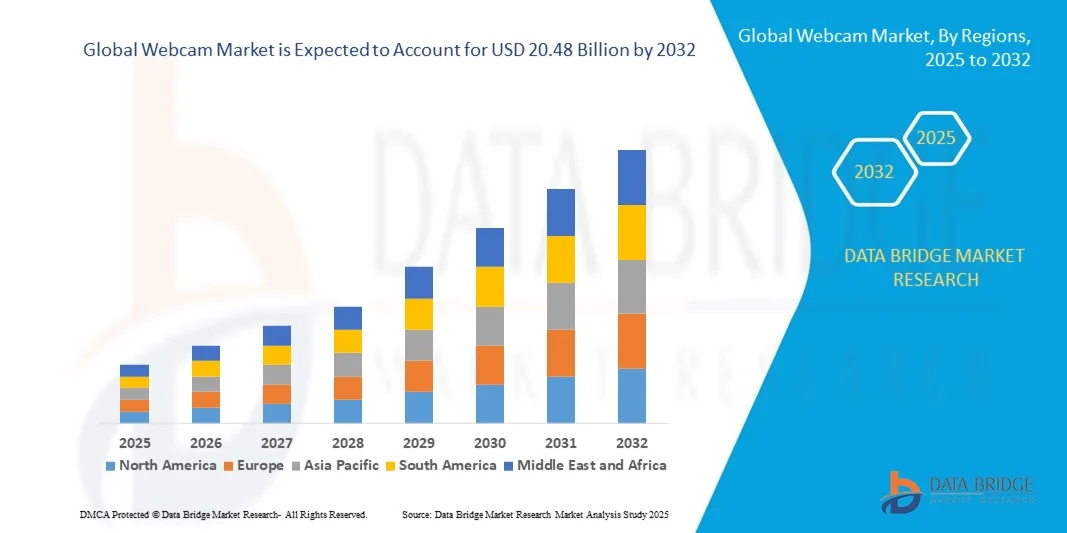
What is the Global Webcam Market Size and Growth Rate?
- The global webcam market size was valued at USD 9.48 billion in 2024 and is expected to reach USD 20.48 billion by 2032, at a CAGR of 20.10% during the forecast period
- The webcam market is anticipated to witness high growth because of increasing demand from government agencies and individual customers and increasing property and better adoption of web services. Smart homes have webcams with associate degree IP address that lets the owner of the house monitor it simply which is also lifting the growth of the webcam market. Also, several local vendors providing cost-effective webcams are also lifting the demand for the webcam market
What are the Major Takeaways of Webcam Market?
- The webcams connected to the net are increasing the chance of criminal activities such as spying and thus the government has created tight laws for a similar and thus will hinder the growth of the webcam market
- Growing population with awareness about security and usage of new technology is going to present many opportunities for webcam market
- North America dominated the webcam market with the largest revenue share of 37.19% in 2024, driven by rising demand for home automation, security monitoring, and increasing awareness of smart home technology
- The Asia-Pacific webcam market is poised to grow at the fastest CAGR of 11.02% during the forecast period of 2025 to 2032, driven by increasing urbanization, rising disposable incomes, and technological advancements in countries such as China, Japan, and India
- The USB segment dominated the Webcam market with the largest market revenue share of 57% in 2024, driven by its affordability, ease of installation, and widespread compatibility with PCs and laptops
Report Scope and Webcam Market Segmentation
|
Attributes |
Webcam Key Market Insights |
|
Segments Covered |
|
|
Countries Covered |
North America
Europe
Asia-Pacific
Middle East and Africa
South America
|
|
Key Market Players |
|
|
Market Opportunities |
|
|
Value Added Data Infosets |
In addition to the insights on market scenarios such as market value, growth rate, segmentation, geographical coverage, and major players, the market reports curated by the Data Bridge Market Research also include in-depth expert analysis, pricing analysis, brand share analysis, consumer survey, demography analysis, supply chain analysis, value chain analysis, raw material/consumables overview, vendor selection criteria, PESTLE Analysis, Porter Analysis, and regulatory framework. |
What is the Key Trend in the Webcam Market?
Enhanced Functionality Through AI and Smart Integration
- A significant and accelerating trend in the global webcam market is the integration of artificial intelligence (AI) and advanced smart home ecosystems, including Amazon Alexa, Google Assistant, and Apple HomeKit. This convergence of technologies is enhancing user convenience, automation, and control over connected environments
- For instance, the August Wi-Fi Webcams integrate seamlessly with major voice assistants, enabling users to monitor their homes and trigger alerts through simple voice commands. Similarly, some Logitech and Nest models support AI-driven notifications for movement detection and environmental changes, offering more intelligent monitoring solution
- AI in Webcams enables features such as motion pattern learning, anomaly detection, and automated alert generation. Voice control allows hands-free operation, enabling remote monitoring and interactions without direct physical access
- Integration with smart home platforms allows centralized control of security, lighting, climate, and other devices, providing a unified home automation experience
- Companies such as Wyze and Arlo are developing AI-powered Webcams with advanced capabilities such as facial recognition, automated tracking, and real-time alerts, reshaping consumer expectations for home security and monitoring
- The growing demand for Webcams with AI and smart integration spans residential and commercial sectors, driven by increasing awareness of convenience, automation, and connected living
What are the Key Drivers of Webcam Market?
- The rising concern for home and workplace security, along with the rapid adoption of smart home ecosystems, is a primary driver for the webcam market
- In April 2024, Onity, Inc. (Honeywell International, Inc.) highlighted IoT-based security advancements in its Passport system, demonstrating the value of connected devices, which is expected to boost the Webcam market
- Consumers increasingly demand real-time monitoring, motion alerts, and activity logs, positioning Webcams as superior alternatives to traditional security solutions
- The rising adoption of interconnected smart devices is making Webcams essential for unified monitoring, with seamless integration across smartphones, voice assistants, and cloud platforms
- Keyless and remote management features, along with smartphone app compatibility, enhance accessibility and control, especially for families, businesses, and rental property management. The DIY smart home trend and availability of user-friendly options further support market growth
Which Factor is Challenging the Growth of the Webcam Market?
- Cybersecurity vulnerabilities in connected devices, including Webcams, pose a critical challenge to market expansion. Since Webcams rely on network connectivity and software, they are susceptible to hacking and data breaches, raising consumer concerns
- Reports of IoT security breaches have led to hesitancy in adopting smart home monitoring solutions, including Webcams
- Companies such as Arlo, Nest, and Logitech emphasize encryption, secure authentication, and regular software updates to build consumer trust. High initial costs of advanced Webcams compared to traditional cameras may also limit adoption among price-sensitive users. While basic Webcams such as Wyze models are affordable, premium features such as AI tracking, HD video, and integrated security analytics often come at a higher price
- Although prices are gradually decreasing, the perceived premium for smart features can still limit widespread adoption
- Addressing cybersecurity risks, educating consumers on secure usage, and offering affordable, feature-rich Webcams will be vital to sustain market growth
How is the Webcam Market Segmented?
The market is segmented on the basis of product, technology, distribution channel, end-user.
- By Product
On the basis of product, the Webcam market is segmented into USB and Wireless. The USB segment dominated the Webcam market with the largest market revenue share of 57% in 2024, driven by its affordability, ease of installation, and widespread compatibility with PCs and laptops. USB Webcams are widely preferred for personal use, remote work setups, and small-scale surveillance applications. They provide plug-and-play functionality, requiring minimal technical knowledge, making them accessible to a broad consumer base. The growing adoption of home offices and video conferencing tools during and post-pandemic has further reinforced the dominance of USB Webcams.
In contrast, the Wireless segment is expected to witness the fastest CAGR of 22% from 2025 to 2032, fueled by the increasing demand for flexible, cable-free setups in enterprise environments, smart home integration, and security monitoring systems. Wireless Webcams offer mobility, aesthetic appeal, and compatibility with IoT ecosystems, making them ideal for modern connected spaces.
- By Technology
On the basis of technology, the Webcam market is segmented into Analog and Digital. The Digital segment held the largest market revenue share of 65% in 2024, driven by its superior image quality, enhanced processing capabilities, and seamless integration with modern computing and cloud platforms. Digital Webcams provide higher resolutions, low-light performance, and AI-enabled features such as motion detection, facial recognition, and automated tracking, making them suitable for professional and commercial applications. Analog Webcams, though simpler and more affordable, are increasingly being replaced by digital solutions due to limitations in image quality and compatibility with modern devices.
The Analog segment is expected to witness the fastest CAGR of 19% from 2025 to 2032, particularly in legacy surveillance systems and low-budget deployments where cost-effectiveness is prioritized. The shift toward digital technology reflects the market’s focus on enhanced image fidelity, connectivity, and feature-rich devices.
- By Distribution Channel
On the basis of distribution channel, the Webcam market is segmented into Brick & Mortar and e-Commerce. The e-Commerce segment dominated the market with the largest revenue share of 58% in 2024, driven by the growing consumer preference for online shopping, availability of diverse product options, and the convenience of doorstep delivery. Online platforms also offer competitive pricing, detailed product information, and customer reviews, which influence purchasing decisions for both individual and business consumers.
Brick & Mortar sales are anticipated to witness the fastest CAGR of 21% from 2025 to 2032, fueled by consumers seeking hands-on experience before purchase, immediate availability, and the ability to access after-sales support. Physical stores remain crucial in emerging regions where online penetration is lower and for high-end professional Webcam solutions requiring demonstration and consultation. Overall, a balanced approach across channels is essential for market players to maximize reach and sales.
- By End-User
On the basis of end-user, the Webcam market is segmented into Security & Surveillance, Entertainment, Videoconference, Live Events, Visual Marketing, and Others. The Videoconference segment accounted for the largest market revenue share of 48% in 2024, driven by the proliferation of remote work, online education, and virtual collaboration tools. Webcams for videoconferencing offer high-quality video, plug-and-play setup, and compatibility with major collaboration platforms such as Zoom, Microsoft Teams, and Google Meet.
The Security & Surveillance segment is expected to witness the fastest CAGR of 23% from 2025 to 2032, fueled by growing concerns for home, retail, and industrial security, and the adoption of smart monitoring systems integrated with AI analytics. In addition, increasing urbanization, smart city projects, and enterprise investments in automated surveillance are boosting demand. Overall, the end-user segmentation highlights the dual influence of corporate adoption and individual consumer needs driving market growth.
Which Region Holds the Largest Share of the Webcam Market?
- North America dominated the webcam market with the largest revenue share of 37.19% in 2024, driven by rising demand for home automation, security monitoring, and increasing awareness of smart home technology
- Consumers in the region highly value the convenience, enhanced security features, and seamless integration offered by webcams with other connected devices such as lighting systems, thermostats, and home assistants
- This widespread adoption is further supported by high disposable incomes, tech-savvy populations, and a growing preference for remote monitoring and control, establishing Webcams as a preferred solution for both residential and commercial properties
U.S. Webcam Market Insight
The U.S. webcam market captured the largest revenue share of 81% in 2024 within North America, fueled by the rapid uptake of connected devices and the increasing trend of home automation. Consumers are prioritizing enhanced home security with smart, remotely controllable Webcams. The growing adoption of DIY smart home setups, coupled with high demand for voice control and mobile app integration, is further driving market expansion. Integration with major smart home ecosystems, including Alexa, Google Assistant, and Apple HomeKit, continues to propel growth in the region.
Europe Webcam Market Insight
The Europe webcam market is projected to expand at a substantial CAGR over the forecast period, driven by strict security regulations and increasing demand for smarter homes and offices. Rising urbanization and the growing use of connected devices are fostering Webcam adoption. European consumers are also drawn to the convenience, energy efficiency, and multifunctionality offered by these devices. The region is witnessing significant growth across residential, commercial, and multi-family housing applications, with Webcams being increasingly incorporated into both new constructions and renovation projects.
U.K. Webcam Market Insight
The U.K. webcam market is anticipated to grow at a noteworthy CAGR during the forecast period, driven by the rising trend of home automation and a desire for greater security and convenience. Concerns regarding burglary and safety are prompting homeowners and businesses to adopt smart monitoring solutions. The U.K.’s embrace of connected devices, supported by robust e-commerce and retail infrastructure, continues to stimulate market growth.
Germany Webcam Market Insight
The Germany webcam market is expected to expand at a considerable CAGR during the forecast period, fueled by rising awareness of digital security and the demand for technologically advanced and eco-conscious solutions. Germany’s strong infrastructure, focus on innovation, and sustainability initiatives encourage Webcam adoption, particularly in residential and commercial buildings. The integration of Webcams with broader home automation systems is increasing, with consumers favoring secure, privacy-focused solutions that align with local expectations.
Which Region is the Fastest Growing Region in the Webcam Market?
The Asia-Pacific webcam market is poised to grow at the fastest CAGR of 11.02% during the forecast period of 2025 to 2032, driven by increasing urbanization, rising disposable incomes, and technological advancements in countries such as China, Japan, and India. The region’s growing inclination toward smart homes, supported by government initiatives promoting digitalization, is accelerating Webcam adoption. As APAC emerges as a manufacturing hub for Webcam components and systems, affordability and accessibility are expanding the market to a wider consumer base.
Japan Webcam Market Insight
The Japan webcam market is gaining momentum due to the country’s tech-driven culture, rapid urbanization, and demand for convenience. Security-conscious consumers are increasingly adopting Webcams in smart homes and connected buildings. Integration with other IoT devices, such as home security cameras and lighting systems, further fuels growth. In addition, Japan’s aging population is such asly to drive demand for easier-to-use, secure access solutions in both residential and commercial sectors.
China Webcam Market Insight
The China webcam market accounted for the largest revenue share in Asia-Pacific in 2024, supported by the country’s expanding middle class, rapid urbanization, and high rates of technological adoption. China is one of the largest markets for smart home devices, and Webcams are gaining popularity across residential, commercial, and rental properties. Government initiatives promoting smart cities and the availability of affordable Webcams, alongside strong domestic manufacturing capabilities, are key factors driving market growth.
Which are the Top Companies in Webcam Market?
The webcam industry is primarily led by well-established companies, including:
- Olympus Corporation (Japan)
- Sony Corporation (Japan)
- Carestream Health (U.S.)
- Stryker Corporation (U.S.)
- Richard Wolf GmbH (Germany)
- Smith & Nephew plc (U.K.)
- Leica Biosystems Nussloch GmbH (Germany)
- Carl Zeiss Meditec AG (Germany)
- Hamamatsu Photonics K.K. (Japan)
- Topcon Corporation (Japan)
- Canon Medical Systems Corporation (Japan)
- Nikon Corporation (Japan)
- JOEL Ltd. (Japan)
- SPOT Imaging (U.S.)
- Allied Vision Technologies GmbH (Germany)
- MediGus Ltd. (Israel)
- IMPERX, Inc. (U.S.)
- STEMMER IMAGING AG (Germany)
- Karl Storz SE & Co. KG (Germany)
- 3D Medivision Inc (South Korea)
What are the Recent Developments in Global Webcam Market?
- In June 2025, Philips launched the new 45B1U6900CH, a curved 44.5-inch QHD monitor with a superwide 32:9 aspect ratio and a maximum refresh rate of 75 Hz, providing users with expansive horizontal screen space ideal for multitasking, gaming, and professional applications, further enhancing user productivity and visual experience
- In September 2024, Insta360 unveiled the Insta360 Link 2 and Insta360 Link 2C, a pair of AI-powered 4K webcams designed to elevate online video conferencing and live streaming quality, ensuring crystal-clear video and audio performance, thereby improving virtual communication for professionals and content creators
- In June 2024, Obsbot introduced the Tiny 2 Lite, an AI-powered PTZ webcam tailored for video conferencing professionals, streamers, and remote workers, offering enhanced tracking and image clarity, which significantly improves the overall user video experience
- In March 2024, Logitech launched the MX Brio webcam in India as part of its Master Series ecosystem, optimized for advanced users and fully compatible with MX keyboards and mice, providing professional-grade video quality and seamless integration for productivity workflows
- In November 2023, Microsoft Teams rolled out an AI-powered webcam feature capable of automatically cleaning up backgrounds during video calls using generative AI, improving user focus and creating a more professional virtual meeting environment
- In November 2023, Opal launched its second webcam, Tadpole, priced at US$175, making it 41% more affordable than the original Opal C1, thereby offering budget-friendly webcam solutions without compromising on essential features for everyday users

- Interactive Data Analysis Dashboard
- Company Analysis Dashboard for high growth potential opportunities
- Research Analyst Access for customization & queries
- Competitor Analysis with Interactive dashboard
- Latest News, Updates & Trend analysis
- Harness the Power of Benchmark Analysis for Comprehensive Competitor Tracking
Global Webcam Market, Supply Chain Analysis and Ecosystem Framework
To support market growth and help clients navigate the impact of geopolitical shifts, DBMR has integrated in-depth supply chain analysis into its Global Webcam Market research reports. This addition empowers clients to respond effectively to global changes affecting their industries. The supply chain analysis section includes detailed insights such as Global Webcam Market consumption and production by country, price trend analysis, the impact of tariffs and geopolitical developments, and import and export trends by country and HSN code. It also highlights major suppliers with data on production capacity and company profiles, as well as key importers and exporters. In addition to research, DBMR offers specialized supply chain consulting services backed by over a decade of experience, providing solutions like supplier discovery, supplier risk assessment, price trend analysis, impact evaluation of inflation and trade route changes, and comprehensive market trend analysis.
Data collection and base year analysis are done using data collection modules with large sample sizes. The stage includes obtaining market information or related data through various sources and strategies. It includes examining and planning all the data acquired from the past in advance. It likewise envelops the examination of information inconsistencies seen across different information sources. The market data is analysed and estimated using market statistical and coherent models. Also, market share analysis and key trend analysis are the major success factors in the market report. To know more, please request an analyst call or drop down your inquiry.
The key research methodology used by DBMR research team is data triangulation which involves data mining, analysis of the impact of data variables on the market and primary (industry expert) validation. Data models include Vendor Positioning Grid, Market Time Line Analysis, Market Overview and Guide, Company Positioning Grid, Patent Analysis, Pricing Analysis, Company Market Share Analysis, Standards of Measurement, Global versus Regional and Vendor Share Analysis. To know more about the research methodology, drop in an inquiry to speak to our industry experts.
Data Bridge Market Research is a leader in advanced formative research. We take pride in servicing our existing and new customers with data and analysis that match and suits their goal. The report can be customized to include price trend analysis of target brands understanding the market for additional countries (ask for the list of countries), clinical trial results data, literature review, refurbished market and product base analysis. Market analysis of target competitors can be analyzed from technology-based analysis to market portfolio strategies. We can add as many competitors that you require data about in the format and data style you are looking for. Our team of analysts can also provide you data in crude raw excel files pivot tables (Fact book) or can assist you in creating presentations from the data sets available in the report.













