


Wegener’s Granulomatosis Treatment Market Size
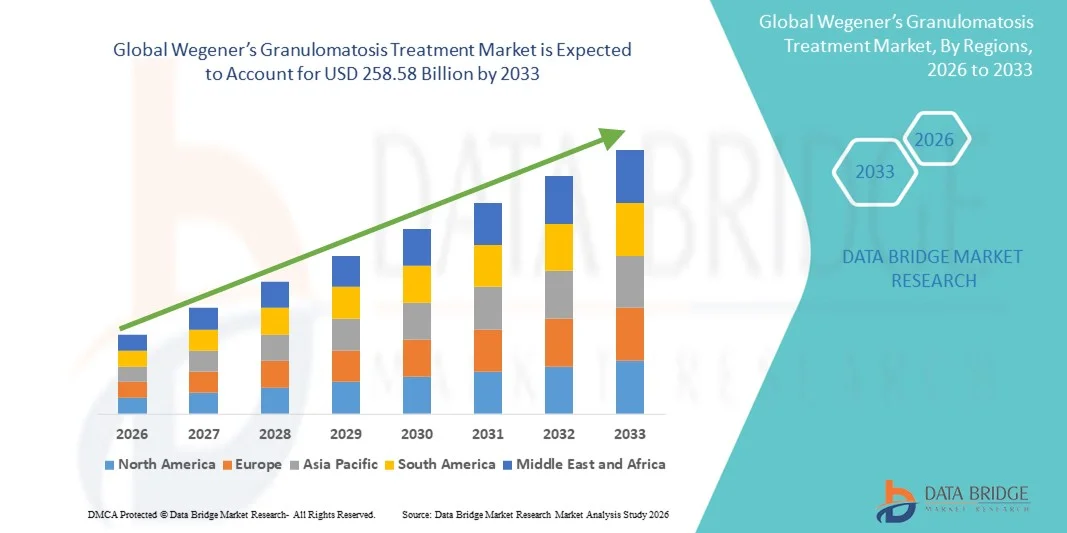
- The global Wegener’s Granulomatosis Treatment market size was valued at USD 150.50 billion in 2025 and is expected to reach USD 258.58 billion by 2033, at a CAGR of 7.00% during the forecast period
- The market growth is largely fueled by the increasing prevalence of autoimmune and rare inflammatory disorders, rising awareness of early diagnosis, and continuous advancements in immunosuppressive and biologic therapies, leading to improved disease management in both hospital and outpatient settings
- Furthermore, growing demand for effective, long-term, and targeted treatment options is establishing advanced corticosteroids, immunosuppressants, and biologic drugs as the preferred choice for managing Wegener’s Granulomatosis. These converging factors are accelerating the uptake of Wegener’s Granulomatosis treatment solutions, thereby significantly boosting the industry’s growth
Wegener’s Granulomatosis Treatment Market Analysis
- Wegener’s Granulomatosis Treatment, which involves the use of corticosteroids, immunosuppressants, and biologic therapies to control inflammation and prevent organ damage, is becoming an essential part of autoimmune disease management in both hospital and specialty clinical settings due to rising disease awareness, improved diagnostic capabilities, and expanding access to advanced therapies
- The escalating demand for Wegener’s Granulomatosis treatment is primarily fueled by an increasing prevalence of autoimmune and vasculitic disorders, growing investment in rare disease research, and a rising focus on early intervention and personalized medicine approaches that enhance patient outcomes
- North America dominated the Wegener’s Granulomatosis Treatment market with the largest revenue share of 38.6% in 2025, driven by advanced healthcare infrastructure, high adoption of biologic therapies, strong research activities, and a growing number of diagnosed cases, with the U.S. contributing significantly due to greater access to specialty care and reimbursement support
- Asia-Pacific is expected to be the fastest-growing region in the Wegener’s Granulomatosis Treatment market during the forecast period, projected to expand at a CAGR of 10.4% from 2026 to 2033, supported by improving healthcare access, rising awareness of rare autoimmune diseases, increasing healthcare expenditure, and expanding availability of advanced treatment options
- The oral segment dominated the market with a revenue share of 44.3% in 2025, owing to its convenience and widespread use in long-term therapy
Report Scope and Wegener’s Granulomatosis Treatment Market Segmentation
|
Attributes |
Wegener’s Granulomatosis Treatment Key Market Insights |
|
Segments Covered |
|
|
Countries Covered |
North America
Europe
Asia-Pacific
Middle East and Africa
South America
|
|
Key Market Players |
• Roche Holding AG (Switzerland) |
|
Market Opportunities |
|
|
Value Added Data Infosets |
In addition to the insights on market scenarios such as market value, growth rate, segmentation, geographical coverage, and major players, the market reports curated by the Data Bridge Market Research also include in-depth expert analysis, patient epidemiology, pipeline analysis, pricing analysis, and regulatory framework. |
Wegener’s Granulomatosis Treatment Market Trends
Enhanced Precision Through Advancements in Personalized and Biomarker-Guided Therapies
- A significant and accelerating trend in the global Wegener’s Granulomatosis (Granulomatosis with Polyangiitis) treatment market is the increasing shift toward personalized, biomarker-guided treatment approaches. Advances in immunology and molecular diagnostics are enabling earlier detection and more accurate disease stratification, allowing physicians to tailor therapies based on disease severity, ANCA status, and organ involvement. This is helping to optimize treatment outcomes while minimizing unnecessary exposure to aggressive immunosuppressive agents
- For instance, modern treatment strategies increasingly rely on detailed antibody profiling, such as PR3-ANCA and MPO-ANCA testing, to guide drug selection and monitor disease activity. This approach enables targeted use of biologics like rituximab in patients who are more likely to respond, improving remission rates and reducing relapse risk. Such measurable, test-driven decision-making is reshaping the standard of care in Wegener’s Granulomatosis management
- The integration of advanced laboratory diagnostics with clinical monitoring tools is also improving long-term disease tracking. Clinicians can now assess flare risks more accurately and adjust maintenance therapy in a timely manner. This reduces disease complications affecting vital organs such as the kidneys, lungs, and upper respiratory tract, which are commonly impacted in Wegener’s Granulomatosis cases
- In addition, growing research into the underlying autoimmune mechanisms of the disease is supporting the development of next-generation immunomodulators. These pipeline therapies aim to offer better efficacy with fewer systemic side effects compared to traditional corticosteroids and cytotoxic drugs. This scientific progress is strengthening confidence in more sustainable, long-term treatment plans for patients
- Overall, the trend toward precision medicine, improved biomarkers, and safer long-term therapies is redefining clinical practices in the Wegener’s Granulomatosis treatment landscape and is expected to accelerate innovation and investment in this niche but critical therapeutic area
Wegener’s Granulomatosis Treatment Market Dynamics
Driver
Rising Awareness, Early Diagnosis, and Expanding Access to Advanced Therapies
- The increasing awareness of rare autoimmune diseases among healthcare professionals and patients is a major driver of growth in the Wegener’s Granulomatosis treatment market. Improved education and training initiatives are helping physicians recognize early signs and symptoms such as chronic sinusitis, lung nodules, and renal impairment, leading to earlier diagnosis and timely initiation of therapy
- For instance, In recent years, healthcare systems across developed and developing regions have strengthened rare disease screening programs and referral networks. This has significantly improved patient access to specialized rheumatology and nephrology care, where targeted treatment for Wegener’s Granulomatosis can be quickly implemented
- The availability of effective biologics, including monoclonal antibodies that selectively suppress abnormal immune activity, has further fueled market growth. These drugs have demonstrated strong remission-inducing capabilities, especially in patients who do not respond well to conventional steroid-based regimens. As a result, doctors are increasingly adopting biologics as frontline or second-line therapies
- In addition, supportive government initiatives for rare disease management and reimbursement support in several countries are reducing the financial burden on patients. This is encouraging higher treatment adoption rates, particularly in cases requiring long-term immunosuppressive therapy and continuous monitoring
- The expanding clinical evidence base, combined with greater acceptance of advanced treatment regimens, continues to drive consistent demand for effective Wegener’s Granulomatosis therapies across hospital and specialty clinic settings worldwide
Restraint/Challenge
High Treatment Costs and Risk of Long-Term Side Effects
- Despite significant progress, the high cost associated with Wegener’s Granulomatosis treatment remains a key restraint, particularly in low- and middle-income regions. Advanced biologic drugs and prolonged immunosuppressive therapy can impose a substantial financial burden on both patients and healthcare systems, limiting widespread accessibility
- For instance, biologic therapies such as rituximab, which are commonly prescribed for remission induction and maintenance in severe cases of Wegener’s Granulomatosis, can cost thousands of dollars per treatment cycle, making them unaffordable for many patients without strong insurance coverage or government support. This significantly restricts treatment adoption in resource-limited settings
- Long-term use of corticosteroids and immunosuppressants can also lead to serious side effects, including increased susceptibility to infections, bone density loss, hypertension, and metabolic complications. These risks often require additional medications and regular monitoring, further increasing overall treatment expenses
- Patients undergoing maintenance therapy are required to attend frequent follow-up visits and laboratory testing to monitor organ function and potential drug toxicity. This adds to indirect costs such as travel, lost productivity, and the emotional strain associated with long-term disease management
- In addition, delayed diagnosis in some regions can result in advanced disease stages at the time of treatment initiation. This not only reduces overall treatment effectiveness but also increases healthcare costs due to complications like kidney failure or pulmonary damage, which may require intensive care or long-term interventions
Wegener’s Granulomatosis Treatment Market Scope
The market is segmented on the basis of treatment, diagnosis, dosage, route of administration, end-users, and distribution channel.
- By Treatment
On the basis of treatment, the Wegener’s Granulomatosis Treatment market is segmented into Corticosteroids, Immunosuppressant, Antibiotics, Plasma Exchange, and Others. The corticosteroids segment dominated the largest market revenue share of 41.6% in 2025, driven by its widespread use as a first-line therapy to rapidly reduce inflammation and suppress abnormal immune responses. Corticosteroids are commonly preferred due to their quick action in controlling disease flare-ups and managing acute symptoms. They are often used in combination with other drugs during the initial phase of treatment to achieve rapid remission. Physicians favor corticosteroids due to their high effectiveness in reducing organ damage, especially in patients with kidney and lung complications. Increased awareness about early diagnosis and prompt initiation of therapy has further strengthened the adoption of corticosteroids. Their easy availability and relatively lower cost also contribute to their strong market dominance. In addition, standardized treatment guidelines across healthcare institutions continue to support their primary role. Ongoing clinical practices reinforce corticosteroids as a cornerstone in managing severe and moderate cases, maintaining their dominance in the market.
The immunosuppressant segment is anticipated to witness the fastest CAGR of 22.8% from 2026 to 2033, driven by the rising need for long-term disease control and relapse prevention. These drugs play a critical role in maintaining remission and reducing dependence on high-dose corticosteroids. Growing clinical evidence supporting the effectiveness of biologics and targeted immunosuppressive therapies is further accelerating adoption. Increasing preference for personalized treatment approaches is encouraging the shift toward advanced immunosuppressive regimens. Pharmaceutical companies are actively investing in the development of safer and more effective molecules, contributing to strong growth. Increased diagnosis rates, along with improved healthcare access in developing regions, are also supporting market expansion. The ability of these therapies to improve quality of life and reduce relapse frequency makes them highly valuable. This segment continues to gain attention among specialists due to its sustainable long-term benefits.
- By Diagnosis
On the basis of diagnosis, the Wegener’s Granulomatosis Treatment market is segmented into Blood Tests, Biopsy, Imaging Tests, and Others. The blood tests segment held the largest market revenue share of 38.9% in 2025, driven by its role as the primary screening and monitoring method for this condition. Blood tests help identify specific antibodies and inflammatory markers associated with the disease, enabling early suspicion and faster clinical decision-making. They are widely used due to their non-invasive nature and quick turnaround time. Regular blood monitoring allows physicians to track disease progression and treatment response effectively. The increasing availability of advanced laboratory equipment in hospitals and diagnostic centers has strengthened the dominance of this segment. Rising awareness of autoimmune disorders has also boosted the number of routine blood investigations being conducted. In addition, blood tests are more affordable and easily accessible compared to other diagnostic procedures. This has significantly expanded their use, especially in regions with limited healthcare resources. Continuous technological advancements in diagnostic kits further support the strong revenue share of this segment.
The biopsy segment is expected to witness the fastest CAGR of 20.4% from 2026 to 2033, driven by its ability to provide definitive confirmation of the disease. Biopsy remains the gold standard for confirming granulomatous inflammation and vasculitis. Increasing adoption of minimally invasive biopsy techniques is making the procedure safer and more acceptable to patients. Enhanced imaging guidance has also improved the accuracy of tissue sampling. Growing emphasis on precise diagnosis before initiating aggressive immunosuppressive therapy is fueling demand for biopsies. Specialized healthcare facilities are increasingly incorporating biopsy as a standard diagnostic step. Rising investments in advanced pathology labs are further accelerating market growth. The segment benefits from improved physician training and diagnostic awareness. Reliable results and higher diagnostic confidence continue to support its rapid expansion globally.
- By Dosage
On the basis of dosage, the Wegener’s Granulomatosis Treatment market is segmented into Injection, Tablet, Capsule, and Others. The tablet segment accounted for the largest market revenue share of 36.5% in 2025, driven by ease of administration and high patient compliance. Tablets are commonly prescribed for maintenance therapy and long-term disease management. Their convenience makes them suitable for home-based treatment, reducing the need for frequent hospital visits. Physicians prefer tablets due to precise dosing and minimal administration complexity. Increased availability of combination oral therapies has enhanced treatment effectiveness. The segment is also supported by the growing trend toward outpatient care and self-managed treatment regimens. Tablets offer better stability, longer shelf life, and easier transportation. This makes them particularly useful in remote and underserved regions. Consistent demand for oral medications strengthens the dominance of this segment across global markets.
The injection segment is anticipated to witness the fastest CAGR of 23.1% from 2026 to 2033, driven by the rising use of biologics and targeted therapies. Injectable drugs are often used in severe cases where rapid and potent action is required. Increased adoption in hospital and specialty care settings is accelerating market growth. Advancements in drug formulation have improved the safety and effectiveness of injectable therapies. Growing preference for advanced immunotherapies is also boosting demand. Patient outcomes are often better with injectables in aggressive disease progression cases. The expansion of home-injection options, including prefilled syringes, is increasing accessibility. Investments in innovative injectable drug pipelines are further supporting the rapid growth of this segment.
- By Route of Administration
On the basis of route of administration, the Wegener’s Granulomatosis Treatment market is segmented into Intramuscular, Intravenous, Oral, and Other. The oral segment dominated the market with a revenue share of 44.3% in 2025, owing to its convenience and widespread use in long-term therapy. Oral administration is preferred for chronic disease management, allowing patients to maintain treatment adherence without clinical supervision. It reduces the burden on healthcare facilities and lowers overall treatment costs. Increased availability of effective oral drugs is further driving market dominance. Patients favor oral medications due to the absence of discomfort associated with injections. This route also supports flexible dosing schedules and improved quality of life. The growing focus on self-care models and home treatment is reinforcing demand. Continuous advancements in oral drug formulations enhance bioavailability and efficacy. These factors collectively support the strong position of the oral route in the market.
The intravenous segment is expected to register the fastest CAGR of 21.9% from 2026 to 2033, driven by its effectiveness in severe and life-threatening cases. Intravenous therapy ensures rapid drug delivery directly into the bloodstream, leading to quicker clinical response. Hospitals prefer this route for acute management and critical care situations. The increasing use of biologics and monoclonal antibodies is strengthening demand for IV administration. Advancements in infusion technology have improved safety and reduced treatment complications. Expanding hospital infrastructure in developing regions is also supporting growth. This route allows better monitoring and dose control in complex cases. Growing patient admissions for severe disease management continue to drive the upward trend.
- By End-Users
On the basis of end-users, the Wegener’s Granulomatosis Treatment market is segmented into Clinic, Hospital, and Others. The hospital segment captured the largest market revenue share of 47.8% in 2025, driven by the availability of advanced diagnostic and treatment facilities. Hospitals serve as the primary center for managing severe and complex cases requiring multidisciplinary care. Access to specialized healthcare professionals and modern equipment strengthens their dominance. Increased patient admissions due to rising disease awareness also contribute to growth. Hospitals are equipped to handle intravenous therapies, biopsies, and emergency care. Government investments in hospital infrastructure have further enhanced capacity. The presence of integrated laboratories and pharmacies supports comprehensive treatment under one roof. Referral of complicated cases from clinics to hospitals also boosts patient footfall. These factors continue to reinforce the hospital segment’s leadership in the market.
The clinic segment is projected to witness the fastest CAGR of 19.6% from 2026 to 2033, driven by the rising number of outpatient visits. Clinics are increasingly managing mild to moderate cases and providing follow-up care. Improved accessibility and shorter waiting times attract more patients to clinics. Growth in specialized rheumatology and immunology clinics is boosting demand. Lower operational costs compared to hospitals also support expansion. Increased focus on preventive care and early diagnosis benefits the clinic segment. Technological integration in clinics is improving treatment efficiency. The shift toward decentralized healthcare models continues to contribute to the strong growth outlook.
- By Distribution Channel
On the basis of distribution channel, the Wegener’s Granulomatosis Treatment market is segmented into Hospital Pharmacy, Retail Pharmacy, and Online Pharmacy. The hospital pharmacy segment accounted for the largest revenue share of 42.7% in 2025, due to the high number of hospitalized patients requiring immediate medication. These pharmacies ensure quick access to critical and specialized drugs used in severe cases. Strong coordination between physicians and hospital pharmacists enhances treatment efficiency. The availability of high-cost biologics and injectables in hospital settings drives higher revenue. Better inventory management and storage facilities further support this segment. Increasing hospital admissions and surgical procedures contribute to continuous demand. Hospital pharmacies also benefit from government funding and institutional procurement programs. Their ability to provide customized dosing strengthens their dominant position in the market.
The online pharmacy segment is expected to witness the fastest CAGR of 24.2% from 2026 to 2033, driven by the rapid digitalization of healthcare services. Increasing use of smartphones and internet connectivity is accelerating adoption. Online platforms offer convenience, home delivery, and access to a wide range of medications. Growing preference for contactless purchasing is also boosting demand. Competitive pricing and subscription models attract long-term patients. The expansion of e-pharmacy services in emerging markets further supports growth. Improved logistics and regulatory support are making online pharmacies more reliable. This segment is rapidly transforming the distribution landscape and is expected to expand significantly in the coming years.
Wegener’s Granulomatosis Treatment Market Regional Analysis
- North America dominated the Wegener’s Granulomatosis Treatment market with the largest revenue share of 38.6% in 2025
- Driven by advanced healthcare infrastructure, high adoption of biologic and immunosuppressive therapies, strong research activity, and a growing number of diagnosed cases
- The market contributing significantly due to greater access to specialty care, improved diagnostic capabilities, and favorable reimbursement policies
U.S. Wegener’s Granulomatosis Treatment Market Insight
The U.S. Wegener’s Granulomatosis Treatment market captured the largest share within North America in 2025, supported by a well-established network of hospitals and specialty clinics, increased funding for rare disease research, and early adoption of innovative treatment approaches such as biologics and targeted immunosuppressants. Growing awareness among healthcare professionals and patients, along with faster diagnosis, is further accelerating market expansion in the country.
Europe Wegener’s Granulomatosis Treatment Market Insight
The Europe Wegener’s Granulomatosis Treatment market is projected to expand at a steady CAGR during the forecast period, primarily driven by strong government support for rare disease management, increasing access to advanced healthcare services, and the presence of leading pharmaceutical and biotechnology companies engaged in autoimmune disorder research. Rising awareness and improved diagnostic capabilities are also encouraging earlier treatment initiation across the region.
U.K. Wegener’s Granulomatosis Treatment Market Insight
The U.K. Wegener’s Granulomatosis Treatment market is anticipated to grow at a notable CAGR during the forecast period, supported by the National Health Service (NHS) initiatives for rare disease management, improved patient screening programs, and growing use of specialized therapies. Increased awareness and rising focus on early intervention are key factors contributing to the market’s development in the country.
Germany Wegener’s Granulomatosis Treatment Market Insight
The Germany Wegener’s Granulomatosis Treatment market is expected to expand at a considerable CAGR, fueled by the country’s advanced medical infrastructure, strong focus on clinical research, and widespread adoption of innovative therapies for autoimmune and inflammatory disorders. Germany’s emphasis on precision medicine and access to specialized care is further enhancing treatment rates.
Asia-Pacific Wegener’s Granulomatosis Treatment Market Insight
Asia-Pacific Wegener’s Granulomatosis Treatment market is expected to be the fastest growing region in the Wegener’s Granulomatosis Treatment market, projected to expand at a CAGR of 10.4% from 2026 to 2033, supported by improving healthcare access, rising awareness of rare autoimmune diseases, increasing healthcare expenditure, and expanding availability of advanced treatment options across key countries such as China, Japan, and India.
Japan Wegener’s Granulomatosis Treatment Market Insight
The Japan Wegener’s Granulomatosis Treatment market is gaining traction due to increased research in autoimmune disorders, advanced healthcare facilities, and rising geriatric population more prone to chronic inflammatory conditions. Government funding for rare disease research and better access to immunosuppressive and biologic therapies are supporting steady market growth.
China Wegener’s Granulomatosis Treatment Market Insight
The China Wegener’s Granulomatosis Treatment market accounted for a significant share in Asia-Pacific in 2025, driven by growing investments in healthcare infrastructure, increasing diagnosis rates of rare autoimmune diseases, and expanded availability of hospital and specialty care services. The rising number of trained medical professionals and improving access to advanced treatments are further strengthening the market in the country.
Wegener’s Granulomatosis Treatment Market Share
The Wegener’s Granulomatosis Treatment industry is primarily led by well-established companies, including:
• Roche Holding AG (Switzerland)
• Johnson & Johnson (U.S.)
• Pfizer Inc. (U.S.)
• Novartis AG (Switzerland)
• GlaxoSmithKline plc (U.K.)
• AstraZeneca (U.K.)
• Sanofi S.A. (France)
• AbbVie Inc. (U.S.)
• Merck & Co., Inc. (U.S.)
• Bristol-Myers Squibb (U.S.)
• Amgen Inc. (U.S.)
• Boehringer Ingelheim (Germany)
• Baxter International Inc. (U.S.)
• Takeda Pharmaceutical Company (Japan)
• Horizon Therapeutics (Ireland)
• F. Hoffmann-La Roche Ltd (Switzerland)
• Biogen Inc. (U.S.)
• Teva Pharmaceutical Industries Ltd. (Israel)
• Eli Lilly and Company (U.S.)
• CSL Limited (Australia)
Latest Developments in Global Wegener’s Granulomatosis Treatment Market
- In October 2021, the U.S. Food and Drug Administration (FDA) approved avacopan (TAVNEOS) for adults with severe active ANCA-associated vasculitis, offering a novel oral C5a-receptor antagonist to reduce inflammation and lower the need for high-dose steroids
- In November 2021, the European Medicines Agency (EMA) began its regulatory assessment of avacopan, paving the way for future approval in EU markets for granulomatosis with polyangiitis (GPA) and related condition
- In September 2022, the UK’s National Institute for Health and Care Excellence (NICE) published guidance (TA825) recommending the use of avacopan in combination with standard therapy (rituximab or cyclophosphamide) for severe GPA/MPA, under a cost-containment arrangement
- In October 2022, Amgen completed its acquisition of ChemoCentryx, the company that developed avacopan (TAVNEOS), strengthening the commercial reach and development potential of this therapy globally
- In March 2023, new long-term and extension study data for avacopan were published, reinforcing its efficacy in maintaining remission and reducing the cumulative steroid burden in patients with ANCA-associated vasculitis

- Interactive Data Analysis Dashboard
- Company Analysis Dashboard for high growth potential opportunities
- Research Analyst Access for customization & queries
- Competitor Analysis with Interactive dashboard
- Latest News, Updates & Trend analysis
- Harness the Power of Benchmark Analysis for Comprehensive Competitor Tracking
Data collection and base year analysis are done using data collection modules with large sample sizes. The stage includes obtaining market information or related data through various sources and strategies. It includes examining and planning all the data acquired from the past in advance. It likewise envelops the examination of information inconsistencies seen across different information sources. The market data is analysed and estimated using market statistical and coherent models. Also, market share analysis and key trend analysis are the major success factors in the market report. To know more, please request an analyst call or drop down your inquiry.
The key research methodology used by DBMR research team is data triangulation which involves data mining, analysis of the impact of data variables on the market and primary (industry expert) validation. Data models include Vendor Positioning Grid, Market Time Line Analysis, Market Overview and Guide, Company Positioning Grid, Patent Analysis, Pricing Analysis, Company Market Share Analysis, Standards of Measurement, Global versus Regional and Vendor Share Analysis. To know more about the research methodology, drop in an inquiry to speak to our industry experts.
Data Bridge Market Research is a leader in advanced formative research. We take pride in servicing our existing and new customers with data and analysis that match and suits their goal. The report can be customized to include price trend analysis of target brands understanding the market for additional countries (ask for the list of countries), clinical trial results data, literature review, refurbished market and product base analysis. Market analysis of target competitors can be analyzed from technology-based analysis to market portfolio strategies. We can add as many competitors that you require data about in the format and data style you are looking for. Our team of analysts can also provide you data in crude raw excel files pivot tables (Fact book) or can assist you in creating presentations from the data sets available in the report.












