


What is the Global Weigh in Motion Market Size and Growth Rate?
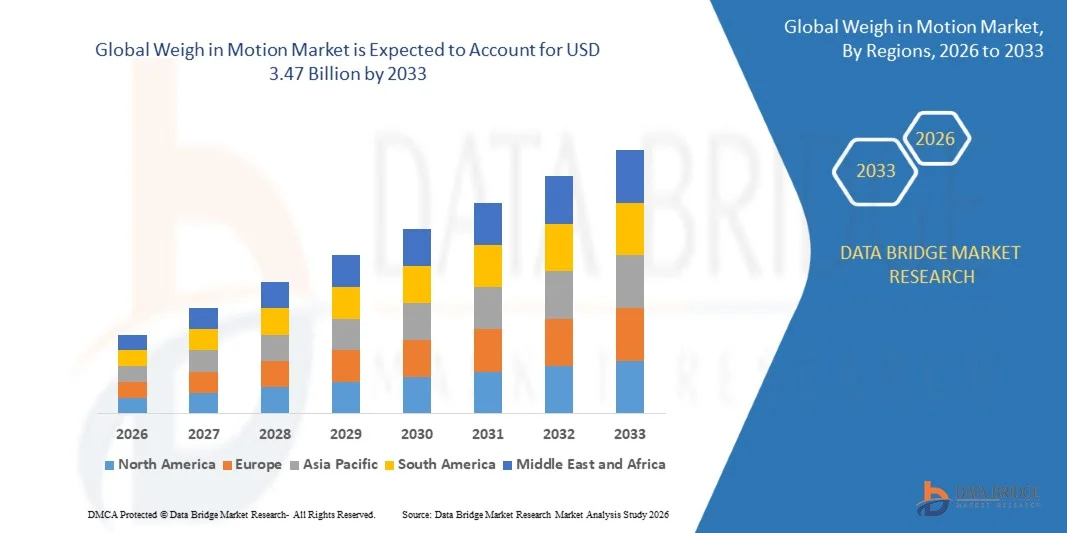
- As per Data Bridge Market Research Analysis the global weigh in motion market size was valued at USD 1.56 billion in 2025 and is expected to reach USD 3.47 billion by 2033, at a CAGR of 10.50% during the forecast period
- The factors such as rapid growth in government regulations towards intelligent transportation and growth in public-private partnership, low cost and increasing traffic congestion are expected to emerge as the significant factors accelerating the growth of weigh in motion market
- In addition to this, the growing awareness regarding its benefits such as road safety, road management, overload vehicles detection, cost reduction, traffic monitoring and analysis along with increasing government initiatives toward intelligent transportation system will further aggravate the growth of the weigh in motion market
Market Size & Forecast
- Global Market Value (2025): USD 1.56 billion in 2025
- Expected Market Value (2033): USD 3.47 billion by 2033
- Forecast CAGR (2026–2033): 10.50%
What are the Major Takeaways of Weigh in Motion Market?
- Lack of standardized, high initial investments and uniform technologies and fusion of data results as a growth restraint for the market. The restrictive installation stipulations of nonintrusive sensors requirement is also projected to hamper market’s growth within the forecasted period
- The increasing investment in smart cities is anticipated to generate lucrative opportunities for the weigh in motion market. The accuracy of weigh-in-motion system will pose as a challenge for the Weigh in motion market
- Europe dominated the weigh in motion market with a 31.8% revenue share in 2025, driven by widespread deployment of WIM systems across highways, smart tolling networks, and urban transport infrastructure
- Asia-Pacific is projected to register the fastest CAGR of 8.2% from 2026 to 2033, fueled by rapid highway expansion, urbanization, and smart city projects in China, India, Japan, South Korea, and Southeast Asia
- The High Speed segment dominated the market with a 58.2% share in 2025, as highways, expressways, and toll plazas increasingly deploy WIM systems to capture vehicle weight without requiring traffic to stop
Report Scope and Weigh in Motion Market Segmentation
|
Attributes |
Weigh in Motion Key Market Insights |
|
Segments Covered |
|
|
Countries Covered |
North America
Europe
Asia-Pacific
Middle East and Africa
South America
|
|
Key Market Players |
|
|
Market Opportunities |
|
|
Value Added Data Infosets |
In addition to the insights on market scenarios such as market value, growth rate, segmentation, geographical coverage, and major players, the market reports curated by the Data Bridge Market Research also include in-depth expert analysis, pricing analysis, brand share analysis, consumer survey, demography analysis, supply chain analysis, value chain analysis, raw material/consumables overview, vendor selection criteria, PESTLE Analysis, Porter Analysis, and regulatory framework. |
What is the Key Trend in the Weigh in Motion Market?
“Increasing Shift Toward Smart, High-Speed, and Integrated Weigh in Motion Systems”
- The weigh in motion market is witnessing strong adoption of high-speed, compact, and sensor-integrated systems designed for real-time vehicle weight measurement without disrupting traffic flow
- Manufacturers are introducing multi-sensor, high-accuracy, and IoT-enabled WIM systems that provide advanced data analytics, cloud-based monitoring, and compatibility with smart traffic management platforms
- Growing demand for lightweight, portable, and field-deployable WIM equipment is driving usage across highways, toll plazas, logistics hubs, and transportation research centers
- For instance, companies such as Kistler Group, International Road Dynamics, TE Connectivity, and SWARCO have upgraded their WIM solutions with multi-lane deployment, cloud dashboards, and AI-assisted weight classification
- Increasing need for real-time traffic monitoring, axle load detection, and automated enforcement is accelerating adoption of integrated, PC- and cloud-connected WIM systems
- As transportation networks become more intelligent and vehicle compliance regulations tighten, Weigh in Motion systems remain vital for efficient freight management, road safety, and infrastructure protection
What are the Key Drivers of Weigh in Motion Market?
- Rising demand for high-accuracy, durable, and automated WIM systems to optimize traffic flow, enforce axle load limits, and reduce road maintenance costs
- For instance, in 2025, leading companies such as Kistler Group, International Road Dynamics, and TE Connectivity deployed next-generation WIM sensors with higher sampling rates and integrated analytics
- Growing adoption of smart highways, toll automation, connected vehicles, and IoT-enabled transportation systems is boosting market demand across North America, Europe, and Asia-Pacific
- Advancements in sensor technology, AI-based traffic analytics, and cloud integration have strengthened system reliability, portability, and scalability
- Increasing government initiatives for road safety, infrastructure monitoring, and heavy vehicle compliance are creating demand for multi-lane, real-time WIM deployments
- Supported by continuous investments in smart transportation infrastructure, logistics optimization, and predictive maintenance, the Weigh in Motion market is expected to witness strong long-term growth
Which Factor is Challenging the Growth of the Weigh in Motion Market?
- High costs associated with premium, multi-lane, and AI-enabled WIM systems restrict adoption among smaller road authorities and emerging markets
- For instance, during 2024–2025, fluctuations in sensor component prices, specialized installation costs, and calibration requirements increased deployment expenses for several global vendors
- Complexity in installing multi-sensor WIM arrays, integrating cloud analytics, and ensuring regulatory compliance requires skilled personnel and training
- Limited awareness in developing regions about WIM benefits, automated enforcement, and traffic monitoring capabilities slows adoption
- Competition from static weighbridges, portable axle scales, and traditional traffic sensors creates pricing pressure and reduces differentiation
- To address these challenges, companies are focusing on cost-optimized designs, simplified installation, AI-driven analytics, and cloud-based monitoring platforms to increase adoption of weigh in motion systems globally
How is the Weigh in Motion Market Segmented?
The market is segmented on the basis of vehicle speed, type, end use industry, function, component, and sensor type.
- By Vehicle Speed
The Weigh in Motion market is segmented into High Speed and Low Speed vehicles. The High Speed segment dominated the market with a 58.2% share in 2025, as highways, expressways, and toll plazas increasingly deploy WIM systems to capture vehicle weight without requiring traffic to stop. High-speed WIM enables real-time traffic monitoring, axle load enforcement, and vehicle classification while maintaining smooth traffic flow. The Low Speed segment is expected to grow at the fastest CAGR from 2026 to 2033, driven by expanding adoption in urban roads, industrial zones, and logistics hubs where slower-moving vehicles enable detailed weight profiling, freight monitoring, and integration with automated toll or access control systems. Increasing urbanization, safety regulations, and vehicle compliance requirements across emerging markets further fuel growth in low-speed applications.
- By Type
Based on system type, the market is segmented into In-Road System, Weigh Bridge System, and Onboard System. The In-Road System dominated with a 45.6% share in 2025, thanks to its ability to measure weight dynamically across multiple lanes, high accuracy, and minimal traffic disruption. These systems are widely deployed on highways and expressways, supporting toll enforcement, traffic management, and compliance monitoring.
The Onboard System segment is projected to grow at the fastest CAGR from 2026 to 2033, propelled by increasing adoption of smart vehicles, fleet telematics, and connected logistics solutions. Onboard systems allow real-time vehicle weight tracking, integration with IoT platforms, and proactive maintenance alerts, especially in commercial fleets and heavy-duty transport applications.
- By End Use Industry
The market is segmented into Highway Toll, Oil and Refinery, Logistics, and Others. The Highway Toll segment dominated the market with a 51.2% share in 2025, driven by global toll automation projects, infrastructure modernization, and government regulations on axle load enforcement. WIM systems in tolling enable automated weight-based fee calculation, reduce congestion, and ensure road safety.
The Logistics segment is expected to grow at the fastest CAGR from 2026 to 2033, fueled by rising e-commerce, smart fleet management, and global supply chain optimization. Companies are integrating WIM with fleet telematics, predictive maintenance, and automated route planning, creating demand for portable and cloud-enabled WIM solutions across logistics hubs and freight terminals.
- By Function
On the basis of function, the WIM market is segmented into Vehicle Profiling, Axle Counting, Weight Enforcement, Weight-Based Toll Collection, and Traffic Data Collection. The Weight Enforcement segment dominated with a 43.5% share in 2025, supported by increasing government regulations on overloading and road maintenance. These systems ensure legal compliance, reduce vehicle-induced road damage, and enhance traffic safety.
The Traffic Data Collection segment is projected to grow at the fastest CAGR from 2026 to 2033, as urban planners and transportation authorities leverage WIM systems to optimize traffic management, vehicle classification, and infrastructure planning. Integration with AI and smart traffic analytics further accelerates adoption of data-driven traffic solutions.
- By Component
The market is segmented into Hardware, Software, and Services. The Hardware segment dominated with a 62.3% share in 2025, as sensors, weighing modules, and embedded electronics form the core of WIM systems, ensuring precision, reliability, and durability in field conditions.
The Software segment is expected to grow at the fastest CAGR from 2026 to 2033, driven by AI-powered analytics, cloud-enabled dashboards, automated reporting, and integration with traffic management systems. Advanced software enhances predictive maintenance, axle-load analysis, and toll automation capabilities, increasing adoption across highways, urban networks, and logistics operations.
- By Sensor Type
Based on sensor type, the WIM market is segmented into Image Sensor, Piezoelectric Sensor, Bending Plate, Inductive Loop, Magnetic Sensor, Acoustic Sensor, Infrared Sensor, Radar Sensor, LiDAR Sensor, and Thermal Sensor. The Piezoelectric Sensor segment dominated with a 47.8% share in 2025, due to its high accuracy, durability, and ability to measure dynamic loads at high vehicle speeds.
The LiDAR Sensor segment is projected to grow at the fastest CAGR from 2026 to 2033, supported by increasing use in smart highways, autonomous vehicles, and AI-enabled traffic analytics. LiDAR enables precise, non-contact weight measurement, vehicle classification, and integration with ITS platforms, driving adoption in next-generation intelligent transportation systems.
Which Region Holds the Largest Share of the Weigh in Motion Market?
- Europe dominated the weigh in motion market with a 31.8% revenue share in 2025, driven by widespread deployment of WIM systems across highways, smart tolling networks, and urban transport infrastructure
- Strong government regulations on vehicle axle load enforcement, road safety, and environmental compliance continue to fuel adoption in Germany, France, the U.K., Italy, and Spain. High investments in smart transportation systems, intelligent traffic management, and automated tolling solutions support market growth
- Leading European companies are introducing advanced WIM solutions with multi-sensor integration, cloud-enabled analytics, and AI-driven traffic insights, strengthening the region’s technological edge. Continuous expansion of highway networks, modernization of freight corridors, and emphasis on sustainable logistics reinforce Europe’s dominant position in the global market
Germany Weigh in Motion Market Insight
Germany is the largest contributor to Europe due to its dense highway network (Autobahns), strong automotive manufacturing base, and stringent road safety regulations. Increasing deployment of high-speed WIM systems, weight-based toll collection, and traffic monitoring applications supports robust regional adoption.
U.K. Weigh in Motion Market Insight
The U.K. contributes significantly, driven by toll road projects, smart transportation initiatives, and rising adoption of AI-powered WIM analytics in logistics and fleet management.
France Weigh in Motion Market Insight
France shows steady growth with focus on highway modernization, freight monitoring, and integration of WIM systems with ITS (Intelligent Transportation Systems) platforms.
Asia-Pacific Weigh in Motion Market
Asia-Pacific is projected to register the fastest CAGR of 8.2% from 2026 to 2033, fueled by rapid highway expansion, urbanization, and smart city projects in China, India, Japan, South Korea, and Southeast Asia. Growing commercial vehicle traffic, adoption of automated tolling systems, and rising logistics activities increase demand for WIM solutions across highways, ports, and industrial zones. High-volume production of heavy vehicles, increasing e-commerce deliveries, and fleet optimization initiatives accelerate market adoption.
China Weigh in Motion Market Insight
China is the largest contributor in Asia-Pacific due to massive investments in highways, smart transportation infrastructure, and freight monitoring systems. Adoption of high-speed, multi-lane WIM systems for toll enforcement, road safety, and traffic management drives growth.
India Weigh in Motion Market Insight
India is emerging as a major growth hub, supported by government-backed highway modernization, expanding expressways, and rising interest in smart city and logistics projects.
Japan Weigh in Motion Market Insight
Japan shows steady growth with focus on intelligent transportation, integration of WIM with AI analytics, and traffic safety monitoring.
South Korea Weigh in Motion Market Insight
South Korea contributes significantly due to adoption of high-precision WIM for highway tolling, smart logistics, and autonomous vehicle testing infrastructure.
Which are the Top Companies in Weigh in Motion Market?
The weigh in motion industry is primarily led by well-established companies, including:
- TE Connectivity (Switzerland)
- Siemens (Germany)
- Raytheon Technologies Corporation (U.S.)
- Axis Communications AB (Sweden)
- Teledyne FLIR LLC (U.S.)
- Kapsch TrafficCom AG (Austria)
- International Road Dynamics Inc. (Canada)
- Kistler Group (Switzerland)
- SWARCO (Austria)
- Infogix Inc (U.S.)
- Reltio (U.S.)
- Sensys Networks, Inc. (U.S.)
- Cross Zlin a.s (Czech Republic)
- Intercomp (U.S.)
- EFKON India Pvt. Ltd (India)
- SICK AG (Germany)
- Image Sensing Systems, Inc. (U.S.)
- LeddarTech Inc (Canada)
What are the Recent Developments in Global Weigh in Motion Market?
- In May 2022, International Road Dynamics Inc., announced that it had secured two contracts worth approximately USD 900 thousand for upgrading weigh-in-motion (WIM) systems for the Illinois State Toll Highway Authority, reinforcing the company’s leadership in advanced WIM solutions
- In April 2022, Mettler Toledo launched the single-draft TruckPass weigh-in-motion scale, delivering legal-for-trade accuracy previously unavailable in in-motion solutions, enhancing operational efficiency, reducing emissions, and enabling seamless integration with DataBridge Transaction Management Software, marking a key advancement in U.S. WIM technology
- In September 2021, International Road Dynamics Inc., was awarded a contract of around USD 1.6 million to supply and install a mainline weigh-in-motion and electronic pre-clearance system for the Idaho Transportation Department, strengthening WIM deployment for state transportation infrastructure
- In September 2021, Quarterhill Inc., the parent company of International Road Dynamics Inc., acquired Electronic Transaction Consultants, LLC., a U.S.-based company specializing in tolling and mobility systems, for approximately USD 120 million in cash, expanding its portfolio in transportation and mobility solutions
- In April 2021, Quarterhill Inc., the parent company of International Road Dynamics Inc., acquired VDS Verkehrstechnik GmbH, a Germany-based Intelligent Transportation Systems (ITS) provider of high-precision traffic monitoring devices, for around USD 2.07 million in cash, enhancing its European WIM and ITS capabilities
- In March 2021, Q-Free ASA launched HI-TRAC TMU4X, a high-speed, multimodal weigh-in-motion (WIM) data collection solution that combines automatic vehicle classification and pedestrian/cyclist data counting in a single unit, offering comprehensive traffic monitoring and intelligent infrastructure insights

- Interactive Data Analysis Dashboard
- Company Analysis Dashboard for high growth potential opportunities
- Research Analyst Access for customization & queries
- Competitor Analysis with Interactive dashboard
- Latest News, Updates & Trend analysis
- Harness the Power of Benchmark Analysis for Comprehensive Competitor Tracking
Data collection and base year analysis are done using data collection modules with large sample sizes. The stage includes obtaining market information or related data through various sources and strategies. It includes examining and planning all the data acquired from the past in advance. It likewise envelops the examination of information inconsistencies seen across different information sources. The market data is analysed and estimated using market statistical and coherent models. Also, market share analysis and key trend analysis are the major success factors in the market report. To know more, please request an analyst call or drop down your inquiry.
The key research methodology used by DBMR research team is data triangulation which involves data mining, analysis of the impact of data variables on the market and primary (industry expert) validation. Data models include Vendor Positioning Grid, Market Time Line Analysis, Market Overview and Guide, Company Positioning Grid, Patent Analysis, Pricing Analysis, Company Market Share Analysis, Standards of Measurement, Global versus Regional and Vendor Share Analysis. To know more about the research methodology, drop in an inquiry to speak to our industry experts.
Data Bridge Market Research is a leader in advanced formative research. We take pride in servicing our existing and new customers with data and analysis that match and suits their goal. The report can be customized to include price trend analysis of target brands understanding the market for additional countries (ask for the list of countries), clinical trial results data, literature review, refurbished market and product base analysis. Market analysis of target competitors can be analyzed from technology-based analysis to market portfolio strategies. We can add as many competitors that you require data about in the format and data style you are looking for. Our team of analysts can also provide you data in crude raw excel files pivot tables (Fact book) or can assist you in creating presentations from the data sets available in the report.













