


Wellness Wearables Market Size
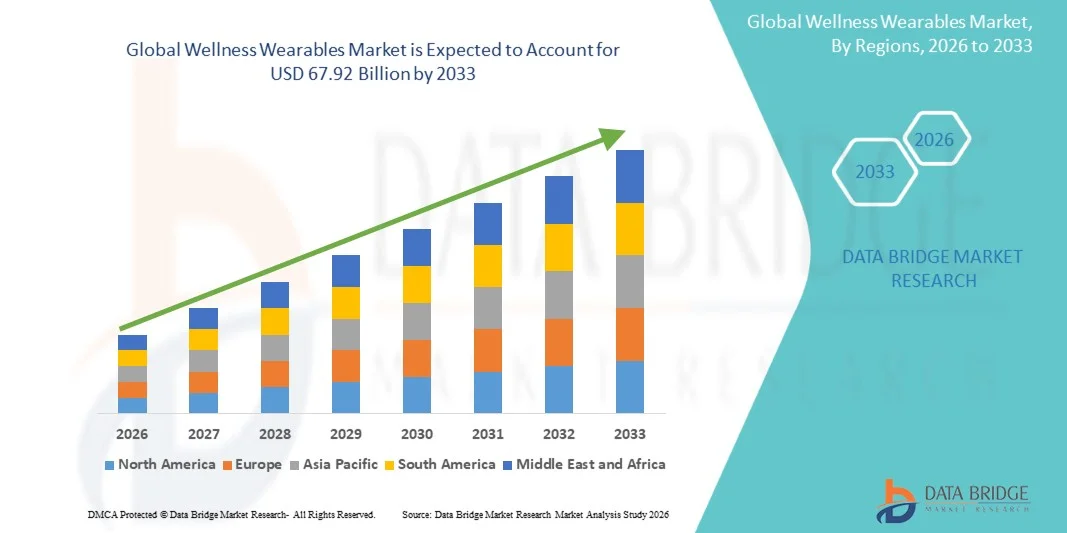
- The global wellness wearables market size was valued at USD 53 billion in 2025and is expected to reach USD 67.92 billion by 2033, at a CAGR of 13.2% during the forecast period
- The market growth is primarily driven by the rising prevalence of lifestyle-related diseases, increasing health consciousness among consumers, and growing adoption of digital health ecosystems integrating wearable devices with mobile health platforms
- In addition, rapid advancements in sensor technology, AI-powered health analytics, and continuous biometric monitoring are positioning wellness wearables as essential tools for preventive healthcare, chronic disease management, and personalized fitness optimization, thereby significantly accelerating market expansion
Wellness Wearables Market Analysis
- Wellness wearables, which enable continuous monitoring of physiological and lifestyle parameters such as heart rate, sleep patterns, activity levels, and stress indicators, are becoming central to modern preventive healthcare and personal fitness management due to their real-time insights and user-friendly integration with smartphones and health apps
- The escalating demand for wellness wearables is primarily driven by increasing health awareness, rising prevalence of obesity and cardiovascular conditions, growing focus on preventive healthcare, and expanding adoption of remote patient monitoring solutions
- North America dominated the wellness wearables market with the largest revenue share of 38.6% in 2025, supported by strong digital health infrastructure, high consumer adoption of smart devices, and the presence of leading technology and healthcare companies driving innovation in wearable ecosystems
- Asia-Pacific is expected to be the fastest growing region during the forecast period with a CAGR of 15.4%, due to rising disposable incomes, rapid urbanization, increasing smartphone penetration, and growing awareness of fitness and preventive healthcare across emerging economies such as India and China
- Smartwatches dominated the market in 2025, driven by their affordability, multifunctionality, ease of use, and strong ecosystem integration with health and fitness applications
Report Scope and Wellness Wearables Market Segmentation
|
Attributes |
Wellness Wearables Key Market Insights |
|
Segments Covered |
|
|
Countries Covered |
North America · U.S. · Canada · Mexico Europe · Germany · France · U.K. · Netherlands · Switzerland · Belgium · Russia · Italy · Spain · Turkey · Rest of Europe Asia-Pacific · China · Japan · India · South Korea · Singapore · Malaysia · Australia · Thailand · Indonesia · Philippines · Rest of Asia-Pacific Middle East and Africa · Saudi Arabia · U.A.E. · South Africa · Egypt · Israel · Rest of Middle East and Africa South America · Brazil · Argentina · Rest of South America |
|
Key Market Players |
|
|
Market Opportunities |
· Expansion of AI-powered and predictive health analytics in wearable ecosystems · Increasing adoption of medical-grade wearables for remote patient monitoring and chronic disease management |
|
Value Added Data Infosets |
In addition to the insights on market scenarios such as market value, growth rate, segmentation, geographical coverage, and major players, the market reports curated by the Data Bridge Market Research also include in-depth expert analysis, patient epidemiology, pipeline analysis, pricing analysis, and regulatory framework |
Wellness Wearables Market Trends
“Integration of AI, Continuous Monitoring, and Personalized Digital Health Ecosystems”
- A significant and accelerating trend in the global wellness wearables market is the integration of artificial intelligence, machine learning, and advanced biosensors to deliver real-time, predictive, and personalized health insights
- For instance, modern smartwatches and fitness platforms now provide ECG monitoring, blood oxygen tracking, sleep staging, and stress analysis, enabling users to proactively manage their health conditions
- The convergence of wearable devices with mobile health applications and cloud-based analytics is enabling continuous health monitoring and data-driven lifestyle recommendations
- Increasing adoption of smart rings and discreet wearable devices is supporting demand for non-intrusive health tracking solutions with long battery life and advanced biometric accuracy
- Growing use of wearable-enabled remote patient monitoring is transforming chronic disease management by allowing healthcare providers to track patients outside clinical settings
- This shift toward intelligent, connected, and preventive healthcare ecosystems is reshaping consumer expectations around convenience, personalization, and long-term wellness management
- Demand for hybrid devices combining fitness tracking and medical-grade monitoring capabilities is rapidly increasing across both consumer and clinical segments
Wellness wearables Market Dynamics
Driver
“Rising Health Awareness and Expansion of Preventive Digital Healthcare”
- The increasing global focus on preventive healthcare, fitness optimization, and early disease detection is a major driver fueling demand for wellness wearables
- For instance, consumers are increasingly using smartwatches and fitness trackers to monitor heart health, sleep quality, physical activity, and calorie consumption in real time
- The growing prevalence of lifestyle-related diseases such as diabetes, obesity, and cardiovascular disorders is encouraging continuous health monitoring through wearable devices
- Furthermore, rising adoption of digital health ecosystems and smartphone-connected health platforms is enhancing user engagement and data accessibility
- Employers are increasingly deploying workplace wellness programs integrated with wearable devices to improve employee productivity and reduce healthcare costs
- Expansion of telehealth and remote monitoring services is further accelerating adoption of connected wearable technologies
- Continuous innovation in sensor accuracy, battery life, and device miniaturization is improving usability and driving mass-market adoption
Restraint/Challenge
“Data Privacy Concerns and Device Accuracy Limitations”
- Concerns related to data privacy, cybersecurity risks, and unauthorized access to sensitive health information pose significant challenges to widespread adoption of wellness wearables
- For instance, continuous health data collection raises concerns regarding storage, sharing, and regulatory compliance across different regions
- Variability in sensor accuracy and inconsistencies in biometric readings can limit clinical reliability for certain medical applications
- High cost of advanced medical-grade wearables and subscription-based digital health services can restrict adoption in price-sensitive markets
- Lack of standardization across wearable platforms and interoperability issues with healthcare systems can hinder seamless data integration
- Limited awareness among older populations regarding device usage and digital health literacy remains a barrier in some regions
- Addressing these challenges through stronger data protection frameworks, improved sensor calibration, and cost optimization strategies will be essential for sustained market growth
Wellness Wearables Market Scope
The market is segmented on the basis of product type, application, and end user.
- By Product Type
On the basis of product type, the global wellness wearables market is segmented into smartwatches, fitness trackers, smart clothing / smart textiles, hearables, medical-grade wearables, smart rings & emerging wearables, and therapeutic patches & monitoring devices. The smartwatches segment dominated the market with the largest revenue share of 41.3% in 2025, driven by strong consumer preference for multifunctional devices that integrate health tracking, communication, and lifestyle applications in a single platform. Smartwatches are widely adopted due to their ability to monitor heart rate, sleep patterns, physical activity, and stress levels, making them essential tools for daily wellness management. Strong ecosystem integration with smartphones, fitness applications, and cloud-based health platforms further strengthens adoption. Continuous innovation in AI-powered health insights, ECG monitoring, and blood oxygen tracking capabilities is reinforcing segment leadership across global markets.
The medical-grade wearables segment is expected to witness the fastest growth during the forecast period, fueled by increasing adoption of remote patient monitoring solutions, rising prevalence of chronic diseases, and growing integration of healthcare systems with digital health technologies. Devices such as ECG patches and biosensors are increasingly being used for continuous monitoring in both clinical and homecare settings.
- By Application
On the basis of application, the market is segmented into personal health monitoring, sports & fitness tracking, remote patient monitoring, elderly care / assisted living, workplace wellness programs, and preventive healthcare & lifestyle management. The personal health monitoring segment accounted for the largest market revenue share in 2025, driven by increasing consumer awareness regarding fitness, wellness, and early detection of health conditions. Consumers are increasingly using wearable devices to track daily activity, heart rate variability, sleep quality, and stress levels to improve overall lifestyle outcomes.
The remote patient monitoring segment is expected to register the fastest growth during the forecast period, driven by the rapid expansion of telehealth services, increasing adoption of home-based healthcare models, and rising need for continuous monitoring of chronic disease patients. Wearable devices are enabling real-time health tracking outside clinical settings, improving early intervention and reducing healthcare costs.
- By End User
On the basis of end user, the market is segmented into individual consumers, healthcare providers & hospitals, corporate / workplace wellness programs, athletes & sports organizations, and military / industrial safety users. Individual consumers dominated the market in 2025, driven by strong adoption of smartwatches and fitness trackers for daily health and fitness tracking. Rising health awareness, smartphone penetration, and integration of wearable devices with mobile health apps are key factors supporting this dominance.
The healthcare providers & hospitals segment is expected to witness the fastest growth during the forecast period, supported by increasing adoption of medical-grade wearables for remote patient monitoring, chronic disease management, and post-discharge care. Growing focus on reducing hospital readmissions and improving patient outcomes through continuous digital monitoring is further accelerating segment expansion.
Wellness Wearables Market Regional Analysis
- North America dominated the wellness wearables market with the largest revenue share of 38.6% in 2025, supported by strong digital health infrastructure, high consumer adoption of smart devices, and the presence of leading technology companies driving innovation in wearable ecosystems
- Patients and consumers in the region demonstrate strong adoption of fitness-focused and medical-grade wearable devices due to high health awareness and advanced healthcare integration
- This leadership position is further strengthened by high healthcare expenditure, widespread insurance coverage for digital health solutions, and strong presence of major wearable technology manufacturers, making North America a global hub for innovation and early adoption
U.S. Wellness Wearables Market Insight
The U.S. wellness wearables market captured the largest revenue in North America in 2025, driven by high consumer adoption of smartwatches, fitness trackers, and advanced health monitoring devices. Increasing focus on preventive healthcare, chronic disease management, and digital fitness ecosystems continues to support market expansion. Strong integration of wearable devices with telehealth platforms and health insurance wellness programs is further accelerating adoption. In addition, the presence of leading technology companies and strong innovation in AI-driven health analytics significantly contributes to market growth.
Europe Wellness Wearables Market Insight
The Europe wellness wearables market is projected to expand at a steady CAGR during the forecast period, driven by increasing health consciousness, aging population, and rising adoption of preventive healthcare solutions. Strong regulatory frameworks supporting digital health adoption and growing investments in healthcare innovation are boosting demand for wearable devices. Consumers across Europe are increasingly adopting fitness trackers and smartwatches for lifestyle and chronic disease management.
U.K. Wellness Wearables Market Insight
The U.K. wellness wearables market is anticipated to grow at a notable CAGR during the forecast period, supported by strong public health initiatives promoting physical activity and preventive healthcare. Rising adoption of wearable devices for fitness tracking, sleep monitoring, and stress management is driving market expansion. The country’s well-established digital healthcare infrastructure and growing integration of wearables with NHS-supported health programs further support growth.
Germany Wellness Wearables Market Insight
The Germany wellness wearables market is expected to expand at a considerable CAGR during the forecast period, driven by strong consumer preference for high-quality health monitoring devices and increasing focus on preventive healthcare. Rising adoption of medical-grade wearables for remote monitoring and chronic disease management is further supporting market growth. Germany’s emphasis on precision health and digital transformation in healthcare is accelerating wearable adoption.
Asia-Pacific Wellness Wearables Market Insight
The Asia-Pacific wellness wearables market is poised to grow at the fastest CAGR during the forecast period of 2026 to 2033, driven by rapid urbanization, rising disposable incomes, increasing smartphone penetration, and growing health awareness in countries such as China, India, and Japan. Expanding middle-class populations and increasing focus on fitness and preventive healthcare are significantly boosting demand for wearable devices. Strong growth in e-commerce and digital health ecosystems is further accelerating market penetration.
Japan Wellness Wearables Market Insight
The Japan wellness wearables market is growing steadily due to its aging population and high adoption of advanced health monitoring technologies. Strong focus on elderly care, chronic disease management, and precision healthcare is driving demand for wearable devices. Compact and discreet wearables such as smart rings and medical-grade sensors are gaining popularity among elderly users.
India Wellness Wearables Market Insight
The India wellness wearables market accounted for a significant revenue share in Asia-Pacific in 2025, attributed to rising health awareness, rapid urbanization, and increasing adoption of fitness-focused lifestyles. Expanding middle-class population and growing smartphone penetration are key drivers supporting wearable adoption. Affordable fitness trackers and smartwatches are widely adopted across urban populations, while increasing interest in preventive healthcare is accelerating market growth across both urban and semi-urban regions.
Wellness Wearables Market Share
The Wellness wearables industry is primarily led by well-established companies, including:
- Apple Inc. (U.S.)
- Samsung Electronics Co., Ltd. (South Korea)
- Fitbit (Google LLC) (U.S.)
- Garmin Ltd. (U.S.)
- Huawei Technologies Co., Ltd. (China)
- Xiaomi Corporation (China)
- Withings (France)
- Oura Health Ltd. (Finland)
- Polar Electro (Finland)
- WHOOP Inc. (U.S.)
- Abbott Laboratories (U.S.)
- Medtronic plc (Ireland)
- Dexcom, Inc. (U.S.)
- BioTelemetry / Philips (Netherlands)
- Sony Corporation (Japan)
- Bose Corporation (U.S.)
- Masimo Corporation (U.S.)
What are the Recent Developments in Global Wellness Wearables Market?
- In May 2026, Google (Fitbit) announced the launch of Fitbit Air, a lightweight screenless wellness wearable integrated with Google Health AI coaching, marking a major shift toward minimalist, AI-driven health tracking devices designed for continuous biometric monitoring and personalized wellness insights
- In May 2025, WHOOP introduced its next-generation WHOOP 5.0 and WHOOP MG wearables featuring ECG monitoring, blood pressure insights, and “WHOOP Age” longevity tracking, strengthening its positioning in medical-grade and performance wellness wearables
- In 2025, Samsung Electronics expanded its Samsung Health ecosystem by integrating wearable data with virtual doctor consultations and guided health services, enhancing remote wellness monitoring and strengthening its connected health platform strategy
- In 2025, Apple Inc. continued advancing its Apple Watch ecosystem with deeper AI-driven health analytics and expanded integration with fitness and medical tracking features, reinforcing its dominance in premium smartwatch-based wellness monitoring across global markets

- Interactive Data Analysis Dashboard
- Company Analysis Dashboard for high growth potential opportunities
- Research Analyst Access for customization & queries
- Competitor Analysis with Interactive dashboard
- Latest News, Updates & Trend analysis
- Harness the Power of Benchmark Analysis for Comprehensive Competitor Tracking
Data collection and base year analysis are done using data collection modules with large sample sizes. The stage includes obtaining market information or related data through various sources and strategies. It includes examining and planning all the data acquired from the past in advance. It likewise envelops the examination of information inconsistencies seen across different information sources. The market data is analysed and estimated using market statistical and coherent models. Also, market share analysis and key trend analysis are the major success factors in the market report. To know more, please request an analyst call or drop down your inquiry.
The key research methodology used by DBMR research team is data triangulation which involves data mining, analysis of the impact of data variables on the market and primary (industry expert) validation. Data models include Vendor Positioning Grid, Market Time Line Analysis, Market Overview and Guide, Company Positioning Grid, Patent Analysis, Pricing Analysis, Company Market Share Analysis, Standards of Measurement, Global versus Regional and Vendor Share Analysis. To know more about the research methodology, drop in an inquiry to speak to our industry experts.
Data Bridge Market Research is a leader in advanced formative research. We take pride in servicing our existing and new customers with data and analysis that match and suits their goal. The report can be customized to include price trend analysis of target brands understanding the market for additional countries (ask for the list of countries), clinical trial results data, literature review, refurbished market and product base analysis. Market analysis of target competitors can be analyzed from technology-based analysis to market portfolio strategies. We can add as many competitors that you require data about in the format and data style you are looking for. Our team of analysts can also provide you data in crude raw excel files pivot tables (Fact book) or can assist you in creating presentations from the data sets available in the report.













