What is the Wet Vacuum Cleaner Market Size and Growth Rate?
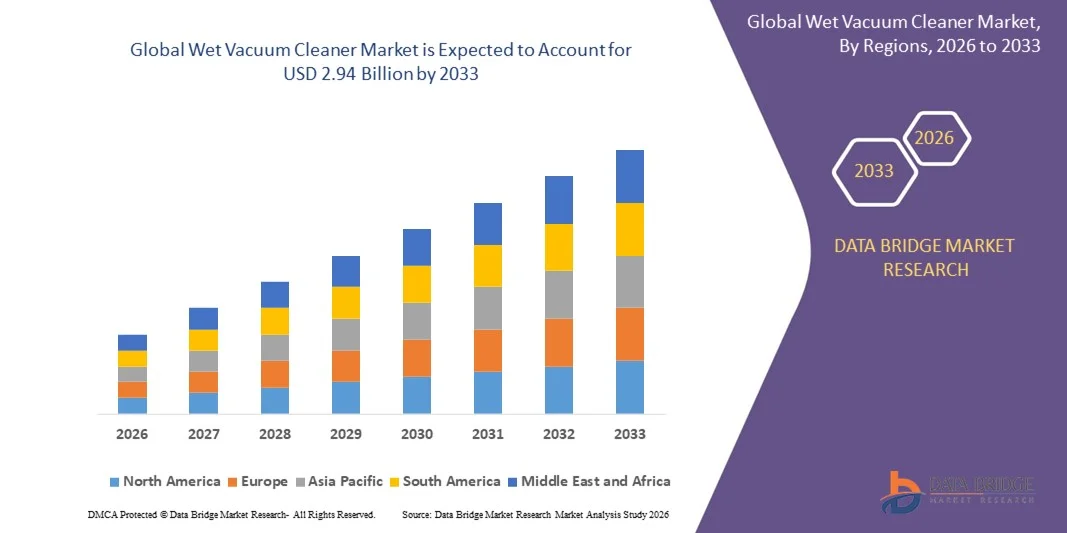
- The global wet vacuum cleaner market size was valued at USD 2.07 billion in 2025 and is expected to reach USD 2.94 billion by 2033, at a CAGR of 4.5% during the forecast period
- The market growth is largely fueled by the increasing adoption of advanced cleaning appliances and technological innovations in wet vacuum cleaners, leading to enhanced efficiency, multifunctionality, and convenience in both residential and commercial settings
- Furthermore, rising consumer demand for versatile, user-friendly, and high-performance cleaning solutions is establishing wet vacuum cleaners as essential tools for maintaining hygiene across households, offices, retail spaces, and industrial environments. These factors are accelerating market adoption and driving substantial growth
What are the Major Takeaways of Wet Vacuum Cleaner Market?
- Wet vacuum cleaners, capable of handling both wet and dry debris, are becoming increasingly vital components of modern cleaning routines in residential, commercial, and industrial spaces due to their superior efficiency, versatility, and ability to maintain high hygiene standards
- The escalating demand for wet vacuum cleaners is primarily fueled by growing awareness of cleanliness, increasing urbanization, rising disposable incomes, and the preference for time-saving, multi-functional cleaning appliances among consumers and businesses
- North America dominated wet vacuum cleaner market with a share of 34.5% in 2025, due to the growing demand for efficient cleaning solutions in households, commercial spaces, and industrial facilities
- Asia-Pacific is expected to be the fastest growing region in the wet vacuum cleaner market during the forecast period due to rapid urbanization, increasing disposable incomes, and rising awareness of hygiene in countries such as China, Japan, and India
- Portable segment dominated the market with a market share of 58.9% in 2025, due to its convenience, lightweight design, and ease of maneuverability across different cleaning areas. Portable wet vacuum cleaners are preferred by households and small commercial spaces due to their compact size and storage-friendly design. Their versatility in handling wet spills and dry debris in confined or hard-to-reach areas contributes to strong adoption. The growing trend of on-the-go cleaning solutions for residential and small business use further reinforces the dominance of portable systems
Report Scope and Wet Vacuum Cleaner Market Segmentation
|
Attributes |
Wet Vacuum Cleaner Key Market Insights |
|
Segments Covered |
|
|
Countries Covered |
North America
Europe
Asia-Pacific
Middle East and Africa
South America
|
|
Key Market Players |
|
|
Market Opportunities |
|
|
Value Added Data Infosets |
In addition to the insights on market scenarios such as market value, growth rate, segmentation, geographical coverage, and major players, the market reports curated by the Data Bridge Market Research also include in-depth expert analysis, pricing analysis, brand share analysis, consumer survey, demography analysis, supply chain analysis, value chain analysis, raw material/consumables overview, vendor selection criteria, PESTLE Analysis, Porter Analysis, and regulatory framework. |
What is the Key Trend in the Wet Vacuum Cleaner Market?
Increasing Adoption of Multi-Functional Wet Vacuum Cleaners
- A significant trend in the wet vacuum cleaner market is the rising adoption of multi-functional devices capable of handling both wet and dry debris, driven by growing consumer demand for efficient, versatile, and time-saving cleaning solutions across households, commercial spaces, and industrial environments. These devices are increasingly viewed as essential tools for maintaining hygiene while reducing the time and effort required for routine cleaning tasks
- For instance, Bissell’s CrossWave series allows simultaneous vacuuming and mopping, offering enhanced cleaning efficiency for hard floors. Such multi-functionality is encouraging adoption among homeowners and commercial operators seeking all-in-one cleaning solutions
- Robotic wet vacuum cleaners, such as Roborock’s Qrevo Curv, are also contributing to this trend by incorporating advanced navigation, anti-tangle brushes, and automated mopping capabilities, positioning these devices as convenient solutions for multi-surface cleaning in smart homes
- The growing focus on pet hygiene and allergy reduction is accelerating the popularity of wet vacuum cleaners with specialized filtration and hair management systems, enabling users to maintain cleaner environments with less effort
- Small businesses, retail stores, and offices are increasingly deploying compact and automated wet vacuum solutions, which allow staff to focus on other operational tasks, thereby enhancing efficiency and productivity
- Integration with smart home ecosystems and app-controlled features is becoming common, allowing users to schedule cleanings, monitor performance, and optimize water and power usage. This technological convergence reinforces the trend toward multi-functional, automated wet vacuum cleaners
Wet Vacuum Cleaner Market Dynamics
Driver What are the Key Drivers of Wet Vacuum Cleaner Market?
Rising Demand for Efficient and Hygienic Cleaning Solutions
- The rising need for efficient and hygienic cleaning solutions across residential, commercial, and industrial sectors is driving market growth for wet vacuum cleaners. Consumers and businesses are prioritizing devices that provide superior suction, multi-surface cleaning, and effective removal of both wet and dry debris
- For instance, Dyson’s WashG1 allows simultaneous wet and dry cleaning with separation technology to ensure hygienic waste disposal, strengthening the adoption of advanced cleaning solutions
- The increase in urbanization and high-density living is pushing demand for compact yet powerful cleaning appliances that can handle frequent spills and accumulated dirt without additional labor
- Healthcare facilities, educational institutions, and hospitality businesses are seeking reliable wet vacuum cleaners to comply with hygiene standards and maintain safe, sanitized environments
- Growing awareness of indoor air quality and environmental cleanliness is influencing consumer preference for wet vacuum cleaners with advanced filtration systems, positioning them as essential devices for healthier living and working spaces
Restraint/Challenge
High Initial Cost and Maintenance Requirements
- The wet vacuum cleaner market faces challenges due to high initial purchase costs for advanced and multi-functional units, which can limit adoption, particularly in price-sensitive segments. The sophisticated technology, automation features, and durable construction required for high-performance models contribute to elevated price points
- For instance, Roborock’s Qrevo Curv, priced at €1,499.99, represents a significant investment for residential consumers despite its advanced capabilities, highlighting cost as a barrier to entry
- Maintenance requirements, including regular filter replacements, brush cleaning, and water tank management, further increase the total cost of ownership and can deter potential buyers
- Commercial and industrial users also encounter operational costs for parts replacement, periodic servicing, and electricity consumption, which may impact long-term affordability
- Balancing the demand for high efficiency, durability, and hygiene with economic feasibility remains a challenge for manufacturers, necessitating innovation in cost-effective designs and maintenance-friendly features to sustain market growth
How is the Wet Vacuum Cleaner Market Segmented?
The market is segmented on the basis of system type, technology, and application.
- By System Type
On the basis of system type, the wet vacuum cleaner market is segmented into portable and stationary. The portable segment dominated the market with the largest revenue share of 58.9% in 2025, driven by its convenience, lightweight design, and ease of maneuverability across different cleaning areas. Portable wet vacuum cleaners are preferred by households and small commercial spaces due to their compact size and storage-friendly design. Their versatility in handling wet spills and dry debris in confined or hard-to-reach areas contributes to strong adoption. The growing trend of on-the-go cleaning solutions for residential and small business use further reinforces the dominance of portable systems. Compatibility with various attachments and easy battery or corded operation also enhance user convenience and efficiency. Overall, portable wet vacuum cleaners offer a blend of performance, mobility, and practicality, making them the leading choice in the market.
The stationary segment is anticipated to witness the fastest growth rate from 2026 to 2033, fueled by rising adoption in large commercial and industrial settings. For instance, Nilfisk offers stationary wet vacuum systems that are widely used in manufacturing plants, warehouses, and large-scale workshops for high-capacity liquid and debris handling. Stationary systems provide consistent suction power, larger tank capacity, and durable construction, making them suitable for prolonged operations. Increasing industrialization and the need for efficient, heavy-duty cleaning solutions drive their demand. Businesses are adopting stationary units to reduce labor costs and improve cleaning efficiency, while integrated safety features add to their appeal. The growing awareness of occupational hygiene standards in industrial environments further accelerates adoption.
- By Technology
On the basis of technology, the wet vacuum cleaner market is segmented into automatic and semi-automatic. The automatic segment dominated the market in 2025 due to its user-friendly operation, consistent performance, and time-saving features. Automatic wet vacuum cleaners offer self-regulating suction, filtration management, and automated debris collection, reducing the manual effort required during cleaning. Their popularity among households and commercial users is strengthened by the integration of smart sensors and programmable cleaning schedules. Consumers often prefer automatic systems for their efficiency, reliability, and adaptability to different surfaces and liquids. Strong brand offerings with advanced features, such as multi-stage filtration and automatic water discharge, further drive market dominance. The segment’s capability to deliver superior cleaning outcomes with minimal supervision reinforces its leading position.
The semi-automatic segment is expected to witness the fastest growth from 2026 to 2033, driven by cost-effectiveness and suitability for small to medium enterprises and workshops. For instance, Kärcher’s semi-automatic wet vacuum cleaners are increasingly adopted by construction sites and car service stations for targeted cleaning tasks. Semi-automatic units offer flexibility, simple maintenance, and the ability to manage intermittent heavy-duty cleaning without the complexity of fully automatic systems. Growing small-scale commercial ventures prefer these units due to their balance between performance and affordability. The segment’s rising popularity is also fueled by the availability of compact designs that can handle both wet and dry waste efficiently. Overall, semi-automatic technology provides a practical solution for users seeking control with moderate automation.
- By Application
On the basis of application, the wet vacuum cleaner market is segmented into household, commercial, professional craftsmen (DIY), woodworking, car service, individual, garage/service, stations, construction site, and commercial establishment. The household segment dominated the market with the largest revenue share in 2025, driven by increasing consumer focus on maintaining hygiene and cleanliness at home. Household users prefer wet vacuum cleaners for their ability to efficiently handle wet spills, pet hair, and dust across multiple surfaces. Compact designs, ease of storage, and multipurpose functionality contribute to strong adoption in urban residences and apartments. Brands offering versatile and quiet operation, such as Dyson and Bissell, further enhance household segment demand. Growing awareness of smart cleaning solutions and easy-to-use features makes household wet vacuum cleaners the preferred choice. Their affordability and effectiveness for everyday cleaning reinforce their market-leading position.
The commercial segment is anticipated to witness the fastest growth rate from 2026 to 2033, fueled by rising adoption in offices, restaurants, hotels, and retail establishments. For instance, Nilfisk and Karcher provide commercial-grade wet vacuum cleaners that are increasingly deployed in hospitality and retail sectors for large-scale cleaning operations. Commercial applications require robust suction, larger tank capacity, and extended operational reliability, all of which drive demand for high-performance units. The growing emphasis on hygiene standards, particularly in high-traffic areas, encourages businesses to invest in efficient cleaning solutions. Integration of features such as quick-drying capabilities and easy maintenance further boosts adoption. Overall, the commercial segment’s growth is driven by efficiency, durability, and compliance with professional cleanliness standards.
Which Region Holds the Largest Share of the Wet Vacuum Cleaner Market?
- North America dominated the wet vacuum cleaner market with the largest revenue share of 34.5% in 2025, driven by the growing demand for efficient cleaning solutions in households, commercial spaces, and industrial facilities
- Consumers in the region value the convenience, versatility, and high-performance capabilities offered by wet vacuum cleaners for both wet and dry cleaning tasks
- This widespread adoption is further supported by high disposable incomes, technologically inclined users, and the growing preference for advanced cleaning appliances in residential, commercial, and industrial applications
U.S. Wet Vacuum Cleaner Market Insight
The U.S. wet vacuum cleaner market captured the largest revenue share in 2025 within North America, fueled by increasing adoption of portable and automatic systems in households, offices, and service industries. Consumers are prioritizing the efficiency and durability of wet vacuum cleaners for everyday and heavy-duty cleaning. The growing preference for multi-functional devices, combined with rising awareness of hygiene and cleanliness standards, further propels market growth. Moreover, innovations such as cordless operation, easy-to-clean filters, and advanced suction technology are significantly contributing to the market expansion.
Europe Wet Vacuum Cleaner Market Insight
The Europe wet vacuum cleaner market is projected to expand at a substantial CAGR throughout the forecast period, primarily driven by rising demand for industrial and commercial cleaning solutions and stringent hygiene regulations. The increase in urbanization and commercial establishments is fostering adoption of both portable and stationary units. European consumers and businesses are drawn to the durability, performance, and ergonomic design of modern wet vacuum cleaners. The region is witnessing significant growth across households, commercial spaces, and industrial workshops, with units increasingly incorporated into both new facilities and renovation projects.
U.K. Wet Vacuum Cleaner Market Insight
The U.K. wet vacuum cleaner market is anticipated to grow at a noteworthy CAGR during the forecast period, driven by the rising trend of home and commercial cleaning automation and the need for efficient cleaning tools. Concerns regarding hygiene, especially in commercial and service sectors, are encouraging adoption of high-capacity wet vacuum cleaners. The U.K.’s well-established retail and e-commerce channels are facilitating easy availability of advanced units, further stimulating market growth.
Germany Wet Vacuum Cleaner Market Insight
The Germany wet vacuum cleaner market is expected to expand at a considerable CAGR during the forecast period, fueled by increasing awareness of industrial and household hygiene standards and the demand for energy-efficient, durable cleaning solutions. Germany’s strong industrial base, combined with its focus on innovation, promotes adoption of stationary and automatic systems for both residential and commercial use. Integration of advanced features, such as automated suction control and enhanced filtration systems, is driving demand for technologically advanced units.
Asia-Pacific Wet Vacuum Cleaner Market Insight
The Asia-Pacific wet vacuum cleaner market is poised to grow at the fastest CAGR during the forecast period of 2026 to 2033, driven by rapid urbanization, increasing disposable incomes, and rising awareness of hygiene in countries such as China, Japan, and India. Growing industrialization, expansion of commercial establishments, and government initiatives promoting cleanliness are driving adoption of wet vacuum cleaners. Moreover, as APAC emerges as a manufacturing hub for vacuum cleaner components and systems, affordability and accessibility of advanced wet vacuum solutions are increasing.
Japan Wet Vacuum Cleaner Market Insight
The Japan wet vacuum cleaner market is gaining momentum due to the country’s technologically advanced culture, focus on cleanliness, and growing adoption of smart and automated appliances. Both residential and commercial consumers prefer high-performance, easy-to-use wet vacuum cleaners. Integration with other cleaning and maintenance tools, along with ergonomic designs suitable for small spaces, is fueling growth. Japan's aging population also drives demand for efficient, lightweight, and convenient cleaning solutions.
China Wet Vacuum Cleaner Market Insight
The China wet vacuum cleaner market accounted for the largest market revenue share in Asia-Pacific in 2025, attributed to the rapid urbanization, expanding middle class, and increasing awareness of hygiene. Both households and commercial establishments are adopting portable and stationary wet vacuum cleaners for efficient cleaning of wet and dry debris. The push toward smart buildings, availability of affordable units, and strong domestic manufacturing capabilities are key factors propelling market growth in China.
Which are the Top Companies in Wet Vacuum Cleaner Market?
The wet vacuum cleaner industry is primarily led by well-established companies, including:
- Electrolux (Sweden)
- Eureka Forbes (India)
- Haier Inc. (China)
- iRobot Corporation (U.S.)
- Koninklijke Philips N.V. (Netherlands)
- LG Electronics (South Korea)
- Panasonic Corporation (Japan)
- SAMSUNG (South Korea)
- BISSELL (U.S.)
- Dyson (U.K.)
- Miele & Cie. KG (Germany)
- BLACK+DECKER Inc. (U.S.)
- Techtronic Industries Co. Ltd. (Hong Kong)
- BSH Hausgeräte GmbH (Germany)
- Groupe SEB (France)
- Hitachi, Ltd. (Japan)
- Midea Group (China)
- Morphy Richards (U.K.)
- Vax Ltd (U.K.)
What are Latest Developments in Global Wet Vacuum Cleaner Market?
- In September 2024, Roborock unveiled the Qrevo Curv and Qrevo Edge robot vacuums during the IFA consumer electronics trade show in Berlin. These models introduced the industry-first “AdaptiLift Chassis,” allowing the robots to independently lift their three wheels up to 10mm to traverse mid-pile carpets and double-layer thresholds. The dual anti-tangle system with a split main brush improved hair management, enhancing usability for households with pets. This launch strengthened the robotic wet vacuum segment by expanding accessibility to multi-surface cleaning, elevating consumer expectations for advanced mobility and self-maintenance features, and positioning Roborock as a premium innovator in the home cleaning market
- In May 2024, Dyson entered the dedicated wet floor cleaning category with the launch of the Dyson WashG1. This machine was designed to remove both wet and dry debris in a single pass without a suction motor, using counter-rotating microfiber rollers and a hydration pump. Its separation technology for wet and dry waste promoted hygienic disposal, while a 1-liter water tank allowed coverage of up to 290 square meters. This strategic expansion into wet floor cleaning signaled Dyson’s commitment to diversifying its floor care portfolio and contributed to market growth by raising standards for efficiency, convenience, and hygiene in hard floor maintenance
- In May 2024, Nilfisk announced a strategic collaboration with LionsBot, a Singapore-based robotics developer, to launch a new autonomous cleaning machine. The SC25 autonomous scrubber, revealed at Interclean Amsterdam, targeted efficiency improvements for professional cleaning staff in small to medium-sized spaces such as retail stores and offices. By combining Nilfisk’s global reach with LionsBot’s agile robotics expertise, the partnership addressed labor shortages and rising cleanliness standards, thereby reinforcing the adoption of professional wet vacuum and floor cleaning automation in commercial environments
- In April 2024, Bissell introduced the CrossWave OmniForce Wet Dry Vac, a cordless device designed for enhanced versatility on hard floors. The “Power Vac” mode delivered 75% more suction, enabling effective dry debris removal, while the “Power Mop” mode allowed simultaneous vacuuming and washing. The tangle-free brush roll technology improved maintenance for pet owners. This launch strengthened the residential wet vacuum segment by providing higher suction efficiency, multi-functionality, and user-friendly maintenance, driving consumer adoption in households seeking comprehensive floor care solutions
- In March 2024, iRobot expanded its Braava Jet series with the Braava Jet X7, a hybrid wet and dry floor cleaner aimed at premium residential users. The device featured advanced navigation with obstacle recognition, precision jet spray for stubborn stains, and improved battery efficiency for extended runtime. By combining automated mopping with adaptive cleaning patterns, this development reinforced the market trend toward smart, multi-functional wet vacuum solutions, encouraging competitive innovation and increasing consumer expectations for high-performance automated floor cleaning systems

- Interactive Data Analysis Dashboard
- Company Analysis Dashboard for high growth potential opportunities
- Research Analyst Access for customization & queries
- Competitor Analysis with Interactive dashboard
- Latest News, Updates & Trend analysis
- Harness the Power of Benchmark Analysis for Comprehensive Competitor Tracking
Data collection and base year analysis are done using data collection modules with large sample sizes. The stage includes obtaining market information or related data through various sources and strategies. It includes examining and planning all the data acquired from the past in advance. It likewise envelops the examination of information inconsistencies seen across different information sources. The market data is analysed and estimated using market statistical and coherent models. Also, market share analysis and key trend analysis are the major success factors in the market report. To know more, please request an analyst call or drop down your inquiry.
The key research methodology used by DBMR research team is data triangulation which involves data mining, analysis of the impact of data variables on the market and primary (industry expert) validation. Data models include Vendor Positioning Grid, Market Time Line Analysis, Market Overview and Guide, Company Positioning Grid, Patent Analysis, Pricing Analysis, Company Market Share Analysis, Standards of Measurement, Global versus Regional and Vendor Share Analysis. To know more about the research methodology, drop in an inquiry to speak to our industry experts.
Data Bridge Market Research is a leader in advanced formative research. We take pride in servicing our existing and new customers with data and analysis that match and suits their goal. The report can be customized to include price trend analysis of target brands understanding the market for additional countries (ask for the list of countries), clinical trial results data, literature review, refurbished market and product base analysis. Market analysis of target competitors can be analyzed from technology-based analysis to market portfolio strategies. We can add as many competitors that you require data about in the format and data style you are looking for. Our team of analysts can also provide you data in crude raw excel files pivot tables (Fact book) or can assist you in creating presentations from the data sets available in the report.