


What is the White Oak Alternatives Market Size and Growth Rate?
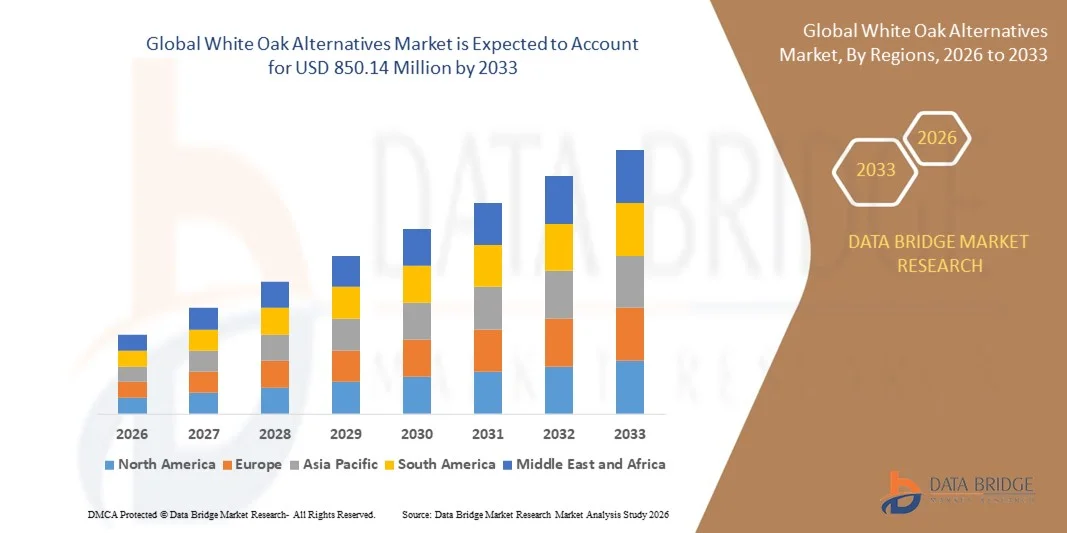
- As per Data Bridge Market Research Analysis the global white oak alternatives market size was valued at USD 363.62 million in 2025 and is expected to reach USD 850.14 million by 2033, at a CAGR of 11.2% during the forecast period
- The market growth is largely fueled by the increasing demand for premium wines, whiskeys, and craft beers, encouraging producers to adopt white oak alternatives such as chips, staves, cubes, spirals, and powder to achieve desired flavor profiles efficiently and cost-effectively
- Furthermore, rising consumer preference for unique, high-quality alcoholic beverages and the need for faster aging processes is driving wineries and distilleries to incorporate oak alternatives into production. These converging factors are accelerating the adoption of white oak products, thereby significantly boosting the industry's growth
Market Size & Forecast
- Global Market Value (2025): USD 363.62 million
- Expected Market Value (2033): USD 850.14 million
- Forecast CAGR (2026–2033): 11.2%
White Oak Alternatives Market Analysis
- White oak alternatives, including chips, staves, cubes, spirals, and powder, are increasingly vital for beverage aging processes, allowing producers to impart oak-derived flavors, aromas, and tannins without relying solely on traditional barrels
- The escalating demand for white oak alternatives is primarily fueled by the growth of craft beverage industries, rising consumer focus on premium and consistent taste profiles, and the need for cost-efficient, flexible aging solutions in both commercial and small-scale production settings
- North America dominated the white oak alternatives market with a share of over 40% in 2025, due to the growing demand for premium wines, whiskeys, and craft beers, as well as increased adoption of cost-effective aging solutions such as oak chips and staves
- Asia-Pacific is expected to be the fastest growing region in the white oak alternatives market during the forecast period due to increasing urbanization, rising disposable incomes, and growing interest in premium alcoholic beverages in countries such as China, Japan, and India
- Oak chips segment dominated the market with a market share of 41.5% in 2025, due to their cost-effectiveness, ease of use, and versatility across different alcoholic beverages. Producers often prefer oak chips for their ability to deliver consistent flavor profiles and accelerated maturation compared to traditional barrels
Report Scope and White Oak Alternatives Market Segmentation
|
Attributes |
White Oak Alternatives Key Market Insights |
|
Segments Covered |
|
|
Countries Covered |
North America
Europe
Asia-Pacific
Middle East and Africa
South America
|
|
Key Market Players |
|
|
Market Opportunities |
|
|
Value Added Data Infosets |
In addition to the insights on market scenarios such as market value, growth rate, segmentation, geographical coverage, and major players, the market reports curated by the Data Bridge Market Research also include import export analysis, production capacity overview, production consumption analysis, price trend analysis, climate change scenario, supply chain analysis, value chain analysis, raw material/consumables overview, vendor selection criteria, PESTLE Analysis, Porter Analysis, and regulatory framework. |
What is the Key Trend in the White Oak Alternatives Market ?
Rising Adoption of Oak Alternatives in Craft and Premium Beverages
- A significant trend in the white oak alternatives market is the growing adoption of oak staves, chips, and spirals in craft spirits, wine, and premium beverage production, driven by the need for controlled maturation and distinctive flavor profiles. This trend is encouraging beverage producers to experiment with alternative oak products to achieve consistent results while managing costs
- For instance, Independent Stave Company provides sustainably sourced oak staves and spirals that are widely used by wineries and distilleries to replicate traditional barrel aging effects. These products allow beverage makers to tailor flavor extraction and aromatic profiles with precision
- The rising preference for smaller batch production in craft distilleries and boutique wineries is increasing the utilization of alternative oak solutions that provide flexibility in aging duration and intensity. Producers are leveraging these alternatives to innovate with limited resources and create signature flavor characteristics
- Premium spirit producers are incorporating white oak alternatives to maintain consistency in taste across seasonal batches and large-scale production runs. This approach ensures product uniformity without relying solely on expensive full-sized barrels
- The wine industry is increasingly adopting oak chips and inserts to enhance aging in stainless steel or neutral vessels, enabling faster maturation and richer flavor profiles. This strategy is shaping the market by offering scalable, cost-efficient aging solutions for wineries of varied sizes
- Sustainability considerations are further driving the use of white oak alternatives as producers seek to minimize waste and reduce reliance on newly harvested barrels. These alternatives support environmentally conscious production while maintaining the sensory qualities expected by consumers
White Oak Alternatives Market Dynamics
Driver
Increasing Demand for Cost-Effective and Controlled Aging Solutions
- The growing need for affordable and consistent aging methods in craft spirits and wine production is driving demand for white oak alternatives that replicate barrel aging effects. These alternatives offer precise flavor control, reduced capital investment, and faster maturation times compared with traditional barrel usage
- For instance, Seguin Moreau supplies toasted oak chips and micro-oxygenation staves that enable distilleries and wineries to achieve targeted flavor profiles efficiently. Their products allow producers to manage aging intensity while reducing storage and investment costs
- Small and medium-sized beverage producers are adopting these alternatives to enhance product consistency, reduce aging times, and optimize warehouse space. This is particularly relevant in markets where traditional barrels are scarce or expensive
- The flexibility of using oak alternatives enables beverage makers to experiment with flavor profiles, adjust tannin levels, and replicate vintage characteristics without altering production timelines. This versatility supports innovation and market differentiation
- The increasing demand for premium-quality beverages at competitive prices is further reinforcing this driver. Producers are strategically leveraging oak alternatives to balance cost, quality, and production efficiency
Restraint/Challenge
High Variability in Flavor Extraction Across Different Oak Products
- The white oak alternatives market faces challenges due to differences in flavor extraction rates, toast levels, and wood composition, which can result in inconsistent taste and aroma across batches. This variability makes standardizing product profiles more difficult, especially for larger-scale operations
- For instance, Independent Stave Company notes that differences in grain tightness and toast profiles can produce variations in flavor intensity even within the same oak source. Producers must carefully monitor usage to achieve desired results
- Achieving uniformity requires precise selection, preparation, and monitoring of oak alternatives, increasing labor and quality control requirements. This complexity can limit scalability for some beverage producers
- The reliance on suppliers for consistent quality and product specifications exposes manufacturers to supply-side risks. Variations in wood sourcing or processing methods may impact sensory outcomes and consumer acceptance
- Market growth continues to be constrained by these flavor variability concerns, as producers must balance the cost and flexibility benefits of oak alternatives with the need to maintain consistent and desirable beverage profiles
White Oak Alternatives Market Scope
The market is segmented on the basis of type and end-user.
- By Type
On the basis of type, the white oak alternatives market is segmented into oak staves, oak chips, oak cubes, oak spiral, and oak powder. The oak chips segment dominated the market with the largest revenue share of 41.5% in 2025, driven by their cost-effectiveness, ease of use, and versatility across different alcoholic beverages. Producers often prefer oak chips for their ability to deliver consistent flavor profiles and accelerated maturation compared to traditional barrels. The market also witnesses strong demand for oak chips due to their compatibility with various aging methods, including stainless steel tanks and smaller vessels, and the wide range of flavor intensities they can impart. Oak chips also allow for precise control over toasting levels, enhancing the sensory characteristics of beverages.
The oak staves segment is anticipated to witness the fastest growth rate of 19.8% from 2026 to 2033, fueled by increasing adoption in premium wine and whiskey production. Oak staves provide more surface contact than chips, allowing for a richer extraction of oak compounds while maintaining a natural maturation process. They are preferred by producers aiming to balance cost efficiency with the depth of flavor traditionally associated with barrels. The flexibility to customize stave sizes and toasting levels further supports their growing popularity in the market.
- By End User
On the basis of end user, the white oak alternatives market is segmented into wine, whiskey, beer, and other alcoholic beverages. The wine segment held the largest market revenue share in 2025, driven by the growing adoption of oak alternatives in both red and white wines to impart oak-derived flavors without relying solely on expensive barrels. Winemakers often choose oak alternatives to maintain flavor consistency and reduce aging time while meeting consumer preferences for smoother, aromatic wines. The market for wine applications also benefits from innovations in infusion techniques that allow controlled extraction of tannins and vanilla, caramel, or smoky notes, enhancing the overall sensory profile.
The whiskey segment is expected to witness the fastest CAGR from 2026 to 2033, driven by the rising demand for premium and craft whiskeys. For instance, companies such as Jim Beam and Buffalo Trace are increasingly using oak cubes and staves to accelerate maturation and develop signature flavor profiles. Oak alternatives in whiskey production offer flexibility, allowing distillers to experiment with different levels of toast and contact times to achieve unique taste experiences. The segment growth is also supported by smaller distilleries adopting cost-effective alternatives to traditional barrels without compromising quality.
White Oak Alternatives Market Regional Analysis
- North America dominated the white oak alternatives market with the largest revenue share of over 40% in 2025, driven by the growing demand for premium wines, whiskeys, and craft beers, as well as increased adoption of cost-effective aging solutions such as oak chips and staves
- Producers in the region highly value the ability of white oak alternatives to impart oak-derived flavors and aromas efficiently, while reducing dependency on traditional barrels and enabling more consistent maturation outcomes
- This widespread adoption is further supported by the presence of established wineries and distilleries, advanced production infrastructure, and a preference for innovation in beverage aging, establishing white oak alternatives as a favored solution across both large-scale and craft beverage producers
U.S. White Oak Alternatives Market Insight
The U.S. white oak alternatives market captured the largest revenue share in 2025 within North America, fueled by the rising popularity of craft spirits and boutique wines. Producers are increasingly adopting oak cubes and chips to achieve premium flavor profiles while optimizing production costs. The growing trend of experimentation in flavor development, combined with robust demand for consistent maturation results, further propels the market. Moreover, the integration of white oak alternatives in small-batch production and custom aging processes is significantly contributing to the market's expansion.
Europe White Oak Alternatives Market Insight
The Europe white oak alternatives market is projected to expand at a substantial CAGR throughout the forecast period, primarily driven by the demand for high-quality wines and spirits, as well as innovative aging solutions. The presence of traditional wine regions, coupled with a growing focus on cost-effective production techniques, is fostering the adoption of oak chips, staves, and cubes. European producers are also drawn to the efficiency and flexibility that white oak alternatives offer, enabling them to meet consumer expectations for consistent taste and aroma. The market is witnessing growth across both commercial wineries and craft distilleries, with alternatives being incorporated into new production lines and renovation projects.
U.K. White Oak Alternatives Market Insight
The U.K. white oak alternatives market is anticipated to grow at a noteworthy CAGR during the forecast period, driven by the rising trend of craft beverages and premium alcohol products. In addition, consumer demand for distinctive flavor profiles and high-quality spirits is encouraging beverage producers to adopt oak-based alternatives. The U.K.’s strong presence of craft breweries, distilleries, and wineries, along with the increasing focus on innovation and experimentation, is expected to continue driving market growth.
Germany White Oak Alternatives Market Insight
The Germany white oak alternatives market is expected to expand at a considerable CAGR during the forecast period, fueled by the country’s well-established wine and spirits industry and the increasing focus on modern production techniques. Germany’s infrastructure and emphasis on technological innovation in beverage production promote the adoption of oak cubes, staves, and chips. Producers are leveraging alternatives to reduce aging time, achieve consistent flavor extraction, and meet rising consumer expectations for premium quality alcoholic beverages.
Asia-Pacific White Oak Alternatives Market Insight
The Asia-Pacific white oak alternatives market is poised to grow at the fastest CAGR during the forecast period of 2026 to 2033, driven by increasing urbanization, rising disposable incomes, and growing interest in premium alcoholic beverages in countries such as China, Japan, and India. The region's beverage producers are adopting oak alternatives to accelerate maturation and introduce nuanced flavors efficiently. Furthermore, the expansion of craft breweries, distilleries, and boutique wineries in APAC is boosting the accessibility and utilization of white oak alternatives across diverse beverage categories.
Japan White Oak Alternatives Market Insight
The Japan white oak alternatives market is gaining momentum due to the country’s appreciation for high-quality beverages and the growing popularity of craft whiskeys and wines. Japanese producers are increasingly using oak staves and cubes to deliver distinct flavor profiles while optimizing aging periods. The integration of white oak alternatives into production aligns with the demand for consistency and premium quality. Moreover, Japan’s aging population and high consumer focus on luxury beverages are expected to spur further adoption in both commercial and small-scale operations.
China White Oak Alternatives Market Insight
The China white oak alternatives market accounted for the largest revenue share in Asia-Pacific in 2025, attributed to the country’s expanding middle class, rising consumption of premium wines and spirits, and increasing interest in craft beverages. Chinese producers are adopting oak chips, cubes, and staves to enhance flavor and reduce reliance on traditional barrels. The push towards innovative beverage production and the presence of domestic manufacturers supplying cost-effective oak alternatives are key factors propelling the market in China.
White Oak Alternatives Market Share
The white oak alternatives industry is primarily led by well-established companies, including:
- White Oak (U.S.)
- The Vintner Vault (U.S.)
- Rich Xiberta USA, Inc (U.S.)
- THE BARREL MILL (U.S.)
- Canadell (France)
- Sascha Rudnik (Germany)
- Seguin Moreau Napa Cooperage (France)
- Oak Solutions Group (U.S.)
- Oak Chips Inc (U.S.)
- AGROVIN (Spain)
Latest Developments in Global White Oak Alternatives Market
- In December 2025, Oak Chips Inc. introduced Boozy Boost Sticks, a micro‑oak stave product designed for single‑bottle aging that allows producers and enthusiasts to replicate barrel-aged flavors efficiently. This launch provides smaller wineries and distilleries with a cost-effective method to produce premium-quality wines and spirits without investing in full barrels, significantly increasing accessibility to oak flavor profiles. The introduction of these sticks also promotes experimentation with flavor intensity and maturation techniques, encouraging innovation and expanding the market for small-batch and artisanal beverage producers
- In 2025, Oak Solutions Group expanded its product line with the Next Generation Series of French and American oak chips, featuring advanced toasting and processing techniques to optimize flavor extraction and structure. This enhancement allows producers to achieve more consistent results while tailoring the aromatic and tannin profile to specific beverage types. By improving control over maturation outcomes, the launch strengthens the adoption of oak alternatives in both commercial-scale and boutique production, reinforcing their value as a flexible and efficient solution for aging
- In 2025, Seguin Moreau broadened its oak alternatives portfolio by upgrading its OenoChips, OenoBlock, and OenoStick product lines to offer precise and targeted flavor extraction. This development supports winemakers and distillers in creating complex and distinctive profiles without relying solely on traditional barrels, reducing both production costs and aging time. The expansion reflects a shift toward customizable oak solutions, which is driving market growth by meeting the increasing demand for high-quality, consistent sensory outcomes in alcoholic beverages
- In November 2024, Oak Solutions Group completed the acquisition of Innerstave, integrating its inventory, technology, and product expertise into its portfolio. This strategic move expanded the company’s global market reach and product offerings, providing a broader array of oak alternatives for beverage producers. The acquisition enables producers to access a wider variety of oak formats, toasting levels, and infusion techniques, supporting innovation in flavor development and accelerating adoption of oak alternatives across different beverage segments

- Interactive Data Analysis Dashboard
- Company Analysis Dashboard for high growth potential opportunities
- Research Analyst Access for customization & queries
- Competitor Analysis with Interactive dashboard
- Latest News, Updates & Trend analysis
- Harness the Power of Benchmark Analysis for Comprehensive Competitor Tracking
Global White Oak Alternatives Market, Supply Chain Analysis and Ecosystem Framework
To support market growth and help clients navigate the impact of geopolitical shifts, DBMR has integrated in-depth supply chain analysis into its Global White Oak Alternatives Market research reports. This addition empowers clients to respond effectively to global changes affecting their industries. The supply chain analysis section includes detailed insights such as Global White Oak Alternatives Market consumption and production by country, price trend analysis, the impact of tariffs and geopolitical developments, and import and export trends by country and HSN code. It also highlights major suppliers with data on production capacity and company profiles, as well as key importers and exporters. In addition to research, DBMR offers specialized supply chain consulting services backed by over a decade of experience, providing solutions like supplier discovery, supplier risk assessment, price trend analysis, impact evaluation of inflation and trade route changes, and comprehensive market trend analysis.
Data collection and base year analysis are done using data collection modules with large sample sizes. The stage includes obtaining market information or related data through various sources and strategies. It includes examining and planning all the data acquired from the past in advance. It likewise envelops the examination of information inconsistencies seen across different information sources. The market data is analysed and estimated using market statistical and coherent models. Also, market share analysis and key trend analysis are the major success factors in the market report. To know more, please request an analyst call or drop down your inquiry.
The key research methodology used by DBMR research team is data triangulation which involves data mining, analysis of the impact of data variables on the market and primary (industry expert) validation. Data models include Vendor Positioning Grid, Market Time Line Analysis, Market Overview and Guide, Company Positioning Grid, Patent Analysis, Pricing Analysis, Company Market Share Analysis, Standards of Measurement, Global versus Regional and Vendor Share Analysis. To know more about the research methodology, drop in an inquiry to speak to our industry experts.
Data Bridge Market Research is a leader in advanced formative research. We take pride in servicing our existing and new customers with data and analysis that match and suits their goal. The report can be customized to include price trend analysis of target brands understanding the market for additional countries (ask for the list of countries), clinical trial results data, literature review, refurbished market and product base analysis. Market analysis of target competitors can be analyzed from technology-based analysis to market portfolio strategies. We can add as many competitors that you require data about in the format and data style you are looking for. Our team of analysts can also provide you data in crude raw excel files pivot tables (Fact book) or can assist you in creating presentations from the data sets available in the report.













