


Wholesale Banking Market Overview
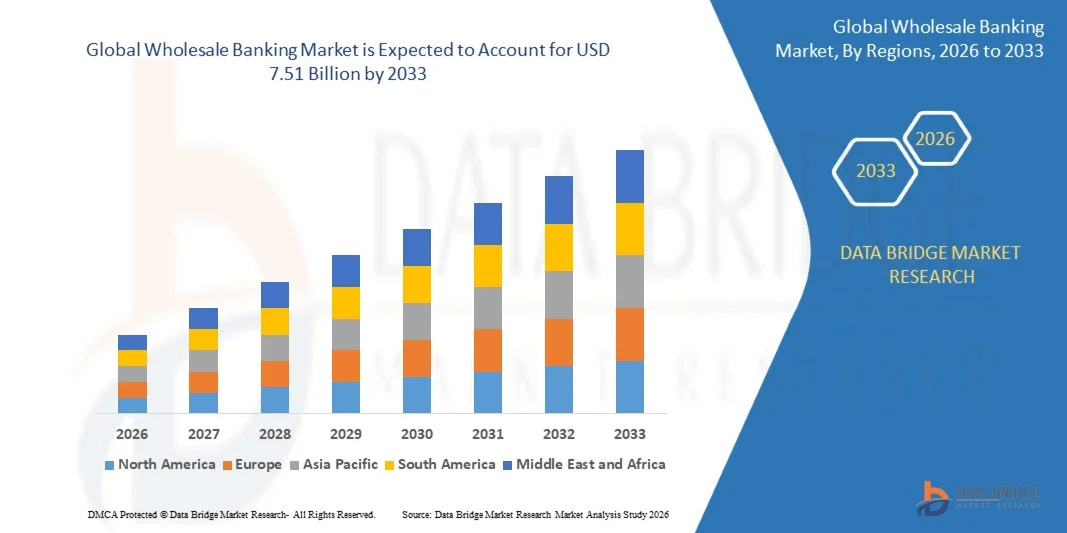
The Wholesale Banking Market was valued at USD 4.97 billion in 2025 and is projected to reach USD 7.51 billion by 2033, growing at a CAGR of 5.30% from 2026 to 2033. The market is witnessing steady expansion driven by rising cross-border trade activities, increasing demand for corporate lending solutions, and the growing need for integrated financial services among large enterprises and institutional clients. Digital transformation in banking operations, including the adoption of AI, blockchain, and cloud-based platforms, is further enhancing efficiency and service delivery across wholesale banking ecosystems.
The increasing globalization of businesses, coupled with expanding infrastructure financing requirements and corporate investment activities, is significantly boosting demand for wholesale banking services. Financial institutions are focusing on advanced risk management systems, real-time payment processing, and data-driven credit assessment tools to better serve corporate clients. In addition, regulatory modernization and the push toward open banking frameworks are encouraging innovation and improving transparency in wholesale banking operations across global markets.
Key Market Trends & Insights
- North America dominated the wholesale banking market with the largest revenue share of 38.6% in 2025, supported by strong presence of leading global financial institutions, advanced digital banking ecosystems, and early adoption of AI enabled corporate banking solutions. The region benefits from mature capital markets, high corporate demand for structured financing, and widespread implementation of real time payment systems. In addition, strong fintech integration and regulatory sophistication continue to reinforce its leadership position.
- Asia-Pacific is expected to be the fastest-growing region, recording a CAGR of 6.9% from 2026 to 2033. Growth is driven by rapid economic expansion, increasing cross border trade, and rising adoption of digital banking and fintech platforms across emerging economies. Countries such as China and India are witnessing strong demand for corporate lending, trade finance, and cash management services. Furthermore, government initiatives promoting financial digitization and infrastructure development are accelerating regional market growth.
- The Financing and Lending segment held the largest market revenue share of approximately 34.6% in 2025 driven by strong demand from corporates for structured credit facilities, syndicated loans, and working capital financing solutions across global markets. Increasing cross border expansion of enterprises and rising infrastructure investments are further strengthening demand for wholesale lending services. Banks are increasingly leveraging digital credit assessment tools and AI based underwriting systems to accelerate loan approvals and reduce default risks. In addition, growing capital expenditure in energy, manufacturing, and infrastructure sectors is sustaining long term demand for large scale corporate financing.
- The Cash Management segment is projected to register steady growth with a market share of approximately 22.1% in 2025, supported by rising adoption of real time payment systems, automated liquidity management, and digital treasury platforms among large enterprises. Banks are increasingly offering integrated cash visibility solutions to optimize corporate financial operations across multiple geographies. The growing need for efficient working capital utilization and improved liquidity forecasting is driving adoption. In addition, API based banking infrastructure is enabling seamless integration with enterprise resource planning systems, improving operational efficiency.
- The Large Enterprises segment held the dominant market revenue share of approximately 71.5% in 2025 driven by high transaction volumes, complex financial structures, and strong demand for customized banking solutions such as syndicated lending and global cash management. Multinational corporations increasingly rely on wholesale banking services for cross border financial operations and capital optimization. Large enterprises also require advanced risk management and hedging solutions to manage exposure across global markets. In addition, their strong credit profiles enable access to large scale structured financing solutions.
- The Small and Medium Enterprises segment is projected to register faster growth with a CAGR of 6.8% from 2026 to 2033, supported by increasing financial inclusion initiatives, digital lending platforms, and simplified access to trade finance solutions. Rising adoption of fintech enabled banking services is improving credit accessibility for SMEs across emerging economies. Governments and financial institutions are introducing SME focused credit guarantee programs to reduce lending risks. Furthermore, cloud based banking platforms are lowering operational barriers for SME onboarding.
- The Corporates segment held the largest market revenue share of approximately 52.3% in 2025 driven by strong demand for working capital financing, treasury services, and cross border payment solutions among large business organizations. Increasing globalization of corporate operations is further accelerating segment dominance. Corporates are also increasingly adopting digital treasury management systems to improve financial efficiency. In addition, demand for structured finance and supply chain financing continues to expand across industries.
- The Financial Institutions segment accounted for approximately 24.6% share in 2025, supported by interbank lending, liquidity management, and risk hedging services across global banking networks. Rising interconnectedness between global banks is increasing demand for wholesale funding solutions. Financial institutions are also adopting advanced risk mitigation tools to manage exposure across volatile markets. Furthermore, increased regulatory requirements are driving demand for stronger liquidity buffers.
Market Size & Forecast
- Global Market Value (2025): USD 4.97 Billion
- Expected Market Value (2033): USD 7.51 Billion
- Forecast CAGR (2026–2033): 5.30%
- Leading Region in 2025: North America
- Fastest Growing Region: Asia-Pacific
Report Scope and Wholesale Banking Market Segmentation
|
Attributes |
Wholesale Banking Key Market Insights |
|
Segments Covered |
· By Services: Financing and Lending, Cash Management, Trade Finance, Treasury Services, and Advisory Services · By Enterprise Size: Large Enterprises and Small and Medium Enterprises · By End Use: Corporates, Financial Institutions, Government/Public Sector, and Others |
|
Countries Covered |
North America · U.S. · Canada · Mexico Europe · Germany · France · U.K. · Netherlands · Switzerland · Belgium · Russia · Italy · Spain · Turkey · Rest of Europe Asia-Pacific · China · Japan · India · South Korea · Singapore · Malaysia · Australia · Thailand · Indonesia · Philippines · Rest of Asia-Pacific Middle East and Africa · Saudi Arabia · U.A.E. · South Africa · Egypt · Israel · Rest of Middle East and Africa South America · Brazil · Argentina · Rest of South America |
|
Key Market Players |
• JPMorgan Chase & Co. (U.S.) |
|
Market Opportunities |
|
|
Value Added Data Infosets |
In addition to the market insights such as market value, growth rate, market segments, geographical coverage, market players, and market scenario, the market report curated by the Data Bridge Market Research team includes in-depth expert analysis, import/export analysis, pricing analysis, production consumption analysis, and pestle analysis. |
Wholesale Banking Market Trends
Trend: Growth In Digital Transformation And API Driven Banking Ecosystems
Increasing demand for faster, more transparent, and highly scalable financial services across corporate and institutional banking segments is accelerating the adoption of digital wholesale banking platforms. Traditional banking systems often rely on fragmented legacy infrastructure, resulting in slower transaction processing and limited real time visibility, which is driving banks toward cloud based and API enabled architectures.
In modern wholesale banking operations, financial institutions are integrating API driven platforms and cloud based core banking systems, For instance for real time payments, cash management, and trade finance automation, to improve transaction speed and enhance client experience while reducing operational costs. In corporate treasury functions, these digital platforms are being used to enable real time liquidity monitoring and automated cash pooling across multiple geographies, improving capital efficiency and financial control.
The rapid expansion of cross border trade and multinational corporate operations is also increasing demand for seamless multi currency settlement systems capable of handling high volume transactions with minimal delay. In addition, fintech partnerships and embedded finance models continue to reshape wholesale banking delivery, such as JPMorgan Chase’s blockchain based Onyx platform used for intraday repo settlements and tokenized collateral transfers, demonstrating improved settlement efficiency and reduced counterparty risk. Growing adoption of real time payment rails in regions such as Europe and Asia Pacific is showing transaction speed improvements of nearly 30 to 50 percent compared to traditional SWIFT based systems under pilot implementations in 2025.
Wholesale Banking Market Dynamics
Key Market Driver: Rising Demand For Corporate Financing And Real Time Payment Infrastructure
Corporations across industries are increasingly requiring large scale financing solutions, structured credit facilities, and efficient cash management systems to support global expansion and operational liquidity needs. Wholesale banks are expanding their digital lending platforms and automated credit underwriting systems to accelerate loan approvals and reduce processing time for corporate clients.
In addition, financial institutions are increasingly deploying real time payment systems and digital treasury management solutions, For instance for cross border settlements, supply chain financing, and working capital optimization, to enhance liquidity management and reduce transaction settlement cycles. Major banking networks such as SWIFT gpi have enabled faster cross border payments, with over 70 percent of transactions reaching end beneficiaries within 30 minutes in participating banks during 2025, improving transparency and tracking capabilities.
Similarly, large corporate clients in manufacturing, energy, and technology sectors are adopting integrated wholesale banking platforms to consolidate financial operations across multiple subsidiaries and regions. Banks in North America and Europe are actively investing in AI driven risk assessment and credit scoring models to improve lending accuracy and reduce default exposure.
Key Restraint/Challenge: Cybersecurity Risks And Legacy System Integration Complexity
Wholesale banking institutions continue to face increasing cybersecurity threats due to rising digital transaction volumes and interconnected financial ecosystems. The adoption of API based systems and cloud infrastructure expands the attack surface, making banks more vulnerable to data breaches, fraud attempts, and system disruptions.
In addition, many established financial institutions still operate on legacy core banking systems that are difficult and costly to modernize, creating integration challenges when implementing new digital platforms. This often leads to operational inefficiencies and increased implementation timelines for digital transformation initiatives.
Industry assessments indicate that financial institutions globally experienced a rise of nearly 40 percent in API related security incidents between 2023 and 2025, highlighting the growing need for stronger encryption, identity management, and real time fraud detection systems.
Key Market Opportunity: Expansion Of AI Driven Corporate Banking And Embedded Finance Solutions
The increasing adoption of artificial intelligence and machine learning in wholesale banking is creating new opportunities for automated credit decisioning, predictive cash flow forecasting, and intelligent risk management systems. Banks are leveraging AI powered analytics to enhance customer segmentation and improve corporate lending efficiency.
In addition, embedded finance models are enabling non banking platforms to integrate wholesale banking services directly into enterprise software ecosystems, For instance for automated invoicing, supply chain financing, and real time payment reconciliation, to improve financial accessibility and operational efficiency for corporate clients.
Furthermore, advancements in blockchain based settlement systems and digital currencies are opening new avenues for faster and more secure cross border transactions. Pilot programs in 2025 across Singapore and the U.K. demonstrated settlement time reductions of up to 60 percent in trade finance transactions using tokenized asset platforms, signaling strong future adoption potential across global wholesale banking networks.
Wholesale Banking Market Scope
The market is segmented on the basis of services, enterprise size, and end use.
- By Services
On the basis of services, the wholesale banking market is segmented into Financing and Lending, Cash Management, Trade Finance, Treasury Services, and Advisory Services. The Financing and Lending segment held the largest market revenue share of approximately 34.6% in 2025 driven by strong demand from corporates for structured credit facilities, syndicated loans, and working capital financing solutions across global markets. Increasing cross border expansion of enterprises and rising infrastructure investments are further strengthening demand for wholesale lending services. Banks are increasingly leveraging digital credit assessment tools and AI based underwriting systems to accelerate loan approvals and reduce default risks. In addition, growing capital expenditure in energy, manufacturing, and infrastructure sectors is sustaining long term demand for large scale corporate financing.
The Cash Management segment is projected to register steady growth with a market share of approximately 22.1% in 2025, supported by rising adoption of real time payment systems, automated liquidity management, and digital treasury platforms among large enterprises. Banks are increasingly offering integrated cash visibility solutions to optimize corporate financial operations across multiple geographies. The growing need for efficient working capital utilization and improved liquidity forecasting is driving adoption. In addition, API based banking infrastructure is enabling seamless integration with enterprise resource planning systems, improving operational efficiency.
- By Enterprise Size
On the basis of enterprise size, the wholesale banking market is segmented into Large Enterprises and Small and Medium Enterprises. The Large Enterprises segment held the dominant market revenue share of approximately 71.5% in 2025 driven by high transaction volumes, complex financial structures, and strong demand for customized banking solutions such as syndicated lending and global cash management. Multinational corporations increasingly rely on wholesale banking services for cross border financial operations and capital optimization. Large enterprises also require advanced risk management and hedging solutions to manage exposure across global markets. In addition, their strong credit profiles enable access to large scale structured financing solutions.
The Small and Medium Enterprises segment is projected to register faster growth with a CAGR of 6.8% from 2026 to 2033, supported by increasing financial inclusion initiatives, digital lending platforms, and simplified access to trade finance solutions. Rising adoption of fintech enabled banking services is improving credit accessibility for SMEs across emerging economies. Governments and financial institutions are introducing SME focused credit guarantee programs to reduce lending risks. Furthermore, cloud based banking platforms are lowering operational barriers for SME onboarding.
- By End Use
On the basis of end use, the wholesale banking market is segmented into Corporates, Financial Institutions, Government/Public Sector, and Others. The Corporates segment held the largest market revenue share of approximately 52.3% in 2025 driven by strong demand for working capital financing, treasury services, and cross border payment solutions among large business organizations. Increasing globalization of corporate operations is further accelerating segment dominance. Corporates are also increasingly adopting digital treasury management systems to improve financial efficiency. In addition, demand for structured finance and supply chain financing continues to expand across industries.
The Financial Institutions segment accounted for approximately 24.6% share in 2025, supported by interbank lending, liquidity management, and risk hedging services across global banking networks. Rising interconnectedness between global banks is increasing demand for wholesale funding solutions. Financial institutions are also adopting advanced risk mitigation tools to manage exposure across volatile markets. Furthermore, increased regulatory requirements are driving demand for stronger liquidity buffers.
Wholesale Banking Market Regional Analysis
North America Wholesale Banking Market Insight
North America dominated the wholesale banking market with the largest revenue share of 38.6% in 2025, supported by strong presence of global financial institutions, advanced digital banking infrastructure, and high adoption of AI driven corporate banking solutions. Enterprises in the region increasingly rely on wholesale banks for complex financing needs, including syndicated loans, cross border settlements, and treasury optimization services. The region benefits from mature capital markets, strong regulatory frameworks, and widespread adoption of real time payment systems. In addition, high corporate digitalization and demand for integrated financial ecosystems continue to strengthen market dominance.
U.S. Wholesale Banking Market Insight
The U.S. wholesale banking market captured the largest revenue share within North America in 2025, driven by the presence of leading global banks, high volume corporate financing activities, and rapid adoption of digital treasury platforms. Corporations are increasingly utilizing AI powered credit underwriting, automated cash management, and blockchain based settlement systems. Growing demand for mergers and acquisitions advisory and structured finance solutions is further supporting market expansion. In addition, strong fintech collaboration and embedded finance models are accelerating innovation in wholesale banking services across the country.
Europe Wholesale Banking Market Insight
The Europe wholesale banking market is expected to witness steady growth from 2026 to 2033, primarily driven by strong cross border trade activities, regulatory harmonization across the EU, and increasing demand for sustainable finance solutions. Financial institutions are focusing on green financing, digital payment modernization, and centralized liquidity management systems. The region is also experiencing rising adoption of API based banking infrastructure to improve interoperability. Moreover, increasing corporate restructuring and investment in infrastructure development are further supporting market growth across Europe.
U.K. Wholesale Banking Market Insight
The U.K. wholesale banking market is expected to witness strong growth from 2026 to 2033, driven by its position as a global financial hub and increasing adoption of digital banking platforms. Corporates in the region are increasingly adopting real time payment systems, advanced treasury services, and AI enabled risk management solutions. Demand for trade finance and investment banking services is also rising due to expanding international trade relationships. Furthermore, the U.K.’s strong fintech ecosystem is enhancing innovation in wholesale banking delivery models.
Germany Wholesale Banking Market Insight
The Germany wholesale banking market is expected to witness steady growth from 2026 to 2033, supported by strong industrial base, export oriented economy, and increasing demand for structured corporate financing solutions. German enterprises are increasingly adopting digital treasury management systems and sustainable finance instruments. The country’s focus on industrial modernization and energy transition is driving demand for large scale infrastructure financing. In addition, integration of advanced analytics in banking operations is improving credit risk assessment and operational efficiency.
Asia-Pacific Wholesale Banking Market Insight
The Asia-Pacific wholesale banking market is expected to witness the fastest growth from 2026 to 2033, supported by rapid economic expansion, increasing cross border trade, and rising adoption of digital banking solutions. Countries such as China, India, and Japan are experiencing strong demand for corporate lending, trade finance, and cash management services. Governments across the region are promoting financial digitalization and fintech adoption. Moreover, increasing foreign direct investment and infrastructure development projects are further accelerating market growth.
Japan Wholesale Banking Market Insight
The Japan wholesale banking market is expected to witness steady growth from 2026 to 2033 due to its advanced financial infrastructure, strong corporate sector, and high adoption of digital banking technologies. Japanese corporations are increasingly using automated treasury systems and AI driven risk management tools to improve efficiency. The demand for trade finance and export related banking services remains strong due to Japan’s manufacturing driven economy. In addition, integration of banking systems with enterprise platforms is enhancing operational efficiency and financial transparency.
China Wholesale Banking Market Insight
The China wholesale banking market accounted for the largest market revenue share in Asia-Pacific in 2025, attributed to rapid industrial expansion, strong export oriented economy, and large scale infrastructure investments. Chinese enterprises are increasingly adopting digital banking platforms for cash management, trade financing, and corporate lending. Government support for financial modernization and digital currency initiatives is further driving adoption. In addition, strong domestic banking institutions and fintech collaborations are enhancing service efficiency and expanding market reach.
Wholesale Banking Market Share
The Wholesale Banking industry is primarily led by well-established companies, including:
- JPMorgan Chase & Co. (U.S.)
• Bank of America (U.S.)
• Citigroup Inc. (U.S.)
• Goldman Sachs (U.S.)
• Morgan Stanley (U.S.)
• HSBC Holdings plc (U.K.)
• BNP Paribas (France)
• Barclays (U.K.)
• Deutsche Bank (Germany)
• Mitsubishi UFJ Financial Group (Japan)
Latest Developments in Wholesale Banking Market
- In April 2026, Sumitomo Mitsui Banking Corporation announced the creation of India as a separate global division along with receiving initial approval to establish a wholly owned subsidiary. This strategic expansion includes a planned investment of approximately USD 7 billion aimed at strengthening its wholesale banking footprint in the country. The initiative is designed to enhance corporate lending, trade finance, and cross border banking capabilities while leveraging local partnerships to expand retail banking reach. It reflects the bank’s confidence in India’s long term economic growth and regulatory modernization. The development is expected to intensify competition in the wholesale banking space and improve financial service penetration in emerging markets.
- In November 2025, Intellect Design Arena Ltd. entered into a strategic collaboration with Bank Albilad to support the bank’s digital transformation in wholesale banking operations. The partnership utilizes Intellect’s eMACH.ai platform to deliver advanced cash management and corporate banking solutions tailored to enterprise clients in Saudi Arabia. This development focuses on improving operational efficiency, automation, and real time financial visibility for corporate customers. It aligns with Saudi Arabia’s Vision 2030 objectives of driving digital innovation and economic diversification. The initiative is expected to enhance customer experience and strengthen digital banking adoption in the regional wholesale banking ecosystem.

- Interactive Data Analysis Dashboard
- Company Analysis Dashboard for high growth potential opportunities
- Research Analyst Access for customization & queries
- Competitor Analysis with Interactive dashboard
- Latest News, Updates & Trend analysis
- Harness the Power of Benchmark Analysis for Comprehensive Competitor Tracking
Data collection and base year analysis are done using data collection modules with large sample sizes. The stage includes obtaining market information or related data through various sources and strategies. It includes examining and planning all the data acquired from the past in advance. It likewise envelops the examination of information inconsistencies seen across different information sources. The market data is analysed and estimated using market statistical and coherent models. Also, market share analysis and key trend analysis are the major success factors in the market report. To know more, please request an analyst call or drop down your inquiry.
The key research methodology used by DBMR research team is data triangulation which involves data mining, analysis of the impact of data variables on the market and primary (industry expert) validation. Data models include Vendor Positioning Grid, Market Time Line Analysis, Market Overview and Guide, Company Positioning Grid, Patent Analysis, Pricing Analysis, Company Market Share Analysis, Standards of Measurement, Global versus Regional and Vendor Share Analysis. To know more about the research methodology, drop in an inquiry to speak to our industry experts.
Data Bridge Market Research is a leader in advanced formative research. We take pride in servicing our existing and new customers with data and analysis that match and suits their goal. The report can be customized to include price trend analysis of target brands understanding the market for additional countries (ask for the list of countries), clinical trial results data, literature review, refurbished market and product base analysis. Market analysis of target competitors can be analyzed from technology-based analysis to market portfolio strategies. We can add as many competitors that you require data about in the format and data style you are looking for. Our team of analysts can also provide you data in crude raw excel files pivot tables (Fact book) or can assist you in creating presentations from the data sets available in the report.













