


What is the Wilms Tumor Size and Growth Rate?
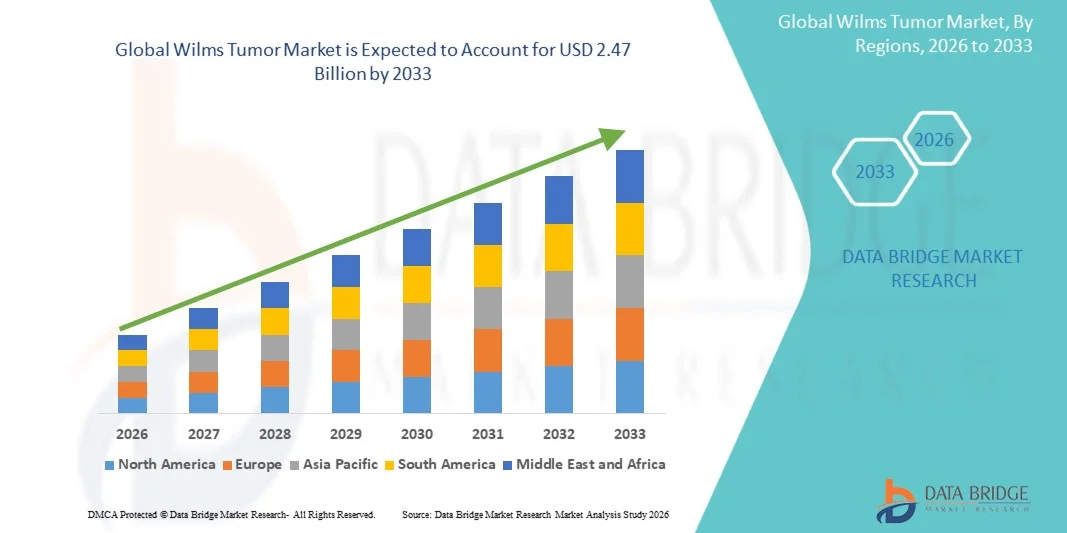
- As per Data Bridge Market Research Analysis the Wilms tumor market size was valued at USD 1.77 billion in 2025 and is expected to reach USD 2.47 billion by 2033, at a CAGR of 4.30% during the forecast period
- The market growth is primarily driven by increasing incidence of pediatric kidney cancers, rising awareness regarding early diagnosis, and continuous advancements in pediatric oncology treatments, including targeted therapies and combination treatment protocols
- In addition, growing investments in rare pediatric cancer research, improved access to specialized healthcare facilities, and supportive government and non-profit initiatives are positioning Wilms tumor therapeutics and diagnostics as a critical segment within the pediatric oncology landscape, thereby contributing to steady market expansion
Market Size & Forecast
- Global Market Value (2025): USD 1.77 billion
- Expected Market Value (2033): USD 2.47 billion
- Forecast CAGR (2026–2033): 4.30%
What are the Major Takeaways of Wilms Tumor?
- Wilms tumor, a rare pediatric kidney cancer primarily affecting children under the age of five, represents a critical segment within the pediatric oncology market due to its requirement for early diagnosis, multimodal treatment approaches, and long-term follow-up care
- The rising demand for Wilms tumor diagnostics and therapeutics is mainly driven by increasing awareness of childhood cancers, improvements in diagnostic imaging and genetic testing, and advancements in treatment protocols combining surgery, chemotherapy, and radiotherapy
- North America dominated the Wilms tumor market with the largest revenue share of 41.6% in 2025, supported by advanced pediatric oncology infrastructure, strong clinical research activity, high healthcare expenditure, and the presence of leading cancer treatment centers in the U.S. and Canada focusing on standardized treatment regimens and clinical trials
- Asia-Pacific is expected to be the fastest-growing region in the Wilms tumor market during the forecast period due to improving healthcare infrastructure, rising pediatric cancer awareness, expanding access to specialized oncology services, and increasing government and non-profit initiatives supporting childhood cancer treatment
- Chemotherapy segment dominated the Wilms tumor treatment market with a market share of 48.3% in 2025, driven by its central role in standard treatment protocols, high efficacy when combined with surgery, and continuous development of optimized drug combinations aimed at improving survival rates while reducing long-term side effects
Report Scope and Wilms Tumor Market Segmentation
|
Attributes |
Wilms Tumor Key Market Insights |
|
Segments Covered |
|
|
Countries Covered |
North America
Europe
Asia-Pacific
Middle East and Africa
South America
|
|
Key Market Players |
|
|
Market Opportunities |
|
|
Value Added Data Infosets |
|
What is the Key Trend in the Wilms Tumor?
“Advancement of Risk-Adapted and Precision Treatment Approaches”
- A significant and accelerating trend in the Wilms tumor market is the increasing adoption of risk-adapted and precision-based treatment strategies that tailor therapy intensity according to tumor stage, histology, and genetic markers, thereby improving survival outcomes while minimizing long-term toxicity
- For instance, cooperative oncology groups such as the Children’s Oncology Group (COG) and SIOP have incorporated molecular and histopathological risk stratification into treatment protocols, enabling clinicians to de-escalate therapy for low-risk patients and intensify treatment for high-risk cases
- Advances in molecular diagnostics and genomic profiling are enabling more accurate classification of Wilms tumor subtypes, supporting targeted treatment decisions and improving prognostic accuracy. For instance, identification of WT1 mutations and loss of heterozygosity at chromosomes 1p and 16q is increasingly influencing therapeutic planning
- The integration of advanced imaging techniques, pathology review, and standardized treatment guidelines across specialized pediatric oncology centers is facilitating more coordinated and effective disease management on a global scale
- This trend toward personalized, evidence-based treatment pathways is reshaping clinical practice in pediatric oncology. Consequently, organizations such as the International Society of Paediatric Oncology (SIOP) continue to refine global protocols focused on balancing cure rates with long-term quality of life
- The growing emphasis on precision and risk-adapted care is strengthening demand for advanced diagnostics, specialized oncology services, and collaborative clinical research in both developed and emerging healthcare markets
- Expanding international data-sharing initiatives and tumor registries are enhancing clinical decision-making and supporting continuous refinement of Wilms tumor treatment standards
Wilms Tumor Market Dynamics
Driver
“Improved Survival Rates Driven by Early Diagnosis and Multimodal Therapy”
- The increasing focus on early diagnosis and the widespread use of multimodal treatment approaches combining surgery, chemotherapy, and radiotherapy are key drivers supporting growth in the Wilms tumor market
- For instance, standardized treatment protocols implemented across pediatric oncology centers have significantly improved five-year survival rates, particularly in high-income countries with access to advanced diagnostics and specialized care
- Rising awareness among healthcare professionals and parents regarding early symptoms of pediatric kidney cancers is leading to earlier detection and timely intervention, which directly improves treatment outcomes
- Furthermore, continuous advancements in pediatric chemotherapy regimens and surgical techniques are reducing treatment-related complications while maintaining high cure rates
- The expanding adoption of structured follow-up programs and survivorship care is further reinforcing the demand for comprehensive Wilms tumor management solutions across healthcare systems
- Growing government and non-profit funding for childhood cancer programs is improving access to diagnostics, treatment, and supportive care services
- Increasing collaboration between academic institutions and healthcare providers is accelerating clinical research and adoption of best-practice treatment models
Restraint/Challenge
“Limited Access to Specialized Care and Treatment-Related Toxicity Concerns”
- Limited access to specialized pediatric oncology centers and advanced diagnostic facilities remains a significant challenge to the Wilms tumor market, particularly in low- and middle-income countries
- For instance, delays in diagnosis and restricted availability of standardized treatment protocols in resource-constrained regions often lead to poorer outcomes and higher mortality rates
- Concerns related to long-term treatment-associated toxicities, including cardiotoxicity, nephrotoxicity, and secondary malignancies, pose additional challenges for therapy optimization and patient quality of life
- Addressing these issues requires continued investment in healthcare infrastructure, expansion of pediatric oncology training programs, and improved access to essential cancer medicines and diagnostic tools
- Overcoming disparities in care delivery through international collaborations, guideline harmonization, and capacity-building initiatives will be critical for sustained market growth and improved global outcomes
- High treatment costs and prolonged therapy duration can create financial and emotional burdens for families, limiting adherence in some regions
- Variability in regulatory approval timelines and reimbursement policies for pediatric oncology therapies can delay access to advanced treatments in certain markets
How is the Wilms Tumor Segmented?
The market is segmented on the basis of type, stage, diagnosis, treatment, end-user, and distribution channel.
- By Type
On the basis of type, the Wilms tumor market is segmented into favourable histology and anaplastic histology. The favourable histology segment dominated the market with the largest revenue share in 2025, primarily due to its high prevalence, accounting for the majority of Wilms tumor cases globally. Patients with favourable histology generally respond well to standard treatment protocols, resulting in high cure rates and predictable clinical outcomes. The availability of well-established chemotherapy regimens and surgical approaches further strengthens this segment’s dominance. Early diagnosis and lower relapse rates also reduce treatment complexity and costs. Strong clinical guidelines and long-term survival data support continued reliance on favourable histology–based treatment pathways.
The anaplastic histology segment is expected to be the fastest-growing during the forecast period due to its aggressive nature and poorer prognosis. These tumors often require intensified chemotherapy, radiation therapy, and closer monitoring, increasing overall treatment demand. Rising research focus on high-risk pediatric cancers is improving diagnostic accuracy for anaplastic cases. Advances in molecular profiling are helping identify anaplastic disease earlier and more precisely. Increasing enrollment of high-risk patients in clinical trials is further driving segment growth.
- By Stage
On the basis of stage, the market is segmented into Stage I, Stage II, Stage III, Stage IV, and Stage V. Stage I dominated the market in 2025 due to higher detection rates at early stages, particularly in developed healthcare systems. Early-stage tumors are typically localized and highly treatable with surgery followed by limited chemotherapy. High survival rates and shorter treatment durations contribute to lower overall disease burden in this segment. Improved imaging access and routine pediatric examinations support early identification. Standardized treatment protocols further reinforce the dominance of Stage I disease management.
Stage III is anticipated to be the fastest-growing segment over the forecast period owing to increasing diagnosis of locally advanced tumors. These cases often require multimodal therapy, including surgery, chemotherapy, and radiation therapy. Growing access to advanced imaging is improving staging accuracy, leading to more Stage III classifications. Higher treatment intensity and longer care duration increase healthcare utilization. Rising referrals to specialized oncology centers also contribute to faster growth of this segment.
- By Diagnosis
On the basis of diagnosis, the market is segmented into physical examination, imaging tests, and lab tests. Imaging tests dominated the market in 2025 due to their essential role in confirming diagnosis, determining tumor size, and staging disease progression. Ultrasound is commonly used as the first-line diagnostic tool, followed by CT and MRI for detailed assessment. Imaging guides surgical planning and treatment decisions across all disease stages. Continuous improvements in imaging technology enhance diagnostic accuracy. Widespread availability of imaging equipment in hospitals further supports dominance of this segment.
Lab tests are expected to be the fastest-growing diagnostic segment during the forecast period due to increasing use of molecular and genetic testing. Advances in cytogenetic analysis and biomarker identification are improving risk stratification. Lab tests support personalized treatment planning and prognosis prediction. Growing adoption of precision medicine in pediatric oncology is driving demand. Increased research funding is also expanding laboratory diagnostic capabilities. Research-driven biomarker identification is expanding clinical utility. Increased funding for pediatric oncology research further drives laboratory testing growth.
- By Treatment
On the basis of treatment, the market is segmented into surgery, chemotherapy, and radiation therapy. Chemotherapy dominated the market in 2025 with a market share of 48.3% as it is a fundamental component of Wilms tumor treatment across nearly all stages. Standard multi-agent chemotherapy regimens are widely accepted and clinically validated. Chemotherapy is used both preoperatively and postoperatively to reduce recurrence risk. High efficacy and standardized dosing protocols support widespread adoption. Continuous optimization of drug combinations sustains long-term demand.
Surgery is expected to be the fastest-growing treatment segment during the forecast period due to advancements in pediatric surgical techniques. Increasing use of nephron-sparing surgery aims to preserve long-term kidney function. Minimally invasive approaches are reducing recovery times and complications. Improved imaging supports precise surgical planning. Growing expertise in pediatric oncology surgery is accelerating adoption. Growing expertise in pediatric oncology surgery supports procedural success. Rising preference for organ-preserving approaches is accelerating segment growth.
- By End-User
On the basis of end-user, the market is segmented into hospitals, cancer research institutes, diagnostic laboratories, and others. Hospitals dominated the market in 2025 as they serve as primary centers for diagnosis, treatment, and follow-up care. Most Wilms tumor therapies, including surgery and chemotherapy, are administered in hospital settings. Availability of multidisciplinary pediatric oncology teams strengthens hospital-based care. Access to imaging, pharmacy, and intensive care facilities supports dominance. Hospitals also manage long-term survivorship monitoring.
Cancer research institutes are projected to be the fastest-growing end-user segment during the forecast period due to rising clinical trial activity. Increasing focus on high-risk and recurrent Wilms tumor cases drives research involvement. Global collaborations are expanding research capacity. Institutes play a key role in developing new protocols. Growing funding for pediatric oncology research supports faster growth. Research institutes contribute to protocol innovation. Their role in precision oncology is driving accelerated growth.
- By Distribution Channel
On the basis of distribution channel, the market is segmented into hospital pharmacy, retail pharmacy, and others. Hospital pharmacy dominated the market in 2025 due to the controlled administration of chemotherapy and supportive drugs. Most treatments are delivered during inpatient or supervised outpatient care. Strict handling requirements favor hospital-based dispensing. Integration with oncology care teams supports safe drug management. High patient dependence on hospital services reinforces dominance.
Retail pharmacy is expected to be the fastest-growing segment during the forecast period as outpatient care expands. Supportive medications and follow-up therapies are increasingly dispensed through retail channels. Improved access to pediatric formulations supports this shift. Growth of ambulatory care services drives demand. Expanding healthcare coverage further accelerates retail pharmacy adoption. Broader healthcare coverage is increasing retail utilization. Convenience and accessibility are accelerating retail pharmacy growth.
Which Region Holds the Largest Share of the Wilms Tumor?
- North America dominated the Wilms tumor market with the largest revenue share of 41.6% in 2025, supported by advanced pediatric oncology infrastructure, strong clinical research activity, high healthcare expenditure, and the presence of leading cancer treatment centers in the U.S. and Canada focusing on standardized treatment regimens and clinical trials
- Healthcare providers in the region emphasize early diagnosis, standardized treatment protocols, and multidisciplinary care approaches, contributing to high survival rates and consistent treatment outcomes for Wilms tumor patients
- This strong market position is further supported by robust clinical research activity, active participation in cooperative oncology trials, favorable reimbursement frameworks, and high awareness of childhood cancers, establishing North America as a leading region for Wilms tumor diagnosis and treatment
U.S. Wilms Tumor Market Insight
The U.S. Wilms tumor market captured the largest revenue share within North America in 2025, driven by advanced pediatric oncology infrastructure and widespread access to specialized cancer care centers. Early diagnosis, standardized treatment protocols, and high awareness of childhood cancers contribute to strong clinical outcomes. The presence of leading research institutions and cooperative oncology groups supports continuous protocol refinement. High healthcare spending and favorable reimbursement further sustain market growth. In addition, strong participation in clinical trials accelerates adoption of advanced treatment approaches.
Europe Wilms Tumor Market Insight
The Europe Wilms tumor market is projected to expand at a steady CAGR throughout the forecast period, primarily driven by well-established public healthcare systems and strong emphasis on pediatric cancer care. Increasing awareness of early diagnosis and standardized treatment guidelines supports consistent disease management. Growth is further aided by collaborative research networks across European countries. Rising investments in pediatric oncology infrastructure are improving access to care. Adoption of risk-adapted treatment protocols is strengthening clinical outcomes across the region.
U.K. Wilms Tumor Market Insight
The U.K. Wilms tumor market is anticipated to grow at a noteworthy CAGR during the forecast period, supported by a robust national healthcare system and strong pediatric oncology referral networks. Early screening practices and centralized treatment centers contribute to improved survival rates. National participation in international clinical trials supports protocol optimization. Increasing awareness among healthcare professionals enhances early-stage detection. Government support for childhood cancer initiatives further stimulates market growth.
Germany Wilms Tumor Market Insight
The Germany Wilms tumor market is expected to expand at a considerable CAGR during the forecast period, fueled by advanced diagnostic capabilities and strong emphasis on evidence-based oncology care. Germany’s well-developed healthcare infrastructure supports timely diagnosis and multimodal treatment. High investment in medical research strengthens innovation in pediatric oncology. Structured follow-up and survivorship programs improve long-term outcomes. The country’s focus on quality care and clinical precision supports sustained market expansion.
Asia-Pacific Wilms Tumor Market Insight
The Asia-Pacific Wilms tumor market is expected to grow at the fastest CAGR during the forecast period of 2026 to 2033, driven by improving healthcare infrastructure and rising awareness of pediatric cancers. Increasing access to diagnostic imaging and oncology services is enhancing early detection rates. Government and non-profit initiatives are expanding childhood cancer care programs. Rapid urbanization and healthcare investments in countries such as China and India are supporting growth. Expanding clinical collaborations are improving treatment standardization across the region.
Japan Wilms Tumor Market Insight
The Japan Wilms tumor market is gaining momentum due to its advanced healthcare system and strong focus on early disease detection. High availability of diagnostic imaging supports accurate staging and treatment planning. Specialized pediatric oncology centers deliver standardized care with favorable outcomes. Increasing research activity contributes to protocol optimization. Japan’s emphasis on precision medicine and long-term survivorship care supports steady market growth.
India Wilms Tumor Market Insight
The India Wilms tumor market accounted for a significant revenue share in Asia Pacific in 2025, supported by expanding pediatric oncology services and growing awareness of childhood cancers. Increasing access to diagnostic facilities is improving early-stage detection. Government-led healthcare initiatives are strengthening cancer treatment infrastructure. Rising collaborations with international oncology groups support treatment standardization. Growing investments in tertiary care hospitals are further propelling market expansion.
Which are the Top Companies in Wilms Tumor?
The Wilms Tumor industry is primarily led by well-established companies, including:
- Pfizer Inc. (U.S.)
- Thermo Fisher Scientific Inc. (U.S.)
- Bristol-Myers Squibb Company (U.S.)
- Novartis AG (Switzerland)
- F. Hoffmann-La Roche Ltd. (Switzerland)
- GSK plc (U.K.)
- Sanofi (France)
- AbbVie Inc. (U.S.)
- Amgen Inc. (U.S.)
- Takeda Pharmaceutical Company Limited (Japan)
- AstraZeneca (U.K.)
- Eli Lilly and Company (U.S.)
- Bayer AG (Germany)
- Abbott (U.S.)
- Abcam plc (U.K.)
- Agilent Technologies Inc. (U.S.)
- Illumina Inc. (U.S.)
- QIAGEN (Netherlands)
- PerkinElmer (U.S.)
- BioLegend, Inc. (U.S.)
What are the Recent Developments in Wilms tumor market?
- In May 2025, researchers from the Wellcome Trust Sanger Institute, University of Cambridge, Princess Máxima Center for Pediatric Oncology, and other global partners published a high-resolution genomic analysis showing that Wilms tumors contain millions of previously undetected genetic changes, redefining how pediatric kidney cancer is viewed and potentially guiding future targeted therapies
- In May 2025, researchers from the University of Würzburg, the Wellcome Sanger Institute, and global collaborators published new findings revealing how both genetic and epigenetic predispositions contribute to the development of Wilms tumors, paving the way for improved genetic screening and early detection strategies
- In January 2025, a collaborative study published through the Wellcome Trust Sanger Institute and partners found that inherited genetic changes in about 30% of children with Wilms tumor influence tumor development pathways, highlighting the importance of personalized screening and therapy strategies
- In March 2024, St. Jude Children’s Research Hospital published a landmark study showing that chemotherapy-resistant bilateral Wilms tumors may actually have favorable outcomes if treated with kidney-sparing surgery, challenging previous treatment assumptions and potentially changing clinical practice for pediatric kidney cancer management
- In January 2024, the Mayo Clinic published insights into advanced multidisciplinary care models for children with Wilms tumor, including integration of proton beam therapy to reduce long-term side effects, demonstrating adoption of next-generation treatment approaches in pediatric oncology centers

- Interactive Data Analysis Dashboard
- Company Analysis Dashboard for high growth potential opportunities
- Research Analyst Access for customization & queries
- Competitor Analysis with Interactive dashboard
- Latest News, Updates & Trend analysis
- Harness the Power of Benchmark Analysis for Comprehensive Competitor Tracking
Data collection and base year analysis are done using data collection modules with large sample sizes. The stage includes obtaining market information or related data through various sources and strategies. It includes examining and planning all the data acquired from the past in advance. It likewise envelops the examination of information inconsistencies seen across different information sources. The market data is analysed and estimated using market statistical and coherent models. Also, market share analysis and key trend analysis are the major success factors in the market report. To know more, please request an analyst call or drop down your inquiry.
The key research methodology used by DBMR research team is data triangulation which involves data mining, analysis of the impact of data variables on the market and primary (industry expert) validation. Data models include Vendor Positioning Grid, Market Time Line Analysis, Market Overview and Guide, Company Positioning Grid, Patent Analysis, Pricing Analysis, Company Market Share Analysis, Standards of Measurement, Global versus Regional and Vendor Share Analysis. To know more about the research methodology, drop in an inquiry to speak to our industry experts.
Data Bridge Market Research is a leader in advanced formative research. We take pride in servicing our existing and new customers with data and analysis that match and suits their goal. The report can be customized to include price trend analysis of target brands understanding the market for additional countries (ask for the list of countries), clinical trial results data, literature review, refurbished market and product base analysis. Market analysis of target competitors can be analyzed from technology-based analysis to market portfolio strategies. We can add as many competitors that you require data about in the format and data style you are looking for. Our team of analysts can also provide you data in crude raw excel files pivot tables (Fact book) or can assist you in creating presentations from the data sets available in the report.













