


What ia the Wind Turbine Casting Market Size and Growth Rate?
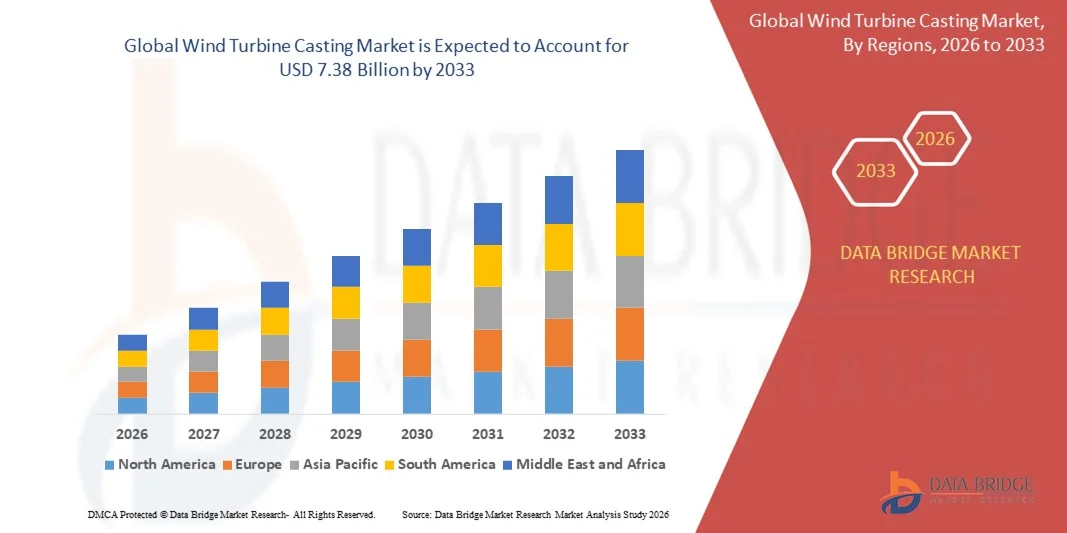
- As per Data Bridge Market Research Analysis the global wind turbine casting market size was valued at USD 3.34 billion in 2025 and is expected to reach USD 7.38 billion by 2033, at a CAGR of 10.40% during the forecast period
- The market growth is largely fuelled by the rising deployment of large-capacity wind turbines, driven by global investments in onshore and offshore wind energy projects
- Growing demand for cast components such as hubs, bases, main frames and gearboxes to support turbine scalability
Market Size and Forecast:
- Global Market Value (2025): USD 3.34 billion
- Expected Market Value (2033): USD 7.38 billion
- Forecast CAGR (2026–2033): 10.40%
How Wind Turbine Casting Market Analysed?
- The market is experiencing strong expansion due to the rapid growth of wind energy installations associated with government-led renewable energy targets and decarbonization goals
- Advancements in casting technologies such as vacuum casting, precision molding and automated foundry systems are improving production efficiency and lowering defect rates, contributing to higher-quality turbine components
- North America dominated the wind turbine casting market with the largest revenue share in 2025, driven by the strong expansion of wind energy projects and the high demand for large-scale cast components used in utility-grade turbines. The region’s advanced manufacturing capabilities and robust supply chain infrastructure further support widespread deployment of precision-engineered castings
- Asia-Pacific region is expected to witness the highest growth rate in the global wind turbine casting market, driven by increasing renewable energy deployment, expanding wind farm installations, and large-scale investments in clean energy initiatives
- The horizontal axis segment held the largest market revenue share in 2025 driven by its widespread adoption in large-scale wind projects and the extensive use of cast components such as hubs, bases, and main frames across major turbine models. Its proven efficiency, greater power output, and compatibility with advanced casting technologies continue to strengthen its dominance in global installations
Report Scope and Wind Turbine Casting Market Segmentation
|
Attributes |
Wind Turbine Casting Key Market Insights |
|
Segments Covered |
|
|
Countries Covered |
North America
Europe
Asia-Pacific
Middle East and Africa
South America
|
|
Key Market Players |
|
|
Market Opportunities |
|
|
Value Added Data Infosets |
In addition to the insights on market scenarios such as market value, growth rate, segmentation, geographical coverage, and major players, the market reports curated by the Data Bridge Market Research also include import export analysis, production capacity overview, production consumption analysis, price trend analysis, climate change scenario, supply chain analysis, value chain analysis, raw material/consumables overview, vendor selection criteria, PESTLE Analysis, Porter Analysis, and regulatory framework. |
What are the Wind Turbine Casting Market Trends?
Rise of Large-Capacity Turbines and Advanced Casting Technologies
- The rapid shift toward large-capacity onshore and offshore wind turbines is reshaping casting requirements, encouraging the production of heavier, more durable components such as hubs, bases, and main frames. These castings must withstand extreme loads, prompting manufacturers to adopt improved metallurgical processes and enhanced quality control measures to meet performance expectations. The trend is also increasing collaboration between turbine OEMs and foundries to optimize component design for next-generation turbines
- The expansion of offshore wind farms is accelerating the demand for corrosion-resistant cast components designed to operate in harsh marine environments. Foundries are investing in specialized alloys and precision molding techniques to increase structural integrity and prolong turbine lifespan. This is particularly important as offshore turbines continue to grow in size, requiring castings that can support complex load dynamics
- Automation and digitalization in casting facilities are improving production speed and defect detection rates. Advanced simulation tools, such as solidification modeling and thermal flow analysis, are helping manufacturers reduce rework and improve yield efficiency, ultimately lowering operational costs. These technologies are also enabling predictive maintenance and better workflow optimization within casting plants
- For instance, in 2024, several European casting manufacturers integrated real-time process monitoring systems into their foundry operations, resulting in reduced scrap rates and higher compliance with turbine OEM specifications. This supported faster project timelines and improved supply chain stability. Such system integrations are paving the way for more standardized and scalable casting processes across the industry
- While improved POC-style casting technologies are enhancing component reliability, sustained innovation, workforce upskilling, and cost optimization will remain crucial for ensuring that advanced turbine castings can meet global renewable energy targets. Investments in R&D, training programs, and automation will play an essential role in addressing rising turbine size and performance demands
Wind Turbine Casting Market Dynamics
Driver
Expansion of Global Wind Energy Installations and Growing Demand for High-Strength Components
- The global surge in wind energy installations is driving strong demand for critical cast components used in turbine assembly. Countries with aggressive renewable energy targets are prioritizing turbine deployments, boosting the need for high-precision castings capable of supporting larger rotor diameters and higher power ratings. This growth is encouraging manufacturers to scale capacity to keep pace with rising project pipelines
- Manufacturers are increasingly aware of the operational efficiencies linked to high-quality cast components, such as reduced maintenance requirements and extended turbine life. This has led to a focus on advanced material formulations and enhanced production techniques among casting suppliers. Improved casting reliability directly supports lower downtime and higher power generation efficiency for wind operators
- Supportive government policies, renewable energy incentives, and rising energy security concerns are further stimulating investment in wind farms. These developments are expanding the supplier ecosystem and encouraging the setup of local casting facilities to meet regional demand. This localization trend is reducing dependence on imports and strengthening domestic manufacturing competitiveness
- For instance, in 2023, the U.S. introduced updated domestic manufacturing incentives for wind energy components, leading to increased investment in large-scale casting plants across the Midwest region. These initiatives aim to boost national supply-chain resilience and enable faster delivery of essential turbine components. The policy shift also reflects the growing emphasis on renewable-focused industrial development
- While demand momentum remains strong, scaling production capacity and ensuring consistent quality across global facilities will remain essential for meeting turbine OEM requirements. Foundries must address process standardization, workforce shortages, and raw material volatility to ensure reliable and timely output for expanding wind projects
Restraint/Challenge
High Production Costs and Limited Access to Advanced Foundry Infrastructure
- The production of large turbine castings requires high-grade raw materials, specialized molds, and energy-intensive processes, resulting in elevated manufacturing costs. Smaller foundries often struggle to meet the capital requirements needed to upgrade equipment or handle large-format castings. This cost burden limits participation in the market and slows supply expansion
- In many emerging regions, limited access to advanced foundry infrastructure and skilled labor restricts the availability of high-quality turbine cast components. This gap creates supply bottlenecks and forces developers to rely on imports, increasing project timelines and overall installation costs. The lack of technical training and modern facilities further hinders regional manufacturing growth
- Fragmented supply chains and logistical challenges associated with transporting heavy cast components hinder market expansion in remote or developing wind energy zones. These constraints further contribute to delays in turbine assembly and commissioning activities. Transportation inefficiencies often result in higher project expenses and unexpected scheduling disruptions
- For instance, in 2024, several wind developers in Southeast Asia reported extended procurement times for nacelle and hub castings due to limited local manufacturing capacity and high import dependency. These delays impacted overall project timelines and increased costs, highlighting the need for stronger regional supply chains. The situation emphasizes the strategic importance of localizing production to support future wind expansion
- While technological improvements continue, expanding regional foundry capabilities, reducing production costs, and strengthening logistics networks are essential to overcoming current constraints and sustaining long-term market growth. Investment in energy-efficient processes, automated systems, and infrastructure upgrades will be critical for addressing industry bottlenecks and ensuring stable supply availability
Wind Turbine Casting Market Scope
The market is segmented on the basis of turbine casting, farm type, application, and connectivity.
- By Turbine Casting
On the basis of turbine casting, the wind turbine casting market is segmented into horizontal axis and vertical axis. The horizontal axis segment held the largest market revenue share in 2025 driven by its widespread adoption in large-scale wind projects and the extensive use of cast components such as hubs, bases, and main frames across major turbine models. Its proven efficiency, greater power output, and compatibility with advanced casting technologies continue to strengthen its dominance in global installations.
The vertical axis segment is expected to witness the fastest growth rate from 2026 to 2033, supported by increasing interest in compact turbine systems suitable for urban and low-wind environments. The rising adoption of decentralized renewable systems and the need for durable castings in small-scale turbines are further propelling this segment’s expansion.
- By Farm Type
On the basis of farm type, the market is segmented into offshore and onshore. The offshore segment held the largest market revenue share in 2025 fuelled by the rapid deployment of high-capacity offshore wind turbines requiring large, corrosion-resistant cast components capable of withstanding extreme marine conditions. Strong government investments in offshore wind expansion and technological advancements in casting materials have further contributed to its growth.
The onshore segment is expected to witness significant growth from 2026 to 2033 owing to increasing installation activities across emerging markets, rising demand for cost-efficient turbine systems, and ongoing upgrades of existing wind farms. The segment benefits from simplified logistics and lower installation costs, supporting broader adoption of cast components in rural and industrial areas.
- By Application
On the basis of application, the market is segmented into industrial, commercial, and residential. The industrial segment held the largest market revenue share in 2025 driven by the predominance of utility-scale wind farms that require heavy-duty castings for high-capacity turbines used in bulk power generation. Large investment inflows from energy developers and government-backed renewable projects continue to strengthen this segment.
The commercial segment is expected to grow steadily from 2026 to 2033 due to increasing deployment of mid-sized turbines for business establishments, industrial parks, and commercial facilities seeking energy cost savings and sustainability compliance. The residential segment is also projected to expand gradually, supported by the adoption of small-scale turbines with lightweight cast components for home-based and community-level power solutions.
- By Connectivity
On the basis of connectivity, the market is segmented into grid connected and stand alone. The grid connected segment held the largest market revenue share in 2025 driven by the dominance of utility-scale wind projects feeding electricity directly into national grids and requiring high-strength cast components for reliable long-term operation. Growing grid modernization initiatives and renewable integration policies further support this segment.
The stand alone segment is expected to witness notable growth from 2026 to 2033 fuelled by rising demand for independent power systems in remote, off-grid, and rural regions. The increasing use of compact turbines with specialized cast components for decentralized energy generation is further contributing to the growth of this segment.
Wind Turbine Casting Market Regional Analysis
- North America dominated the wind turbine casting market with the largest revenue share in 2025, driven by the strong expansion of wind energy projects and the high demand for large-scale cast components used in utility-grade turbines. The region’s advanced manufacturing capabilities and robust supply chain infrastructure further support widespread deployment of precision-engineered castings
- Manufacturers in North America benefit from access to high-quality raw materials, skilled labor, and advanced casting technologies, enabling consistent production of heavy-duty turbine components such as hubs, bases, and nacelle frames. Continuous investments in renewable energy capacity additions and component modernization also strengthen regional market adoption
- This dominance is further reinforced by government incentives, increased grid modernization efforts, and the growing emphasis on clean energy transitions, positioning wind turbine castings as essential elements for both onshore and offshore wind projects across the region
U.S. Wind Turbine Casting Market Insight
The U.S. wind turbine casting market captured the largest revenue share in 2025 within North America, driven by rapid wind energy deployment and sustained investment in large-capacity turbines. Demand for high-strength cast components continues to rise as project developers prioritize durable, long-life materials for both onshore and offshore projects. The presence of major casting foundries, combined with policies supporting domestic manufacturing of renewable components, is further boosting market growth. In addition, the increasing use of automated casting systems and simulation-based quality enhancements is accelerating adoption across the U.S. wind supply chain.
Europe Wind Turbine Casting Market Insight
The Europe wind turbine casting market is expected to witness the fastest growth rate from 2026 to 2033, fuelled by ambitious renewable energy targets and ongoing expansion of offshore wind farms. European countries are investing heavily in large-scale wind installations, creating strong demand for corrosion-resistant and high-precision castings. The region is also experiencing significant technological advancements in foundry processes, driven by sustainability goals and the push for low-emission manufacturing. Cast components are increasingly integrated into both new turbine deployments and repowering projects across Europe.
U.K. Wind Turbine Casting Market Insight
The U.K. wind turbine casting market is expected to witness the fastest growth rate from 2026 to 2033, supported by expanding offshore wind capacity and a strong national commitment to renewable energy transition. The increasing installation of large offshore wind farms requires advanced castings capable of withstanding extreme marine conditions. Growing interest in localizing supply chains and strengthening domestic manufacturing further positions the U.K. as a rapidly emerging market for turbine cast components.
Germany Wind Turbine Casting Market Insight
The Germany wind turbine casting market is expected to witness the fastest growth rate from 2026 to 2033, driven by rising emphasis on energy independence, strong engineering capabilities, and a longstanding commitment to green technologies. German manufacturers prioritize high-performance, sustainable casting solutions, aligning with the country's focus on high-quality industrial output. The integration of automation and advanced simulation tools into foundry operations is further enhancing casting precision and supporting widespread adoption across wind projects.
Asia-Pacific Wind Turbine Casting Market Insight
The Asia-Pacific wind turbine casting market is expected to witness the fastest growth rate from 2026 to 2033, fuelled by rapid wind farm expansion, accelerating industrialization, and rising investments in renewable energy infrastructure. Key countries such as China, India, Japan, and South Korea are scaling up wind energy capacity, increasing demand for large cast components used in both onshore and offshore installations. APAC’s strong manufacturing ecosystem and competitive production costs continue to widen the availability of castings across regional and global markets.
Japan Wind Turbine Casting Market Insight
The Japan wind turbine casting market is expected to witness the fastest growth rate from 2026 to 2033 owing to its growing offshore wind initiatives, advanced technological capabilities, and increasing focus on clean energy adoption. Japan’s need for highly durable cast components suitable for complex marine environments is driving investments in high-precision casting technologies. The integration of wind turbine castings into smart energy systems and next-generation infrastructure is further reinforcing market expansion.
China Wind Turbine Casting Market Insight
The China wind turbine casting market accounted for the largest market revenue share in Asia-Pacific in 2025, supported by large-scale manufacturing capabilities, extensive wind farm installations, and strong government backing for renewable energy development. China remains a key global hub for turbine component production, including high-volume castings required for large onshore and offshore turbines. The presence of leading domestic manufacturers, combined with the push for smart city development and continued cost optimization, is significantly accelerating market growth across the country.
Which are the Top Companies in Wind Turbine Casting Market?
The Wind Turbine Casting industry is primarily led by well-established companies, including:
- ACCIONA, S.A. (Spain)
- Nordex SE (Germany)
- General Electric Company (U.S.)
- Envision Energy (China)
- Goldwind Science & Technology Co., Ltd. (China)
- Siemens Gamesa Renewable Energy, S.A. (Spain)
- Suzlon Energy Limited (India)
- Vestas Wind Systems A/S (Denmark)
- Sinovel Wind Group Co., Ltd. (China)
- DEC (China)
- ENERCON GmbH (Germany)
- Mingyang Smart Energy Group Co., Ltd. (China)
- juwi AG (Germany)
- Inox Wind Ltd. (India)
- AEROVIDE GmbH (Germany)
What are the Latest Developments in Global Wind Turbine Casting Market?
- In April 2020, IceWInd introduced a new product development with the launch of its Freya vertical axis wind turbine. The six-bladed model is designed to operate efficiently at low start-up wind speeds, supported by inner blades that also function as an automatic braking system during high wind conditions. This advancement enhances reliability and safety, making the turbine suitable for both urban and remote installations. The improved performance and durability are expected to strengthen IceWInd’s position in the small wind turbine segment and contribute to broader market adoption of innovative vertical axis designs

- Interactive Data Analysis Dashboard
- Company Analysis Dashboard for high growth potential opportunities
- Research Analyst Access for customization & queries
- Competitor Analysis with Interactive dashboard
- Latest News, Updates & Trend analysis
- Harness the Power of Benchmark Analysis for Comprehensive Competitor Tracking
Global Wind Turbine Casting Market, Supply Chain Analysis and Ecosystem Framework
To support market growth and help clients navigate the impact of geopolitical shifts, DBMR has integrated in-depth supply chain analysis into its Global Wind Turbine Casting Market research reports. This addition empowers clients to respond effectively to global changes affecting their industries. The supply chain analysis section includes detailed insights such as Global Wind Turbine Casting Market consumption and production by country, price trend analysis, the impact of tariffs and geopolitical developments, and import and export trends by country and HSN code. It also highlights major suppliers with data on production capacity and company profiles, as well as key importers and exporters. In addition to research, DBMR offers specialized supply chain consulting services backed by over a decade of experience, providing solutions like supplier discovery, supplier risk assessment, price trend analysis, impact evaluation of inflation and trade route changes, and comprehensive market trend analysis.
Data collection and base year analysis are done using data collection modules with large sample sizes. The stage includes obtaining market information or related data through various sources and strategies. It includes examining and planning all the data acquired from the past in advance. It likewise envelops the examination of information inconsistencies seen across different information sources. The market data is analysed and estimated using market statistical and coherent models. Also, market share analysis and key trend analysis are the major success factors in the market report. To know more, please request an analyst call or drop down your inquiry.
The key research methodology used by DBMR research team is data triangulation which involves data mining, analysis of the impact of data variables on the market and primary (industry expert) validation. Data models include Vendor Positioning Grid, Market Time Line Analysis, Market Overview and Guide, Company Positioning Grid, Patent Analysis, Pricing Analysis, Company Market Share Analysis, Standards of Measurement, Global versus Regional and Vendor Share Analysis. To know more about the research methodology, drop in an inquiry to speak to our industry experts.
Data Bridge Market Research is a leader in advanced formative research. We take pride in servicing our existing and new customers with data and analysis that match and suits their goal. The report can be customized to include price trend analysis of target brands understanding the market for additional countries (ask for the list of countries), clinical trial results data, literature review, refurbished market and product base analysis. Market analysis of target competitors can be analyzed from technology-based analysis to market portfolio strategies. We can add as many competitors that you require data about in the format and data style you are looking for. Our team of analysts can also provide you data in crude raw excel files pivot tables (Fact book) or can assist you in creating presentations from the data sets available in the report.













