What is the Wine Cabinets Market Size and Growth Rate?
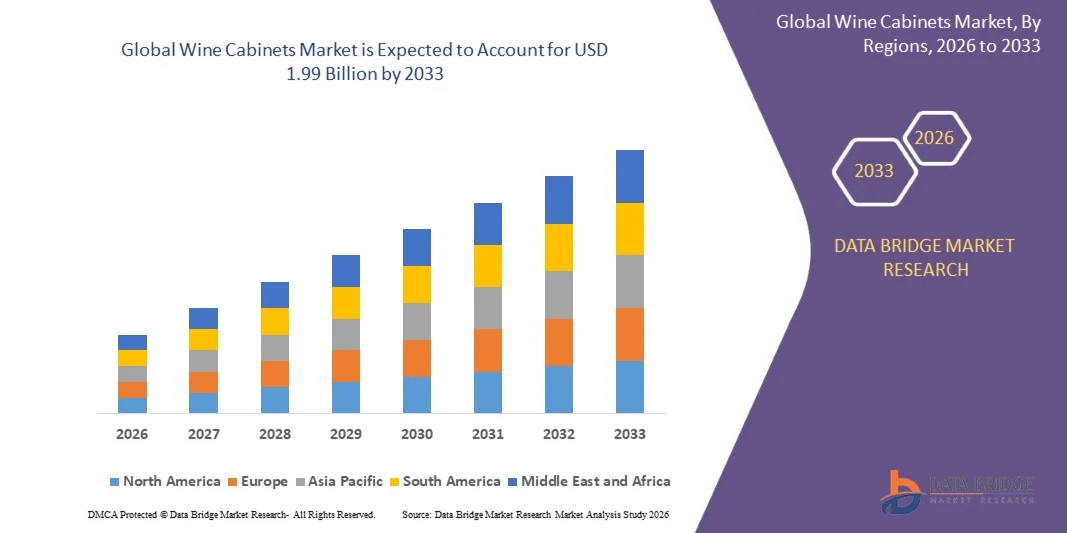
- As per Data Bridge Market Research analysis the wine cabinets market was valued at USD 1.27 billion in 2025 and is projected to reach USD 1.99 billion by 2033, growing at a CAGR of 5.80% from 2026 to 2033.
- The market is experiencing steady growth driven by rising global wine consumption, increasing demand for premium wine storage solutions, and growing adoption of smart home appliances with advanced temperature and humidity control features.
- The expanding residential and commercial hospitality sectors, combined with rising consumer preference for preserving wine quality through proper storage and the increasing popularity of luxury kitchens and home entertainment spaces, is encouraging households, restaurants, hotels, and wine collectors to invest in advanced wine cabinet solutions.
Market Size & Forecast
- Market Value (2025): USD 1.27 Billion
- Expected Market Value (2033): USD 1.99 Billion
- Forecast CAGR (2026–2033): 5.80%
- Leading Region in 2025: North America
- Fastest Growing Region: Asia-Pacific
What are the Major Takeaways of the Wine Cabinets Market?
- North America dominated the wine cabinets market with the largest revenue share of 45.5% in 2025, supported by high wine consumption, increasing demand for premium home appliances, and a well-established hospitality industry.
- Asia-Pacific wine cabinets market is expected to witness the fastest growth rate from 2026 to 2033, supported by rising disposable incomes, rapid urbanization, expanding middle-class populations, and increasing wine consumption across China, Japan, South Korea, and Australia.
- The refrigerated wine cabinets segment held the largest market revenue share in 2025, driven by growing consumer preference for precise temperature and humidity control to preserve wine quality. Increasing adoption across residential, hospitality, and commercial establishments, coupled with advancements in energy-efficient cooling technologies, continues to strengthen segment growth.
- The non-conditioned cabinets segment is projected to register the fastest growth at a CAGR from 2026 to 2033, driven by rising demand for affordable wine storage solutions and increasing adoption among occasional wine consumers and entry-level collectors.
- The freestanding segment accounted for the largest market revenue share in 2025, driven by its ease of installation, flexible placement, broad product availability, and affordability for residential users and hospitality establishments.
- The built-in (slot in) segment is expected to witness the fastest CAGR from 2026 to 2033, supported by increasing demand for premium modular kitchens, luxury residential projects, and integrated home appliance solutions.
Report Scope and Wine Cabinets Market Segmentation
|
Attributes |
Wine Cabinets Key Market Insights |
|
Segments Covered |
|
|
Countries Covered |
North America
Europe
Asia-Pacific
Middle East and Africa
South America
|
|
Key Market Players |
|
|
Market Opportunities |
|
|
Value Added Data Infosets |
In addition to the insights on market scenarios such as market value, growth rate, segmentation, geographical coverage, and major players, the market reports curated by the Data Bridge Market Research also include in-depth expert analysis, pricing analysis, brand share analysis, consumer survey, demography analysis, supply chain analysis, value chain analysis, raw material/consumables overview, vendor selection criteria, PESTLE Analysis, Porter Analysis, and regulatory framework. |
What is the Key Trend in the Wine Cabinets Market?
- Smart and connected wine cabinets are increasingly gaining popularity as consumers seek precise temperature control, humidity management, UV protection, and remote monitoring through mobile applications to preserve wine quality and enhance convenience.
- For instance, in January 2025, CES 2025 showcased several AI-enabled premium kitchen appliances, including connected wine storage solutions with smart temperature management and energy-efficient technologies, reflecting the growing integration of smart home features into luxury appliances.
- Manufacturers are also focusing on premium designs, dual-zone cooling technology, and energy-efficient refrigeration systems to meet the growing demand from residential kitchens, restaurants, hotels, and wine collectors.
- For instance, in September 2024, Liebherr expanded its range of energy-efficient wine storage appliances featuring advanced temperature control, humidity regulation, and UV-protected glass doors designed for long-term wine preservation.
- As consumers increasingly invest in premium home living spaces and smart kitchen appliances, the adoption of technologically advanced wine cabinets is expected to accelerate, strengthening their role in both residential and commercial wine storage.
What are the Key Drivers of the Wine Cabinets Market?
- The growing global consumption of premium wines, rising disposable incomes, and increasing demand for luxury home appliances have significantly increased the adoption of wine cabinets across residential and commercial applications.
- For instance, in April 2025, EuroCave introduced new premium wine cabinet solutions designed with enhanced humidity control, energy-efficient cooling systems, and customizable storage configurations for wine collectors and hospitality establishments.
- Hotels, restaurants, wine retailers, and homeowners are increasingly investing in professional wine storage systems to preserve wine quality, optimize serving conditions, and enhance customer experience.
- For instance, in October 2024, Perlick Corporation expanded its luxury residential refrigeration portfolio with high-performance wine reserve solutions featuring dual-zone temperature management and premium integrated designs for modern kitchens.
- With growing consumer preference for premium wines, luxury kitchens, and smart home appliances, wine cabinets are expected to remain an essential appliance for long-term wine preservation and premium beverage storage.
Which Factors are Challenging the Growth of the Wine Cabinets Market?
- Advanced wine cabinets require relatively high initial investment due to premium refrigeration systems, dual-zone cooling technology, humidity control features, and energy-efficient components.
- These higher costs limit adoption among budget-conscious households and consumers in emerging economies, where conventional refrigeration solutions continue to be widely used for wine storage.
- For instance, in 2024, Electrolux highlighted continued raw material cost inflation and supply chain pressures affecting premium appliance manufacturing, contributing to higher production and retail costs for refrigeration products.
- The high purchase price, ongoing electricity consumption, and maintenance costs associated with premium wine cabinets continue to restrict broader market penetration, particularly in price-sensitive markets. These factors remain key challenges despite increasing consumer demand for dedicated wine storage and premium home appliances.
How is the Wine Cabinets Market Segmented?
The market is segmented on the basis of type, product type, bottle capacity, material, application, distribution channel, price range, and technology.
- By Type
On the basis of type, the wine cabinets market is segmented into non-conditioned cabinets and refrigerated wine cabinets. The refrigerated wine cabinets segment held the largest market revenue share in 2025, driven by growing consumer preference for precise temperature and humidity control to preserve wine quality. Increasing adoption across residential, hospitality, and commercial establishments, coupled with advancements in energy-efficient cooling technologies, continues to strengthen segment growth.
The non-conditioned cabinets segment is projected to register the fastest growth at a CAGR from 2026 to 2033, driven by rising demand for affordable wine storage solutions and increasing adoption among occasional wine consumers and entry-level collectors.
- By Product Type
On the basis of product type, the wine cabinets market is segmented into freestanding, table top/counter top, built-in (slot in), and walk-in cellars. The freestanding segment accounted for the largest market revenue share in 2025, driven by its ease of installation, flexible placement, broad product availability, and affordability for residential users and hospitality establishments.
The built-in (slot in) segment is expected to witness the fastest CAGR from 2026 to 2033, supported by increasing demand for premium modular kitchens, luxury residential projects, and integrated home appliance solutions.
- By Bottle Capacity
On the basis of bottle capacity, the wine cabinets market is segmented into below 70 bottles, 71-150 bottles, 151-350 bottles, 351-600 bottles, and above 600 bottles. The below 70 bottles segment dominated the market with a revenue share in 2025, owing to rising demand from households, first-time wine buyers, and compact urban homes requiring space-efficient storage solutions.
The 151-350 bottles segment is anticipated to register the fastest growth at a CAGR from 2026 to 2033, driven by increasing adoption among restaurants, hotels, wine retailers, and serious wine collectors seeking larger storage capacity.
- By Material
On the basis of material, the wine cabinets market is segmented into metal, wood, and glass. The metal segment held the largest market revenue share in 2025, driven by its superior durability, corrosion resistance, modern aesthetics, and compatibility with advanced refrigeration systems used in premium wine cabinets.
The glass segment is projected to witness the fastest CAGR from 2026 to 2033, supported by growing demand for premium display cabinets featuring UV-resistant glass doors and enhanced product visibility in residential and commercial settings.
- By Application
On the basis of application, the wine cabinets market is segmented into residential, commercial, and industrial. The residential segment accounted for the largest market revenue share in 2025, driven by increasing wine consumption, rising disposable incomes, expanding luxury home renovations, and growing interest in home entertainment spaces.
The commercial segment is expected to register the fastest CAGR from 2026 to 2033, fueled by increasing investments from restaurants, hotels, bars, wineries, and specialty wine retailers in professional wine preservation systems.
- By Distribution Channel
On the basis of distribution channel, the wine cabinets market is segmented into online channel and offline channel. The offline channel segment held the largest market revenue share in 2025, driven by consumers' preference for physical product inspection, personalized consultation, installation support, and after-sales service through specialty appliance retailers.
The online channel segment is projected to witness the fastest CAGR from 2026 to 2033, supported by the rapid expansion of e-commerce platforms, competitive pricing, wider product availability, and increasing digital purchasing behavior.
- By Price Range
On the basis of price range, the wine cabinets market is segmented into economy, mid-range, and premium. The mid-range segment dominated the market with a revenue share in 2025, owing to its balance between affordability, advanced cooling features, and attractive design, making it the preferred choice for a broad consumer base.
The premium segment is expected to register the fastest CAGR from 2026 to 2033, driven by rising demand for luxury kitchen appliances, smart wine storage technologies, and customized high-capacity wine cabinets.
- By Technology
On the basis of technology, the wine cabinets market is segmented into compressed and electric. The compressed segment accounted for the largest market revenue share in 2025, driven by its efficient cooling performance, reliability, and widespread adoption in medium- and large-capacity wine cabinets for residential and commercial use.
The electric segment is projected to register the fastest growth at a CAGR from 2026 to 2033, driven by increasing demand for compact, energy-efficient, and low-noise wine cabinets suitable for apartments, offices, and modern residential environments.
Which Region Holds the Largest Share of the Wine Cabinets Market?
- North America dominated the wine cabinets market with the largest revenue share of 45.5% in 2025, supported by high wine consumption, increasing demand for premium home appliances, and a well-established hospitality industry.
- Consumers in the region highly value advanced wine preservation technologies, including dual-zone cooling, humidity control, and UV-protected storage. Rising disposable incomes, growing home renovation activities, and increasing investments in luxury kitchens continue to strengthen the adoption of wine cabinets across residential and commercial applications.
U.S. Wine Cabinets Market Insight
The U.S. wine cabinets market captured the largest revenue share in 2025 within North America, fueled by the growing popularity of wine collecting, rising premium wine consumption, and increasing adoption of smart home appliances. Consumers are increasingly investing in dedicated wine storage systems that offer precise temperature control, energy efficiency, and modern aesthetics. The expanding hospitality sector, together with strong demand for built-in and connected wine cabinets, continues to drive market growth across the country.
Europe Wine Cabinets Market Insight
Europe wine cabinets market is expected to witness the fastest growth rate from 2026 to 2033, primarily driven by the region's strong wine culture, expanding hospitality industry, and increasing consumer demand for premium wine preservation solutions. Growing investments in luxury residential projects, restaurants, and wine retail outlets are encouraging the adoption of advanced wine storage technologies. The market is also benefiting from increasing demand for energy-efficient and environmentally sustainable refrigeration systems.
U.K. Wine Cabinets Market Insight
The U.K. wine cabinets market is expected to witness the fastest growth rate from 2026 to 2033, driven by increasing consumer preference for premium kitchen appliances, rising wine consumption, and expanding home renovation activities. Growing investments in luxury residential developments, together with the increasing popularity of wine collections and home entertainment spaces, are expected to continue supporting market growth.
Germany Wine Cabinets Market Insight
Germany wine cabinets market is expected to witness the fastest growth rate from 2026 to 2033, fueled by rising demand for energy-efficient refrigeration appliances, growing premium home appliance adoption, and increasing consumer focus on wine preservation. Germany's advanced manufacturing capabilities, emphasis on product quality, and growing hospitality industry continue to promote the adoption of technologically advanced wine cabinets across residential and commercial sectors.
Asia-Pacific Wine Cabinets Market Insight
The Asia-Pacific wine cabinets market is expected to witness the fastest growth rate from 2026 to 2033, supported by rising disposable incomes, rapid urbanization, expanding middle-class populations, and increasing wine consumption across China, Japan, South Korea, and Australia. Growing luxury residential developments, premium hospitality investments, and expanding retail distribution channels are accelerating the adoption of wine cabinets throughout the region.
Japan Wine Cabinets Market Insight
Japan wine cabinets market is expected to witness the fastest growth rate from 2026 to 2033 due to increasing demand for premium kitchen appliances, compact living solutions, and advanced refrigeration technologies. Consumers are increasingly adopting space-efficient, energy-saving wine cabinets with precise temperature and humidity control. The country's strong preference for technologically advanced household appliances continues to support market expansion.
China Wine Cabinets Market Insight
The China wine cabinets market accounted for the largest market revenue share in Asia-Pacific in 2025, attributed to rapid urbanization, rising disposable incomes, growing wine consumption, and expanding demand for premium household appliances. China has become one of the fastest-growing markets for luxury home products, with consumers increasingly investing in wine cabinets for residential, hospitality, and commercial applications. The growth of modern retail channels and smart home adoption continues to propel the market across the country.
Which are the Top Companies in Wine Cabinets Market?
The wine cabinets industry is primarily led by well-established companies, including:
- Liebherr-International Deutschland GmbH (Germany)
- EuroCave (France)
- Enofrigo S.p.A. (Italy)
- Climadiff (France)
- Perlick Corporation (U.S.)
- Sub-Zero Group, Inc. (U.S.)
- Danby Products Ltd. (Canada)
- Avanti Products (U.S.)
- Wine Enthusiast Companies (U.S.)
- Haier Smart Home Co., Ltd. (China)
- The Middleby Corporation (U.S.)
- Electrolux AB (Sweden)
- Vintec (Australia)
- Thermador (U.S.)
- Wine Cellar Innovations (U.S.)
What are Latest Developments in Wine Cabinets Market?
- In February 2025, Liebherr announced the expansion of its premium refrigeration portfolio with new energy-efficient wine storage cabinets featuring advanced temperature control, humidity management, and UV-protected glass doors. The product development is designed to improve long-term wine preservation while reducing energy consumption for residential and commercial users. The launch strengthens Liebherr's premium appliance portfolio and supports the growing demand for sustainable wine storage solutions, contributing to innovation in the global wine cabinets market.
- In September 2024, EuroCave introduced new premium wine cabinet solutions featuring enhanced connectivity, customizable storage configurations, and precise climate control technologies for wine collectors and hospitality establishments. The product innovation is intended to improve wine preservation, user convenience, and premium storage capabilities while meeting the growing demand for luxury wine appliances. The development reinforces EuroCave's leadership in premium wine storage and supports the continued growth of the global wine cabinets market.

- Interactive Data Analysis Dashboard
- Company Analysis Dashboard for high growth potential opportunities
- Research Analyst Access for customization & queries
- Competitor Analysis with Interactive dashboard
- Latest News, Updates & Trend analysis
- Harness the Power of Benchmark Analysis for Comprehensive Competitor Tracking
Data collection and base year analysis are done using data collection modules with large sample sizes. The stage includes obtaining market information or related data through various sources and strategies. It includes examining and planning all the data acquired from the past in advance. It likewise envelops the examination of information inconsistencies seen across different information sources. The market data is analysed and estimated using market statistical and coherent models. Also, market share analysis and key trend analysis are the major success factors in the market report. To know more, please request an analyst call or drop down your inquiry.
The key research methodology used by DBMR research team is data triangulation which involves data mining, analysis of the impact of data variables on the market and primary (industry expert) validation. Data models include Vendor Positioning Grid, Market Time Line Analysis, Market Overview and Guide, Company Positioning Grid, Patent Analysis, Pricing Analysis, Company Market Share Analysis, Standards of Measurement, Global versus Regional and Vendor Share Analysis. To know more about the research methodology, drop in an inquiry to speak to our industry experts.
Data Bridge Market Research is a leader in advanced formative research. We take pride in servicing our existing and new customers with data and analysis that match and suits their goal. The report can be customized to include price trend analysis of target brands understanding the market for additional countries (ask for the list of countries), clinical trial results data, literature review, refurbished market and product base analysis. Market analysis of target competitors can be analyzed from technology-based analysis to market portfolio strategies. We can add as many competitors that you require data about in the format and data style you are looking for. Our team of analysts can also provide you data in crude raw excel files pivot tables (Fact book) or can assist you in creating presentations from the data sets available in the report.