


What is the Wine Yeast Market Size and Growth Rate?
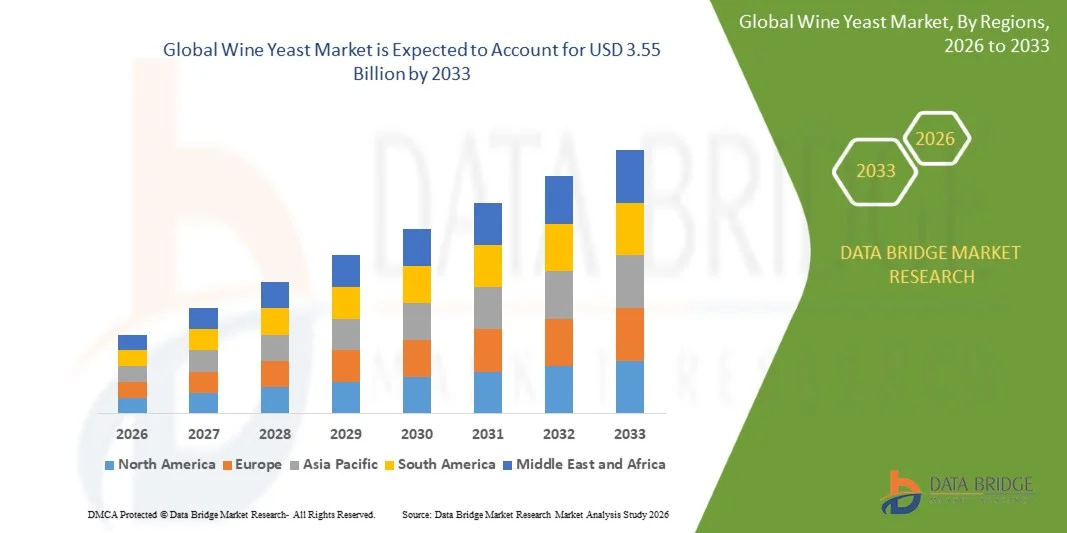
- As per Data Bridge Market Research analysis, the wine yeast market was valued at USD 1.67 billion in 2025 and is projected to reach USD 3.55 billion by 2033, growing at a CAGR of 9.90% from 2026 to 2033.
- The market is experiencing significant growth driven by demand for sensory differentiation and reliable fermentation processes, alongside technological advancements in wine yeast research and development that are enabling the creation of specialized strains with distinct flavor and aroma profiles.
- The increasing demand for non-GMO, vegan, and organic wine yeasts, combined with innovations in fermentation technology and the development of strains capable of improving fermentation efficiency and wine quality, is encouraging winemakers to adopt specialized yeast solutions. However, contamination risks, variability in grape quality, and changing fermentation conditions remain key challenges affecting yeast performance and wine consistency.
Market Size & Forecast
- Global Market Value (2025): USD 1.67 Billion
- Expected Market Value (2033): USD 3.55 Billion
- Forecast CAGR (2026–2033): 9.90%
- Leading Region in 2025: North America
- Fastest Growing Region: Asia Pacific
What are the Major Takeaways of the Wine Yeast Market?
- North America dominated the Wine Yeast market with the largest revenue share of 35.1% in 2025, supported by rising wine consumption, growth in premium and craft wine segments, an expanding number of wineries, and increasing demand for specialized wine yeast strains.
- Asia-Pacific is expected to be the fastest-growing region at a CAGR of 6.1% from 2026 to 2033, fueled by expanding wine production and increasing demand for wine yeast across China, Japan, India, and South Korea.
- The active dry yeast segment led the market with a 54.8% share in 2025, driven by its long shelf life, ease of storage and transportation, reliable fermentation performance, and availability in a wide range of strains tailored to different wine types.
- Dry yeast is the fastest-growing form type, projected to register a CAGR of 6.5%, reflecting the surge in demand for convenient, easy-to-store, and transportable yeast products, along with their extended shelf life and reliable fermentation performance.
- The pure culture fermentation segment dominated the fermentation type category with a 70% revenue share in 2025, led by the increasing adoption of controlled and standardized fermentation processes, which provide predictable fermentation kinetics, consistent wine quality and greater control over aroma and flavor development.
- Yeast extract accounted for 65% of the market share in 2025, preferred by winemakers for its rich supply of amino acids, vitamins, minerals, and other nutrients that support healthy yeast growth and efficient fermentation.
- The hanseniaspora segment is the fastest-growing genus category, with a CAGR of 8.0%, driven by rising adoption of non-Saccharomyces yeasts for enhancing wine aroma complexity, fruity and floral characteristics, and sensory differentiation.
Report Scope and Wine Yeast Market Segmentation
|
Attributes |
Wine Yeast Key Market Insights |
|
Segments Covered |
|
|
Countries Covered |
North America
Europe
Asia-Pacific
Middle East and Africa
South America
|
|
Key Market Players |
|
|
Market Opportunities |
|
|
Value Added Data Infosets |
In addition to the insights on market scenarios such as market value, growth rate, segmentation, geographical coverage, and major players, the market reports curated by the Data Bridge Market Research also include in-depth expert analysis, pricing analysis, brand share analysis, consumer survey, demography analysis, supply chain analysis, value chain analysis, raw material/consumables overview, vendor selection criteria, PESTLE Analysis, Porter Analysis, and regulatory framework. |
What is the Key Trend in the Wine Yeast Market?
- Winemakers are increasingly adopting non-Saccharomyces and mixed-starter cultures to enhance aroma complexity, modulate acidity, reduce alcohol content, and create differentiated wine profiles while maintaining controlled fermentation.
- For instance, in April 2025, an article published in European Food Research and Technology by Springer Nature reported that mixed fermentation using Metschnikowia pulcherrima and Saccharomyces cerevisiae enhanced the aroma and sensory characteristics of Falanghina wine, supporting the growing adoption of non-Saccharomyces yeasts in winemaking
- The shift toward specialized strains is supported by the growing commercialization of non-Saccharomyces yeasts, particularly Torulaspora delbrueckii, Lachancea thermotolerans, and Metschnikowia pulcherrima, for targeted oenological applications.
- Bio-protective yeast solutions are also gaining attention as wineries seek alternatives for improving wine stability and reducing reliance on sulfur dioxide during fermentation and preservation.
- In addition, researchers are developing mixed-fermentation approaches that combine non-Saccharomyces yeasts with Saccharomyces cerevisiae to improve sensory characteristics, manage undesirable compounds, and achieve more controlled fermentation outcomes.
What are the Key Drivers of the Wine Yeast Market?
- The rising demand for premium wines with distinctive aroma, flavor, and sensory characteristics is increasing the adoption of specialized wine yeast strains capable of delivering consistent and differentiated fermentation profiles.
- For instance, in May 2025, an article published in ACS Food Science & Technology by the American Chemical Society, evaluated four indigenous S. cerevisiae strains isolated from the Greek terroir and found that the strains produced distinct aroma and sensory profiles in Assyrtiko wine, with strain S10-A6Y10 generating a more complex profile, supporting demand for specialized yeast strains to improve wine quality.
- The commercialization of non-Saccharomyces strains is strengthening this demand, with research identifying approximately 42 commercial non-Saccharomyces yeast products, predominantly involving T. delbrueckii, L. thermotolerans, and M. pulcherrima.
- Growing interest in low-alcohol wines and climate-adaptive winemaking is further driving yeast innovation, particularly strains capable of reducing ethanol production while maintaining desirable wine acidity, aroma, and sensory quality.
- For instance, in August 2024, an article published in MDPI, evaluated eight indigenous Saccharomyces cerevisiae strains from Huailai, China, across Riesling, Sémillon, Cabernet Sauvignon, and Syrah wines. The study found that indigenous strains produced higher concentrations of aroma-related compounds and higher odor activity values for fruity and floral attributes than commercial strains.
- As wineries increasingly prioritize fermentation consistency, sensory differentiation, and adaptation to changing grape composition, demand for specialized and application-specific wine yeast solutions is expected to continue increasing.
Which Factors are Challenging the Growth of the Wine Yeast Market?
- The use of non-Saccharomyces yeasts can create fermentation-management challenges because several strains have lower fermentative power and alcohol tolerance than Saccharomyces cerevisiae, requiring controlled mixed or sequential fermentation.
- For instance, in October 2024, an article published in Food Microbiology by Elsevier, reported that temperature, sulfur dioxide (SO₂), and ethanol strongly affected yeast community dynamics during spontaneous fermentation, with temperature having the greatest impact on fermentation rate and duration.
- These biological limitations can affect fermentation completion and increase the need for strain compatibility testing, nutrient management, and technical monitoring, particularly when wineries adopt newer commercial yeast cultures.
- Wine fermentation is also affected by grape composition, temperature, nutrients, microbial interactions, and vintage conditions, creating variability in yeast performance and potentially affecting fermentation reliability and final wine characteristics.
- Wine yeast performance can be challenged by nutrient competition and strain interactions during mixed fermentation, which may cause sluggish or stuck fermentations and negatively affect final wine quality, increasing the need for careful strain selection and nutrient management
How is the Wine Yeast Market Segmented?
The wine yeast market is segmented on the basis of form, fermentation type, extract type, genus, and application.
- By Form
On the basis of form, the wine yeast market is segmented into liquid yeast, dry yeast, and active dry yeast. The active dry yeast segment dominated the market with 54.8% share in 2025. Active dry yeast is widely preferred because of its long shelf life, ease of transportation, simple storage requirements, and reliable fermentation performance. Wineries can maintain consistent fermentation results without the complex cold-chain requirements associated with certain liquid preparations. The format is particularly suitable for commercial wineries that require standardized yeast cultures across large production volumes. Its established supply chain and availability in strains designed for different wine styles further reinforce its leading position.
The dry yeast segment is expected to be the fastest-growing form, with an estimated CAGR of 6.5% during 2026–2033. Its growth is being supported by increasing demand for convenient, stable, and transport-friendly fermentation products. Dry yeast can be stored for longer periods and generally requires less specialized handling than liquid yeast. Growing wine production in emerging markets is also increasing demand for yeast formats that can be transported over long distances without substantial loss of viability. Manufacturers are developing specialized dry strains with improved alcohol tolerance, temperature tolerance, aroma generation, and fermentation reliability. Increasing adoption by small and medium-sized wineries is further supporting the segment.
- By Fermentation Type
On the basis of fermentation type, the wine yeast market is segmented into natural fermentation and pure culture fermentation. The pure culture fermentation segment is estimated to dominated the market with 70% share in 2025. Pure culture fermentation provides wineries with greater control over fermentation kinetics, alcohol production, aroma development, and microbial stability. Commercially selected cultures, particularly Saccharomyces strains, are widely used when consistent product quality is required. Large wineries favor controlled cultures because they reduce batch-to-batch variation and allow predictable fermentation performance. Pure cultures can also be selected for specific temperature ranges and alcohol tolerance levels. The growing premiumization of wine production is encouraging producers to select strains based on desired sensory characteristics rather than relying solely on spontaneous fermentation.
The natural fermentation segment is estimated to be the fastest-growing, with a CAGR of 6.0% from 2026 to 2033. Natural fermentation is gaining popularity among artisanal wineries and producers emphasizing minimal-intervention winemaking. It uses indigenous microorganisms associated with grapes, vineyards, and winery environments, potentially producing distinctive regional characteristics. Growing consumer interest in authentic, terroir-driven, and naturally produced wines is supporting this approach. Winemakers are also increasingly investigating native yeast populations to generate greater aromatic complexity and differentiate premium wine products. Advances in microbial monitoring are making it easier to manage the variability traditionally associated with spontaneous fermentation. Research continues to show that vineyard environment and indigenous yeast populations can influence fermentation behavior and wine characteristics.
- By Extract Type
On the basis of extract type, the wine yeast market is segmented into yeast extract and autolyzed yeast. The yeast extract segment is estimated to hold the dominant position, accounting for 65% of the segment in 2025. Yeast extracts provide amino acids, peptides, vitamins, minerals, and other nutrients that can support yeast activity during fermentation. Their use is particularly important when grape must does not provide an optimal nutritional environment for fermentation. Wineries use yeast-derived nutritional products to promote reliable fermentation and reduce the risk of sluggish or incomplete fermentation. Growing emphasis on fermentation optimization is supporting demand for functional yeast extracts. Commercial availability and familiarity among winemakers also contribute to their leading position.
The autolyzed yeast segment is estimated to be the fastest-growing, with a CAGR of 7.0% from 2026 to 2033. Autolyzed yeast is produced by allowing yeast cells to break down, releasing intracellular nutrients and functional components. These products can supply amino acids, peptides, vitamins, minerals, and other compounds useful for supporting fermentation. Increasing winery focus on yeast nutrition and fermentation efficiency is creating opportunities for autolyzed yeast products. Their ability to provide naturally derived nutrients is particularly attractive to producers seeking alternatives to conventional synthetic nutrient formulations. Growing demand for consistent fermentation performance in premium wine production is also contributing to adoption. Product innovation aimed at improving yeast vitality and fermentation robustness should further support segment growth.
- By Genus
On the basis of genus, the wine yeast market is segmented into saccharomyces, kloeckera, hanseniaspora, candida, hansenula, pichia, and brettanomyces. The saccharomyces segment dominated the market with an estimated 62.4% share in 2025. Saccharomyces cerevisiae is the most commercially established wine-fermentation yeast because of its strong sugar-fermenting capability, reliability, and tolerance to increasing ethanol concentrations. Commercial wineries use numerous Saccharomyces strains designed for different wine styles and fermentation conditions. Its predictable fermentation behavior makes it particularly important for large-scale wine production. The availability of specialized strains for red, white, sparkling, and other wines further strengthens its position.
The hanseniaspora segment is estimated to be the fastest-growing genus, with a CAGR of 8.0% during 2026–2033. Hanseniaspora is a major non-Saccharomyces yeast genus associated with grape and wine fermentation. Growing interest in non-Saccharomyces yeasts is being driven by their ability to influence aroma, acidity, mouthfeel, and overall sensory complexity. Winemakers increasingly use selected hanseniaspora strains either individually during early fermentation or together with Saccharomyces in sequential fermentation systems. This provides producers with greater flexibility in developing differentiated wine profiles. The trend is particularly relevant to premium and specialty wines where sensory differentiation can support higher product value. Increasing research and commercialization of non-conventional yeast strains is expected to accelerate the genus's market penetration.
- By Application
On the basis of application, the wine yeast market is segmented into red wine, white wine, sparkling wine, and dessert wine. The red wine segment dominated the market with 41.7% share in 2025. Red wine requires controlled fermentation involving grape skins, seeds, and phenolic compounds, making yeast selection particularly important. Specialized yeast strains can influence fermentation speed, aroma generation, color stability, tannin integration, and overall sensory quality. The large global production base for red wine provides a substantial demand pool for wine fermentation yeast. Premium red wine producers also increasingly use specialized cultures to achieve differentiated flavor profiles. The segment's strong established production base therefore continues to support its leading position.
The sparkling wine segment is estimated to be the fastest-growing application, with a CAGR of 6.5 from 2026 to 2033. Sparkling wine requires specialized fermentation management, particularly when secondary fermentation is used to generate carbon dioxide and develop the desired effervescence. Yeast strains must maintain fermentation activity under challenging conditions while contributing appropriate aroma and sensory characteristics. Rising consumer demand for premium sparkling wines is creating additional opportunities for specialized yeast products. Expansion of sparkling wine consumption beyond traditional European markets is also supporting demand. Producers are increasingly investing in strain selection to improve consistency and sensory quality. Consequently, sparkling wine is expected to record faster yeast-demand growth than several mature wine applications.
Which Region Holds the Largest Share of the Wine Yeast Market?
- North America dominated the Wine Yeast market with the largest revenue share of 35.1% in 2025, supported by rising wine consumption, growth in premium and craft wine segments, an expanding number of wineries, and increasing demand for specialized wine yeast strains
- The region also benefits from growing demand for premium and ultra-premium wines, increasing adoption of specialty yeast strains for differentiated aromatic profiles, and expanding wine production across Oregon, Washington, New York, and other U.S. states. Rising interest in artisanal winemaking and advanced fermentation technologies further supports North America's position in the global wine yeast market.
U.S. Wine Yeast Market Insight
The U.S. wine yeast market is witnessing steady demand due to the country’s large and technologically advanced wine-production industry, particularly in California. The U.S. produced approximately 23.6 million hectoliters of wine in 2024, while the country remained the world’s largest wine-consuming market at 33.3 million hectoliters, creating substantial demand for fermentation yeasts and specialized cultures. California alone accounted for approximately 81% of total U.S. wine production in 2024, reinforcing the importance of controlled fermentation technologies and commercial yeast products. The continued focus on wine quality, fermentation consistency, and differentiated sensory profiles is supporting the use of specialized wine yeast strains across U.S. wineries.
Asia-Pacific Wine Yeast Market Insight
The Asia-Pacific wine yeast market is expected to witness strong growth, driven by the region’s expanding wine consumer base, developing domestic wine industries, and increasing adoption of modern winemaking practices. China has the world’s third-largest planted vineyard area and was the eighth-largest wine-consuming country, according to the OIV, while its Ningxia region alone accounts for approximately 40% of China’s national wine production. Japan is also an important regional market, with wine consumption reaching 3.1 million hectoliters in 2024. Increasing investment in vineyard development, winery modernization, fermentation research, and premium wine production is supporting demand for selected and specialized yeast cultures across the region.
Japan Wine Yeast Market Insight
The Japan wine yeast market is witnessing consistent growth due to the country’s established wine-consumption base, expanding domestic wine culture, and increasing interest in quality-oriented winemaking. Japan consumed approximately 3.1 million hectoliters of wine in 2024, making it one of the important wine markets in Asia. The country’s growing interest in domestic wines and premium products is encouraging wineries to focus more closely on fermentation control, aroma development, and product consistency. OIV data also shows that Japan’s wine consumption remained significant within the Asian market, while the latest 2025 assessment reported a 6.8% increase in consumption to 3.3 million hectoliters, indicating renewed market momentum. These developments are supporting opportunities for specialized fermentation yeasts and advanced winemaking inputs.
China Wine Yeast Market Insight
The China wine yeast market is developing due to the country’s substantial vineyard base, established wine-producing regions, and continuing investment in modern viticulture and winemaking technologies. China has the third-largest planted vineyard surface globally and was the eighth-largest wine-consuming country, according to the OIV. The Ningxia wine region is particularly important, accounting for approximately 40% of China's national wine production, while the region has placed quality viticulture, wine tourism, and new production technologies at the center of its development strategy. China's formal acceptance into the OIV in November 2024 also strengthened its scientific and technical cooperation with the international wine sector. These developments are supporting greater adoption of controlled fermentation practices and specialized yeast strains in Chinese wineries.
U.K. Wine Yeast Market Insight
The U.K. wine yeast market is experiencing steady growth, supported by the rapid development of English wine production, particularly sparkling wine. The U.K. consumed approximately 12.6 million hectoliters of wine in 2024, making it the fifth-largest wine-consuming country globally. At the production level, English vineyards experienced a major expansion, with 2023 wine production increasing 77% to 161,960 hectoliters, equivalent to approximately 21.6 million bottles. The growth of English sparkling wine and increased investment in vineyards are creating greater requirements for specialized fermentation cultures capable of supporting consistent secondary fermentation and desirable sensory characteristics. The emergence of England as a recognized sparkling-wine producer is therefore strengthening demand for specialized wine yeast solutions.
Germany Wine Yeast Market Insight
The Germany wine yeast market is expanding steadily due to the country’s established wine-producing industry, substantial domestic wine consumption, and strong emphasis on controlled and quality-oriented winemaking. Germany produced approximately 8.1 million hectoliters of wine in 2024, according to the OIV, while the German Federal Statistical Office reported total wine and must production of approximately 7.75 million hectoliters for the same year. Germany also consumed approximately 17.8 million hectoliters of wine in 2024, making it the fourth-largest wine-consuming market globally. The combination of a significant domestic wine industry and large consumer base supports ongoing demand for fermentation inputs, including commercial and specialized yeast cultures. Continued emphasis on fermentation reliability and wine-quality management further supports the use of selected yeast strains in German wineries.
Which are the Top Companies in Wine Yeast Market?
The wine yeast industry is primarily led by well-established companies, including:
- Lallemand Inc. (Canada)
- AB Mauri (UK) Limited (U.K.)
- Angel Yeast Co., Ltd. (China)
- AEB S.p.A. (Italy)
- ENARTIS S.r.l. (Italy)
- Enologica Vason S.p.A. (Italy)
- LAFFORT (France)
- ERBSLÖH Geisenheim GmbH (Germany)
- Proenol S.A. (Portugal)
- OENOBRANDS SAS (France)
- Renaissance Bioscience Corp. (Canada)
- Wyeast Laboratories, Inc. (U.S.)
- Novonesis Group (Denmark)
- Gusmer Enterprises, Inc. (U.S.)
- Scott Laboratories (U.S.)
- Biorigin S.A. (Brazil)
- Oriental Yeast Co., Ltd. (Japan)
- Leiber Group GmbH & Co. KG (Germany)
- Alltech (U.S.)
- AB Biotek (U.K.)
What are Latest Developments in Wine Yeast Market?
- In September 2025, Lallemand Œnology launched LEVEL² SALVA, a new bioprotective wine yeast designed to eliminate Brettanomyces bruxellensis, one of the major microbial contaminants affecting wine quality. The yeast produces a factor capable of damaging the cell wall of Brettanomyces, providing wineries with a biological approach to managing this spoilage microorganism. The launch represents a significant development in wine-yeast technology because the product is designed not only for fermentation but also for microbial protection during winemaking.
- In August 2025, Lallemand Œnology launched CAUDALYS, its first inactivated non-Saccharomyces yeast for the 2025 harvest. The product was developed for white and rosé wines and was positioned to provide aromatic longevity, freshness, minerality, and salinity. The launch represents an expansion of Lallemand’s specialized non-Saccharomyces yeast portfolio and reflects growing interest in yeast-derived solutions for improving wine sensory characteristics.
- In June 2024, Lallemand Œnology introduced GO-FERM STEROL FLASH, a new yeast protector designed to accelerate wine-yeast rehydration. The product uses a micro-agglomerated yeast autolysate containing highly bioavailable ergosterols to support yeast during rehydration. Its development addresses the need for improved yeast vitality and fermentation performance, particularly under challenging fermentation conditions. This launch illustrates continuing innovation around yeast nutrition and fermentation management
- In May 2023, Angel Yeast launched its organic wine yeast products, using naturally selected Saccharomyces cerevisiae together with organic grain starch and protein as raw materials. The company positioned the products for organic winemaking applications, providing winemakers with yeast options compatible with the growing interest in organic wine production. The launch expanded Angel Yeast’s wine-fermentation product portfolio and demonstrated increasing commercialization of specialized yeast products for organic applications.
- In July 2021, Lallemand Œnology launched PURE-LEES ELEGANCY, a selected specific inactivated yeast designed to improve the texture and balance of red wines. The product uses Lallemand’s High Pressure Homogenization process to disrupt yeast cells and increase interactions between yeast constituents and the wine matrix. Its yeast fractions were designed to help reduce harsh, astringent, and bitter tannins. The launch highlights the development of specialized yeast-derived products for improving wine sensory quality beyond primary fermentation.

- Interactive Data Analysis Dashboard
- Company Analysis Dashboard for high growth potential opportunities
- Research Analyst Access for customization & queries
- Competitor Analysis with Interactive dashboard
- Latest News, Updates & Trend analysis
- Harness the Power of Benchmark Analysis for Comprehensive Competitor Tracking
Global Wine Yeast Market, Supply Chain Analysis and Ecosystem Framework
To support market growth and help clients navigate the impact of geopolitical shifts, DBMR has integrated in-depth supply chain analysis into its Global Wine Yeast Market research reports. This addition empowers clients to respond effectively to global changes affecting their industries. The supply chain analysis section includes detailed insights such as Global Wine Yeast Market consumption and production by country, price trend analysis, the impact of tariffs and geopolitical developments, and import and export trends by country and HSN code. It also highlights major suppliers with data on production capacity and company profiles, as well as key importers and exporters. In addition to research, DBMR offers specialized supply chain consulting services backed by over a decade of experience, providing solutions like supplier discovery, supplier risk assessment, price trend analysis, impact evaluation of inflation and trade route changes, and comprehensive market trend analysis.
Data collection and base year analysis are done using data collection modules with large sample sizes. The stage includes obtaining market information or related data through various sources and strategies. It includes examining and planning all the data acquired from the past in advance. It likewise envelops the examination of information inconsistencies seen across different information sources. The market data is analysed and estimated using market statistical and coherent models. Also, market share analysis and key trend analysis are the major success factors in the market report. To know more, please request an analyst call or drop down your inquiry.
The key research methodology used by DBMR research team is data triangulation which involves data mining, analysis of the impact of data variables on the market and primary (industry expert) validation. Data models include Vendor Positioning Grid, Market Time Line Analysis, Market Overview and Guide, Company Positioning Grid, Patent Analysis, Pricing Analysis, Company Market Share Analysis, Standards of Measurement, Global versus Regional and Vendor Share Analysis. To know more about the research methodology, drop in an inquiry to speak to our industry experts.
Data Bridge Market Research is a leader in advanced formative research. We take pride in servicing our existing and new customers with data and analysis that match and suits their goal. The report can be customized to include price trend analysis of target brands understanding the market for additional countries (ask for the list of countries), clinical trial results data, literature review, refurbished market and product base analysis. Market analysis of target competitors can be analyzed from technology-based analysis to market portfolio strategies. We can add as many competitors that you require data about in the format and data style you are looking for. Our team of analysts can also provide you data in crude raw excel files pivot tables (Fact book) or can assist you in creating presentations from the data sets available in the report.













