


What is the Global Wireless Mesh Network Market Size and Growth Rate?
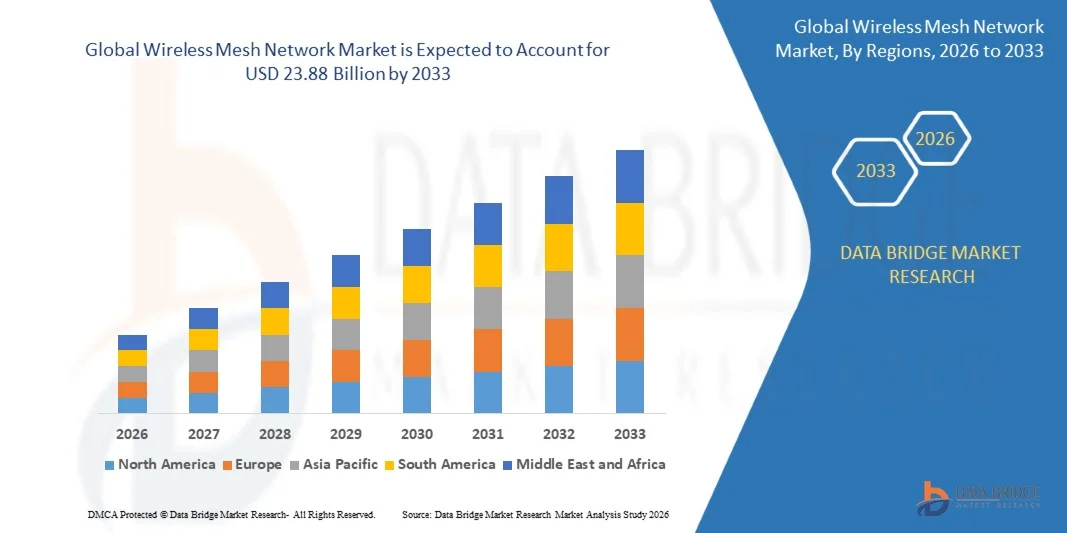
- The global wireless mesh network market size was valued at USD 11.06 billion in 2025 and is expected to reach USD 23.88 billion by 2033, at a CAGR of 10.1% during the forecast period
- Major factors that are expected to boost the growth of the wireless mesh network market in the forecast period are the rise in the connectivity in the mobiles and handsets because of artificial intelligence and the increase in the need for smart street lighting infrastructure which controls the density of lights for favourable uses and used for safe guarding publics from terrorism and assassination, by the help of video surveillance is further anticipated to propel the growth of the wireless mesh network market
What are the Major Takeaways of Wireless Mesh Network Market?
- The decrease in the cost of connected devices is further projected to impede the growth of the wireless mesh network market. On the other hand, concerns regarding data security and privacy are further projected to impede the growth of the wireless mesh network market in the timeline period
- In addition, the growing of developed networking technologies among SMES will further provide potential opportunities for the growth of the wireless mesh network market in the coming years. However, the dearth of standards for interconnectivity and interoperability which might further challenge the growth of the wireless mesh network market in the near future
- North America dominated the wireless mesh network market with a 39.8% revenue share in 2025, driven by strong adoption of smart city infrastructure, industrial IoT, enterprise connectivity solutions, and public safety communication systems across the U.S. and Canada
- Asia-Pacific is projected to register the fastest CAGR of 11.2% from 2026 to 2033, driven by rapid urbanization, large-scale smart city investments, industrial automation, and growing deployment of IoT-based infrastructure across China, Japan, India, South Korea, and Southeast Asia
- The Mesh Platforms segment dominated the market with a 41.6% share in 2025, as organizations increasingly prefer centralized software-driven network management solutions that enable seamless node connectivity, real-time monitoring, and scalable deployment
Report Scope and Wireless Mesh Network Market Segmentation
|
Attributes |
Wireless Mesh Network Key Market Insights |
|
Segments Covered |
|
|
Countries Covered |
North America
Europe
Asia-Pacific
Middle East and Africa
South America
|
|
Key Market Players |
|
|
Market Opportunities |
|
|
Value Added Data Infosets |
In addition to the insights on market scenarios such as market value, growth rate, segmentation, geographical coverage, and major players, the market reports curated by the Data Bridge Market Research also include in-depth expert analysis, pricing analysis, brand share analysis, consumer survey, demography analysis, supply chain analysis, value chain analysis, raw material/consumables overview, vendor selection criteria, PESTLE Analysis, Porter Analysis, and regulatory framework. |
What is the Key Trend in the Wireless Mesh Network Market?
“Increasing Shift Toward Self-Healing, Scalable, and IoT-Integrated Wireless Mesh Networks”
- The wireless mesh network market is witnessing strong adoption of self-healing, multi-node, and software-defined network architectures designed to support smart cities, industrial IoT, defense communication, and large-scale enterprise connectivity
- Manufacturers are introducing high-capacity mesh routers, low-latency gateways, and cloud-managed networking platforms that offer advanced routing protocols, seamless roaming, and multi-band connectivity
- Growing demand for cost-efficient, scalable, and easily deployable wireless communication infrastructure is driving usage across industrial plants, transportation hubs, campuses, and remote monitoring environments
- For instance, companies such as ABB, Rajant, Cambium Networks, and Qualcomm have upgraded their mesh networking solutions with higher throughput, edge intelligence, and enhanced cybersecurity capabilities
- Increasing need for uninterrupted connectivity, dynamic node expansion, and resilient communication systems is accelerating the shift toward next-generation wireless mesh networks
- As connected ecosystems become more complex and distributed, Wireless Mesh Networks will remain vital for reliable communication, real-time data exchange, and large-scale IoT deployment
What are the Key Drivers of Wireless Mesh Network Market?
- Rising demand for reliable, scalable, and low-latency connectivity solutions to support smart infrastructure, industrial automation, and mission-critical communication is driving market expansion
- For instance, in 2025, leading companies such as Cambium Networks, Rajant, and HPE enhanced their mesh networking portfolios to support higher bandwidth, better node density, and intelligent traffic routing
- Growing adoption of IoT devices, smart factories, autonomous vehicles, public safety networks, and utility grid monitoring is boosting demand for mesh networking solutions across the U.S., Europe, and Asia-Pacific
- Advancements in Wi-Fi 6/6E, edge computing, AI-based network optimization, and multi-hop routing protocols have significantly strengthened performance and network resilience
- Rising use of smart city infrastructure, industrial sensors, and connected transport systems is creating strong demand for advanced wireless mesh solutions
- Supported by steady investments in digital infrastructure, Industry 4.0, and smart mobility, the Wireless Mesh Network market is expected to witness strong long-term growth
Which Factor is Challenging the Growth of the Wireless Mesh Network Market?
- High costs associated with large-scale deployment, advanced mesh nodes, and secure networking infrastructure restrict adoption among SMEs and cost-sensitive regions
- For instance, during 2024–2025, fluctuations in semiconductor prices, communication chipset costs, and supply chain disruptions increased deployment expenses for several global vendors
- Complexity in managing network interference, node synchronization, and large multi-hop communication systems increases the need for skilled network engineers and specialized deployment expertise
- Limited awareness in emerging markets regarding mesh network scalability, security, and deployment best practices slows adoption
- Competition from traditional Wi-Fi networks, cellular connectivity, and LPWAN technologies creates pricing pressure and reduces differentiation
- To address these issues, companies are focusing on cost-optimized deployments, AI-driven network management, stronger cybersecurity, and simplified installation tools to increase global adoption of wireless mesh networks
How is the Wireless Mesh Network Market Segmented?
The market is segmented on the basis of component, mesh design, service, radio frequency, and application.
• By Component
On the basis of component, the Wireless Mesh Network market is segmented into Physical Appliances, Mesh Platforms, and Services. The Mesh Platforms segment dominated the market with a 41.6% share in 2025, as organizations increasingly prefer centralized software-driven network management solutions that enable seamless node connectivity, real-time monitoring, and scalable deployment. These platforms support automated routing, self-healing capabilities, network orchestration, and cloud-based analytics, making them highly suitable for smart city infrastructure, industrial IoT, public safety, and enterprise campus deployments. Growing adoption of connected devices and distributed communication systems continues to support segment leadership.
The Services segment is expected to grow at the fastest CAGR from 2026 to 2033, driven by rising demand for managed services, maintenance, consulting, and integration support across large-scale wireless network installations. Increasing complexity of mesh ecosystems and need for continuous performance optimization are accelerating service adoption globally.
• By Mesh Design
On the basis of mesh design, the market is segmented into Infrastructure Wireless Mesh and Ad-Hoc Mesh. The Infrastructure Wireless Mesh segment dominated the market with a 58.3% share in 2025, owing to its extensive use in municipal Wi-Fi, industrial automation, transportation hubs, military communication systems, and smart utility grids. This design provides fixed access points and backbone nodes that ensure stable connectivity, wider coverage, and high reliability. Strong deployment across enterprise networks and public infrastructure projects continues to drive growth.
The Ad-Hoc Mesh segment is projected to grow at the fastest CAGR from 2026 to 2033, supported by rising demand for flexible, temporary, and rapidly deployable communication networks for defence operations, disaster response, and remote connectivity applications. Increasing adoption in drone communication and tactical field operations further boosts segment expansion.
• By Service
On the basis of service, the market is segmented into Deployment & Provisioning and Network Planning. The Deployment & Provisioning segment dominated the market with a 53.1% share in 2025, supported by rising implementation of wireless mesh solutions across industrial sites, warehouses, transport systems, and smart building environments. Businesses increasingly require seamless installation, configuration, and activation of mesh nodes to ensure uninterrupted connectivity and fast operational readiness.
The Network Planning segment is expected to grow at the fastest CAGR from 2026 to 2033, driven by increasing focus on signal optimization, node placement strategy, interference reduction, and scalability planning. As mesh networks become denser and more application-specific, demand for professional network planning services is expected to rise significantly.
• By Radio Frequency
On the basis of radio frequency, the market is segmented into Sub 1 GHz Band, 2.4 GHz Band, and 4.9 GHz Band. The 2.4 GHz Band segment dominated the market with a 46.8% share in 2025, due to its broad compatibility, cost-effectiveness, and widespread use across consumer and industrial wireless communication devices. It offers reliable range and stable performance for surveillance, campus networks, and IoT applications.
The Sub 1 GHz Band segment is anticipated to grow at the fastest CAGR from 2026 to 2033, driven by rising demand for long-range, low-power connectivity in industrial IoT, agriculture monitoring, and smart utility applications. Its strong penetration capability makes it highly suitable for large-scale deployments.
• By Applications
On the basis of applications, the market is segmented into Video Streaming & Surveillance and Disaster Management. The Video Streaming & Surveillance segment dominated the market with a 49.4% share in 2025, driven by growing deployment of real-time monitoring systems across smart cities, transportation networks, airports, industrial facilities, and public safety infrastructure. High-bandwidth and uninterrupted connectivity requirements strongly support adoption.
The Disaster Management segment is expected to grow at the fastest CAGR from 2026 to 2033, propelled by rising need for resilient emergency communication systems, rapid deployment networks, and uninterrupted connectivity during natural disasters and crisis situations. Increasing investments in public safety infrastructure continue to strengthen this segment’s growth outlook.
Which Region Holds the Largest Share of the Wireless Mesh Network Market?
- North America dominated the wireless mesh network market with a 39.8% revenue share in 2025, driven by strong adoption of smart city infrastructure, industrial IoT, enterprise connectivity solutions, and public safety communication systems across the U.S. and Canada. Rising deployment of intelligent surveillance systems, utility grid modernization projects, transportation connectivity, and mission-critical communication networks continues to fuel demand for wireless mesh solutions across municipalities, defence operations, industrial facilities, and commercial campuses
- Leading companies in North America are introducing advanced mesh networking platforms with enhanced bandwidth optimization, self-healing capabilities, edge computing integration, and cloud-based network orchestration, strengthening the region’s technological leadership. Continuous investment in smart infrastructure, autonomous systems, and industrial digitalization supports long-term market expansion
- Strong technology ecosystems, high enterprise IT spending, and ongoing modernization of communication infrastructure further reinforce North America’s market leadership
U.S. Wireless Mesh Network Market Insight
The U.S. is the largest contributor in North America, supported by extensive deployment of smart city projects, public safety networks, industrial automation systems, and enterprise campus connectivity solutions. Increasing demand for resilient communication infrastructure across defence, transportation, healthcare, and utilities sectors continues to accelerate adoption of wireless mesh platforms. The presence of major network solution providers, rapid rollout of IoT ecosystems, and strong investment in intelligent surveillance and connected infrastructure further drives market growth.
Canada Wireless Mesh Network Market Insight
Canada contributes significantly to regional growth, driven by increasing adoption of smart utility grids, remote connectivity solutions, industrial communication networks, and public sector digital infrastructure projects. Growing use of wireless mesh systems in mining, oil & gas, transportation, and municipal surveillance strengthens market demand. Government-backed digital innovation programs and rising focus on secure communication infrastructure further support expansion across the country.
Asia-Pacific Wireless Mesh Network Market
Asia-Pacific is projected to register the fastest CAGR of 11.2% from 2026 to 2033, driven by rapid urbanization, large-scale smart city investments, industrial automation, and growing deployment of IoT-based infrastructure across China, Japan, India, South Korea, and Southeast Asia. Rising demand for uninterrupted wireless connectivity across manufacturing plants, logistics hubs, transport corridors, and public infrastructure continues to accelerate adoption of wireless mesh networks across the region.
China Wireless Mesh Network Market Insight
China is the largest contributor to Asia-Pacific due to extensive smart city deployment, rapid industrial digitization, and large-scale infrastructure modernization initiatives. Growing investments in connected transportation systems, surveillance infrastructure, and industrial IoT continue to support strong market growth.
Japan Wireless Mesh Network Market Insight
Japan shows steady growth supported by advanced telecom infrastructure, industrial robotics, smart manufacturing systems, and high adoption of resilient communication technologies across public and private sectors.
India Wireless Mesh Network Market Insight
India is emerging as a major growth hub, driven by expanding smart city projects, rising enterprise digitization, and increasing deployment of connected public infrastructure. Growing adoption across transport, utilities, and industrial facilities further strengthens market expansion.
South Korea Wireless Mesh Network Market Insight
South Korea contributes significantly due to strong demand for smart industrial networks, connected urban infrastructure, and advanced public safety systems. Continuous innovation in wireless communication technologies and digital ecosystems supports sustained long-term market growth.
Which are the Top Companies in Wireless Mesh Network Market?
The wireless mesh network industry is primarily led by well-established companies, including:
- Hewlett Packard Enterprise Development LP (U.S.)
- Qorvus Systems, Inc. (U.S.)
- Firetide, Inc. (U.S.)
- Fluidmesh Networks LLC (U.S.)
- Synapse Wireless (U.S.)
- ZIH Corp (U.S.)
- Concentris Systems LLC (U.S.)
- ABB (Switzerland)
- SCAN RF Projects (South Africa)
- Rajant Corporation (U.S.)
- Cambium Networks, Ltd. (U.S.)
- Qualcomm Technologies, Inc. (U.S.)
- Wirepas Ltd. (Finland)
- Ruckus Networks (U.S.)
- Strix Systems (U.S.)
- Nortel Networks Inc. (Canada)
- LumenRadio (Sweden)
- ValuePoint Networks, Inc. (U.S.)
- Proxim Wireless (U.S.)
- Winncom Technologies Corp. (U.S.)
- Trilliant Holdings Inc. (U.S.)
- Filament (U.S.)
- Veniam (Portugal)
- Hype Labs (Portugal)
- Quantenna Communications, Inc. (U.S.)
What are the Recent Developments in Global Wireless Mesh Network Market?
- In October 2025, Cisco Systems partnered with Amazon Web Services to integrate its Catalyst mesh controllers with AWS IoT Core, enabling seamless unified management across on-premises and cloud environments for manufacturing analytics and industrial operations, further strengthening the scalability and efficiency of wireless mesh network deployments across smart industries
- In September 2025, Cambium Networks introduced the XV3-8 outdoor mesh node featuring Wi-Fi 7 capability, a 10-gigabit uplink, and GPS-based timing synchronization for industrial automation applications, reinforcing the market’s shift toward high-speed, low-latency, and mission-critical connectivity solutions
- In August 2025, Motorola Solutions acquired Kodiak Networks for USD 145 million to integrate push-to-talk-over-cellular capabilities with mission-critical mesh communication systems, enhancing its portfolio for emergency response, public safety, and enterprise communication networks, which is expected to accelerate innovation in secure mesh networking solutions
- In June 2025, Qualcomm launched the FastConnect 7900 Wi-Fi 7 chipset with support for tri-band mesh routing speeds of up to 5.8 Gbps, significantly improving data throughput and network performance, thereby supporting the next generation of high-capacity wireless mesh infrastructure

- Interactive Data Analysis Dashboard
- Company Analysis Dashboard for high growth potential opportunities
- Research Analyst Access for customization & queries
- Competitor Analysis with Interactive dashboard
- Latest News, Updates & Trend analysis
- Harness the Power of Benchmark Analysis for Comprehensive Competitor Tracking
Data collection and base year analysis are done using data collection modules with large sample sizes. The stage includes obtaining market information or related data through various sources and strategies. It includes examining and planning all the data acquired from the past in advance. It likewise envelops the examination of information inconsistencies seen across different information sources. The market data is analysed and estimated using market statistical and coherent models. Also, market share analysis and key trend analysis are the major success factors in the market report. To know more, please request an analyst call or drop down your inquiry.
The key research methodology used by DBMR research team is data triangulation which involves data mining, analysis of the impact of data variables on the market and primary (industry expert) validation. Data models include Vendor Positioning Grid, Market Time Line Analysis, Market Overview and Guide, Company Positioning Grid, Patent Analysis, Pricing Analysis, Company Market Share Analysis, Standards of Measurement, Global versus Regional and Vendor Share Analysis. To know more about the research methodology, drop in an inquiry to speak to our industry experts.
Data Bridge Market Research is a leader in advanced formative research. We take pride in servicing our existing and new customers with data and analysis that match and suits their goal. The report can be customized to include price trend analysis of target brands understanding the market for additional countries (ask for the list of countries), clinical trial results data, literature review, refurbished market and product base analysis. Market analysis of target competitors can be analyzed from technology-based analysis to market portfolio strategies. We can add as many competitors that you require data about in the format and data style you are looking for. Our team of analysts can also provide you data in crude raw excel files pivot tables (Fact book) or can assist you in creating presentations from the data sets available in the report.













