


Wireless Radio Frequency Transceivers Market Size
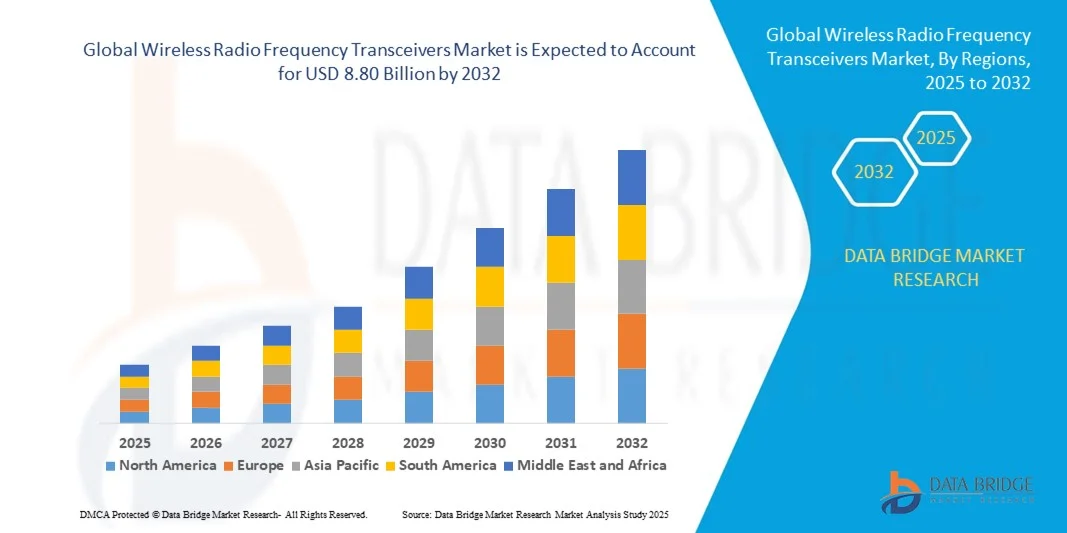
- The global wireless radio frequency transceivers market size was valued at USD 8.00 billion in 2024 and is expected to reach USD 8.80 billion by 2032, at a CAGR of 1.20% during the forecast period
- The market growth is largely fuelled by the increasing adoption of wireless communication technologies across consumer electronics, automotive, healthcare, and industrial applications
- Growing demand for high-speed data transmission, low-latency communication, and miniaturized transceiver modules is further driving market expansion
Wireless Radio Frequency Transceivers Market Analysis
- Rising deployment of IoT devices, smart homes, and connected vehicles is accelerating the need for efficient and reliable radio frequency transceivers, enhancing market adoption
- Technological advancements in low-power, high-performance transceivers, along with increasing integration with 5G and Wi-Fi 6 standards, are supporting market growth
- North America dominated the wireless radio frequency (RF) transceivers market with the largest revenue share in 2024, driven by a growing demand for reliable wireless connectivity, IoT adoption, and advanced communication infrastructure
- Asia-Pacific region is expected to witness the highest growth rate in the global wireless radio frequency transceivers market, driven by rising demand for mobile devices, smart home technologies, industrial automation, and supportive government initiatives for technology adoption
- The 5G transceiver segment held the largest market revenue share in 2024, driven by the rapid global rollout of 5G networks and the growing demand for high-speed, low-latency connectivity across mobile devices and IoT applications. 5G-enabled RF transceivers are increasingly integrated into smartphones, routers, and industrial devices, supporting enhanced data transmission rates and improved network performance
Report Scope and Wireless Radio Frequency Transceivers Market Segmentation
|
Attributes |
Wireless Radio Frequency Transceivers Key Market Insights |
|
Segments Covered |
|
|
Countries Covered |
North America
Europe
Asia-Pacific
Middle East and Africa
South America
|
|
Key Market Players |
|
|
Market Opportunities |
|
|
Value Added Data Infosets |
In addition to the insights on market scenarios such as market value, growth rate, segmentation, geographical coverage, and major players, the market reports curated by the Data Bridge Market Research also include in-depth expert analysis, geographically represented company-wise production and capacity, network layouts of distributors and partners, detailed and updated price trend analysis and deficit analysis of supply chain and demand. |
Wireless Radio Frequency Transceivers Market Trends
Increasing Adoption of Wireless RF Transceivers in IoT and Communication Networks
- The growing adoption of wireless radio frequency (RF) transceivers is transforming the communications and electronics landscape by enabling high-speed, reliable, and low-latency data transmission. The integration of RF transceivers in IoT devices, industrial automation, and consumer electronics allows seamless connectivity and improved operational efficiency. In addition, industries such as healthcare, automotive, and logistics are leveraging RF technology to enhance remote monitoring, real-time tracking, and smart device interoperability
- Rising demand for wireless communication in remote, under-served, and mobile applications is accelerating the deployment of compact and low-power RF transceivers. These systems are particularly critical in smart homes, wearable devices, and industrial sensor networks, ensuring real-time data exchange and control. Furthermore, the expansion of telecommunication networks and smart city initiatives is driving the integration of RF transceivers into large-scale infrastructure projects
- The affordability, miniaturization, and ease of integration of modern RF transceivers are making them attractive for both OEMs and aftermarket suppliers. Manufacturers can deploy RF modules across a variety of electronic platforms, improving connectivity, reliability, and user experience. The trend is also supported by advancements in semiconductor manufacturing, reducing the cost and size of RF transceiver modules while maintaining high performance
- For instance, in 2023, several smart city projects across Europe and Asia reported enhanced wireless network performance after implementing advanced RF transceiver modules in traffic monitoring, environmental sensing, and utility management systems. These deployments improved operational efficiency, data accuracy, and real-time responsiveness in critical applications
- While RF transceivers are enabling seamless wireless communication, their effectiveness depends on continued innovation in frequency management, power efficiency, and signal integrity. Providers must focus on low-cost, energy-efficient, and scalable solutions to fully capitalize on growing demand. Collaboration with IoT platform developers and network providers is also essential to ensure interoperability across devices and standards
Wireless Radio Frequency Transceivers Market Dynamics
Driver
Rising Demand For IoT Connectivity And Advanced Communication Networks
- The growing expansion of IoT devices and connected infrastructure is driving the adoption of RF transceivers across consumer, industrial, and enterprise applications. Reliable wireless connectivity is essential for real-time data transfer, monitoring, and automation. In addition, industrial automation, smart grids, and connected vehicles rely heavily on RF technology for efficient and secure communication
- Increasing investments in 5G, Wi-Fi 6, and other next-generation communication networks are encouraging manufacturers to integrate RF transceivers in devices to meet bandwidth, speed, and latency requirements. These technologies are critical for smart cities, autonomous systems, and industrial IoT deployments. Moreover, government initiatives promoting digital infrastructure and Industry 4.0 adoption further stimulate RF transceiver demand
- OEMs and module suppliers are offering integrated RF solutions, including system-on-chip (SoC) modules, which simplify design, reduce costs, and enhance network performance. This trend supports wider adoption in mobile devices, wearables, and smart appliances. The introduction of low-power, multi-band RF transceivers also facilitates scalable deployments across diverse industrial and consumer segments
- For instance, in 2022, several telecom operators in North America and Europe deployed RF transceiver modules in IoT gateways to improve network reliability, device interoperability, and real-time data communication. These deployments significantly reduced network latency and improved overall service quality for end users
- While IoT growth and network expansion are driving market growth, ensuring device compatibility, low-power consumption, and signal reliability remains critical for sustained adoption. Market players are increasingly investing in research and development to create robust, interference-resistant transceivers suitable for harsh and high-density deployment environments
Restraint/Challenge
High Component Costs And Technical Complexity
- The high cost of advanced RF transceivers, particularly multi-band and high-frequency modules, limits adoption among cost-sensitive consumer electronics and industrial applications. The pricing challenge remains a significant barrier for widespread deployment. In addition, the need for high-quality components to meet strict performance and regulatory standards further increases the overall system cost
- In many regions, limited access to skilled RF engineers and designers capable of implementing and optimizing transceiver systems restricts deployment. Designing efficient antenna systems, power management, and interference mitigation requires specialized expertise. Companies must also invest in testing and calibration processes, which add to project timelines and operational expenses
- Supply chain challenges and the complexity of integrating RF transceivers with existing wireless protocols and networks can delay product rollout. Ensuring consistent performance across diverse environments and frequency bands adds to operational complexity. Shortages in semiconductor materials and global logistics disruptions can also impede timely module availability
- For instance, in 2023, several small-scale IoT device manufacturers in Asia-Pacific reported delays in product launches due to high RF component costs and limited local technical expertise. These challenges affected production schedules, delayed market entry, and reduced competitiveness in price-sensitive markets
- While technological advances continue to improve RF transceiver performance, addressing cost and integration challenges is essential. Collaboration among component manufacturers, system integrators, and network providers is necessary to unlock the full potential of the wireless RF transceivers market. Companies are increasingly adopting modular designs, standardized interfaces, and scalable production strategies to mitigate complexity and accelerate deployment
Wireless Radio Frequency Transceivers Market Scope
The wireless radio frequency (RF) transceivers market is segmented on the basis of type, design type, end-user industry, and application.
- By Type
On the basis of type, the market is segmented into 5G transceiver, 4G transceiver, 3G transceiver, and others. The 5G transceiver segment held the largest market revenue share in 2024, driven by the rapid global rollout of 5G networks and the growing demand for high-speed, low-latency connectivity across mobile devices and IoT applications. 5G-enabled RF transceivers are increasingly integrated into smartphones, routers, and industrial devices, supporting enhanced data transmission rates and improved network performance.
The 4G transceiver segment is expected to witness the fastest growth rate from 2025 to 2032, driven by the continued reliance on 4G infrastructure in emerging markets and hybrid network deployments. 4G RF transceivers offer cost-effective, reliable connectivity solutions for mobile devices, routers, and embedded modules, making them an attractive option for OEMs and end-users seeking seamless communication across legacy and modern networks.
- By Design Type
On the basis of design type, the market is segmented into standalone transceiver and transceiver chip. Standalone transceivers dominated the market in 2024 due to their versatility, ease of integration into diverse electronic platforms, and capability to handle high-frequency communication efficiently.
The transceiver chip segment is expected to witness the fastest growth rate from 2025 to 2032, driven by increasing miniaturization of devices and demand for compact, energy-efficient solutions. Chip-based RF transceivers are particularly suited for mobile devices, wearables, and embedded applications requiring low power consumption and high performance.
- By End-user Industry
On the basis of end-user industry, the market is segmented into consumer electronics, telecommunications, cable/broadcasting, aerospace, military and defense, healthcare, and others. The consumer electronics segment held the largest revenue share in 2024 due to widespread adoption of smartphones, tablets, and smart home devices requiring reliable wireless connectivity.
The telecommunications segment is expected to witness the fastest growth rate from 2025 to 2032, driven by network expansion, deployment of 5G infrastructure, and increasing demand for IoT connectivity in enterprise and industrial applications.
- By Application
On the basis of application, the market is segmented into mobile devices, routers, add-on cards, and embedded modules. The mobile devices segment dominated the market in 2024 owing to the proliferation of smartphones, tablets, and connected gadgets that rely on high-performance RF transceivers for fast, seamless communication.
The embedded modules segment is expected to witness the fastest growth rate from 2025 to 2032, fueled by growing adoption in industrial IoT, automotive electronics, healthcare devices, and smart city infrastructure, where compact, integrated RF solutions are critical for real-time data exchange and system interoperability.
Wireless Radio Frequency Transceivers Market Regional Analysis
- North America dominated the wireless radio frequency (RF) transceivers market with the largest revenue share in 2024, driven by a growing demand for reliable wireless connectivity, IoT adoption, and advanced communication infrastructure
- Consumers and enterprises in the region highly value the high-speed data transfer, low-latency performance, and integration capabilities of RF transceivers across applications such as smart homes, industrial automation, and mobile devices
- This widespread adoption is further supported by technological advancements, high investment in 5G and next-generation networks, and the presence of leading semiconductor and communication equipment manufacturers, establishing RF transceivers as a preferred solution for diverse industries
U.S. Wireless RF Transceivers Market Insight
The U.S. RF transceivers market captured the largest revenue share in North America in 2024, fueled by the rapid rollout of 5G networks, increasing IoT deployments, and strong demand for high-performance communication devices. Enterprises and telecom operators are investing in next-generation transceivers to enhance network reliability, reduce latency, and support high-bandwidth applications. Moreover, the integration of RF transceivers in smartphones, wearables, and industrial automation systems is significantly contributing to the market’s expansion.
Europe Wireless RF Transceivers Market Insight
The Europe RF transceivers market is expected to witness the fastest growth rate from 2025 to 2032, driven by stringent regulatory standards for wireless communication, smart city initiatives, and rising industrial automation. Increasing urbanization and the demand for energy-efficient, high-performance devices are fostering adoption. European manufacturers are also developing advanced RF solutions for aerospace, defense, and consumer electronics applications, driving strong market growth across multiple sectors.
U.K. Wireless RF Transceivers Market Insight
The U.K. RF transceivers market is expected to witness a robust growth rate from 2025 to 2032, fueled by the adoption of IoT-enabled devices, smart home solutions, and 5G network expansion. Businesses and consumers are increasingly leveraging RF technology for connected applications, including industrial automation, mobile devices, and telecommunication networks. The U.K.’s strong R&D ecosystem and advanced electronics manufacturing capabilities are further supporting market growth.
Germany Wireless RF Transceivers Market Insight
The Germany RF transceivers market is expected to witness significant growth from 2025 to 2032, driven by technological advancements, high adoption of Industry 4.0 solutions, and demand for reliable communication systems in automotive, aerospace, and industrial sectors. Germany’s emphasis on innovation and precision engineering promotes the adoption of advanced RF modules, particularly in high-frequency, multi-band, and low-power applications. Integration with smart devices, autonomous systems, and industrial IoT networks is also accelerating market expansion.
Asia-Pacific Wireless RF Transceivers Market Insight
The Asia-Pacific RF transceivers market is expected to witness the highest growth rate from 2025 to 2032, driven by rapid urbanization, rising disposable incomes, and widespread adoption of connected devices in countries such as China, Japan, and India. Government initiatives promoting digitalization, smart cities, and advanced communication networks are fueling market expansion. In addition, APAC’s position as a major manufacturing hub for semiconductors and RF components ensures greater availability, affordability, and innovation in RF transceivers for consumer and industrial applications.
Japan Wireless RF Transceivers Market Insight
The Japan RF transceivers market is expected to witness strong growth from 2025 to 2032 due to the country’s high-tech culture, rapid urbanization, and extensive IoT ecosystem. Japanese consumers and enterprises are increasingly adopting RF-enabled devices for smart homes, healthcare monitoring, industrial automation, and mobile communication. Integration with advanced technologies such as AI, robotics, and 5G networks is also contributing to market growth, while the demand for compact, energy-efficient, and high-frequency transceivers is rising.
China Wireless RF Transceivers Market Insight
The China RF transceivers market accounted for the largest revenue share in Asia-Pacific in 2024, attributed to rapid urbanization, high technological adoption, and strong government support for smart city and 5G initiatives. China represents one of the largest markets for consumer electronics, industrial IoT, and telecommunications, with RF transceivers being widely deployed in mobile devices, routers, and embedded systems. The availability of local manufacturers and cost-effective solutions, combined with strong R&D capabilities, is driving continued growth across both commercial and industrial applications.
Wireless Radio Frequency Transceivers Market Share
The Wireless Radio Frequency Transceivers industry is primarily led by well-established companies, including:
• Intel Corporation (U.S.)
• RF Micro Devices Inc (U.S.)
• SAMSUNG (South Korea)
• Qualcomm Technologies, Inc. and/or its Affiliated Companies (U.S.)
• Broadcom (U.S.)
• Renesas Electronics Corporation (Japan)
• Qorvo, Inc (U.S.)
• STMicroelectronics (Switzerland)
• Texas Instruments Incorporated (U.S.)
• Skyworks Solutions, Inc. (U.S.)
• Infineon Technologies AG (Germany)
• NXP Semiconductors (Netherlands)
• Maxim Integrated (U.S.)
• TOSHIBA ELECTRONIC DEVICES & STORAGE CORPORATION (Japan)
• Linx Technologies (U.S.)
• FUJITSU Semiconductor (Japan)
• Semiconductor Components Industries, LLC (U.S.)
• Murata Manufacturing Co., Ltd. (Japan)
• Nokia (Finland)

- Interactive Data Analysis Dashboard
- Company Analysis Dashboard for high growth potential opportunities
- Research Analyst Access for customization & queries
- Competitor Analysis with Interactive dashboard
- Latest News, Updates & Trend analysis
- Harness the Power of Benchmark Analysis for Comprehensive Competitor Tracking
Global Wireless Radio Frequency Transceivers Market, Supply Chain Analysis and Ecosystem Framework
To support market growth and help clients navigate the impact of geopolitical shifts, DBMR has integrated in-depth supply chain analysis into its Global Wireless Radio Frequency Transceivers Market research reports. This addition empowers clients to respond effectively to global changes affecting their industries. The supply chain analysis section includes detailed insights such as Global Wireless Radio Frequency Transceivers Market consumption and production by country, price trend analysis, the impact of tariffs and geopolitical developments, and import and export trends by country and HSN code. It also highlights major suppliers with data on production capacity and company profiles, as well as key importers and exporters. In addition to research, DBMR offers specialized supply chain consulting services backed by over a decade of experience, providing solutions like supplier discovery, supplier risk assessment, price trend analysis, impact evaluation of inflation and trade route changes, and comprehensive market trend analysis.
Data collection and base year analysis are done using data collection modules with large sample sizes. The stage includes obtaining market information or related data through various sources and strategies. It includes examining and planning all the data acquired from the past in advance. It likewise envelops the examination of information inconsistencies seen across different information sources. The market data is analysed and estimated using market statistical and coherent models. Also, market share analysis and key trend analysis are the major success factors in the market report. To know more, please request an analyst call or drop down your inquiry.
The key research methodology used by DBMR research team is data triangulation which involves data mining, analysis of the impact of data variables on the market and primary (industry expert) validation. Data models include Vendor Positioning Grid, Market Time Line Analysis, Market Overview and Guide, Company Positioning Grid, Patent Analysis, Pricing Analysis, Company Market Share Analysis, Standards of Measurement, Global versus Regional and Vendor Share Analysis. To know more about the research methodology, drop in an inquiry to speak to our industry experts.
Data Bridge Market Research is a leader in advanced formative research. We take pride in servicing our existing and new customers with data and analysis that match and suits their goal. The report can be customized to include price trend analysis of target brands understanding the market for additional countries (ask for the list of countries), clinical trial results data, literature review, refurbished market and product base analysis. Market analysis of target competitors can be analyzed from technology-based analysis to market portfolio strategies. We can add as many competitors that you require data about in the format and data style you are looking for. Our team of analysts can also provide you data in crude raw excel files pivot tables (Fact book) or can assist you in creating presentations from the data sets available in the report.













