


What is the Wireless Surgical Instrument Tracking Systems Market Size and Growth Rate?
- As per Data Bridge Market Research Analysis the global wireless surgical instrument tracking systems market size was valued at USD 936 billion in 2025 and is expected to reach USD 3866.43 billion by 2033, at a CAGR of 19.40% during the forecast period
- The market growth is largely fueled by the increasing adoption of digital healthcare solutions and advanced surgical technologies, leading to improved efficiency and patient safety in operating rooms
- Furthermore, rising demand for accurate surgical instrument tracking, reduction in instrument loss, and compliance with sterilization protocols is establishing wireless surgical instrument tracking systems as a critical component in modern healthcare facilities. These converging factors are accelerating the uptake of Wireless Surgical Instrument Tracking Systems solutions, thereby significantly boosting the industry's growth
Market Size & Forecast
- Global Market Value (2025): USD 936 billion
- Expected Market Value (2033): USD 3866.43 billion
- Forecast CAGR (2026–2033): 19.40%
What are the Major Takeaways of Wireless Surgical Instrument Tracking Systems Market?
- Wireless Surgical Instrument Tracking Systems are increasingly vital components in modern operating rooms, offering real-time tracking, inventory management, and enhanced safety for surgical instruments in both hospitals and ambulatory surgical centers due to their ability to improve workflow efficiency, reduce errors, and optimize sterilization processes
- The escalating demand for these systems is primarily fueled by the growing adoption of digital healthcare technologies, increasing surgical volumes, rising focus on patient safety, and the need for efficient instrument management in healthcare facilities
- North America dominated the wireless surgical instrument tracking systems market with the largest revenue share of 39.2% in 2025, characterized by advanced healthcare infrastructure, high adoption of digital surgical technologies, and a strong presence of key medical device companies, with the U.S. experiencing substantial growth in system deployments in hospitals and ambulatory surgical centers
- Asia-Pacific is expected to be the fastest growing region in the wireless surgical instrument tracking systems market during the forecast period, with a projected CAGR of 10.5%, due to increasing healthcare expenditure, rising adoption of smart hospital technologies, and growing awareness of patient safety and operational efficiency
- The surgical instrument management segment accounted for the largest market revenue share of 46.5% in 2025, driven by hospitals and clinics prioritizing efficient workflow, accurate instrument counts, and reduction of misplaced or lost tools during surgeries
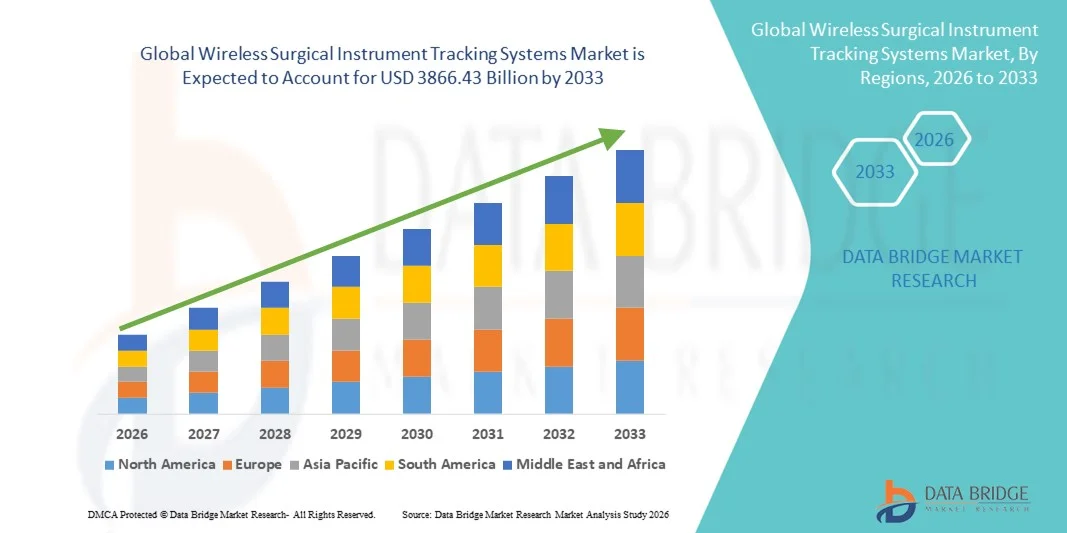
Report Scope and Wireless Surgical Instrument Tracking Systems Market Segmentation
|
Attributes |
Wireless Surgical Instrument Tracking Systems Key Market Insights |
|
Segments Covered |
|
|
Countries Covered |
North America
Europe
Asia-Pacific
Middle East and Africa
South America
|
|
Key Market Players |
|
|
Market Opportunities |
|
|
Value Added Data Infosets |
In addition to the insights on market scenarios such as market value, growth rate, segmentation, geographical coverage, and major players, the market reports curated by the Data Bridge Market Research also include in-depth expert analysis, patient epidemiology, pipeline analysis, pricing analysis, and regulatory framework. |
What is the Key Trend in the Wireless Surgical Instrument Tracking Systems Market?
Enhanced Convenience Through Technological Integration
- A significant and accelerating trend in the global Wireless Surgical Instrument Tracking Systems market is the integration of advanced tracking technologies with hospital management systems and connected surgical environments. This enables real-time monitoring of surgical instruments, reducing errors, and improving operational efficiency
- For instance, advanced systems now offer RFID-based tracking, allowing hospitals to locate instruments instantly, track sterilization cycles, and maintain accurate inventory records. Similarly, Bluetooth-enabled solutions provide seamless integration with surgical carts and centralized hospital databases, ensuring instruments are always accounted for
- Technological integration also supports automated alerts for missing or overdue instruments, reducing the risk of procedural delays and potential surgical complications. These systems enhance workflow efficiency and reduce staff workload by eliminating manual tracking processes
- The combination of wireless connectivity, cloud-based reporting, and centralized management facilitates better coordination across operating rooms, inventory departments, and sterilization units, creating a unified and automated surgical workflow
- This trend towards more intelligent, connected, and reliable tracking systems is reshaping hospital expectations regarding operational efficiency, patient safety, and regulatory compliance. Consequently, leading manufacturers are continuously innovating solutions that offer higher accuracy, improved integration with hospital IT systems, and automated compliance reporting
- The demand for advanced wireless surgical instrument tracking systems is growing rapidly across hospitals and surgical centers worldwide, driven by the need for efficient workflows, patient safety, and compliance with healthcare standards
Wireless Surgical Instrument Tracking Systems Market Dynamics
Driver
Rising Need for Operational Efficiency and Patient Safety
- The increasing complexity of surgical procedures and the rising number of surgeries performed worldwide are driving the demand for efficient tracking solutions that ensure instruments are available, sterile, and accounted for
- For instance, BD (Becton Dickinson) implemented a wireless tracking solution in multiple hospital networks in the U.S., which helped reduce misplaced instruments by over 30% and improved operating room turnover rates, demonstrating tangible efficiency gains. Similarly, Getinge’s RFID solutions have enabled European hospitals to automate sterilization cycle tracking and inventory audits, reducing human error and improving patient safety compliance
- Adoption of advanced surgical techniques and minimally invasive procedures requires precise instrument management, encouraging hospitals to implement automated tracking solutions
- Growing awareness of regulatory compliance and sterilization standards, such as those set by the Joint Commission and ISO, is pushing healthcare providers to invest in reliable instrument tracking technologies
- Increasing emphasis on hospital efficiency, cost reduction, and improved patient outcomes is motivating healthcare institutions to integrate wireless tracking systems into their operating rooms and central sterilization departments
Restraint/Challenge
High Implementation Costs and Integration Complexities
- The relatively high cost of advanced wireless surgical instrument tracking systems compared to traditional manual tracking methods can limit adoption, especially in small or budget-constrained hospitals
- For instance, Steris’ OR management system deployment in several developing-region hospitals faced delays due to high equipment costs, IT integration challenges, and the need for staff training, highlighting the practical difficulties of adoption despite clear efficiency benefits. Similarly, some hospitals adopting Stryker’s Smart OR solutions encountered signal interference and compatibility issues with legacy EMR systems, underscoring the complexity of large-scale implementation
- Integration with existing hospital IT infrastructure and electronic medical record (EMR) systems can be complex and may require additional training and technical support
- Potential technical issues, such as signal interference in operating rooms or data transmission errors, may affect reliability and require careful system calibration
- Hospitals may face challenges in standardizing procedures across multiple departments or surgical units, delaying full implementation of tracking systems
- Overcoming these challenges through cost-effective system designs, staff training, and robust IT support is crucial for broader adoption and long-term growth of wireless surgical instrument tracking solutions
How is the Wireless Surgical Instrument Tracking Systems Market Segmented?
The market is segmented on the basis of product type, end user, and application.
- By Product Type
On the basis of product type, the Wireless Surgical Instrument Tracking Systems market is segmented into RFID-based tracking systems, barcode-based tracking systems, and hybrid systems. The RFID-based tracking systems segment dominated the largest market revenue share of 44.1% in 2025, driven by its ability to provide real-time, automated tracking of surgical instruments in hospitals and surgical centers. RFID systems reduce human errors, enhance inventory management, and improve sterilization compliance. The growing adoption of digital hospital workflows and smart operating rooms further fuels demand. Hospitals and specialty clinics prefer RFID systems for accurate asset tracking and improved patient safety. Technological advancements in RFID tags and readers enhance detection accuracy and durability. Regulatory support for instrument traceability strengthens adoption. Integration with hospital information systems allows seamless data management. Cost-effectiveness in the long term compared to manual tracking methods also drives growth. Increased awareness of infection control protocols in healthcare settings supports adoption. Training programs and vendor support further encourage uptake. Manufacturers continue to innovate with hybrid RFID solutions that can integrate with existing infrastructure. Government initiatives to improve healthcare quality are bolstering market penetration.
The barcode-based tracking systems segment is expected to witness the fastest CAGR of 12.7% from 2026 to 2033, fueled by its simplicity, cost-effectiveness, and widespread applicability in small to mid-sized hospitals and ASCs. Barcode systems allow efficient scanning and tracking of surgical instruments during sterilization, storage, and use. They are particularly favored in regions with limited budgets or existing barcode infrastructure. Growing emphasis on operational efficiency, inventory management, and reduction of instrument loss drives adoption. Barcode systems are compatible with existing electronic health records and asset management software. Healthcare staff can be quickly trained on barcode usage, enhancing compliance. Integration with sterilization workflows ensures safety standards. Barcode labels with durable materials increase usability in repeated sterilization cycles. The rising number of outpatient procedures and ambulatory surgical centers worldwide supports segment growth. Manufacturers are innovating with 2D barcodes and enhanced scanning technologies. Partnerships with software providers enable centralized instrument data tracking. The segment’s low implementation cost and rapid ROI make it highly attractive for emerging markets.
- By End User
On the basis of end user, the market is segmented into hospitals, ambulatory surgical centers (ASCs), and specialty clinics. The hospitals segment held the largest market revenue share of 50.3% in 2025, owing to the high volume of surgical procedures and the need for efficient instrument management and sterilization protocols. Hospitals increasingly adopt wireless tracking systems to enhance operational efficiency, reduce instrument loss, and ensure compliance with hygiene regulations. Advanced IT infrastructure in hospitals supports integration of RFID and barcode systems. Large hospital networks benefit from real-time visibility across multiple departments. Investments in smart operating rooms and digital workflows promote adoption. Hospitals also leverage tracking data for audit trails and regulatory reporting. Multi-disciplinary surgical departments increase the complexity of instrument management, encouraging wireless solutions. Cost savings from reduced instrument loss and improved staff productivity reinforce demand. Government support and hospital accreditation requirements further boost adoption. The presence of experienced technical staff facilitates smooth deployment of wireless tracking systems. Increasing global healthcare expenditure ensures continued growth of hospital segment dominance.
The ambulatory surgical centers (ASCs) segment is expected to witness the fastest CAGR of 13.2% from 2026 to 2033, driven by the rising number of outpatient surgeries and minimally invasive procedures. ASCs seek efficient instrument tracking to optimize workflow and reduce turnaround times between procedures. The smaller size and focused surgical scope of ASCs make wireless tracking solutions ideal for improving operational efficiency. Adoption is also fueled by growing patient volume, staff shortage concerns, and the need for cost-effective solutions. Regulatory emphasis on infection prevention and instrument sterilization increases the demand for tracking systems. Integration with electronic medical records enables better data management. ASCs benefit from easy scalability of wireless solutions to match procedure growth. Hybrid systems combining RFID and barcode technology are gaining traction in these settings. Vendors are offering tailored solutions for ASCs with subscription-based models, reducing upfront costs. The segment’s growth is also supported by healthcare reforms encouraging outpatient care. Training programs and user-friendly software improve adoption rates. ASCs are expected to continue rapidly adopting wireless tracking technologies for operational excellence.
- By Application
On the basis of application, the market is segmented into surgical instrument management, asset tracking, and sterilization monitoring. The surgical instrument management segment accounted for the largest market revenue share of 46.5% in 2025, driven by hospitals and clinics prioritizing efficient workflow, accurate instrument counts, and reduction of misplaced or lost tools during surgeries. Wireless tracking systems allow real-time visibility of instruments throughout preoperative, intraoperative, and postoperative processes. Enhanced management ensures compliance with safety standards and improves patient outcomes. High procedure volumes and complex surgeries increase reliance on automated instrument management. Integration with sterilization workflows ensures instruments are properly cleaned and ready for use. Hospitals leverage system analytics for inventory optimization and cost savings. Staff efficiency improves as manual counting is minimized. Innovations in RFID tagging and automated reporting further strengthen segment growth. Training programs support smooth deployment in clinical environments. Regulatory frameworks and accreditation standards reinforce adoption. Large-scale hospitals continue to implement advanced systems to maintain quality and safety standards.
The sterilization monitoring segment is expected to witness the fastest CAGR of 13.6% from 2026 to 2033, fueled by increasing emphasis on infection control and hospital-acquired infection prevention. Wireless tracking systems monitor sterilization cycles, track instrument readiness, and provide alerts for sterilization failures. Hospitals, ASCs, and specialty clinics benefit from automated compliance reporting and audit trails. Technological advancements, such as IoT-enabled sterilization monitoring, increase efficiency. Adoption is supported by stringent hygiene protocols and regulatory mandates. Healthcare providers are increasingly aware of patient safety implications of inadequate sterilization. Integration with surgical instrument management systems enhances visibility and accountability. Real-time alerts reduce human error and improve turnaround times. The increasing number of surgical procedures worldwide drives demand for sterilization monitoring solutions. Cost savings from reduced instrument damage and reprocessing errors further promote adoption. Emerging markets are investing in wireless sterilization monitoring to meet global standards. The segment’s rapid growth is expected to continue as hospitals and surgical centers emphasize patient safety and operational excellence.
Which Region Holds the Largest Share of the Wireless Surgical Instrument Tracking Systems Market?
- North America dominated the wireless surgical instrument tracking systems market with the largest revenue share of 39.2% in 2025, characterized by advanced healthcare infrastructure, high adoption of digital surgical technologies, and a strong presence of key medical device companies
- Consumers and healthcare providers in the region highly value the efficiency, accuracy, and real-time monitoring capabilities offered by wireless surgical instrument tracking systems, which help reduce procedural errors, streamline sterilization processes, and ensure compliance with hospital protocols
- This widespread adoption is further supported by high healthcare spending, technologically advanced hospital networks, and the growing preference for data-driven, automated surgical environments, establishing tracking systems as a favored solution for both hospitals and ambulatory surgical centers
U.S. Wireless Surgical Instrument Tracking Systems Market Insight
The U.S. wireless surgical instrument tracking systems market captured the largest revenue share in North America in 2025, driven by the rapid deployment of digital surgical technologies across hospitals and outpatient surgery centers. Hospitals are increasingly prioritizing patient safety, operational efficiency, and inventory management through wireless tracking solutions. Leading examples include Censis Technologies’ RFID systems, which allow for real-time instrument tracking throughout sterilization and surgeries, and Stryker Smart OR solutions, which enhance instrument availability and reduce procedural delays. Furthermore, integration with hospital IT systems and cloud-based dashboards enables centralized monitoring, boosting adoption of these systems nationwide.
Europe Wireless Surgical Instrument Tracking Systems Market Insight
The Europe wireless surgical instrument tracking systems market is projected to grow at a substantial CAGR during the forecast period, driven by stringent regulatory requirements for surgical instrument traceability, increasing hospital digitization, and demand for enhanced patient safety. Hospitals across Germany, France, and other countries are adopting automated tracking solutions to improve efficiency and compliance with sterilization and safety standards.
U.K. Wireless Surgical Instrument Tracking Systems Market Insight
The U.K. wireless surgical instrument tracking systems market is anticipated to expand at a noteworthy CAGR, supported by the rising trend of hospital automation and the need for secure, efficient surgical workflows. Concerns regarding procedural delays, instrument misplacement, and patient safety are encouraging hospitals and surgical centers to adopt wireless tracking technologies. Systems such as Surgical Theater Bluetooth trackers are being implemented to optimize operating room readiness and reduce manual errors.
Germany Wireless Surgical Instrument Tracking Systems Market Insight
Germany’s wireless surgical instrument tracking systems market is expected to grow significantly, fueled by high awareness of digital surgical technologies, strong healthcare infrastructure, and a focus on operational efficiency and patient safety. Hospitals are integrating wireless tracking solutions with their hospital information systems, enabling seamless workflow management and real-time compliance monitoring. Advanced systems also support sustainable practices by reducing instrument loss and improving sterilization efficiency.
Asia-Pacific Wireless Surgical Instrument Tracking Systems Market Insight
The Asia-Pacific wireless surgical instrument tracking systems market is poised to grow at the fastest CAGR of 10.5% during the forecast period, driven by rising healthcare expenditure, increasing hospital modernization, and growing awareness of patient safety and operational efficiency. Countries like China, India, and Japan are investing heavily in digital hospital infrastructure and smart surgical systems.
Japan Wireless Surgical Instrument Tracking Systems Market Insight
The Japanese wireless surgical instrument tracking systems market is expanding due to high technological adoption, aging population, and emphasis on patient safety and surgical accuracy. Integration of wireless tracking systems with other hospital IT solutions and IoT devices is fueling growth, enabling hospitals to optimize instrument availability and reduce procedural risks.
China Wireless Surgical Instrument Tracking Systems Market Insight
China wireless surgical instrument tracking systems market accounted for the largest revenue share in APAC in 2025, driven by rapid urbanization, a growing middle-class healthcare sector, and large-scale hospital digitalization projects. Government initiatives supporting smart hospitals and adoption of advanced surgical technologies are encouraging widespread deployment of wireless tracking systems. Domestic manufacturers and affordable solutions are further enhancing accessibility across urban and semi-urban hospitals.
Which are the Top Companies in Wireless Surgical Instrument Tracking Systems Market?
The Wireless Surgical Instrument Tracking Systems industry is primarily led by well-established companies, including:
- Stryker (U.S.)
- Medtronic (Ireland)
- Becton Dickinson (U.S.)
- Getinge AB (Sweden)
- Oracle (U.S.)
- Terumo Corporation (Japan)
- CareFusion (U.S.)
- GE Healthcare (U.S.)
- Johnson & Johnson – Ethicon (U.S.)
- BD Medical (U.S.)
- Smith & Nephew (U.K.)
- Philips Healthcare (Netherlands)
- BD RFID Solutions (U.S.)
- Cardinal Health (U.S.)
- STERIS Corporation (U.S.)
- CriticalPoint Solutions (U.S.)
- OPSGEAR (U.S.)
- Imris (Canada)
- MediTrak (U.K.)
- Carestream Health (U.S.)
What are Latest Developments in Wireless Surgical Instrument Tracking Systems Market?
- In April 2021, Ommo Technologies introduced ORBIT, the first-ever precision surgical instrument tracking system based on permanent magnet technology, designed to deliver real‑time tracking with sub‑millimeter accuracy for surgical tools across various clinical environments, advancing the precision and reliability of instrument tracing technology
- In September 2022, HID Global acquired Vizinex RFID, a significant step expanding its RFID portfolio for healthcare tracking applications, including surgical instrument tracking systems — strengthening its capacity to deliver enhanced wireless asset tracking solutions across hospital environments
- In March 2023, BD (Becton, Dickinson & Company) launched a new robotic track system designed to automate specimen and instrument processing in clinical settings, reflecting an increasing trend of automation and wireless tracking in hospital workflows linked to surgical instrument traceability
- In April 2023, Surglogs released the Sterile Processing Records module, a digital tracking enhancement that enables detailed monitoring of surgical instrument sterilization cycles and related data — improving compliance and workflow management in healthcare facilities
- In April 2024, Aesculap, Inc. launched the AESCULAP Aicon RTLS, a real‑time location service integrated with the Aicon sterile container system, enabling wireless tracking of surgical instrument sets from sterilization departments to operating rooms — transforming sterile processing operations with digital visibility
- In July 2024, Mobile Aspects (US) launched SurgiCart, an RFID‑enabled mobile inventory and supply tracking system designed for operating rooms and procedural areas. The platform provides real‑time wireless visibility of surgical tools and supplies, helping hospitals reduce instrument loss and improve procedural readiness
- In January 2025, Censis Technologies unveiled its next‑generation CensisAI3 platform, incorporating advanced predictive analytics and wireless tracking capabilities to optimize instrument maintenance and sterile processing workflows — enhancing how surgical instruments are tracked and managed in real time
- In February 2025, Identiv and Novanta announced a strategic partnership to deliver end‑to‑end RFID solutions for medical OEMs, integrating high‑performance RFID inlays with advanced reader modules to streamline instrument traceability and clinical workflow automation in OR settings
- In April 2025, ID Integration partnered with Zebra Technologies at HIMSS 2025 to demonstrate passive RFID‑based hospital asset and specimen tracking — including wireless surgical instrument location systems using handheld and fixed readers — highlighting growing industry adoption of connected tracking solutions
- In May 2025, Elucent Medical received Breakthrough Device Designation from the FDA for its EnVisio X1 In‑Body Spatial Intelligence System, featuring implantable SmartClips and SmartSensor‑equipped devices to enable real‑time 3D tracking of surgical instruments and soft‑tissue markers during procedures, signifying a leap toward advanced wireless tracking in surgical environment

- Interactive Data Analysis Dashboard
- Company Analysis Dashboard for high growth potential opportunities
- Research Analyst Access for customization & queries
- Competitor Analysis with Interactive dashboard
- Latest News, Updates & Trend analysis
- Harness the Power of Benchmark Analysis for Comprehensive Competitor Tracking
Data collection and base year analysis are done using data collection modules with large sample sizes. The stage includes obtaining market information or related data through various sources and strategies. It includes examining and planning all the data acquired from the past in advance. It likewise envelops the examination of information inconsistencies seen across different information sources. The market data is analysed and estimated using market statistical and coherent models. Also, market share analysis and key trend analysis are the major success factors in the market report. To know more, please request an analyst call or drop down your inquiry.
The key research methodology used by DBMR research team is data triangulation which involves data mining, analysis of the impact of data variables on the market and primary (industry expert) validation. Data models include Vendor Positioning Grid, Market Time Line Analysis, Market Overview and Guide, Company Positioning Grid, Patent Analysis, Pricing Analysis, Company Market Share Analysis, Standards of Measurement, Global versus Regional and Vendor Share Analysis. To know more about the research methodology, drop in an inquiry to speak to our industry experts.
Data Bridge Market Research is a leader in advanced formative research. We take pride in servicing our existing and new customers with data and analysis that match and suits their goal. The report can be customized to include price trend analysis of target brands understanding the market for additional countries (ask for the list of countries), clinical trial results data, literature review, refurbished market and product base analysis. Market analysis of target competitors can be analyzed from technology-based analysis to market portfolio strategies. We can add as many competitors that you require data about in the format and data style you are looking for. Our team of analysts can also provide you data in crude raw excel files pivot tables (Fact book) or can assist you in creating presentations from the data sets available in the report.













