What is the Work Order Management Systems Market Size and Growth Rate?
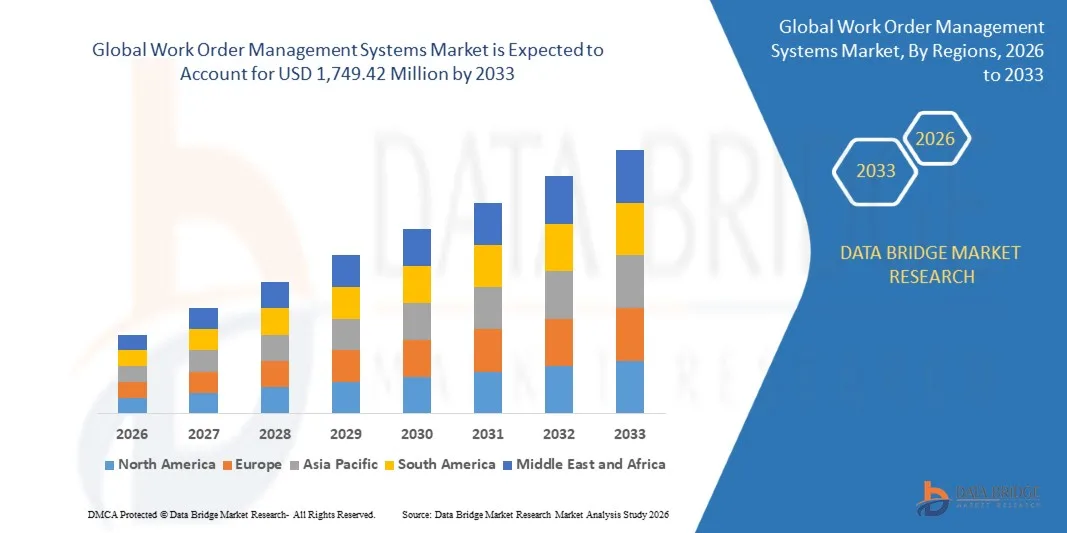
- As per Data Bridge Market Research analysis, the work order management systems market was valued at USD 791.61 million in 2025 and is projected to reach USD 1,749.42 million by 2033, growing at a CAGR of 10.42% from 2026 to 2033.
- The market is experiencing consistent growth driven by rising demand for digital maintenance and service workflows, increasing adoption of cloud-based and mobile-first platforms, and expanding applications across manufacturing, healthcare, energy and utilities, logistics, and facilities management sectors.
- The increasing shift from paper-based and spreadsheet-driven maintenance toward automated scheduling, real-time asset visibility, and data-driven decision-making, combined with growing integration of work order platforms with IoT sensors, mobile devices, and enterprise systems, is supporting market adoption. Computerized maintenance management is being applied across preventive maintenance, field service operations, inventory control, and compliance reporting, offering organizations greater control over enterprise asset performance and technician productivity.
Market Size & Forecast
- Global Market Value (2025): USD 791.61 Million
- Expected Market Value (2033): USD 1,749.42 Million
- Forecast CAGR (2026–2033): 10.42%
- Leading Region in 2025: North America
- Fastest Growing Region: Asia Pacific
What are the Major Takeaways of the Work Order Management Systems Market?
- North America dominated the work order management systems market with the largest revenue share of 36.84% in 2025, supported by strong adoption of cloud-based maintenance software, enterprise asset management platforms, and digitized facility operations.
- Asia-Pacific is expected to be the fastest-growing region at a CAGR of 12.96% from 2026 to 2033, fueled by rapid industrialization, expanding smart-factory investments, and growing adoption of mobile-enabled maintenance platforms.
- The software segment led the market with a 71.25% share in 2025, driven by increasing adoption of work order creation, scheduling, tracking, and analytics modules across industries.
- Services are the fastest-growing component type, projected to register a CAGR of 12.31%, reflecting the surge in demand for implementation, integration, training, and managed support.
- The cloud-based segment dominated the deployment category with a 58.73% revenue share in 2025, led by lower upfront costs, faster rollout, and remote accessibility.
- Maintenance & repair operations accounted for 38.62% of the market share in 2025, preferred by increasing need to reduce unplanned downtime and extend asset life across industrial and commercial facilities.
- The field service management segment is the fastest-growing application category, with a CAGR of 12.67%, driven by increasing demand for technician dispatch, mobile work orders, and customer-service tracking.
Report Scope and Work Order Management Systems Market Segmentation
|
Attributes |
Work Order Management Systems Key Market Insights |
|
Segments Covered |
|
|
Countries Covered |
North America
Europe
Asia-Pacific
Middle East and Africa
South America
|
|
Key Market Players |
|
|
Market Opportunities |
|
|
Value Added Data Infosets |
In addition to the market insights such as market value, growth rate, market segments, geographical coverage, market players, and market scenario, the market report curated by the Data Bridge Market Research team includes in-depth expert analysis, import/export analysis, pricing analysis, production consumption analysis, and pestle analysis. |
What is the Key Trend in the Work Order Management Systems Market?
- Work order management systems are increasingly evolving from simple ticket-tracking tools into intelligent operations platforms, combining mobile access, automation, IoT data, and generative AI to create, prioritize, and route maintenance and service tasks in real time.
- For instance, in January 2026, according to Limble, the company announced a Winter Release featuring AI-powered workload and scheduling recommendations, automated asset-record creation from equipment photos, and a Model Context Protocol connection linking maintenance data with enterprise systems and AI tools, highlighting the move toward AI-assisted work management.
- AI-assisted request intake is enabling organizations to convert emails, messages, and calls into structured work orders, reducing manual data entry and shortening response times.
- Mobile-first and knowledge-enabled work order tools are also gaining traction, as technicians increasingly expect procedures, equipment manuals, and historical repair records to be available directly inside each work order in the field.
- For instance, in February 2025, according to MaintainX, the company released CoPilot, an AI assistant that uses OEM manuals and work order history to generate standardized work orders and procedures and to deliver equipment knowledge to technicians in the field, supporting faster and more consistent task execution.
- As AI, IoT connectivity, mobile access, and open integration capabilities continue to advance, work order management systems are expected to expand beyond maintenance tracking into predictive scheduling, autonomous triage, vendor coordination, and enterprise-wide operational intelligence.
What are the Key Drivers of the Work Order Management Systems Market?
- The rapid shift toward preventive and predictive maintenance has significantly increased demand for systems that schedule, document, and analyze work consistently across assets, sites, and teams.
- For instance, in April 2024, according to Rockwell Automation, Fiix introduced generative AI prescriptive work orders within its Asset Risk Predictor software, which can be set up in as little as two weeks, predicts asset failures days in advance, and converts those predictions into detailed work orders aimed at reducing unplanned downtime.
- Manufacturers, healthcare providers, utilities, logistics operators, and facilities teams are adopting digital work order platforms to improve technician productivity, maintain audit-ready records, and control maintenance costs.
- For instance, in May 2025, according to FlowPath, the company launched a Work Order AI Automation package that parses inbound requests from emails, texts, calls, Slack messages, and forms to create or route work orders automatically, flag duplicates, and monitor delays, supporting automation-led maintenance operations.
- With organizations increasingly replacing manual tracking with connected maintenance workflows, work order management systems can support faster response, better asset uptime, and integration with enterprise resource planning and asset management platforms.
What Factors Are Challenging the Growth of the Work Order Management Systems Market?
- Work order management systems require integration with asset registers, inventory, finance, and identity systems, which increases implementation effort and complexity for organizations with legacy or fragmented data.
- For instance, in June 2024, according to Lula, its Foresight work order platform was introduced to a group of early adopters in a pilot phase with waitlist-based access and depends on custom integrations with existing property management systems, illustrating the onboarding effort involved.
- These integration, training, and change-management requirements can increase deployment timelines and create challenges related to data quality, user adoption, mobile connectivity at remote sites, and consistent process standardization across locations.
- Advanced capabilities such as AI automation, predictive scheduling, and analytics are often priced as add-ons, which can raise total subscription costs and constrain adoption among small and mid-sized organizations with limited budgets.
- For instance, in March 2025, according to the IBM Sustainability Software Ideas Portal, IBM responded to a request for an AI model within Maximo trained on work management data by stating that it was a use-case area being explored, indicating that AI-driven work management is still maturing even within established enterprise asset management platforms.
- The combination of integration effort, data-quality dependence, add-on pricing, and evolving AI maturity can constrain adoption among cost-sensitive users and organizations, particularly where spreadsheets, email, or basic ticketing tools already satisfy routine maintenance tracking requirements.
How is the Work Order Management Systems Market Segmented?
The work order management systems market is segmented on the basis of component, deployment, application, and end user.
- By Component
On the basis of component, the work order management systems market is segmented into software and services. The software segment dominated the market with 71.25% share in 2025, supported by increasing adoption of platforms for work order creation, scheduling, tracking, and reporting. Software allows organizations to centralize maintenance requests, assign technicians, track parts usage, and maintain complete service histories. It is increasingly used across manufacturing, healthcare, utilities, and facilities environments. Improvements in mobile interfaces, automation, and analytics are further strengthening demand. Integration with enterprise resource planning, asset management, and IoT platforms also enables work data to be shared across departments and sites.
The services segment is projected to register the fastest growth at a CAGR of 12.31% from 2026 to 2033, driven by increasing demand for implementation, system integration, data migration, training, and managed support. Many organizations require expert assistance to configure workflows, connect legacy systems, and standardize maintenance processes across multiple sites. Consulting and customization services help align platforms with industry-specific compliance requirements. Growing adoption of AI-enabled features is also creating demand for onboarding and change-management support. Ongoing optimization, analytics, and support contracts further improve system utilization and long-term customer retention.
- By Deployment
On the basis of deployment, the work order management systems market is segmented into cloud-based, on-premises, and hybrid. The cloud-based segment dominated the market with 58.73% share in 2025, supported by lower upfront costs, faster implementation, and remote accessibility. Cloud platforms enable technicians and managers to create, update, and close work orders from mobile devices in real time. Subscription pricing makes advanced capabilities accessible to small and mid-sized organizations. Automatic updates, scalable storage, and easier integration with other software services further strengthen adoption. Vendors are also embedding AI assistants and analytics into cloud offerings, increasing their appeal across industries.
The hybrid segment is projected to register the fastest growth at a CAGR of 12.74% from 2026 to 2033, supported by organizations that need to balance cloud flexibility with local control of sensitive operational data. Industrial plants, utilities, and healthcare facilities often operate in environments with limited connectivity or strict data-residency requirements. Hybrid architectures allow work orders to be captured offline at the edge and synchronized with cloud analytics when connectivity is available. Integration with plant-level control systems and existing enterprise software can also be maintained. Growing use of on-site AI processing for privacy-sensitive data is creating additional demand.
- By Application
On the basis of application, the work order management systems market is segmented into maintenance & repair operations, field service management, facility management, and others. The maintenance & repair operations segment dominated the application category with 38.62% share in 2025, supported by the need to reduce unplanned downtime and extend asset life. Work order platforms help teams schedule preventive tasks, record corrective actions, and track asset history. They support compliance with inspection and safety requirements through documented procedures. Integration with sensors and condition-monitoring tools enables maintenance requests to be triggered automatically. Organizations are increasingly seeking technologies that combine task execution with performance analytics.
The field service management segment is projected to register the fastest growth at a CAGR of 12.67% from 2026 to 2033, driven by increasing demand for technician dispatch, route optimization, mobile work orders, and customer-service tracking. Service organizations are using work order platforms to improve first-time fix rates and response times. Mobile access to manuals, parts availability, and customer history helps technicians complete jobs efficiently. Integration with scheduling, invoicing, and customer-management systems can reduce administrative effort. Growth in outsourced facilities and equipment servicing is also creating demand for connected, multi-vendor work order coordination.
- By End User
On the basis of end user, the work order management systems market is segmented into Manufacturing, Healthcare, Energy & Utilities, Transportation & Logistics, Real Estate & Facilities, and Others. The manufacturing segment dominated the end-user category with 31.47% share in 2025, supported by the need to maintain production equipment and minimize unplanned downtime. Plants use work order systems to schedule preventive maintenance, manage spare parts, and document repairs. Integration with production systems and condition monitoring improves maintenance planning. Increasing investment in smart-factory initiatives is creating further opportunities for connected maintenance workflows. Quality, safety, and audit requirements also encourage standardized digital records.
The healthcare segment is projected to register the fastest growth at CAGR of 12.35% from 2026 to 2033, driven by increasing digitization of biomedical equipment maintenance, facility management, and regulatory compliance documentation. Hospitals depend on reliable medical equipment, building systems, and environmental controls, where service delays can affect patient care. Work order platforms help track inspections, calibrations, and repairs while maintaining audit-ready records. Integration with asset inventories and vendor management tools improves accountability. Growing pressure to control operating costs and extend equipment life is further supporting adoption. Data security and compatibility with hospital information systems remain important deployment considerations.
Which Region Holds the Largest Share of the Work Order Management Systems Market?
- North America dominated the work order management systems market with the largest revenue share of 36.84% in 2025, supported by strong adoption of cloud-based maintenance software, enterprise asset management platforms, and digitized facility operations.
- The region also benefits from a high concentration of established software vendors, mature industrial and healthcare infrastructure, and strong demand for AI-enabled automation and mobile workforce solutions. Increasing use of work order platforms for preventive maintenance, compliance documentation, and field service continues to strengthen North America’s position in the global market.
U.S. Work Order Management Systems Market Insight
The U.S. work order management systems market is witnessing strong growth due to rising adoption of cloud-based maintenance platforms, mobile workforce tools, and AI-enabled automation across manufacturing, healthcare, utilities, and commercial real estate. The country’s mature software ecosystem, along with increasing integration of work order platforms with IoT sensors, enterprise asset management, and financial systems, is driving demand for advanced scheduling and analytics. In addition, growing emphasis on reducing unplanned downtime, maintaining compliance records, and improving technician productivity is accelerating adoption of connected work management solutions across industrial and commercial facilities.
Asia-Pacific Work Order Management Systems Market Insight
The Asia-Pacific work order management systems market is expected to witness rapid growth, driven by expanding industrial bases, rising smart-factory investments, and increasing adoption of cloud and mobile technologies across countries such as China, India, and Japan. Growing demand for digital maintenance, affordable subscription-based software, and standardized service processes is supporting regional market expansion. In addition, the region’s expanding manufacturing, infrastructure, and real estate sectors and increasing adoption of digital workflows across healthcare, utilities, and logistics are accelerating demand for work order management systems.
Japan Work Order Management Systems Market Insight
The Japan work order management systems market is witnessing consistent growth due to rising investments in industrial automation, preventive maintenance, and workforce productivity solutions. Manufacturers, infrastructure operators, hospitals, and building managers are increasingly adopting digital work order platforms to document inspections, schedule maintenance, and preserve technical knowledge as experienced workforces age. Moreover, strong demand for reliability, quality control, and detailed maintenance records, along with growing adoption of mobile tools for field technicians, is further contributing to market growth in Japan.
China Work Order Management Systems Market Insight
The China work order management systems market is growing rapidly, driven by large-scale industrial digitalization, expanding smart-manufacturing programs, and increasing adoption of cloud and mobile platforms across factories, logistics networks, and commercial properties. Growing use of work order systems in manufacturing, energy, and property management is significantly boosting market demand. In addition, strong domestic software development, increasing integration with IoT devices and industrial platforms, and rapid adoption of digital operations are positioning China as a key growth market for work order management solutions across Asia-Pacific.
U.K. Work Order Management Systems Market Insight
The U.K. work order management systems market is experiencing steady growth, supported by increasing adoption of digital facilities management, asset compliance tracking, and mobile workforce technologies. Healthcare providers, local authorities, housing operators, and commercial property managers are increasingly utilizing work order platforms to improve response times and maintain audit-ready records. Furthermore, growing integration of work order systems with contractor management, building systems, and enterprise applications is supporting wider adoption of connected maintenance solutions in the U.K.
Germany Work Order Management Systems Market Insight
The Germany work order management systems market is expanding steadily due to the country’s strong manufacturing base, advanced engineering ecosystem, and increasing adoption of digital maintenance solutions. Industrial companies, automotive suppliers, utilities, and healthcare organizations are increasingly utilizing work order platforms for preventive maintenance, technical documentation, and workflow digitization. Continuous advancements in Industry 4.0, connected equipment, and enterprise software integration, along with Germany’s focus on process reliability and data protection, are further driving market growth in the country.
Which are the Top Companies in Work Order Management Systems Market?
The work order management systems industry is primarily led by well-established companies, including:
- IBM Corporation (U.S.)
- SAP SE (Germany)
- Oracle Corporation (U.S.)
- ServiceNow, Inc. (U.S.)
- Infor, Inc. (U.S.)
- Rockwell Automation, Inc. (U.S.)
- Hexagon AB (Sweden)
- Siemens AG (Germany)
- Eptura, Inc. (U.S.)
- Fortive Corporation (U.S.)
- MaintainX, Inc. (U.S.)
- UpKeep Technologies, Inc. (U.S.)
- Limble Solutions (U.S.)
- FlowPath (U.S.)
- Facilio Inc. (U.S.)
- Fluke Reliability (U.S.)
- ServiceTitan, Inc. (U.S.)
- IFS AB (Sweden)
- Planon (Netherlands)
- Salesforce, Inc. (U.S.)
What are Latest Developments in Work Order Management Systems Market?
- In April 2024, Rockwell Automation announced generative AI prescriptive work orders in its Fiix Asset Risk Predictor software. The capability converts asset health predictions into detailed, actionable work orders using asset data, completed work orders, and trusted maintenance sources, and can be purchased independently or integrated with the Fiix CMMS, supporting manufacturers seeking to reduce unplanned downtime.
- In June 2024, Lula launched Foresight, an AI-powered work order management system for residential property managers and investors. The platform combines automated work order scheduling, AI-based triage and scoping, technician management for W2 and 1099 workers, an AI assistant, and custom integrations with existing property management systems, and was introduced initially through a pilot with early adopters.
- In February 2025, MaintainX released CoPilot, an AI assistant that uses OEM manuals and work order history to generate standardized work orders and procedures and to surface equipment knowledge in the field. The release also added new scheduling options for work orders and data exports and improved notifications for requesters, strengthening the platform’s mobile maintenance workflows.
- In May 2025, FlowPath launched its Work Order AI Automation package for customers of its CMMS software, using customizable AI agents to parse inbound requests from emails, texts, calls, Slack messages, and external forms. The add-on creates or routes work orders, flags duplicates, monitors delays, and was priced at USD 200 per month, with further automation packages planned for later in 2025.
- In January 2026, Limble announced its Winter Release with three AI-powered capabilities: Asset Snap, which turns equipment photos into structured asset records, Resource Planning for workload and scheduling recommendations, and Model Context Protocol connectivity to enterprise systems and AI tools. The features became available to U.S. customers immediately, with a global rollout planned to complete in summer 2026.

- Interactive Data Analysis Dashboard
- Company Analysis Dashboard for high growth potential opportunities
- Research Analyst Access for customization & queries
- Competitor Analysis with Interactive dashboard
- Latest News, Updates & Trend analysis
- Harness the Power of Benchmark Analysis for Comprehensive Competitor Tracking
Data collection and base year analysis are done using data collection modules with large sample sizes. The stage includes obtaining market information or related data through various sources and strategies. It includes examining and planning all the data acquired from the past in advance. It likewise envelops the examination of information inconsistencies seen across different information sources. The market data is analysed and estimated using market statistical and coherent models. Also, market share analysis and key trend analysis are the major success factors in the market report. To know more, please request an analyst call or drop down your inquiry.
The key research methodology used by DBMR research team is data triangulation which involves data mining, analysis of the impact of data variables on the market and primary (industry expert) validation. Data models include Vendor Positioning Grid, Market Time Line Analysis, Market Overview and Guide, Company Positioning Grid, Patent Analysis, Pricing Analysis, Company Market Share Analysis, Standards of Measurement, Global versus Regional and Vendor Share Analysis. To know more about the research methodology, drop in an inquiry to speak to our industry experts.
Data Bridge Market Research is a leader in advanced formative research. We take pride in servicing our existing and new customers with data and analysis that match and suits their goal. The report can be customized to include price trend analysis of target brands understanding the market for additional countries (ask for the list of countries), clinical trial results data, literature review, refurbished market and product base analysis. Market analysis of target competitors can be analyzed from technology-based analysis to market portfolio strategies. We can add as many competitors that you require data about in the format and data style you are looking for. Our team of analysts can also provide you data in crude raw excel files pivot tables (Fact book) or can assist you in creating presentations from the data sets available in the report.