


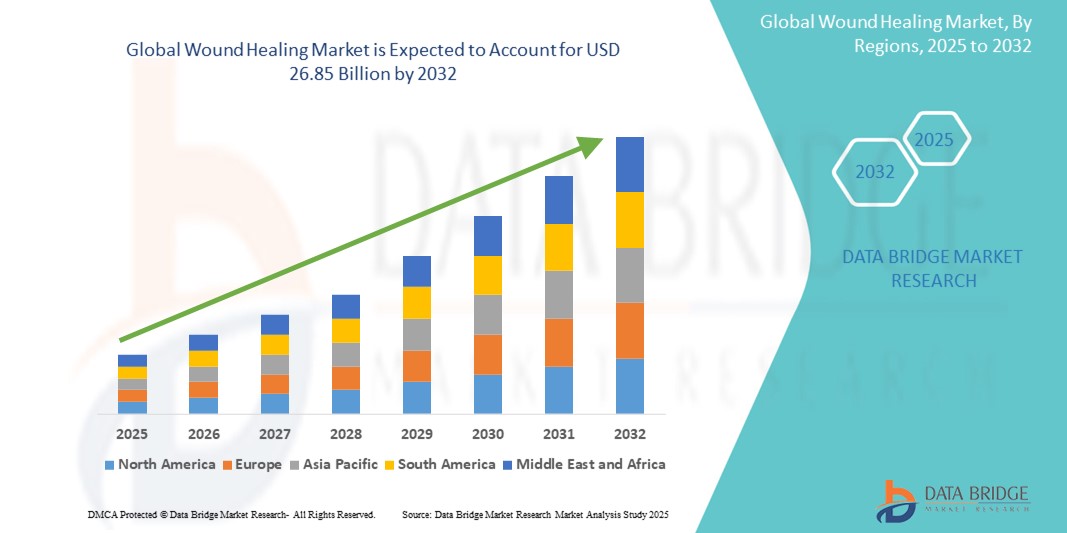
Wound Healing Market Size
- The global wound healing market size was valued at USD 19.55 billion in 2024 and is expected to reach USD 26.85 billion by 2032, at a CAGR of 4.05% during the forecast period
- The market growth is largely fueled by the rising prevalence of chronic wounds such as diabetic foot ulcers, pressure ulcers, and venous leg ulcers, coupled with an aging global population and increasing rates of diabetes and obesity. These factors are significantly boosting demand for advanced wound healing solutions across both hospital and homecare settings
- Furthermore, the adoption of technologically advanced products such as bioactive dressings, skin substitutes, and negative pressure wound therapy (NPWT) devices is enhancing healing outcomes and reducing recovery times. These innovations are accelerating the uptake of Wound Healing solutions, thereby significantly boosting the industry's growth
Wound Healing Market Analysis
- Wound healing solutions, including dressings, devices, and biologics, are becoming increasingly vital in modern healthcare due to rising incidences of chronic wounds, surgical procedures, and a growing elderly population requiring advanced care. These solutions offer improved recovery outcomes, infection control, and faster tissue regeneration across various healthcare settings
- The escalating demand for wound healing products is primarily driven by the global rise in diabetes and obesity, increasing cases of pressure ulcers and venous leg ulcers, and technological advancements in wound care materials and therapies
- North America dominated the wound healing market with the largest revenue share of 38.6% in 2024, owing to the region’s well-established healthcare infrastructure, high awareness of advanced wound care, and increased prevalence of chronic wounds. The U.S. leads the region with significant adoption of bioactive dressings and negative pressure wound therapy (NPWT), supported by robust R&D and reimbursement policies
- Asia-Pacific is expected to be the fastest growing region in the wound healing market during the forecast period, projected to grow at a CAGR of 12.4% from 2025 to 2032, driven by rapid healthcare modernization, growing patient population, and increased investments in hospital infrastructure across countries such as China, India, and Japan
- The dressings segment dominated the wound healing market with a market share of 31.4% in 2024, owing to its extensive use in managing both acute and chronic wounds. The segment's growth is driven by the increasing adoption of advanced dressings such as hydrocolloids, alginates, and foam dressings, which are preferred for their ability to maintain a moist wound environment and accelerate the healing process
Report Scope and Wound Healing Market Segmentation
|
Attributes |
Wound Healing Key Market Insights |
|
Segments Covered |
|
|
Countries Covered |
North America
Europe
Asia-Pacific
Middle East and Africa
South America
|
|
Key Market Players |
|
|
Market Opportunities |
|
|
Value Added Data Infosets |
In addition to the insights on market scenarios such as market value, growth rate, segmentation, geographical coverage, and major players, the market reports curated by the Data Bridge Market Research also include in-depth expert analysis, pricing analysis, brand share analysis, consumer survey, demography analysis, supply chain analysis, value chain analysis, raw material/consumables overview, vendor selection criteria, PESTLE Analysis, Porter Analysis, and regulatory framework. |
Wound Healing Market Trends
“Advancement in Biologics and Regenerative Therapies”
- A significant and accelerating trend in the global wound healing market is the growing adoption of biologics and regenerative medicine, including skin substitutes, growth factors, and stem cell-based therapies. These solutions are proving highly effective in managing chronic and non-healing wounds, especially diabetic foot ulcers and pressure ulcers
- For instance, products such as Apligraf and Dermagraft have demonstrated improved healing outcomes by promoting cellular regeneration and tissue repair, representing a shift from conventional wound dressings toward more targeted, biologically active interventions
- Biologics not only accelerate tissue regeneration but also reduce the need for surgical interventions and lower the risk of infections, making them increasingly popular in clinical settings
- Furthermore, the integration of advanced wound care techniques with regenerative therapies is expanding treatment options, especially for aging populations and patients with underlying chronic conditions such as diabetes and vascular disease
- Hospitals, specialty clinics, and home care settings are increasingly adopting these next-generation therapies due to their ability to shorten healing times and reduce hospitalization durations, thereby improving patient outcomes and reducing healthcare costs
- The demand for these innovative wound healing solutions continues to rise globally, especially in developed regions with well-established reimbursement structures and emerging economies focused on modernizing their healthcare delivery
Wound Healing Market Dynamics
Driver
“Growing Need Due to Rising Chronic Conditions and Advanced Wound Care Adoption”
- The increasing prevalence of chronic conditions such as diabetes, obesity, and venous ulcers, combined with the rising geriatric population, is significantly driving demand for advanced wound healing solutions globally
- For instance, in April 2024, Smith+Nephew (U.K.) launched its next-generation negative pressure wound therapy (NPWT) system, PICO 7Y, which features enhanced pressure settings and extended battery life to improve patient mobility and healing outcomes. Such innovations are expected to propel the wound healing market in the forecast period
- As healthcare providers and patients seek faster, more effective healing outcomes, advanced wound care products—such as hydrocolloids, antimicrobial dressings, and bioengineered skin substitutes—offer a compelling alternative to traditional gauze and bandages
- Furthermore, the rise in surgical procedures, trauma cases, and hospital-acquired pressure ulcers is contributing to the growing adoption of wound healing products in both acute and chronic care settings
- Technological advancements, including smart dressings that monitor wound condition and bioactive therapies that accelerate tissue regeneration, are fueling demand across hospitals, specialty clinics, and home care settings
- The global shift toward home healthcare and minimally invasive treatment is also increasing the popularity of user-friendly, self-applicable wound healing products, enabling better patient compliance and faster recover
Restraint/Challenge
“High Cost of Advanced Products and Limited Access in Low-Income Regions”
- The relatively high cost of advanced wound care solutions, such as growth factor-based therapies, skin substitutes, and NPWT systems, presents a major challenge to widespread adoption—especially in low- and middle-income countries
- For instance, while bioengineered skin products offer superior healing for diabetic foot ulcers, their cost often exceeds the reimbursement limits in many public healthcare systems, making them inaccessible to large patient populations
- In addition, healthcare infrastructure limitations in rural and underdeveloped regions hinder the availability of wound care specialists and essential products, further restricting market penetration.
- Addressing these challenges through cost-effective innovations, expanded reimbursement coverage, and educational programs for clinicians and caregivers will be crucial to ensuring equitable access to quality wound healing care
- Companies such as Mölnlycke (Sweden) and ConvaTec (U.K.) are increasingly focusing on producing affordable and scalable solutions tailored to the needs of emerging markets, which may help alleviate access gaps in the near future
- Building awareness, enhancing distribution networks, and leveraging digital health platforms for remote wound monitoring are also essential steps to overcome these barriers and unlock long-term growth potential in the wound healing market
Wound Healing Market Scope
The market is segmented on the basis of product type, wound type, and gender.
• By Product Type
On the basis of product type, the wound healing market is segmented into dressings, bandages, tropical agents, wound closure agents, gauges & sponges, tapes, and therapy devices. The dressings segment dominated the market with the largest revenue share of 31.4% in 2024, owing to its widespread use in treating both acute and chronic wounds. Advanced dressings such as hydrocolloids, alginates, and foam dressings are increasingly favored for promoting a moist wound environment, which accelerates healing.
The therapy devices segment is projected to witness the fastest CAGR of 9.8% from 2025 to 2032, driven by the rising adoption of negative pressure wound therapy (NPWT) and electrical stimulation therapies. These devices are gaining traction in hospital and homecare settings due to their effectiveness in complex wound management and faster recovery outcomes.
• By Wound Type
On the basis of wound type, the wound healing market is segmented into acute wound, ulcers, and chronic wound. The acute wound segment held the largest market share of 45.7% in 2024, attributed to the high volume of surgical procedures, trauma cases, and burn injuries globally. The demand for advanced dressings and closure devices in surgical and emergency care settings supports the dominance of this segment.
The ulcers segment is expected to register the highest growth rate of 10.4% during the forecast period, due to the increasing prevalence of diabetic foot ulcers, venous leg ulcers, and pressure ulcers, especially in aging and diabetic populations.
• By Gender
On the basis of gender, the wound healing market is segmented into male and female. The female segment dominated the market with a revenue share of 52.6% in 2024, driven by a higher rate of elective surgical procedures, particularly in cosmetic and obstetric applications.
The male segment is projected to grow at a notable CAGR of 8.5% from 2025 to 2032, supported by increasing incidences of occupational injuries, chronic wounds, and a growing awareness of wound care solutions among male patients.
Wound Healing Market Regional Analysis
- North America dominated the wound healing market with the largest revenue share of 38.6% in 2024, driven by increasing cases of chronic wounds, a growing geriatric population, and the presence of key market players offering advanced wound care products and therapies
- The region benefits from high healthcare spending, robust reimbursement policies, and growing awareness of advanced wound care, which supports the rapid adoption of innovative healing solutions
- Moreover, North America’s well-established healthcare infrastructure and continuous technological advancements in wound treatment significantly contribute to market leadership
U.S. Wound Healing Market Insight
The U.S. wound healing market captured the largest revenue share of 86.1% in 2024 within North America, driven by the high prevalence of diabetes, obesity, and surgical wounds that demand timely and effective wound care solutions. The country is a leader in adopting advanced products such as bioactive dressings, negative pressure wound therapy (NPWT), and skin substitutes. In addition, increasing investments in wound care research and growing patient preference for home-based treatments further stimulate market growth.
Europe Wound Healing Market Insight
The Europe wound healing market is projected to grow at a significant CAGR during the forecast period, fueled by the rising burden of chronic wounds, favorable government initiatives, and an aging population. Countries such as Germany, the U.K., and France are investing heavily in modernizing their healthcare systems, which includes better wound management protocols. The increasing availability of cost-effective products and growing awareness about early treatment of ulcers and burns support the regional market expansion.
U.K. Wound Healing Market Insight
The U.K. wound healing market is expected to grow at a noteworthy CAGR, primarily supported by the National Health Service’s (NHS) commitment to improving chronic wound care outcomes. The country is witnessing a rise in diabetic ulcers and pressure ulcers, which is increasing demand for advanced dressings and negative pressure devices. Ongoing clinical trials and strategic partnerships between hospitals and medical device companies further support market development.
Germany Wound Healing Market Insight
The Germany wound healing market is set to expand at a steady CAGR, driven by the country’s focus on innovation, medical technology excellence, and aging population prone to wound-related complications. High adoption of novel wound care products and digital wound management systems are enhancing patient outcomes. Germany’s strong regulatory framework and insurance coverage also play a key role in expanding access to wound care solutions.
Asia-Pacific Wound Healing Market Insight
The Asia-Pacific wound healing market is expected to grow at the fastest CAGR of 12.4% from 2025 to 2032, owing to rising chronic diseases, increasing healthcare expenditure, and expanding access to healthcare in developing economies. Countries such as China, India, and Japan are witnessing a surge in diabetic wounds and trauma cases. Government-led initiatives to strengthen healthcare infrastructure and improve wound care awareness are further accelerating regional market growth.
Japan Wound Healing Market Insight
The Japan wound healing market is growing steadily, supported by its advanced healthcare system, high elderly population, and strong focus on patient-centric care. The market is seeing increased use of advanced wound dressings and pressure ulcer prevention technologies in both hospital and home care settings.In addition, the adoption of telemedicine for wound consultation and follow-ups is enhancing treatment accessibility and patient compliance.
China Wound Healing Market Insight
The China wound healing market accounted for the largest revenue share in Asia-Pacific in 2024, driven by a growing middle-class population, increasing lifestyle diseases such as diabetes, and rapid urbanization. China is a manufacturing hub for wound care products and has seen rapid expansion of domestic and international wound care companies.
Wound Healing Market Share
The wound healing industry is primarily led by well-established companies, including:
- ION MEDICAL (South Korea)
- Smith+Nephew (U.K.)
- 3M (U.S.)
- Mölnlycke AB (Sweden)
- Convatec Inc. (U.K.)
- Baxter (U.S.)
- Coloplast Group (Denmark)
- PAUL HARTMANN AG (Germany)
- MIMEDX Group, Inc. (U.S.)
- DeRoyal Industries, Inc. (U.S.)
- Organogenesis Inc. (U.S.)
- Talley Group Ltd. (U.K.)
- Medtronic (Ireland)
- Integra LifeSciences Holding Corporation (U.S.)
- Lohmann & Rauscher International GmbH & Co. KG (Germany)
- Kerecis (Iceland)
- Medela (Switzerland)
Latest Developments in Global Wound Healing Market
- In May 2025, Avita Medical launched Cohealyx, a novel biologic wound healing product aimed at accelerating cellular migration and revascularization. This product is designed to prepare wound beds effectively for closure, strengthening the company’s portfolio in regenerative wound care solutions
- In 2024, Smith & Nephew introduced smart antimicrobial dressings infused with silver nanoparticles, enabling faster infection control and enhanced healing. The company also integrated digital wound-monitoring tools linked with electronic health records (EHR), highlighting the shift toward tech-enabled wound care

- Interactive Data Analysis Dashboard
- Company Analysis Dashboard for high growth potential opportunities
- Research Analyst Access for customization & queries
- Competitor Analysis with Interactive dashboard
- Latest News, Updates & Trend analysis
- Harness the Power of Benchmark Analysis for Comprehensive Competitor Tracking
Data collection and base year analysis are done using data collection modules with large sample sizes. The stage includes obtaining market information or related data through various sources and strategies. It includes examining and planning all the data acquired from the past in advance. It likewise envelops the examination of information inconsistencies seen across different information sources. The market data is analysed and estimated using market statistical and coherent models. Also, market share analysis and key trend analysis are the major success factors in the market report. To know more, please request an analyst call or drop down your inquiry.
The key research methodology used by DBMR research team is data triangulation which involves data mining, analysis of the impact of data variables on the market and primary (industry expert) validation. Data models include Vendor Positioning Grid, Market Time Line Analysis, Market Overview and Guide, Company Positioning Grid, Patent Analysis, Pricing Analysis, Company Market Share Analysis, Standards of Measurement, Global versus Regional and Vendor Share Analysis. To know more about the research methodology, drop in an inquiry to speak to our industry experts.
Data Bridge Market Research is a leader in advanced formative research. We take pride in servicing our existing and new customers with data and analysis that match and suits their goal. The report can be customized to include price trend analysis of target brands understanding the market for additional countries (ask for the list of countries), clinical trial results data, literature review, refurbished market and product base analysis. Market analysis of target competitors can be analyzed from technology-based analysis to market portfolio strategies. We can add as many competitors that you require data about in the format and data style you are looking for. Our team of analysts can also provide you data in crude raw excel files pivot tables (Fact book) or can assist you in creating presentations from the data sets available in the report.













