What is the X by Wire Market Size and Growth Rate?
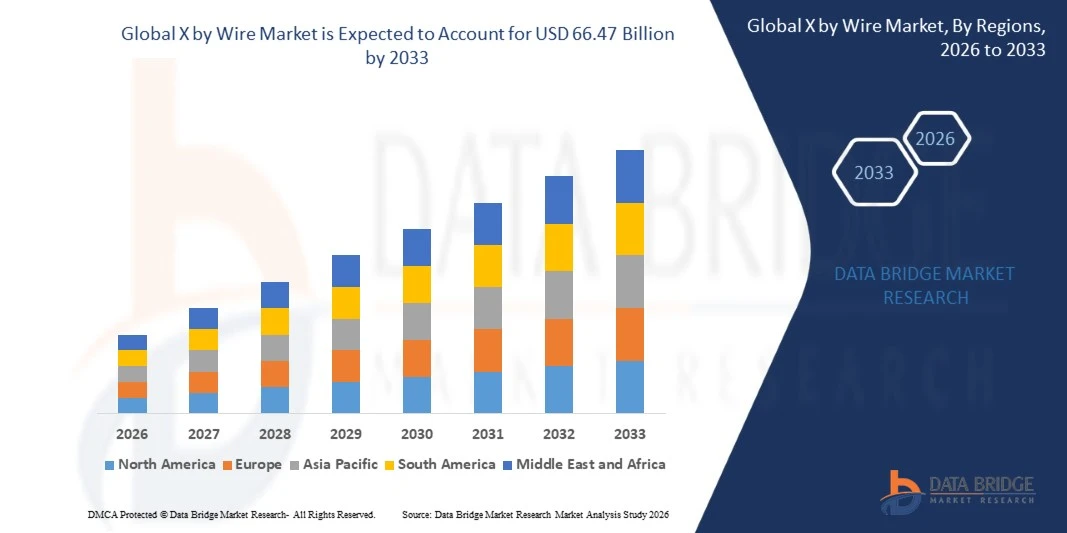
- As per Data Bridge Market Research analysis, the X by Wire market was valued at USD 26.00 billion in 2025 and is projected to reach USD 66.47 billion by 2033, growing at a CAGR of 12.45% from 2026 to 2033.
- The market is experiencing consistent growth driven by increasing vehicle electrification, rising demand for advanced vehicle control systems, and growing integration of electronic technologies that replace conventional mechanical and hydraulic control mechanisms.
- Growing demand for enhanced vehicle safety, improved driving precision, reduced vehicle weight, and greater design flexibility is encouraging automotive manufacturers to adopt X by Wire technologies. These systems use electronic signals, sensors, actuators, and control units to manage functions such as steering, braking, acceleration, and gear shifting, supporting wider adoption across passenger cars, commercial vehicles, hybrid electric vehicles, and battery electric vehicles.
Market Size & Forecast
- Global Market Value (2025): USD 26.00 Billion
- Expected Market Value (2033): USD 66.47 Billion
- Forecast CAGR (2026–2033): 12.45%
- Leading Region in 2025: North America
- Fastest Growing Region: Asia Pacific
What are the Major Takeaways of the X By Wire Market?
- North America dominated the X by Wire market with the largest revenue share of 32.3% in 2025, supported by advanced automotive manufacturing capabilities, increasing adoption of vehicle automation technologies, and rising demand for electronic steering and braking systems.
- Asia Pacific is expected to be the fastest-growing region at a CAGR of 12.8% from 2026 to 2033, fueled by expanding automotive production, increasing electric vehicle adoption, and growing integration of advanced electronic control systems in China, India, Japan, and South Korea.
- The steer-by-wire segment led the market with an estimated revenue share of 35.0% in 2025, driven by increasing demand for precise vehicle control, improved design flexibility, reduced mechanical complexity, and integration with advanced driver-assistance systems.
- The brake-by-wire segment is expected to be the fastest-growing system type, projected to register a CAGR of 14.2% from 2026 to 2033, reflecting rising demand for advanced braking technologies, regenerative braking integration in electric vehicles, and enhanced vehicle safety and control.
- The passenger cars segment dominated the vehicle type category with an estimated revenue share of 68.0% in 2025, supported by increasing adoption of electric and premium vehicles, growing integration of advanced driver-assistance systems, and rising demand for improved driving comfort and safety.
- The electronic control units segment accounted for an estimated 30.0% of the market share in 2025, driven by their essential role in processing sensor signals, coordinating actuators, and enabling reliable electronic control across vehicle systems.
- The battery electric vehicles segment is expected to be among the fastest-growing propulsion type categories, projected to register a CAGR of 15.0% from 2026 to 2033, driven by increasing electric vehicle production, demand for integrated electronic control architectures, and the growing need for efficient steering, braking, and powertrain management systems.
Report Scope and X By Wire Market Segmentation
|
Attributes |
X by Wire Key Market Insights |
|
Segments Covered |
|
|
Countries Covered |
North America
Europe
Asia-Pacific
Middle East and Africa
South America
|
|
Key Market Players |
|
|
Market Opportunities |
|
|
Value Added Data Infosets |
In addition to the market insights such as market value, growth rate, market segments, geographical coverage, market players, and market scenario, the market report curated by the Data Bridge Market Research team includes in-depth expert analysis, import/export analysis, pricing analysis, production consumption analysis, and pestle analysis. |
What is the Key Trend in the X by Wire Market?
- Automotive manufacturers are increasingly adopting steer-by-wire, brake-by-wire, and shift-by-wire technologies to replace conventional mechanical linkages with electronic control systems, improving vehicle responsiveness, packaging flexibility, and integration with advanced driver-assistance systems.
- The growing shift toward software-defined vehicles is accelerating the development of electronic control architectures that support precise steering, braking, and powertrain functions while enabling greater integration between sensors, actuators, and electronic control units.
- Manufacturers are focusing on redundant electronic architectures, advanced sensors, and fail-operational control systems to improve reliability and maintain essential vehicle functions in the event of component or communication failures.
- Integration of X by Wire technologies with electric vehicle platforms is gaining momentum as automakers seek to optimize regenerative braking, reduce mechanical complexity, and support flexible vehicle design.
- As vehicle electrification, automation, and software-based control continue to advance, technological innovation is expected to accelerate the adoption of X by Wire systems across passenger cars and commercial vehicles.
- For instance, in February 2025, NIO announced the integration of steer-by-wire technology developed in collaboration with ZF into its ET9 electric vehicle, highlighting the growing commercialization of electronically controlled steering systems and their role in software-defined vehicles.
- Increasing production of electric vehicles and growing demand for advanced vehicle control technologies are encouraging manufacturers to develop integrated by-wire systems that improve maneuverability, driving stability, and compatibility with automated driving functions.
- For instance, in April 2026, steer-by-wire technology entered series production for a passenger vehicle from a leading Chinese new energy vehicle manufacturer, demonstrating the transition of the technology from development and validation to commercial deployment.
- As automakers continue to invest in electronic vehicle architectures, functional safety, and advanced control technologies, the adoption of X by Wire systems is expected to expand across passenger cars and commercial vehicles.
What are the Key Drivers of the X by Wire Market?
- The growing demand for electric vehicles and software-defined vehicles is increasing the adoption of X by Wire systems that replace conventional mechanical connections with electronic signals, sensors, actuators, and control units.
- For instance, in July 2025, a major automotive technology supplier announced plans to supply steer-by-wire technology for a premium passenger vehicle beginning in 2026, supporting the transition toward electronically controlled steering and more flexible vehicle architectures.
- Rising emphasis on vehicle safety, driving precision, and advanced driver-assistance systems is encouraging automotive manufacturers to integrate electronic steering, braking, and powertrain control technologies.
- For instance, in April 2026, a production passenger vehicle featuring a full drive-by-wire chassis entered series production, demonstrating advancements in system redundancy, fault diagnosis, and electronic control integration.
- As vehicle electrification and automation continue to influence automotive design, demand for reliable and integrated X by Wire technologies is expected to increase across multiple vehicle categories.
What Factors are Challenging the Growth of the X by Wire Market?
- X by Wire systems involve high development, integration, and validation costs associated with electronic control units, sensors, actuators, and redundant safety architectures, which can limit adoption in cost-sensitive vehicle segments.
- Dependence on electronic components, communication networks, and software-based control introduces functional safety and cybersecurity challenges, requiring rigorous testing and reliable backup mechanisms to maintain vehicle control during component failures.
- Integrating X by Wire technologies into existing vehicle platforms can require substantial redesign of steering, braking, powertrain, and electrical architectures, increasing engineering complexity and development time.
- For instance, in August 2025, advancements in steer-by-wire sensor technology entered additional series-production programs, illustrating the importance of precise sensor measurements and reliable electronic signal transmission in enabling safe steering control.
- The combination of high implementation costs, stringent functional safety requirements, system integration complexity, and the need for dependable electronic redundancy continues to challenge the widespread adoption of X by Wire technologies, particularly in lower-cost vehicles and markets with limited access to advanced automotive electronics.
How is the X by Wire Market Segmented?
The X by Wire market is segmented on the basis of system type, vehicle type, component, propulsion type, and application.
- By System Type
On the basis of system type, the X by Wire market is segmented into throttle-by-wire, brake-by-wire, steer-by-wire, shift-by-wire, park-by-wire, and other systems. The steer-by-wire segment is estimated to dominate the market with an estimated 35% share in 2025, driven by increasing demand for precise steering control, improved vehicle maneuverability, and flexible vehicle design. Steer-by-wire systems replace conventional mechanical steering connections with electronic controls that transmit driver inputs to steering actuators. These systems support integration with advanced driver-assistance systems and enable automakers to optimize steering response across different driving conditions. Growing electric vehicle production and the development of software-defined vehicle architectures are further supporting adoption. However, system reliability, functional safety requirements, and integration costs remain important considerations.
The brake-by-wire segment is estimated to be among the fastest-growing system categories, registering an estimated CAGR of 14.2% from 2026 to 2033, as automakers increasingly adopt electronic braking technologies for electric and advanced passenger vehicles. These systems electronically transmit braking commands and coordinate braking components to support responsive braking performance. Their integration with regenerative braking can improve energy recovery in electric and hybrid vehicles. Growing emphasis on vehicle safety, braking precision, and advanced driver-assistance capabilities is encouraging manufacturers to develop more sophisticated electronic braking architectures. However, adoption depends on reliable backup mechanisms, regulatory compliance, and the successful integration of electronic and hydraulic braking components where required.
- By Vehicle Type
On the basis of vehicle type, the X by Wire market is segmented into passenger cars, light commercial vehicles, medium and heavy commercial vehicles, and other vehicles. The passenger cars segment is estimated to dominate the market with an estimated 68% share in 2025, supported by high passenger vehicle production, increasing electric vehicle adoption, and growing integration of advanced electronic control technologies. Passenger cars increasingly incorporate electronic steering, braking, and transmission control systems to improve driving comfort, vehicle responsiveness, and compatibility with advanced driver-assistance systems. Premium vehicles and electric passenger cars provide important opportunities for the integration of advanced by-wire architectures. Growing consumer demand for enhanced safety and intelligent vehicle features is further supporting adoption. However, implementation costs and differences in vehicle platform requirements can influence the pace of integration across vehicle price categories.
The light commercial vehicles segment is estimated to experience significant growth during the forecast period, registering an indicative CAGR of 12.5% from 2026 to 2033, as fleet operators and vehicle manufacturers increasingly explore electronic control systems for electric delivery vehicles and connected commercial fleets. X by Wire technologies can support precise vehicle control, flexible packaging, and integration with automated driving functions. Growing demand for efficient last-mile delivery, electrified commercial transportation, and advanced fleet safety systems is creating opportunities for adoption. However, cost considerations, vehicle-duty requirements, and the need for reliable operation under demanding commercial conditions may influence deployment. Continued improvements in system durability and integration efficiency are expected to support adoption across selected light commercial vehicle applications.
- By Component
On the basis of component, the X by Wire market is segmented into electronic control units, sensors, actuators, and other components. The electronic control units segment is estimated to account for an estimated 30% share in 2025, owing to the essential role of electronic controllers in processing driver inputs, interpreting sensor signals, and coordinating actuator responses. These units manage the communication and control logic required for electronically operated steering, braking, acceleration, and transmission functions. Increasing system complexity and the integration of multiple vehicle control functions are strengthening demand for reliable and high-performance electronic control units. Automakers are also focusing on functional safety, diagnostic capabilities, and efficient communication between vehicle subsystems. However, software validation, hardware reliability, and the need for redundancy in safety-critical applications remain important engineering considerations.
The sensor segment is expected to experience strong growth during the forecast period, registering an indicative CAGR of 13.6% from 2026 to 2033, driven by increasing demand for accurate measurement of steering position, braking pressure, pedal inputs, vehicle movement, and other operating parameters. Sensors provide essential information that enables electronic control units to interpret driver commands and adjust actuator responses. Growing integration of advanced driver-assistance systems and electronically controlled vehicle architectures is increasing the need for reliable sensor technologies. Developments in sensor accuracy, durability, and real-time data transmission are supporting their integration across multiple by-wire applications. However, sensor calibration, environmental resistance, signal integrity, and functional safety requirements remain important considerations for manufacturers.
- By Propulsion Type
On the basis of propulsion type, the X by Wire market is segmented into internal combustion engine vehicles, hybrid electric vehicles, and battery electric vehicles. The battery electric vehicles segment is estimated to account for an estimated 38% share in 2025, supported by increasing vehicle electrification and the integration of electronically controlled steering, braking, and powertrain systems. Battery electric vehicle platforms provide opportunities to incorporate advanced electronic architectures and coordinate vehicle functions through centralized or distributed control systems. X by Wire technologies can also support regenerative braking and reduce dependence on conventional mechanical linkages in selected vehicle applications. Growing investments in electric mobility and software-defined vehicles are further supporting adoption. However, system costs, functional safety requirements, and platform-specific engineering needs can influence implementation.
The battery electric vehicles segment is also expected to remain among the fastest-growing propulsion categories, registering an indicative CAGR of 15.0% from 2026 to 2033, as automakers expand electric vehicle portfolios and develop more integrated electronic control architectures. Demand for efficient regenerative braking, responsive steering, advanced vehicle automation, and flexible vehicle packaging is creating opportunities for X by Wire technologies. The transition toward software-defined electric vehicles is encouraging manufacturers to integrate sensors, actuators, and electronic controllers across multiple vehicle functions. Improvements in electronic component reliability and control-system integration may further support deployment. However, adoption will depend on vehicle production volumes, technology costs, safety validation, and the availability of qualified components.
- By Application
On the basis of application, the X by Wire market is segmented into powertrain control, braking systems, steering systems, transmission control, parking systems, and other applications. The steering systems segment is estimated to dominate the market with an estimated 32% share in 2025, driven by increasing demand for advanced steering functionality, improved maneuverability, and integration with driver-assistance technologies. Electronic steering systems enable vehicle manufacturers to adjust steering response according to driving conditions and vehicle operating requirements. They can also provide greater flexibility in vehicle design by reducing dependence on conventional mechanical steering connections. Growing adoption of electric vehicles and advanced automotive electronics is supporting the development of steer-by-wire solutions. However, reliability, redundancy, and compliance with automotive safety requirements remain essential for commercial deployment.
The braking systems segment is expected to be among the fastest-growing application categories, registering an indicative CAGR of 14.2% from 2026 to 2033, as electric vehicle manufacturers increasingly integrate electronically controlled braking and regenerative braking functions. Brake-by-wire technologies can support rapid braking-command transmission, coordinated braking control, and integration with advanced driver-assistance systems. Growing emphasis on vehicle safety, braking performance, and energy efficiency is encouraging investment in electronic braking architectures. Improvements in control software, sensors, actuators, and fault-monitoring capabilities may further strengthen adoption. However, manufacturers must address system redundancy, braking reliability, integration complexity, and regulatory requirements to support widespread implementation.
Which Region Holds the Largest Share of the X by Wire Market?
- North America dominated the X by Wire market with the largest revenue share of 32.3% in 2025, supported by advanced automotive manufacturing capabilities, increasing adoption of electronic vehicle control technologies, and rising demand for enhanced vehicle safety and performance.
- The region also benefits from strong investments in automotive research and development, increasing electric vehicle production, and growing integration of steer-by-wire and brake-by-wire systems in passenger cars. Advancements in vehicle automation, functional safety, and software-defined vehicle architectures are strengthening North America's position in the global market.
U.S. X by Wire Market Insight
The U.S. X by Wire market is witnessing strong growth due to rising adoption of electric vehicles, increasing demand for advanced driver-assistance systems, and growing integration of electronic control technologies in modern vehicles. The country's established automotive industry, along with investments in vehicle automation and software-defined vehicle platforms, is driving demand for steer-by-wire, brake-by-wire, and other electronic control systems. In addition, increasing emphasis on vehicle safety, improved driving precision, and flexible vehicle design is accelerating the adoption of X by Wire technologies among automotive manufacturers.
Asia-Pacific X by Wire Market Insight
The Asia Pacific X by Wire market is expected to witness rapid growth, driven by expanding automotive production, rising electric vehicle adoption, and increasing integration of advanced electronic control systems across countries such as China, Japan, South Korea, and India. Growing demand for intelligent vehicle technologies, electronic steering and braking systems, and software-defined vehicle architectures is supporting regional market expansion. In addition, investments in automotive electrification, domestic electric vehicle manufacturing, and advanced automotive electronics are accelerating the adoption of X by Wire technologies across the region.
Japan X by Wire Market Insight
The Japan X by Wire market is witnessing consistent growth due to rising investments in automotive electronics, increasing development of electric and hybrid vehicles, and growing demand for advanced vehicle control technologies. Automotive manufacturers are increasingly exploring electronic steering, braking, and transmission systems to improve vehicle responsiveness, safety, and design flexibility. Moreover, Japan's established automotive engineering capabilities, focus on technological innovation, and development of advanced driver-assistance systems are further contributing to market growth.
China X by Wire Market Insight
The China X by Wire market is growing rapidly, driven by extensive electric vehicle production, increasing adoption of intelligent vehicle technologies, and rising investments in automotive electronics. Growing integration of steer-by-wire, brake-by-wire, and electronic transmission control systems across electric and premium passenger vehicles is boosting market demand. In addition, advancements in vehicle software, increasing domestic electric vehicle manufacturing, and the development of software-defined vehicle platforms are positioning China as a key market for X by Wire technologies.
U.K. X by Wire Market Insight
The U.K. X by Wire market is experiencing steady growth, supported by increasing adoption of electric vehicles, rising emphasis on vehicle safety, and growing demand for advanced automotive control systems. Increasing integration of electronic steering, braking, and powertrain technologies in passenger vehicles is contributing to market development. Furthermore, investments in automotive innovation, electric mobility, and connected vehicle technologies are supporting the adoption of X by Wire systems across the U.K. automotive industry.
Germany X by Wire Market Insight
The Germany X by Wire market is expanding steadily due to the country's strong automotive manufacturing base, advanced vehicle engineering capabilities, and increasing adoption of electric and software-defined vehicles. Automotive manufacturers are investing in electronic steering and braking technologies to improve vehicle control, enhance safety, and support integration with advanced driver-assistance systems. Continuous advancements in automotive electronics, growing demand for premium electric vehicles, and increasing emphasis on vehicle automation are further driving market growth in Germany.
Which are the Top Companies in X by Wire Market?
The X by Wire industry is primarily led by well-established companies, including:
- Robert Bosch GmbH (Germany)
- ZF Friedrichshafen AG (Germany)
- Continental AG (Germany)
- Nexteer Automotive Corporation (U.S.)
- SKF Ltd. (Japan)
- Curtiss-Wright Corporation (U.S.)
- Hitachi, Ltd. (Japan)
- Schaeffler AG (Germany)
- Stoneridge Inc. (U.S.)
- Infineon Technologies AG (Germany)
- Jaguar Land Rover Automotive PLC (U.K.)
- Orscheln Products (U.S.)
- Danaher (U.S.)
- EFB-Elektronik GmbH (Germany)
- CTS Corporation (U.S.)
- Nissan (Japan)
- Citroën (France)
- Parker Hannifin Corporation (U.S.)
- Torc Robotics (U.S.)
What are Latest Developments in X by Wire Market?
- In April 2026, Nexteer Automotive announced that its steer-by-wire system had entered series production for a passenger vehicle from a Chinese new energy vehicle manufacturer. The system incorporates redundant controllers, power supplies, communication links, and actuation paths to support functional safety and precise steering control. This development highlights the transition of steer-by-wire technology from development to commercial vehicle production.
- In April 2025, Nexteer Automotive launched its electro-mechanical brake (EMB) system, an advanced brake-by-wire solution designed to replace hydraulic fluid and mechanical linkages with electronic control and actuators at each wheel. The system is designed to improve braking precision, vehicle stability, and integration with software-defined vehicle architectures, supporting the advancement of electronic braking technologies.
- In January 2025, ZF Friedrichshafen AG announced a major brake-by-wire business agreement with a global vehicle manufacturer, covering planned production for nearly five million vehicles over the contract period. The project combines electro-mechanical braking technology with steering systems and is designed to support more flexible vehicle architectures across passenger cars and light commercial vehicles.
- In February 2025, NIO Inc., in collaboration with ZF Friedrichshafen AG, introduced steer-by-wire technology as part of the NIO ET9's SkyRide chassis, with the system entering serial production. The technology eliminates the conventional mechanical steering connection and enables variable steering ratios according to vehicle speed, demonstrating the growing adoption of electronic steering in premium electric vehicles.
- In April 2025, FORVIA HELLA introduced a modular by-wire pedal system integrating acceleration and braking functions into a compact unit. The system is designed to improve packaging flexibility, reduce component count and weight, and support software updates for vehicle control functions. This development demonstrates continued innovation in electronic pedal systems and the broader X by Wire technology ecosystem.

- Interactive Data Analysis Dashboard
- Company Analysis Dashboard for high growth potential opportunities
- Research Analyst Access for customization & queries
- Competitor Analysis with Interactive dashboard
- Latest News, Updates & Trend analysis
- Harness the Power of Benchmark Analysis for Comprehensive Competitor Tracking
Data collection and base year analysis are done using data collection modules with large sample sizes. The stage includes obtaining market information or related data through various sources and strategies. It includes examining and planning all the data acquired from the past in advance. It likewise envelops the examination of information inconsistencies seen across different information sources. The market data is analysed and estimated using market statistical and coherent models. Also, market share analysis and key trend analysis are the major success factors in the market report. To know more, please request an analyst call or drop down your inquiry.
The key research methodology used by DBMR research team is data triangulation which involves data mining, analysis of the impact of data variables on the market and primary (industry expert) validation. Data models include Vendor Positioning Grid, Market Time Line Analysis, Market Overview and Guide, Company Positioning Grid, Patent Analysis, Pricing Analysis, Company Market Share Analysis, Standards of Measurement, Global versus Regional and Vendor Share Analysis. To know more about the research methodology, drop in an inquiry to speak to our industry experts.
Data Bridge Market Research is a leader in advanced formative research. We take pride in servicing our existing and new customers with data and analysis that match and suits their goal. The report can be customized to include price trend analysis of target brands understanding the market for additional countries (ask for the list of countries), clinical trial results data, literature review, refurbished market and product base analysis. Market analysis of target competitors can be analyzed from technology-based analysis to market portfolio strategies. We can add as many competitors that you require data about in the format and data style you are looking for. Our team of analysts can also provide you data in crude raw excel files pivot tables (Fact book) or can assist you in creating presentations from the data sets available in the report.