


What is the X-linked Adrenal Hypoplasia Congenita Market Size and Overview?
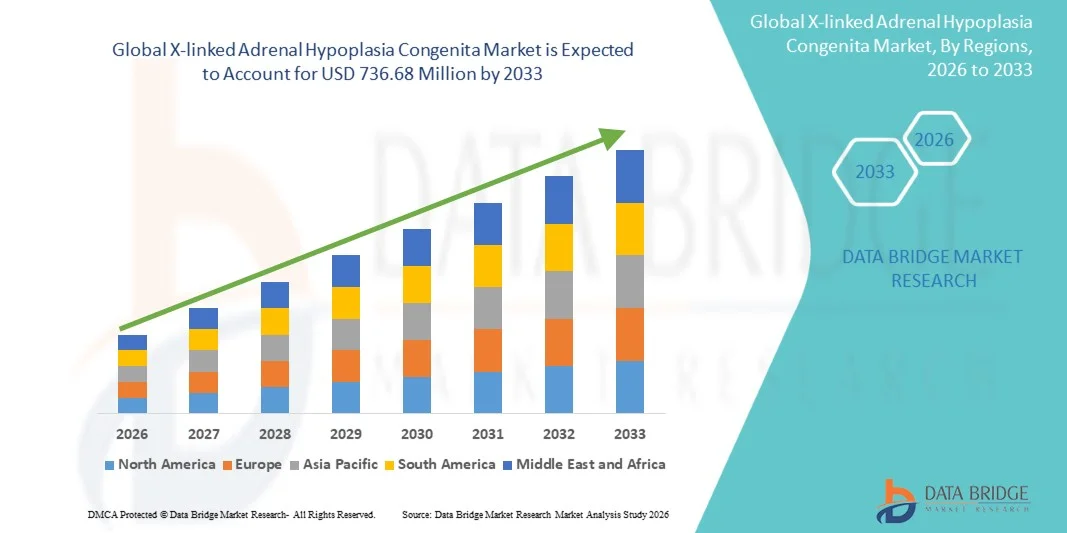
As per Data Bridge Market Research analysis The X-linked Adrenal Hypoplasia Congenita Market was valued at USD 410.00 million in 2025 and is projected to reach USD 736.68 million by 2033, growing at a CAGR of 7.6% from 2026 to 2033. The market is witnessing steady expansion driven by increasing awareness of rare endocrine disorders, improving diagnostic capabilities through genetic screening, and rising adoption of long-term hormone replacement therapies.
The growing focus on early diagnosis of congenital adrenal disorders, combined with advancements in molecular genetics and newborn screening programs, is significantly improving detection rates of X-linked adrenal hypoplasia congenita. In addition, ongoing research in endocrine replacement therapies and emerging interest in gene-based and precision medicine approaches are expected to enhance treatment outcomes. Increasing healthcare investments in rare disease management and improved access to specialized endocrinology care are further supporting market growth across developed and emerging regions.
Market Size & Forecast
- Global Market Value (2025): USD 410.00 Million
- Expected Market Value (2033): USD 736.68 Million
- Forecast CAGR (2026–2033): 7.6%
- Leading Region in 2025: North America
- Fastest Growing Region: Asia Pacific
What are the Major Takeaways of X-linked Adrenal Hypoplasia Congenita Market?
- North America dominated the X-linked Adrenal Hypoplasia Congenita Market with the largest revenue share of 38.12% in 2025, supported by advanced genetic testing infrastructure, strong rare disease reimbursement frameworks, and high adoption of specialized endocrine therapies.
- The Non-biologics segment led the market with a 78.34% share in 2025, driven by the widespread reliance on conventional hormone replacement therapies such as glucocorticoids and mineralocorticoids.
- Asia-Pacific is expected to be the fastest-growing region at a CAGR of 7.6% from 2026 to 2033, fueled by improving healthcare infrastructure, rising newborn screening programs, increasing awareness of rare genetic disorders, and expanding access to endocrine care in countries such as China, India, and Japan.
- Biologics are the fastest-growing drug type, projected to register a CAGR of 8.2%, reflecting the surge in increasing research in gene-based therapies and targeted endocrine biologics.
- The Oral segment dominated the route of administration category with a 64.91% revenue share in 2025, led by the extensive use of oral corticosteroids and mineralocorticoids for long-term disease management.
- Pediatric accounted for 61.87% of the market, preferred by pediatric endocrinologists and healthcare providers managing congenital adrenal disorders due to early disease onset, high diagnostic rates in childhood, and the need for lifelong hormone replacement therapy initiated soon after diagnosis.
- The Neonatal segment is the fastest-growing patients category, with a CAGR of 8.4%, driven by expanding newborn genetic screening programs and early diagnostic advancements.
Report Scope and X-linked Adrenal Hypoplasia Congenita Market Segmentation
Attributes |
X-linked Adrenal Hypoplasia Congenita Key Market Insights |
|
Segments Covered |
|
|
Countries Covered |
North America · U.S. · Canada · Mexico Europe · Germany · France · U.K. · Netherlands · Switzerland · Belgium · Russia · Italy · Spain · Turkey · Rest of Europe Asia-Pacific · China · Japan · India · South Korea · Singapore · Malaysia · Australia · Thailand · Indonesia · Philippines · Rest of Asia-Pacific Middle East and Africa · Saudi Arabia · U.A.E. · South Africa · Egypt · Israel · Rest of Middle East and Africa South America · Brazil · Argentina · Rest of South America |
|
Key Market Players |
· Neurocrine Biosciences (U.S.) · Pfizer Inc. (U.S.) · Novartis AG (Switzerland) · Sanofi (France) · Takeda Pharmaceutical Company Limited (Japan) · Amgen Inc. (U.S.) · Roche Holding AG (Switzerland) · AstraZeneca (U.K.) · Merck & Co., Inc. (U.S.) · Bristol Myers Squibb Company (U.S.) · Eli Lilly and Company (U.S.) · Johnson & Johnson Services, Inc. (U.S.) · Eton Pharmaceuticals, Inc. (U.S.) · Xeris Biopharma Holdings, Inc. (U.S.) · BridgeBio Pharma, Inc. (U.S.) · Sarepta Therapeutics, Inc. (U.S.) · CRISPR Therapeutics AG (Switzerland) · Editas Medicine, Inc. (U.S.) · Illumina, Inc. (U.S.) · Quest Diagnostics Incorporated (U.S.) |
|
Market Opportunities |
· Expansion of newborn genetic screening programs · Rising gene therapy and precision medicine pipelines · Increasing adoption of orphan drug incentives and rare disease funding programs |
|
Value Added Data Infosets |
In addition to the insights on market scenarios such as market value, growth rate, segmentation, geographical coverage, and major players, the market reports curated by the Data Bridge Market Research also include in-depth expert analysis, patient epidemiology, pipeline analysis, pricing analysis, and regulatory framework. |
What is the Key Trend in the X-linked Adrenal Hypoplasia Congenita Market?
Trend: Expansion of Early Genetic Screening Programs in Rare Endocrine Disorders
Healthcare systems are increasingly adopting newborn and carrier genetic screening programs to enable early detection of X-linked adrenal hypoplasia congenita, improving survival outcomes through timely initiation of hormone replacement therapies. The integration of next-generation sequencing and whole-exome testing is enhancing diagnostic precision, allowing clinicians to identify NR0B1 gene mutations at an earlier stage. For instance, expanded newborn screening initiatives in select European and Asia-Pacific countries are improving early diagnosis rates and enabling preventive endocrine intervention strategies.
X-linked Adrenal Hypoplasia Congenita Market Dynamics
Key Market Driver: Rising Dependence on Lifelong Hormone Replacement Therapy
The increasing prevalence of congenital adrenal insufficiency conditions is driving sustained demand for lifelong glucocorticoid and mineralocorticoid replacement therapies, which remain the cornerstone of disease management. Growing awareness among healthcare providers and improved access to endocrinology care are supporting early treatment initiation and long-term patient monitoring. For instance, standardized adrenal insufficiency treatment protocols in pediatric endocrinology centers across North America are reinforcing continuous therapy adoption and improving patient survival outcomes.
Key Restraint/Challenge: Limited Disease Awareness and Delayed Diagnosis Rates
A major restraint in the X-linked Adrenal Hypoplasia Congenita Market is the low awareness of the disorder among general practitioners, leading to frequent misdiagnosis or delayed identification of adrenal insufficiency symptoms. This delay often results in life-threatening adrenal crises in undiagnosed pediatric patients and reduces effective early intervention opportunities. For instance, clinical reports from rare disease registries highlight cases in developing regions where delayed genetic testing significantly impacts treatment outcomes and disease management efficiency.
Key Market Opportunity: Advancement in Gene Therapy and Precision Endocrinology
The development of gene-based therapies and precision medicine approaches targeting NR0B1 mutations presents a significant growth opportunity for curative treatment innovation in X-linked adrenal hypoplasia congenita. Increasing investments in rare disease research and orphan drug development are accelerating clinical exploration of disease-modifying therapies beyond symptomatic hormone replacement. For instance, ongoing experimental gene-editing studies in rare endocrine disorder research programs are exploring long-term restoration of adrenal function through targeted genetic correction strategies.
How is the X-linked Adrenal Hypoplasia Congenita Market Segmented?
The X-linked Adrenal Hypoplasia Congenita market is segmented on the basis of drug type, route of administration, patient type, and distribution channel.
- By Drug Type
On the basis of drug type, the X-linked Adrenal Hypoplasia Congenita Market is segmented into biologics and non-biologics. The Non-biologics segment dominated the market with a 78.34% share in 2025, primarily due to the widespread reliance on conventional hormone replacement therapies such as glucocorticoids and mineralocorticoids. These therapies remain the first-line and lifelong treatment standard for managing adrenal insufficiency associated with the disorder. Their long-established clinical efficacy, affordability, and wide availability across healthcare systems further strengthen their dominance. Non-biologics are also supported by standardized treatment guidelines in pediatric and adult endocrinology. Continuous demand for chronic disease management ensures stable revenue contribution. However, they do not address the underlying genetic cause, limiting long-term curative potential.
The Biologics segment is expected to witness the fastest growth at a CAGR of 8.2% from 2026 to 2033, driven by increasing research in gene-based therapies and targeted endocrine biologics. Advancements in molecular biology and rare disease drug development are enabling more precise interventions targeting NR0B1 gene dysfunction. Growing investments from pharmaceutical companies in orphan drug pipelines are accelerating innovation in this space. Biologics also offer potential disease-modifying effects compared to conventional therapies. Expanding clinical trials in gene therapy and regenerative medicine are further supporting growth. Increasing regulatory incentives for rare disease biologics are expected to boost commercialization prospects significantly.
- By Route of Administration
On the basis of route of administration, the X-linked Adrenal Hypoplasia Congenita Market is segmented into oral and injectable forms. The Oral segment dominated the market with a 64.91% share in 2025, driven by the extensive use of oral corticosteroids and mineralocorticoids for long-term disease management. Oral administration remains the most convenient and patient-friendly approach, especially for pediatric and chronic care patients requiring daily lifelong therapy. High compliance rates and ease of dosage adjustment further support its dominance. Oral formulations are widely available across hospital and retail pharmacies. Established clinical protocols strongly favor oral therapy as the standard treatment method. Its cost-effectiveness also contributes to widespread adoption in both developed and emerging regions.
The Injectable segment is projected to register the fastest growth at a CAGR of 7.9% from 2026 to 2033, driven by the development of long-acting injectable hormone formulations and emergency adrenal crisis management therapies. Injectable treatments are increasingly used in acute care settings where rapid hormonal correction is required. Advancements in sustained-release drug delivery systems are improving therapeutic efficiency and patient outcomes. Increasing hospital-based administration for severe cases is further supporting growth. Rising research in depot formulations is enhancing treatment durability and reducing dosing frequency. Expanding critical care infrastructure in emerging markets is also accelerating adoption.
- By Patients
On the basis of patient type, the X-linked Adrenal Hypoplasia Congenita Market is segmented into neonatal, pediatric, and adult patients. The Pediatric segment dominated the market with a 61.87% share in 2025, as the disorder is typically diagnosed early in childhood due to symptoms of adrenal insufficiency and genetic inheritance patterns. Early-life onset of the disease necessitates immediate and long-term hormone replacement therapy. Pediatric endocrinology centers play a central role in disease management and monitoring. Increased newborn screening programs are improving early detection rates in infants. Long-term treatment adherence requirements further contribute to sustained demand in this segment. Continuous clinical follow-up and dosage adjustments are critical in pediatric cases, reinforcing its dominance.
The Neonatal segment is expected to witness the fastest growth at a CAGR of 8.4% from 2026 to 2033, driven by expanding newborn genetic screening programs and early diagnostic advancements. Improved awareness of rare endocrine disorders is leading to earlier identification of at-risk infants. Advances in genetic sequencing technologies are enabling faster confirmation of NR0B1 mutations shortly after birth. Early intervention significantly reduces mortality risks associated with adrenal crises. Government-led neonatal screening initiatives are expanding globally, particularly in developed and emerging healthcare systems. Increasing focus on preventive pediatric healthcare is further supporting growth in this segment.
- By Distribution Channel
On the basis of distribution channel, the X-linked Adrenal Hypoplasia Congenita Market is segmented into hospital pharmacies, retail pharmacies, online pharmacies, and others. The Hospital Pharmacy segment dominated the market with a 57.62% share in 2025, due to the critical nature of disease management requiring specialist supervision and frequent hospital-based diagnosis. Most patients initiate therapy in hospital settings where endocrinologists closely monitor hormone levels and adjust treatment regimens. Hospital pharmacies ensure consistent drug availability for emergency adrenal crisis management. Integration with pediatric and endocrine care units strengthens their dominance. High reliance on inpatient and outpatient hospital services for rare disease management supports sustained demand. Centralized prescription control further reinforces this segment’s leadership.
The Online Pharmacies segment is projected to register the fastest growth at a CAGR of 8.0% from 2026 to 2033, driven by increasing digital healthcare adoption and improved access to chronic disease medications. Patients requiring lifelong hormone therapy benefit from home delivery and subscription-based medication services. Expansion of e-pharmacy platforms in emerging markets is improving drug accessibility. Digital prescription management and telemedicine integration are enhancing convenience for long-term patients. Growing preference for contactless healthcare solutions post-pandemic is further supporting adoption. Regulatory improvements in online pharmaceutical distribution are also accelerating segment growth.
X-linked Adrenal Hypoplasia Congenita Market Regional Analysis
North America dominated the X-linked Adrenal Hypoplasia Congenita Market with the largest revenue share of 38.12% in 2025, supported by advanced genetic testing infrastructure, strong rare disease reimbursement frameworks, and high adoption of specialized endocrine therapies. The region also benefits from well-established newborn screening programs, early adoption of next-generation sequencing technologies, and strong presence of leading academic and clinical research centers focused on rare endocrine disorders. Increasing investments in orphan drug development and precision medicine are further strengthening North America’s leadership position in the global market.
U.S. X-linked Adrenal Hypoplasia Congenita Market Insight
The U.S. X-linked Adrenal Hypoplasia Congenita market is witnessing steady growth due to strong adoption of advanced genetic testing, well-established rare disease treatment infrastructure, and high availability of specialized pediatric and endocrine care centers. The country benefits from robust newborn screening programs, early diagnosis capabilities, and strong reimbursement support for orphan disease therapies. In addition, increasing research activities in gene therapy and precision medicine, along with growing clinical trials focused on rare adrenal disorders, are accelerating market development across the United States.
Europe X-linked Adrenal Hypoplasia Congenita Market Insight
The Europe X-linked Adrenal Hypoplasia Congenita market remains a key regional contributor, driven by strong healthcare systems, government support for rare disease management, and widespread implementation of newborn genetic screening programs. The region also benefits from well-established rare disease registries, increasing adoption of hormone replacement therapies, and strong collaboration between academic institutions and pharmaceutical companies. Rising investments in precision endocrinology and orphan drug development continue to strengthen market expansion across Europe.
U.K. X-linked Adrenal Hypoplasia Congenita Market Insight
The U.K. X-linked Adrenal Hypoplasia Congenita market is experiencing stable growth, supported by the National Health Service (NHS) framework, early diagnostic programs, and increasing awareness of congenital adrenal disorders. Expanding access to genetic testing services and specialized pediatric endocrinology care is improving early detection rates. Furthermore, growing participation in rare disease research initiatives and clinical trials, along with adoption of precision medicine approaches, is enhancing treatment outcomes and market development in the country.
Germany X-linked Adrenal Hypoplasia Congenita Market Insight
The Germany X-linked Adrenal Hypoplasia Congenita market is expanding steadily due to strong diagnostic infrastructure, advanced laboratory capabilities, and increasing focus on rare endocrine disorder management. The country’s well-developed healthcare system supports early genetic screening and long-term hormone replacement therapy adoption. In addition, rising investments in biotechnology research and precision medicine, along with active collaboration between hospitals and research institutes, are contributing to continued market growth in Germany.
Asia-Pacific X-linked Adrenal Hypoplasia Congenita Market Insight
The Asia-Pacific X-linked Adrenal Hypoplasia Congenita market is expected to witness rapid growth, driven by improving healthcare infrastructure, increasing awareness of rare genetic disorders, and expanding access to diagnostic testing across countries such as China, India, and Japan. Growing adoption of newborn screening programs and rising investments in pediatric endocrinology care are supporting regional expansion. In addition, increasing government initiatives for rare disease management and expanding availability of affordable treatment options are accelerating market growth across the region.
Japan X-linked Adrenal Hypoplasia Congenita Market Insight
The Japan X-linked Adrenal Hypoplasia Congenita market is witnessing consistent growth due to advanced healthcare infrastructure, strong focus on early disease detection, and high adoption of genetic testing technologies. The country’s emphasis on precision medicine and rare disease research is supporting improved diagnosis and treatment outcomes. Furthermore, integration of advanced laboratory diagnostics and increasing collaboration between academic institutions and pharmaceutical companies are contributing to market development in Japan.
China X-linked Adrenal Hypoplasia Congenita Market Insight
The China X-linked Adrenal Hypoplasia Congenita market is growing rapidly, driven by expanding healthcare infrastructure, increasing awareness of rare diseases, and rising adoption of genetic screening technologies. Government initiatives supporting newborn screening programs and rare disease diagnosis are significantly improving early detection rates. In addition, growing investments in biotechnology research, increasing access to endocrine care, and rapid development of specialized hospitals are positioning China as one of the fastest-growing markets globally.
X-linked Adrenal Hypoplasia Congenita Market Share
The X-linked Adrenal Hypoplasia Congenita industry is primarily led by well-established companies, including:
- Neurocrine Biosciences (U.S.)
- Pfizer Inc. (U.S.)
- Novartis AG (Switzerland)
- Sanofi (France)
- Takeda Pharmaceutical Company Limited (Japan)
- Amgen Inc. (U.S.)
- Roche Holding AG (Switzerland)
- AstraZeneca (U.K.)
- Merck & Co., Inc. (U.S.)
- Bristol Myers Squibb Company (U.S.)
- Eli Lilly and Company (U.S.)
- Johnson & Johnson Services, Inc. (U.S.)
- Eton Pharmaceuticals, Inc. (U.S.)
- Xeris Biopharma Holdings, Inc. (U.S.)
- BridgeBio Pharma, Inc. (U.S.)
- Sarepta Therapeutics, Inc. (U.S.)
- CRISPR Therapeutics AG (Switzerland)
- Editas Medicine, Inc. (U.S.)
- Illumina, Inc. (U.S.)
- Quest Diagnostics Incorporated (U.S.)
Latest Developments in X-linked Adrenal Hypoplasia Congenita Market
- In December 2024, U.S. FDA approved Crenessity (crinecerfont), a first-in-class oral therapy developed by Neurocrine Biosciences for classic congenital adrenal hyperplasia, marking a major advancement in non-steroidal treatment options for adrenal hormone disorders. The drug reduces excess androgen production and decreases reliance on high-dose steroid therapy, improving long-term disease management outcomes. This approval represents a significant breakthrough in rare adrenal disorder therapeutics closely linked to X-linked adrenal insufficiency treatment pathways
- In June 2023, multiple rare disease research programs published expanded genomic insights into NR0B1 (DAX1) mutations in adrenal hypoplasia congenita, highlighting improved understanding of X-linked adrenal development disorders and their link to hypogonadotropic hypogonadism. These findings are supporting ongoing gene-targeted therapy research and precision medicine approaches
- In August 2022, GeneDx and other clinical genetic testing providers expanded next-generation sequencing panels for adrenal disorders, including NR0B1 (DAX1)-related X-linked adrenal hypoplasia congenita, enabling earlier molecular confirmation of suspected cases and improving diagnostic accuracy in pediatric adrenal insufficiency patients. This advancement has strengthened the role of genomic testing in rare endocrine disease diagnosis and supported faster initiation of hormone replacement therapy
- In March 2022, the U.S. Centers for Disease Control and Prevention (CDC) reported expanded state-level newborn screening programs for congenital adrenal hyperplasia, improving early detection rates of adrenal insufficiency disorders. This initiative strengthened early diagnosis pipelines relevant to X-linked adrenal hypoplasia congenita and reduced delays in initiating hormone replacement therapy
- In May 2021, the European Medicines Agency (EMA) continued orphan designation support for multiple investigational therapies targeting adrenal insufficiency and congenital endocrine disorders, reinforcing incentives for rare disease drug development across Europe. This regulatory support has encouraged pharmaceutical companies to invest in hormone replacement optimization and gene-based therapeutic research

- Interactive Data Analysis Dashboard
- Company Analysis Dashboard for high growth potential opportunities
- Research Analyst Access for customization & queries
- Competitor Analysis with Interactive dashboard
- Latest News, Updates & Trend analysis
- Harness the Power of Benchmark Analysis for Comprehensive Competitor Tracking
Data collection and base year analysis are done using data collection modules with large sample sizes. The stage includes obtaining market information or related data through various sources and strategies. It includes examining and planning all the data acquired from the past in advance. It likewise envelops the examination of information inconsistencies seen across different information sources. The market data is analysed and estimated using market statistical and coherent models. Also, market share analysis and key trend analysis are the major success factors in the market report. To know more, please request an analyst call or drop down your inquiry.
The key research methodology used by DBMR research team is data triangulation which involves data mining, analysis of the impact of data variables on the market and primary (industry expert) validation. Data models include Vendor Positioning Grid, Market Time Line Analysis, Market Overview and Guide, Company Positioning Grid, Patent Analysis, Pricing Analysis, Company Market Share Analysis, Standards of Measurement, Global versus Regional and Vendor Share Analysis. To know more about the research methodology, drop in an inquiry to speak to our industry experts.
Data Bridge Market Research is a leader in advanced formative research. We take pride in servicing our existing and new customers with data and analysis that match and suits their goal. The report can be customized to include price trend analysis of target brands understanding the market for additional countries (ask for the list of countries), clinical trial results data, literature review, refurbished market and product base analysis. Market analysis of target competitors can be analyzed from technology-based analysis to market portfolio strategies. We can add as many competitors that you require data about in the format and data style you are looking for. Our team of analysts can also provide you data in crude raw excel files pivot tables (Fact book) or can assist you in creating presentations from the data sets available in the report.












