


X-ray Digital Imaging Systems Market Overview
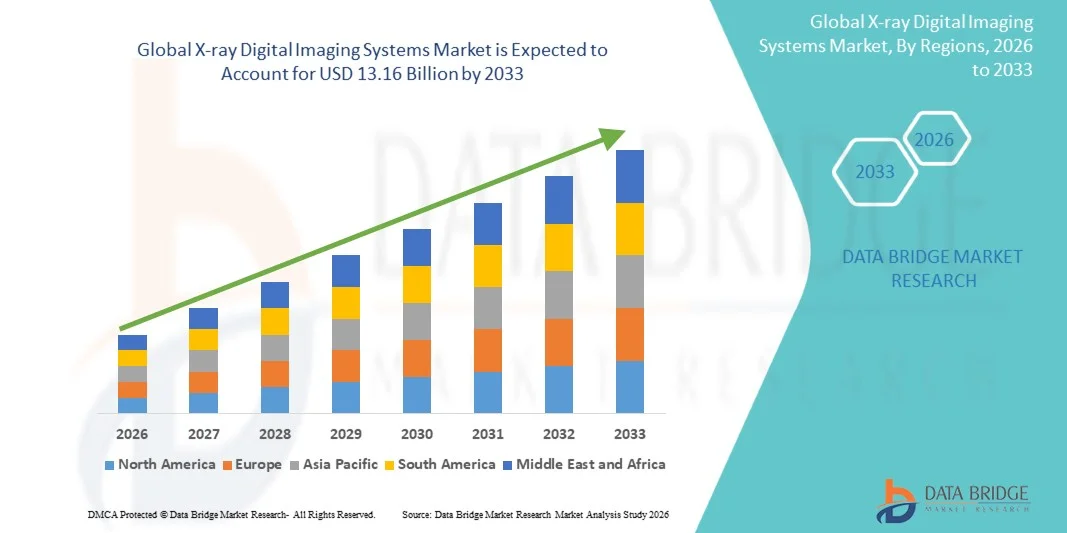
The X-ray Digital Imaging Systems Market was valued at USD 8.38 billion in 2025 and is projected to reach USD 13.16 billion by 2033, growing at a CAGR of 5.80% from 2026 to 2033. Market growth is supported by increasing prevalence of chronic diseases requiring diagnostic imaging, rising geriatric population susceptible to musculoskeletal and cardiovascular conditions, and the widespread transition from analog to digital radiography systems across healthcare facilities globally.
The superior image quality, reduced radiation exposure, and enhanced workflow efficiency associated with digital X-ray systems are driving accelerated adoption among hospitals, diagnostic imaging centers, and outpatient clinics. Ongoing technological advancements in flat-panel detector technology, wireless digital radiography, and artificial intelligence-enabled image analysis are expanding the clinical applicability of X-ray digital imaging systems across cardiology, oncology, neurology, and orthopedic specialties. In addition, growing healthcare infrastructure investments in emerging markets and favorable reimbursement policies for diagnostic imaging procedures are creating new opportunities for stakeholders across the forecast period.
Key Market Trends & Insights
- North America dominated the X-ray Digital Imaging Systems Market with the largest revenue share of 38.6% in 2025, supported by advanced healthcare infrastructure, high adoption rates of digital imaging technologies, and favorable reimbursement frameworks.
- Asia-Pacific is expected to be the fastest-growing region at a CAGR of 7.45% from 2026 to 2033, driven by expanding healthcare infrastructure, rising patient volumes, and increasing government investments in modernizing diagnostic imaging capabilities.
- The 2D technology segment led the market with a 64.8% market share in 2025, reflecting established clinical workflows, lower acquisition costs, and widespread installation base across healthcare settings.
- The 3D/4D technology segment is anticipated to be the fastest-growing technology category, driven by increasing demand for volumetric imaging, cone-beam computed tomography applications, and advanced visualization capabilities.
- The Hospitals segment dominated the end-use category with a 58.2% market share in 2025, supported by access to comprehensive diagnostic imaging departments, multidisciplinary clinical teams, and high procedural volumes.
- The Diagnostic Imaging Centers segment is expected to witness strong growth during the forecast period, driven by cost-effective imaging services, shorter patient wait times, and expanding outpatient diagnostic programs.
Market Size & Forecast
- Global Market Value (2025): USD 8.38 Billion
- Expected Market Value (2033): USD 13.16 Billion
- Forecast CAGR (2026–2033): 5.80%
- Leading Region in 2025: North America
- Fastest Growing Region: Asia-Pacific
Report Scope and X-ray Digital Imaging Systems Market Segmentation
|
Attributes |
X-ray Digital Imaging Systems Key Market Insights |
|
Segments Covered |
|
|
Countries Covered |
North America · U.S. · Canada · Mexico Europe · Germany · France · U.K. · Netherlands · Switzerland · Belgium · Russia · Italy · Spain · Turkey · Rest of Europe Asia-Pacific · China · Japan · India · South Korea · Singapore · Malaysia · Australia · Thailand · Indonesia · Philippines · Rest of Asia-Pacific Middle East and Africa · Saudi Arabia · U.A.E. · South Africa · Egypt · Israel · Rest of Middle East and Africa South America · Brazil · Argentina · Rest of South America |
|
Key Market Players |
· GE HealthCare (U.S.) · Siemens Healthineers AG (Germany) · Koninklijke Philips N.V. (Netherlands) · Canon Inc. (Japan) · FUJIFILM Holdings Corporation (Japan) · Carestream Health (U.S.) · Hologic Inc. (U.S.) · Shimadzu Corporation (Japan) · Agfa-Gevaert Group (Belgium) · Konica Minolta Inc. (Japan) · Samsung Electronics Co. Ltd. (South Korea) · Hitachi Ltd. (Japan) |
|
Market Opportunities |
· Expansion of AI-integrated digital X-ray platforms enabling automated image analysis, workflow optimization, and clinical decision support · Development of portable and wireless digital radiography systems enabling point-of-care imaging in ambulatory settings and underserved regions |
|
Value Added Data Infosets |
In addition to the insights on market scenarios such as market value, growth rate, segmentation, geographical coverage, and major players, the market reports curated by the Data Bridge Market Research also include depth expert analysis, patient epidemiology, pipeline analysis, pricing analysis, and regulatory framework. |
X-ray Digital Imaging Systems Market Trends
Trend: Integration of Artificial Intelligence and Advanced Image Processing Technologies
Clinical adoption of X-ray digital imaging systems continues to accelerate as artificial intelligence and machine learning algorithms enhance image quality, diagnostic accuracy, and workflow efficiency. AI-powered image analysis tools enable automated detection of abnormalities, quantitative measurements, and prioritization of critical findings, reducing radiologist workload and improving diagnostic throughput. Deep learning algorithms integrated within digital X-ray platforms support real-time image enhancement, noise reduction, and dose optimization, improving clinical outcomes while minimizing radiation exposure.
For instance,
GE HealthCare has expanded its AI-enabled imaging portfolio with advanced chest X-ray analysis algorithms capable of detecting over 20 pathological findings, supporting radiologists in high-volume clinical environments and improving diagnostic confidence.
In addition, research demonstrates that AI-assisted digital radiography reduces interpretation time by up to 30% compared to conventional reading workflows, supporting broader clinical adoption across emergency departments, intensive care units, and outpatient imaging facilities.
The integration of artificial intelligence and advanced image processing technologies is expected to remain a key market trend, driving innovation and expanding clinical capabilities across diagnostic imaging applications.
X-ray Digital Imaging Systems Market Dynamics
Key Market Driver: Growing Prevalence of Chronic Diseases Requiring Diagnostic Imaging
The rising global burden of chronic diseases, including cardiovascular conditions, cancer, respiratory disorders, and musculoskeletal diseases, is a primary driver of market growth. X-ray digital imaging systems serve as essential diagnostic tools for disease detection, treatment planning, and longitudinal monitoring across multiple clinical specialties. The increasing incidence of conditions requiring frequent imaging surveillance, combined with aging populations in developed and developing markets, is expanding the patient population eligible for digital radiography procedures.
For instance,
According to the World Health Organization, cardiovascular diseases remain the leading cause of mortality globally, accounting for approximately 17.9 million deaths annually. Digital X-ray imaging plays a critical role in cardiac assessment, chest radiography, and interventional cardiology guidance, supporting comprehensive cardiovascular care delivery.
Rising prevalence of chronic diseases requiring diagnostic imaging is expected to strengthen adoption of X-ray digital imaging systems globally, supporting market growth throughout the forecast period.
Key Restraint/Challenge: High Capital Investment and Equipment Maintenance Costs
The substantial upfront capital investment required for advanced digital X-ray systems, along with ongoing maintenance, software licensing, and technical support costs, presents a significant barrier to adoption, particularly for smaller healthcare facilities, independent imaging centers, and institutions in emerging markets. The total cost of ownership, including detector replacement, system upgrades, and service contracts, can limit the financial feasibility of digital radiography programs.
For instance,
Healthcare facilities evaluating digital X-ray system procurement must balance clinical benefits against significant capital expenditure, with high-end flat-panel detector systems requiring substantial initial investment compared to computed radiography alternatives.
High capital investment and equipment maintenance costs may constrain adoption, particularly among budget-sensitive healthcare providers and facilities in resource-limited settings.
Key Market Opportunity: Expansion of Portable and Point-of-Care Digital Radiography Solutions
The development of compact, portable, and wireless digital X-ray systems is creating significant opportunities for adoption beyond traditional radiology departments. Point-of-care digital radiography solutions enable bedside imaging in intensive care units, emergency departments, and operating rooms, improving diagnostic accessibility and reducing patient transport requirements. Portable digital X-ray systems are also expanding imaging capabilities in ambulatory care settings, long-term care facilities, and remote or underserved regions.
For instance,
The global portable X-ray device market is experiencing accelerated growth driven by increasing demand for mobile imaging solutions, home healthcare services, and emergency response applications. Wireless flat-panel detectors and battery-powered X-ray generators are enabling flexible deployment across diverse clinical environments.
Expansion of portable and point-of-care digital radiography solutions is expected to create new market opportunities, supporting adoption across ambulatory settings and emerging healthcare markets throughout the forecast period.
X-ray Digital Imaging Systems Market Scope
The X-ray digital imaging systems market is segmented on the basis of technology, application, and end use.
By Technology
On the basis of technology, the X-ray Digital Imaging Systems Market is segmented into 2D and 3D/4D. The 2D technology segment dominated the market with a 64.8% market share in 2025, reflecting established clinical workflows, lower acquisition costs, and widespread installation base across hospitals, imaging centers, and outpatient clinics. Two-dimensional digital radiography remains the standard imaging modality for chest radiography, skeletal imaging, and general diagnostic applications, supported by extensive clinical evidence and favorable reimbursement frameworks.
The 3D/4D technology segment is expected to witness the fastest growth from 2026 to 2033, driven by increasing demand for volumetric imaging capabilities, cone-beam computed tomography applications, and advanced three-dimensional visualization in dental, orthopedic, and interventional radiology settings. Technological advancements enabling higher spatial resolution, reduced scan times, and improved dose efficiency are expanding clinical adoption of 3D/4D digital X-ray systems across specialty applications.
By Application
On the basis of application, the X-ray Digital Imaging Systems Market is segmented into cardiology, oncology, neurology, urology, gynecology, and others. The Cardiology segment dominated the market with a 28.4% market share in 2025, driven by high procedural volumes in cardiovascular imaging, chest radiography for cardiac assessment, and fluoroscopy-guided interventional procedures. Digital X-ray systems provide essential diagnostic capabilities for evaluating cardiac silhouette, pulmonary vasculature, and thoracic pathology, supporting comprehensive cardiovascular care delivery.
The Oncology segment is expected to witness the fastest growth from 2026 to 2033, driven by rising global cancer incidence, increasing demand for diagnostic imaging in tumor detection and staging, and expanding applications of digital radiography in radiation therapy planning and treatment monitoring. Advanced digital X-ray platforms with integrated image analysis capabilities are improving diagnostic accuracy and supporting multidisciplinary oncology care pathways.
By End Use
On the basis of end use, the X-ray Digital Imaging Systems Market is segmented into hospitals, diagnostic imaging centers, and others. The Hospitals segment dominated the market with a market share of 58.2% in 2025, driven by access to comprehensive radiology departments, multidisciplinary clinical teams, and high procedural volumes requiring diagnostic imaging services. Hospitals serve as primary centers for complex imaging procedures, emergency radiography, and inpatient diagnostic services, contributing to high equipment utilization and technology adoption.
The Diagnostic Imaging Centers segment is expected to witness the fastest growth from 2026 to 2033, driven by cost-effective imaging services, shorter patient wait times, and expanding outpatient diagnostic programs. Freestanding imaging centers are increasingly adopting advanced digital X-ray systems to meet growing patient demand for convenient, accessible diagnostic services. Favorable reimbursement policies and rising preference for outpatient care are supporting segment expansion across developed and emerging markets.
X-ray Digital Imaging Systems Market Regional Analysis
North America dominated the X-ray digital imaging systems market with a revenue share of 38.6% in 2025, supported by advanced healthcare infrastructure, high adoption rates of digital imaging technologies, and favorable reimbursement frameworks for diagnostic radiology procedures. The presence of leading market players, extensive installed base of digital X-ray systems, and robust clinical training infrastructure contribute to regional market leadership.
U.S. X-ray Digital Imaging Systems Market Insight
The U.S. X-ray digital imaging systems market benefits from the highest healthcare expenditure globally, extensive adoption of advanced flat-panel detector systems, and comprehensive radiologist training programs. Academic medical centers, large health systems, and independent imaging facilities continue to invest in digital radiography upgrades, AI-integrated imaging platforms, and portable X-ray solutions. Favorable Medicare and commercial payer reimbursement supports procedural volumes and equipment modernization initiatives. The U.S. held approximately 78.5% of the North American regional market share in 2025.
Europe X-ray Digital Imaging Systems Market Insight
The Europe X-ray digital imaging systems market remains a major contributor, with strong hospital-based radiology programs across Germany, the U.K., France, and Italy. Growing adoption of wireless digital radiography systems and AI-powered image analysis tools is improving diagnostic efficiency and workflow optimization across public and private healthcare systems. Regulatory harmonization and structured quality assurance frameworks are supporting standardized equipment procurement and clinical practice.
U.K. X-ray Digital Imaging Systems Market Insight
The U.K. X-ray digital imaging systems market is characterized by expanding digital radiography programs within NHS trusts and private healthcare facilities. Investment in modern flat-panel detector systems and mobile X-ray units is improving diagnostic access and reducing imaging backlogs across acute care and community healthcare settings.
Germany X-ray Digital Imaging Systems Market Insight
Germany's robust hospital infrastructure and advanced medical technology ecosystem support comprehensive digital radiography programs across academic medical centers, regional hospitals, and diagnostic imaging networks. Strong clinical training frameworks and favorable reimbursement policies contribute to high procedure volumes and technology adoption. Germany held the largest market share within the European regional market at 24.3% in 2025.
Asia-Pacific X-ray Digital Imaging Systems Market Insight
The Asia-Pacific X-ray digital imaging systems market is poised for rapid growth with a CAGR of 7.45% during the forecast period, driven by expanding healthcare infrastructure, rising patient volumes, and increasing government investments in modernizing diagnostic imaging capabilities. Private healthcare systems in China, Japan, India, and South Korea are investing in advanced digital X-ray platforms to meet growing patient demand and improve clinical outcomes.
Japan X-ray Digital Imaging Systems Market Insight
The Japan X-ray digital imaging systems market benefits from advanced healthcare infrastructure, high technology adoption rates, and strong presence of domestic medical imaging manufacturers. Digital radiography systems are well-established across hospitals, imaging centers, and clinics, with expanding applications in chest radiography, orthopedic imaging, and dental diagnostics. Japan held the largest market share within the Asia-Pacific regional market at 26.8% in 2025.
China X-ray Digital Imaging Systems Market Insight
The China X-ray digital imaging systems market is experiencing rapid growth driven by healthcare modernization initiatives, expanding hospital networks, and increasing patient demand for advanced diagnostic services. Government investments in medical equipment procurement and rural healthcare infrastructure development are supporting market expansion. China is expected to be the fastest-growing country in the Asia-Pacific region, recording a CAGR of 8.12% from 2026 to 2033.
X-ray Digital Imaging Systems Market Share
The X-ray digital imaging systems industry is primarily led by well-established companies, including:
- GE HealthCare (U.S.)
- Siemens Healthineers AG (Germany)
- Koninklijke Philips N.V. (Netherlands)
- Canon Inc. (Japan)
- FUJIFILM Holdings Corporation (Japan)
- Carestream Health (U.S.)
- Hologic Inc. (U.S.)
- Shimadzu Corporation (Japan)
- Agfa-Gevaert Group (Belgium)
- Konica Minolta Inc. (Japan)
- Samsung Electronics Co. Ltd. (South Korea)
- Hitachi Ltd. (Japan)
Latest Developments in X-ray Digital Imaging Systems Market
- In March 2026, Siemens Healthineers announced the launch of its MOBILETT Elara Max mobile X-ray system with enhanced AI-powered image processing and wireless connectivity capabilities. The new system is designed to improve bedside imaging workflows in intensive care and emergency department settings, supporting faster diagnostic decision-making and reduced patient transport requirements.
- In January 2026, GE HealthCare introduced its Definium Tempo digital radiography system with integrated chest X-ray AI algorithms capable of detecting multiple thoracic pathologies. The platform features advanced dose management tools and streamlined workflow interfaces, enabling radiology departments to improve diagnostic throughput while maintaining image quality standards.
- In November 2025, FUJIFILM Holdings Corporation announced the expansion of its FDR D-EVO III wireless flat-panel detector portfolio with new lightweight models designed for portable and point-of-care radiography applications. The enhanced detectors feature improved image quality, faster processing speeds, and extended battery life, supporting flexible deployment across diverse clinical environments.
- In September 2025, Koninklijke Philips N.V. received U.S. FDA clearance for its DigitalDiagnost C90 ceiling-mounted digital radiography system with AI-assisted positioning and automated exposure control. The system is designed to improve patient throughput and reduce operator variability in high-volume radiology departments.
- In June 2025, Canon Inc. launched its CXDI-Pro Series wireless digital radiography detectors with advanced cesium iodide scintillator technology. The new detectors provide enhanced image quality, reduced radiation dose requirements, and improved durability for demanding clinical applications.
- In April 2025, Carestream Health announced the global availability of its DRX-Evolution Plus digital radiography system with enhanced workflow automation and connectivity features. The system supports integration with hospital information systems and radiology information systems, enabling streamlined image acquisition and distribution across healthcare networks.
- In February 2025, Samsung Electronics Co. Ltd. introduced its GC85A digital radiography system with AI-powered bone suppression and rib analysis algorithms. The platform is designed to improve detection of subtle pulmonary pathology and support radiologists in high-volume chest radiography environments.
- In December 2024, Agfa-Gevaert Group announced the launch of its DR 100s mobile digital X-ray system with enhanced maneuverability and wireless image transfer capabilities. The system is optimized for bedside imaging in hospitals and long-term care facilities, supporting improved diagnostic access for immobile patients.
- In October 2024, Shimadzu Corporation received regulatory approval for its RADspeed Pro EDGE digital radiography system in multiple international markets. The system features advanced flat-panel detector technology and dose reduction algorithms, supporting high-quality diagnostic imaging with minimized radiation exposure.
- In August 2024, Hologic Inc. announced the expansion of its digital radiography portfolio with new mammography-integrated imaging solutions designed for comprehensive breast health assessment. The integrated platforms support streamlined workflow and improved patient experience in breast imaging centers.

- Interactive Data Analysis Dashboard
- Company Analysis Dashboard for high growth potential opportunities
- Research Analyst Access for customization & queries
- Competitor Analysis with Interactive dashboard
- Latest News, Updates & Trend analysis
- Harness the Power of Benchmark Analysis for Comprehensive Competitor Tracking
Data collection and base year analysis are done using data collection modules with large sample sizes. The stage includes obtaining market information or related data through various sources and strategies. It includes examining and planning all the data acquired from the past in advance. It likewise envelops the examination of information inconsistencies seen across different information sources. The market data is analysed and estimated using market statistical and coherent models. Also, market share analysis and key trend analysis are the major success factors in the market report. To know more, please request an analyst call or drop down your inquiry.
The key research methodology used by DBMR research team is data triangulation which involves data mining, analysis of the impact of data variables on the market and primary (industry expert) validation. Data models include Vendor Positioning Grid, Market Time Line Analysis, Market Overview and Guide, Company Positioning Grid, Patent Analysis, Pricing Analysis, Company Market Share Analysis, Standards of Measurement, Global versus Regional and Vendor Share Analysis. To know more about the research methodology, drop in an inquiry to speak to our industry experts.
Data Bridge Market Research is a leader in advanced formative research. We take pride in servicing our existing and new customers with data and analysis that match and suits their goal. The report can be customized to include price trend analysis of target brands understanding the market for additional countries (ask for the list of countries), clinical trial results data, literature review, refurbished market and product base analysis. Market analysis of target competitors can be analyzed from technology-based analysis to market portfolio strategies. We can add as many competitors that you require data about in the format and data style you are looking for. Our team of analysts can also provide you data in crude raw excel files pivot tables (Fact book) or can assist you in creating presentations from the data sets available in the report.













