


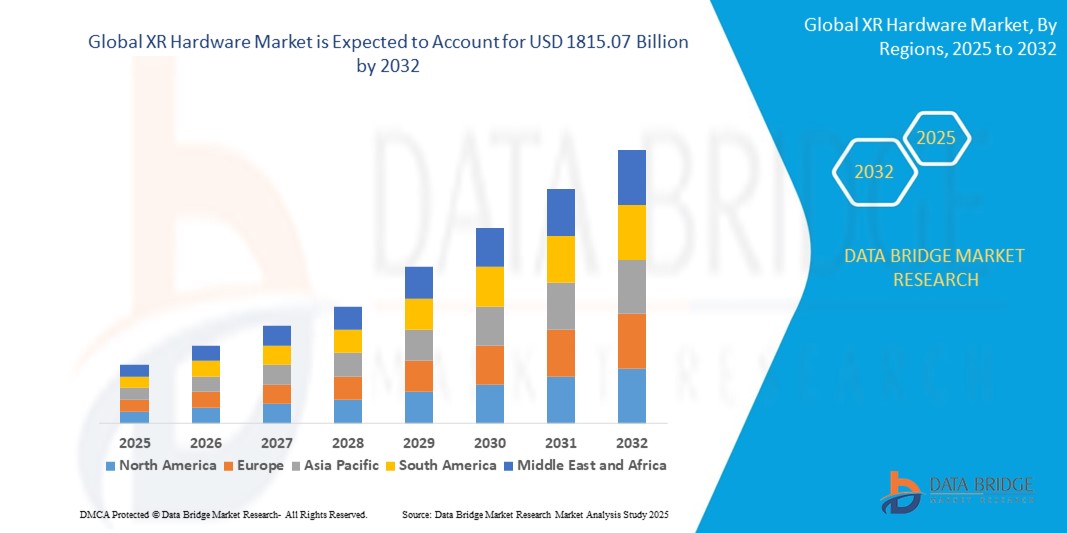
What is the Global XR Hardware Market Size and Growth Rate?
- The global XR hardware market size was valued at USD 128.76 billion in 2024 and is expected to reach USD 1815.07 billion by 2032, at a CAGR of 39.20% during the forecast period
- The XR hardware refers to the collective industry focused on manufacturing and distributing hardware components and devices related to Extended Reality (XR) technologies, which include Virtual Reality (VR), Augmented Reality (AR), and Mixed Reality (MR). This market encompasses a diverse range of products such as VR headsets, AR glasses, mixed reality devices, controllers, sensors, cameras, and associated accessories
- The XR hardware market is driven by increasing applications across various sectors, including gaming, healthcare, education, manufacturing, and more, with continuous technological advancements aimed at enhancing immersive and interactive experiences for users worldwide
What are the Major Takeaways of XR Hardware Market?
- Increased competition and advancements in component technology act as significant drivers for the market. The competitive landscape fosters innovation among key players to stay ahead, leading to continuous enhancements in XR hardware components such as optics, sensors, processors, and display technologies. This competitive drive fuels the development of more sophisticated and feature-rich devices contributes to cost reduction, making XR hardware more accessible to a broader consumer and enterprise audience
- North America dominated the XR hardware market with the largest revenue share of 39.96% in 2024, driven by strong demand for immersive technologies across gaming, entertainment, education, and enterprise applications
- Asia-Pacific XR hardware market is poised to grow at the fastest CAGR of 15.4% from 2025 to 2032, driven by rapid urbanization, a booming gaming industry, and expanding enterprise applications in manufacturing, education, and retail
- The consumer engagement segment dominated the XR hardware market with the largest market revenue share of 61.4% in 2024, driven by the rapid adoption of immersive entertainment, gaming, and social interaction experiences among consumers
Report Scope and XR Hardware Market Segmentation
|
Attributes |
XR Hardware Key Market Insights |
|
Segments Covered |
|
|
Countries Covered |
North America
Europe
Asia-Pacific
Middle East and Africa
South America
|
|
|
|
Market Opportunities |
|
|
Value Added Data Infosets |
In addition to the insights on market scenarios such as market value, growth rate, segmentation, geographical coverage, and major players, the market reports curated by the Data Bridge Market Research also include in-depth expert analysis, pricing analysis, brand share analysis, consumer survey, demography analysis, supply chain analysis, value chain analysis, raw material/consumables overview, vendor selection criteria, PESTLE Analysis, Porter Analysis, and regulatory framework. |
What is the Key Trend in the XR Hardware Market?
Enhanced Immersion through AI-Driven and Voice-Enabled Experiences
- A prominent and accelerating trend in the global XR hardware market is the deeper integration of artificial intelligence (AI) with leading voice-controlled platforms such as Amazon Alexa, Google Assistant, and Apple Siri, significantly enriching user interactivity and convenience within immersive environments
- For instance, Meta’s Quest Pro supports hands-free navigation and control through voice commands, while Sony’s PlayStation VR2 offers AI-assisted adaptive rendering, delivering a more personalized and realistic experience for users. Similarly, Magic Leap 2 integrates AI-based spatial mapping with voice-enabled control, enhancing professional and enterprise applications
- AI capabilities in XR devices can optimize graphics rendering, adjust field of view dynamically, and provide predictive user assistance based on activity patterns. For instance, Varjo’s XR-4 series uses AI to fine-tune image clarity and improve hand-tracking accuracy over time, while voice integration enables streamlined operations, allowing users to open menus, switch environments, or execute commands without manual interaction
- The convergence of XR hardware with smart assistants and connected platforms supports unified control of various devices and applications through a single interface, whether in gaming, virtual collaboration, or industrial training scenarios
- This movement toward more intelligent, intuitive, and seamlessly connected XR devices is redefining user expectations for immersive technology. Companies such as Pico Interactive are developing AI-powered headsets with context-aware automation and deep compatibility with voice platforms, enhancing both productivity and entertainment experiences
- The demand for XR hardware that combines AI adaptability with voice-enabled interaction is surging in both consumer and enterprise markets, driven by a growing emphasis on convenience, realism, and seamless integration into broader digital ecosystems
What are the Key Drivers of XR Hardware Market?
- The increasing demand for immersive experiences across gaming, enterprise training, healthcare simulation, and virtual collaboration is a core driver for the XR Hardware market’s rapid growth
- For instance, in March 2025, HTC unveiled the Vive XR Elite Business Edition with enhanced enterprise-grade security, AI-powered training tools, and multi-user collaboration features, targeting sectors such as education, manufacturing, and healthcare
- As awareness of XR’s potential expands, users are seeking devices with advanced tracking, higher display resolutions, and integration with existing digital tools. XR hardware offers compelling advantages over conventional displays by providing interactive 3D environments, spatial awareness, and real-time collaboration capabilities
- In addition, the rising popularity of metaverse platforms and the demand for hybrid work solutions are fueling adoption, with XR devices becoming essential for remote design reviews, medical procedures, and immersive retail experiences
- The growing appeal of wireless, lightweight, and ergonomic designs, combined with more affordable options for consumers and scalable solutions for enterprises, is further accelerating adoption. Easy setup processes and compatibility with existing computing systems are also enabling wider market reach
Which Factor is challenging the Growth of the XR Hardware Market?
- Cybersecurity and data privacy concerns represent a significant hurdle for the XR Hardware market, as these devices collect and process sensitive biometric, spatial, and behavioral data. Potential vulnerabilities to hacking, unauthorized tracking, or data misuse raise user concerns, especially in corporate and healthcare applications
- For instance, reports of motion tracking data being exploited in certain VR applications have made some enterprises cautious about deploying XR hardware at scale
- Addressing these risks requires robust encryption, strict access controls, and regular firmware updates. Brands such as Varjo and Magic Leap emphasize enterprise-grade security protocols to build customer confidence
- Furthermore, the high initial cost of advanced XR systems particularly those with premium optics, haptic feedback, or enterprise features can be a barrier, especially in cost-sensitive markets. While entry-level devices such as Meta Quest 3 offer a more affordable gateway into XR, professional-grade solutions often command a premium
- Although hardware costs are expected to decline over time, price sensitivity and lack of immediate ROI in certain applications can slow adoption
- To overcome these barriers, industry players must prioritize security assurances, user education, and the development of cost-efficient yet high-performance devices to encourage broader market uptake
How is the XR Hardware Market Segmented?
The market is segmented on the basis of solution, application, and end-user.
- By Solution
On the basis of solution, the XR hardware market is segmented into consumer engagement and business engagement. The consumer engagement segment dominated the XR hardware market with the largest market revenue share of 61.4% in 2024, driven by the rapid adoption of immersive entertainment, gaming, and social interaction experiences among consumers. The growing popularity of virtual concerts, multiplayer VR games, and social VR spaces continues to boost demand for consumer-oriented XR hardware.
The business engagement segment is anticipated to witness the fastest growth rate of 19.8% from 2025 to 2032, fueled by increasing use cases in corporate training, product design visualization, and collaborative virtual environments. Enterprises are leveraging XR hardware to improve productivity, reduce operational costs, and enhance customer engagement through interactive product demonstrations and immersive presentations.
- By Application
On the basis of application, the XR hardware market is segmented into virtual reality (VR), augmented reality (AR), and mixed reality (MR). The VR segment held the largest market revenue share in 2024 at 48.7%, driven by its widespread use in gaming, simulation training, and immersive storytelling. Advancements in display resolution, field of view, and motion tracking have significantly improved user experience, further fueling demand for VR devices.
The AR segment is expected to witness the fastest CAGR from 2025 to 2032, driven by its growing adoption in navigation, remote assistance, and retail visualization applications. AR hardware enables users to overlay digital information in real-world environments, making it highly valuable in fields such as maintenance, healthcare, and education.
- By End-user
On the basis of end-user, the XR hardware market is segmented into education, retail, industrial and manufacturing, healthcare, media and entertainment, and others. The media and entertainment segment dominated the XR Hardware market with a market revenue share of 39.2% in 2024, driven by the rising consumption of immersive content in gaming, sports broadcasting, and live events. The availability of premium XR content libraries and growing partnerships between hardware manufacturers and entertainment companies continue to push this segment forward.
The healthcare segment is projected to grow at the fastest CAGR from 2025 to 2032, supported by increasing applications in surgical simulations, patient rehabilitation, and mental health therapy. XR hardware offers healthcare providers innovative tools for training, diagnosis, and patient engagement, enhancing overall care delivery.
Which Region Holds the Largest Share of the XR Hardware Market?
- North America dominated the XR hardware market with the largest revenue share of 39.96% in 2024, driven by strong demand for immersive technologies across gaming, entertainment, education, and enterprise applications
- The region benefits from the presence of leading XR hardware manufacturers, robust R&D capabilities, and a tech-savvy consumer base eager to adopt cutting-edge solutions
- Consumers and businesses in North America value the high-quality visual performance, ergonomic designs, and seamless integration of XR devices with cloud platforms, 5G networks, and AI-powered applications. High disposable incomes, a mature digital infrastructure, and strong content ecosystems further reinforce the region’s leadership in XR adoption
U.S. XR Hardware Market Insight
The U.S. XR hardware market captured the largest revenue share in 2024 within North America, supported by rapid uptake in gaming consoles, VR headsets, and AR glasses. Enterprises in sectors such as healthcare, automotive, and manufacturing are also driving adoption for training and simulation purposes. The market is further fueled by growing consumer enthusiasm for mixed reality experiences, the rise of the metaverse, and strong integration with platforms such as Meta’s Horizon Worlds, Microsoft Mesh, and Apple Vision Pro.
Europe XR Hardware Market Insight
The Europe XR hardware market is projected to expand at a steady CAGR throughout the forecast period, driven by digital transformation initiatives, high-speed internet penetration, and strong government support for Industry 4.0 technologies. Demand is fueled by applications in design visualization, education, and tourism, as well as gaming. XR hardware adoption in Europe is supported by a strong focus on privacy, sustainability, and energy-efficient devices, with both new installations and retrofits in residential, commercial, and industrial sectors gaining traction.
U.K. XR Hardware Market Insight
The U.K. XR hardware market is anticipated to grow at a robust CAGR during the forecast period, driven by the country’s dynamic gaming sector, creative industries, and enterprise adoption of immersive solutions. Applications in virtual retail showrooms, education, and corporate training are expanding rapidly. Strong 5G deployment, combined with active investment in XR startups and innovation hubs, is further accelerating adoption.
Germany XR Hardware Market Insight
The Germany XR hardware market is expected to expand considerably, supported by its strong manufacturing base, automotive sector, and focus on advanced simulation technologies. Demand is growing in industrial training, remote maintenance, and product design. Sustainability and precision engineering remain key priorities for German consumers and enterprises, encouraging the adoption of energy-efficient, durable, and high-performance XR devices.
Which Region is the Fastest Growing Region in the XR Hardware Market?
Asia-Pacific XR hardware market is poised to grow at the fastest CAGR of 15.4% from 2025 to 2032, driven by rapid urbanization, a booming gaming industry, and expanding enterprise applications in manufacturing, education, and retail. Countries such as China, Japan, South Korea, and India are witnessing surging demand for affordable yet advanced XR devices, backed by government initiatives promoting digitalization and smart city development. The region’s strong position as a manufacturing hub for XR components ensures competitive pricing and rapid technology deployment.
Japan XR Hardware Market Insight
The Japan XR hardware market is gaining momentum due to the country’s advanced consumer electronics industry, high-speed internet infrastructure, and deep cultural integration of technology. Strong adoption is seen in gaming, education, and healthcare, with aging demographics also creating demand for assistive XR solutions. Japan’s emphasis on innovation and high-quality design aligns well with the growing sophistication of XR devices.
China XR Hardware Market Insight
The China XR hardware market accounted for the largest share in Asia-Pacific in 2024, driven by mass adoption in entertainment, e-commerce, and education. Government-backed initiatives to promote AR/VR integration into manufacturing and public services are also accelerating growth. A large domestic production base, competitive pricing, and the rapid rise of local XR brands contribute to China’s leading position in the region.
Which are the Top Companies in XR Hardware Market?
The XR hardware industry is primarily led by well-established companies, including:
- Microsoft Corporation (U.S.)
- Sony Corporation (Japan)
- HTC Corporation (Taiwan)
- Oculus VR (U.S.)
- Samsung Electronics Co., Ltd. (South Korea)
- Google LLC (U.S.)
- Magic Leap, Inc. (U.S.)
- Vuzix Corporation (U.S.)
- Epson America, Inc. (U.S.)
- Qualcomm Technologies, Inc. (U.S.)
- Apple Inc. (U.S.)
- Intel Corporation (U.S.)
- Acer Inc. (Taiwan)
- Dell Technologies Inc. (U.S.)
- ASUSTeK Computer Inc. (Taiwan)
- Lenovo Group Limited (Hong Kong)
- Pico Interactive (China)
- Varjo Technologies (Finland)
- Nreal (China)
- Lynx Laboratories Inc. (U.S.)
What are the Recent Developments in Global XR Hardware Market?
- In March 2025, during the 2025 SXSW festival, GIGABYTE announced a collaboration with the Taiwan Creative Content Agency (TAICCA) to advance the adoption of an AI-powered XR content creation platform, marking a significant step toward enhancing immersive content development worldwide
- In December 2024, Google unveiled its Android XR platform, which will debut on Samsung’s Project Moohan device, highlighting a major push towards strengthening its position in the extended reality ecosystem
- In November 2024, IIT Madras, through its Experiential Technology Innovation Centre (XTIC), launched the XTIC-APP (Academic Partnership Program) to accelerate growth and innovation in India’s XR sector, reinforcing the country’s emerging role in immersive technology advancements
- In August 2023, Meta introduced the Quest Pro, a high-end VR headset equipped with advanced mixed reality capabilities, upgraded display resolution and processing power, and integrated eye-tracking technology, setting a new benchmark in premium VR hardware
- In August 2023, Pico Interactive released the Pico 4 Pro, positioned as a competitor to the Quest Pro and offering features such as pancake lenses, hand tracking, and a wider field of view than the standard Pico 4, strengthening its standing in the global VR market

- Interactive Data Analysis Dashboard
- Company Analysis Dashboard for high growth potential opportunities
- Research Analyst Access for customization & queries
- Competitor Analysis with Interactive dashboard
- Latest News, Updates & Trend analysis
- Harness the Power of Benchmark Analysis for Comprehensive Competitor Tracking
Global Xr Hardware Market, Supply Chain Analysis and Ecosystem Framework
To support market growth and help clients navigate the impact of geopolitical shifts, DBMR has integrated in-depth supply chain analysis into its Global Xr Hardware Market research reports. This addition empowers clients to respond effectively to global changes affecting their industries. The supply chain analysis section includes detailed insights such as Global Xr Hardware Market consumption and production by country, price trend analysis, the impact of tariffs and geopolitical developments, and import and export trends by country and HSN code. It also highlights major suppliers with data on production capacity and company profiles, as well as key importers and exporters. In addition to research, DBMR offers specialized supply chain consulting services backed by over a decade of experience, providing solutions like supplier discovery, supplier risk assessment, price trend analysis, impact evaluation of inflation and trade route changes, and comprehensive market trend analysis.
Data collection and base year analysis are done using data collection modules with large sample sizes. The stage includes obtaining market information or related data through various sources and strategies. It includes examining and planning all the data acquired from the past in advance. It likewise envelops the examination of information inconsistencies seen across different information sources. The market data is analysed and estimated using market statistical and coherent models. Also, market share analysis and key trend analysis are the major success factors in the market report. To know more, please request an analyst call or drop down your inquiry.
The key research methodology used by DBMR research team is data triangulation which involves data mining, analysis of the impact of data variables on the market and primary (industry expert) validation. Data models include Vendor Positioning Grid, Market Time Line Analysis, Market Overview and Guide, Company Positioning Grid, Patent Analysis, Pricing Analysis, Company Market Share Analysis, Standards of Measurement, Global versus Regional and Vendor Share Analysis. To know more about the research methodology, drop in an inquiry to speak to our industry experts.
Data Bridge Market Research is a leader in advanced formative research. We take pride in servicing our existing and new customers with data and analysis that match and suits their goal. The report can be customized to include price trend analysis of target brands understanding the market for additional countries (ask for the list of countries), clinical trial results data, literature review, refurbished market and product base analysis. Market analysis of target competitors can be analyzed from technology-based analysis to market portfolio strategies. We can add as many competitors that you require data about in the format and data style you are looking for. Our team of analysts can also provide you data in crude raw excel files pivot tables (Fact book) or can assist you in creating presentations from the data sets available in the report.













