


Yersiniosis Treatment Market Size
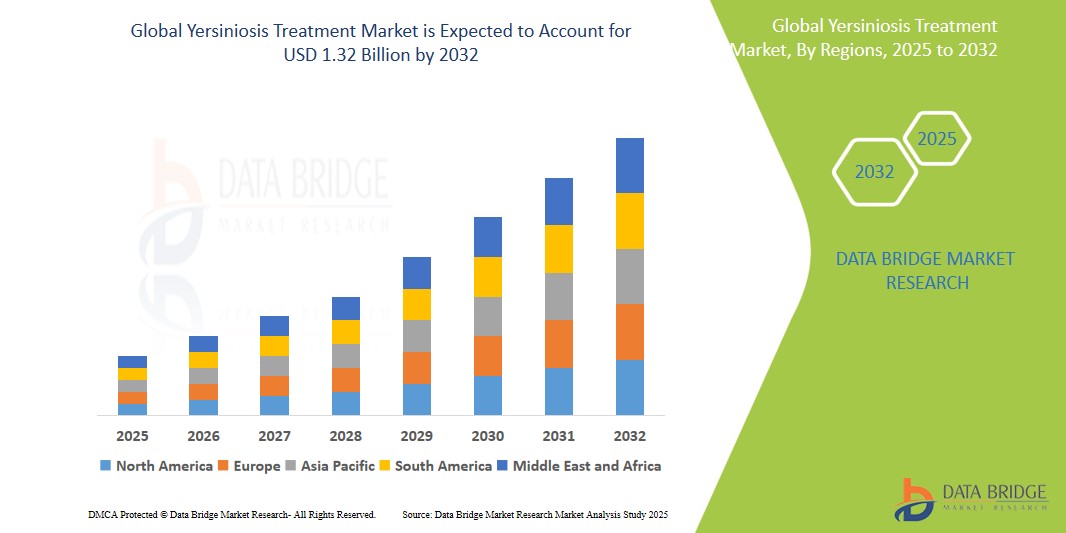
- The Global Yersiniosis Treatment Market size was valued at USD 800.15 Million in 2024 and is expected to reach USD 1.32 billion by 2032, at a CAGR of 6.52% during the forecast period
- This growth is driven by increasing awareness of zoonotic diseases, improvements in diagnostic techniques, and the rising prevalence of foodborne infections
Yersiniosis Treatment Market Analysis
- Yersiniosis is a bacterial infection primarily caused by Yersinia enterocolitica and Yersinia pseudotuberculosis, often transmitted through contaminated food or water. Treatment involves antimicrobial or antibiotic therapy and, in severe cases, surgical interventions.
- The rising incidence of gastrointestinal infections and zoonotic diseases globally is a key factor driving the demand for effective treatment options, including targeted antibiotic and antimicrobial drugs.
- North America is expected to hold the largest market share due to a well-established healthcare infrastructure, improved diagnostics, and growing awareness of foodborne bacterial infections.
- Asia-Pacific is projected to witness the fastest growth in the yersiniosis treatment market during the forecast period, owing to increasing population, improving healthcare access, and greater incidence of gastrointestinal infections.
- The diarrhea indication segment is anticipated to lead the market with 63.75% share, due to the high frequency of this symptom in yersiniosis cases, coupled with a growing demand for prompt and effective treatment.
Report Scope and Yersiniosis Treatment Market Segmentation
|
Attributes |
Yersiniosis Treatment Key Market Insights |
|
Segments Covered |
|
|
Countries Covered |
North America
Europe
Asia-Pacific
Middle East and Africa
South America
|
|
Key Market Players |
|
|
Market Opportunities |
|
|
Value Added Data Infosets |
In addition to the insights on market scenarios such as market value, growth rate, segmentation, geographical coverage, and major players, the market reports curated by the Data Bridge Market Research also include import export analysis, production capacity overview, production consumption analysis, price trend analysis, climate change scenario, supply chain analysis, value chain analysis, raw material/consumables overview, vendor selection criteria, PESTLE Analysis, Porter Analysis, and regulatory framework. |
Yersiniosis Treatment Market Trends
“Rising Focus on Rapid Diagnostic Technologies and Antimicrobial Resistance Monitoring”
- A prominent trend shaping the yersiniosis treatment market is the increased focus on rapid diagnostic techniques and antimicrobial resistance surveillance to support timely and accurate therapeutic decisions
- The integration of advanced molecular diagnostics, such as multiplex PCR assays and next-generation sequencing (NGS), is transforming the detection and management of Yersinia infections
- These innovations enhance diagnostic accuracy, reduce turnaround times, and help clinicians initiate early, targeted treatment strategies
- For instance, automated real-time PCR platforms now enable detection of Yersinia enterocolitica and Yersinia pseudotuberculosis within hours instead of days, significantly improving disease management and limiting the spread of infection
- Additionally, global initiatives for antimicrobial resistance (AMR) monitoring have underscored the need for precise treatment options, which in turn are driving demand for advanced antimicrobial agents and infection control solutions
Yersiniosis Treatment Market Dynamics
Driver
“Increasing Incidence of Foodborne Zoonotic Infections”
- The global rise in foodborne illnesses, particularly zoonotic infections like yersiniosis, is significantly contributing to the growing demand for effective treatment options
- Yersiniosis commonly spreads through contaminated pork, unpasteurized milk, and untreated water, making it a public health concern, especially in countries with poor food hygiene practices
- As awareness grows and reporting becomes more accurate, the number of diagnosed cases has increased, fueling demand for both antimicrobial therapy and supportive care
- For instance, In April 2024, the European Food Safety Authority (EFSA) reported that yersiniosis remained the third most commonly reported zoonosis in the EU, with over 6,800 confirmed human cases, primarily linked to Yersinia enterocolitica. The burden of these infections places significant pressure on public health systems, necessitating effective treatment and control strategies
- This growing incidence is pushing governments and healthcare providers to improve disease surveillance, implement rapid diagnostics, and ensure accessibility to reliable therapeutic interventions
Opportunity
“Expansion of Public Health Programs and Food Safety Regulations in Emerging Markets”
- Emerging economies are increasingly adopting stricter food safety laws and expanding public health initiatives aimed at controlling zoonotic and gastrointestinal infections, presenting strong growth opportunities for the yersiniosis treatment market
- These initiatives include better veterinary hygiene, public education on safe food handling, and funding for disease surveillance systems
- Pharmaceutical and biotech companies have the opportunity to collaborate with local governments and healthcare institutions to supply affordable antibiotics, launch awareness campaigns, and improve healthcare infrastructure
- For instance, In October 2024, the World Health Organization (WHO) announced a multi-country initiative in Southeast Asia focusing on zoonotic disease prevention and outbreak preparedness, including enhanced monitoring and response systems for yersiniosis and other bacterial infections
- These collaborative public health efforts can significantly improve access to treatment and drive market expansion in underpenetrated regions
Restraint/Challenge
“Limited Awareness and Misdiagnosis in Low-Income Regions”
- Despite growing incidence, low awareness about yersiniosis and its similarity to other gastrointestinal conditions often lead to underreporting and misdiagnosis, particularly in rural and low-resource settings
- This lack of clinical differentiation reduces the likelihood of timely and appropriate treatment, potentially exacerbating disease outcomes and hindering market growth
- Furthermore, insufficient access to diagnostic laboratories, particularly in sub-Saharan Africa and parts of South Asia, remains a critical barrier to effective disease identification and treatment.
- For instance, According to the Global Burden of Disease Study (2023), low-income countries suffer from major underdiagnosis of bacterial enteric diseases due to the absence of adequate laboratory infrastructure, with up to 40% of cases being incorrectly attributed to non-specific gastrointestinal infections
- As a result, delayed or improper treatment leads to prolonged infection cycles and increased risk of complications, such as mesenteric adenitis, further limiting the market’s reach in underserved populations
Yersiniosis Treatment Market Scope
The market is segmented on the basis strain type, indication, treatment, drug class, route of administration and end users.
|
Segmentation |
Sub-Segmentation |
|
By Strain Type |
|
|
By Indication |
|
|
By Treatment |
|
|
By Drugs Class |
|
|
By Route of Administration |
|
|
By End- Users |
|
In 2025, the diarrhea indication is projected to dominate the market with the largest share in the indication segment
The diarrhea segment is expected to dominate the global yersiniosis treatment market with the largest share of 63.75% in 2025, owing to the high frequency of this symptom in Yersinia infections and the urgent need for timely treatment. Diarrhea is the most common clinical manifestation of yersiniosis, particularly in children and immunocompromised individuals. The increasing incidence of foodborne infections and the growing emphasis on early intervention and supportive care are driving segment growth. Additionally, improvements in diagnostic accuracy and accessibility to effective antimicrobial therapies further contribute to the market dominance of this segment.
The antimicrobial agents segment is expected to account for the largest share during the forecast period in the drug class market
In 2025, the antimicrobial agents segment is expected to dominate the market with the largest market share of 58.42%, due to their central role in treating Yersinia infections. Antimicrobials such as fluoroquinolones and third-generation cephalosporins remain the first-line treatment for severe yersiniosis cases. Rising awareness of antimicrobial resistance, advancements in targeted therapies, and an increasing focus on appropriate antibiotic stewardship are contributing to the sustained demand for effective antimicrobial agents. Moreover, expanding clinical research and the development of broad-spectrum agents are expected to reinforce this segment's dominance throughout the forecast period.
Yersiniosis Treatment Market Regional Analysis
“North America Holds the Largest Share in the Yersiniosis Treatment Market”
- North America dominates the global yersiniosis treatment market, primarily due to its robust healthcare infrastructure, advanced diagnostic capabilities, and early adoption of effective treatment protocols
- The U.S. holds a major share within the region, fueled by heightened awareness of foodborne illnesses, a well-established public health surveillance system, and swift access to antimicrobial therapies
- Government initiatives from agencies such as the CDC for controlling outbreaks and promoting food safety have significantly contributed to disease monitoring and timely intervention
- Additionally, the region benefits from extensive R&D activities, strong pharmaceutical pipelines, and the presence of leading biotech and pharma companies focusing on antibacterial drug development, further solidifying its market position
“Asia-Pacific is Projected to Register the Highest CAGR in the Yersiniosis Treatment Market”
- The Asia-Pacific region is expected to record the highest compound annual growth rate in the yersiniosis treatment market, driven by increased public health initiatives, improving diagnostic access, and rising food safety concerns
- Countries like China, India, and Japan are key contributors due to rising population densities, increasing prevalence of zoonotic and foodborne diseases, and expanding healthcare access
- Japan remains a key market due to its strong emphasis on clinical hygiene standards and technological advancements in rapid diagnostics and microbial resistance management
- India and China, with their high burden of gastrointestinal infections, are witnessing government-led programs aimed at improving water and food sanitation and disease awareness. These initiatives, coupled with growing investment in healthcare infrastructure and pharmaceutical production, are fueling regional market expansion
Yersiniosis Treatment Market Share
The market competitive landscape provides details by competitor. Details included are company overview, company financials, revenue generated, market potential, investment in research and development, new market initiatives, global presence, production sites and facilities, production capacities, company strengths and weaknesses, product launch, product width and breadth, application dominance. The above data points provided are only related to the companies' focus related to market.
The Major Market Leaders Operating in the Market Are:
- Enesi (United Kingdom)
- General Dynamics Information Technology, Inc. (U.S.)
- Merck & Co., Inc. (U.S.)
- Mitsubishi Tanabe Pharma Corporation (Japan)
- Novartis AG (Switzerland)
- Vertex Pharmaceuticals Incorporated (U.S.)
- Pfizer Inc. (U.S.)
- GlaxoSmithKline Plc (United Kingdom)
- F. Hoffmann-La Roche Ltd (Switzerland)

- Interactive Data Analysis Dashboard
- Company Analysis Dashboard for high growth potential opportunities
- Research Analyst Access for customization & queries
- Competitor Analysis with Interactive dashboard
- Latest News, Updates & Trend analysis
- Harness the Power of Benchmark Analysis for Comprehensive Competitor Tracking
Data collection and base year analysis are done using data collection modules with large sample sizes. The stage includes obtaining market information or related data through various sources and strategies. It includes examining and planning all the data acquired from the past in advance. It likewise envelops the examination of information inconsistencies seen across different information sources. The market data is analysed and estimated using market statistical and coherent models. Also, market share analysis and key trend analysis are the major success factors in the market report. To know more, please request an analyst call or drop down your inquiry.
The key research methodology used by DBMR research team is data triangulation which involves data mining, analysis of the impact of data variables on the market and primary (industry expert) validation. Data models include Vendor Positioning Grid, Market Time Line Analysis, Market Overview and Guide, Company Positioning Grid, Patent Analysis, Pricing Analysis, Company Market Share Analysis, Standards of Measurement, Global versus Regional and Vendor Share Analysis. To know more about the research methodology, drop in an inquiry to speak to our industry experts.
Data Bridge Market Research is a leader in advanced formative research. We take pride in servicing our existing and new customers with data and analysis that match and suits their goal. The report can be customized to include price trend analysis of target brands understanding the market for additional countries (ask for the list of countries), clinical trial results data, literature review, refurbished market and product base analysis. Market analysis of target competitors can be analyzed from technology-based analysis to market portfolio strategies. We can add as many competitors that you require data about in the format and data style you are looking for. Our team of analysts can also provide you data in crude raw excel files pivot tables (Fact book) or can assist you in creating presentations from the data sets available in the report.












