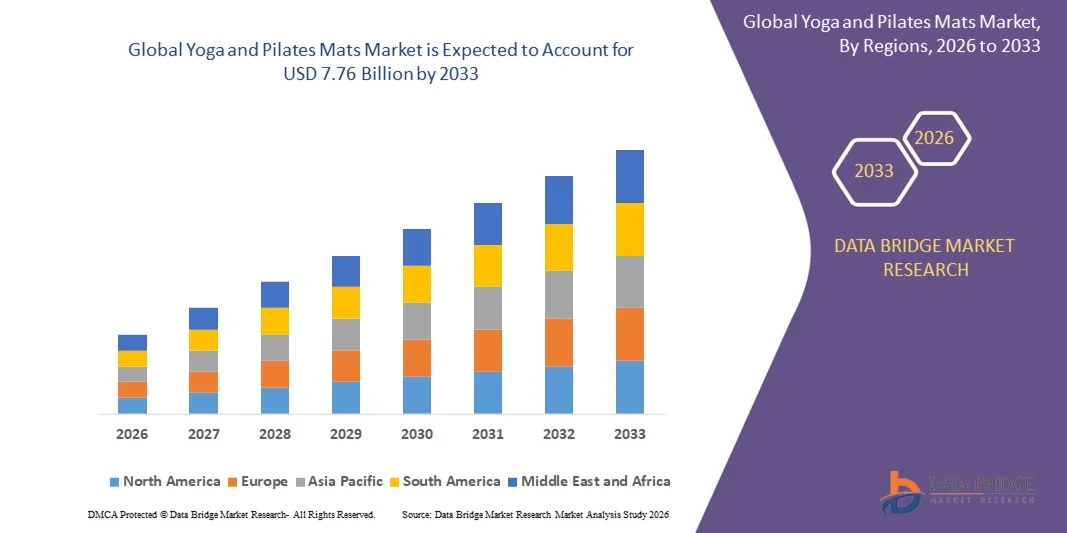
Yoga and Pilates Mats Market Size
- The global yoga and pilates mats market size was valued at USD 4.74 billion in 2025 and is expected to reach USD 7.76 billion by 2033, at a CAGR of 6.35% during the forecast period
- The market growth is largely fueled by the increasing adoption of fitness and wellness routines, along with rising health consciousness among consumers, leading to greater demand for yoga and pilates mats for both home and studio use
- Furthermore, the growing popularity of online fitness classes, digital wellness platforms, and at-home workout programs is establishing yoga and pilates mats as essential fitness accessories, accelerating product adoption and significantly boosting industry growth
Yoga and Pilates Mats Market Analysis
- Yoga and pilates mats, providing comfort, stability, and grip during exercises, are becoming vital components of home and commercial fitness setups due to their ability to enhance performance, prevent injuries, and support diverse workout routines
- The escalating demand for yoga and pilates mats is primarily driven by increasing awareness of physical and mental wellness, the rising number of fitness studios and gyms, and the preference for eco-friendly, durable, and high-performance mats among consumers
- North America dominated yoga and pilates mats market with a share of over 40% in 2025, due to growing awareness of fitness, wellness, and home workout routines
- Asia-Pacific is expected to be the fastest growing region in the yoga and pilates mats market during the forecast period due to increasing health awareness, urbanization, and rising disposable incomes in countries such as China, Japan, and India
- TPE segment dominated the market with a market share of 36.1% in 2025, due to its eco-friendly nature, durability, and non-toxic composition. Consumers increasingly prefer TPE mats for their lightweight design, superior grip, and ease of maintenance. TPE mats are highly compatible with various fitness routines and are resistant to wear and tear, making them a preferred choice for both beginners and professional users. Leading manufacturers such as Liforme and Manduka have emphasized TPE-based mats in their product lines, further boosting adoption. The versatility of TPE mats across yoga, Pilates, and general fitness exercises contributes significantly to their market dominance
Report Scope and Yoga and Pilates Mats Market Segmentation
|
Attributes |
Yoga and Pilates Mats Key Market Insights |
|
Segments Covered |
|
|
Countries Covered |
North America
Europe
Asia-Pacific
Middle East and Africa
South America
|
|
Key Market Players |
|
|
Market Opportunities |
|
|
Value Added Data Infosets |
In addition to the insights on market scenarios such as market value, growth rate, segmentation, geographical coverage, and major players, the market reports curated by the Data Bridge Market Research also include in-depth expert analysis, pricing analysis, brand share analysis, consumer survey, demography analysis, supply chain analysis, value chain analysis, raw material/consumables overview, vendor selection criteria, PESTLE Analysis, Porter Analysis, and regulatory framework. |
Yoga and Pilates Mats Market Trends
Rising Consumer Preference for Eco-Friendly and Sustainable Yoga Mats
- A significant trend in the yoga and pilates mats market is the increasing consumer preference for eco-friendly and sustainable mats, driven by growing awareness of environmental impact and health-conscious lifestyles. This trend is elevating the demand for mats made from biodegradable, recycled, or natural materials, positioning sustainability as a key factor in purchasing decisions
- For instance, Manduka has expanded its PRO and eKO series mats using sustainably sourced natural rubber, attracting eco-conscious consumers globally. Similarly, Liforme emphasizes environmentally responsible materials and non-toxic production processes, appealing to users seeking premium, green alternatives. Such initiatives strengthen brand positioning and reinforce market growth in the sustainable segment
- The rising focus on wellness and holistic fitness practices is encouraging consumers to select mats that align with their ethical and environmental values, increasing demand for premium eco-friendly products. This trend is also influencing fitness studios and yoga centers to provide environmentally responsible options for members
- Consumers are increasingly integrating mats into diverse exercise routines beyond yoga, such as pilates, core training, and functional workouts. Sustainable mats that combine durability, grip, and environmental benefits are becoming essential tools in both home and professional settings
- Manufacturers are responding with innovative designs that incorporate recycled materials, antimicrobial surfaces, and biodegradable packaging, further reinforcing consumer adoption. This trend is establishing eco-conscious mats as a standard offering rather than a niche product
- The market is witnessing strong growth in mats that balance performance, comfort, and sustainability, with companies emphasizing premium, eco-friendly designs that meet rising consumer expectations for durability and environmental responsibility
Yoga and Pilates Mats Market Dynamics
Driver
Growing Adoption of Home-Based Fitness and Wellness Routines
- The growing adoption of at-home fitness and wellness routines is driving demand for yoga and pilates mats, as consumers increasingly prefer convenient, personalized workout options within their residences. This shift is supported by the proliferation of online yoga classes, virtual fitness subscriptions, and mobile wellness platforms
- For instance, Lululemon Athletica has expanded its online offerings, providing guided yoga sessions paired with premium mat recommendations, which enhances consumer engagement and increases product adoption. Similarly, Gaiam promotes home fitness kits, including mats, to meet the rising demand for convenient, at-home exercise solutions
- The trend toward self-managed fitness routines is motivating consumers to invest in high-quality mats that provide comfort, grip, and durability for daily use. Mats are becoming central to home fitness setups, ensuring safe and effective exercise experiences
- Rising awareness of mental and physical wellness is further fueling demand, as yoga and pilates mats are perceived as essential tools for stress reduction, flexibility, and core strengthening. This is driving both first-time purchases and repeat upgrades of premium mats
- The integration of mats into professional wellness programs and online fitness challenges is also accelerating adoption, as consumers seek products that complement guided routines. This convergence of health consciousness, convenience, and digital accessibility is significantly boosting market growth
Restraint/Challenge
High Cost of Premium and Eco-Friendly Mats
- The yoga and pilates mats market faces challenges due to the higher costs associated with premium, eco-friendly, and sustainably produced mats. These products often involve advanced materials such as natural rubber, TPE, or recycled polymers, as well as specialized production processes, which elevate manufacturing expenses
- For instance, Manduka’s eKO and PRO series mats are priced at a premium due to the use of sustainably sourced rubber and non-toxic manufacturing techniques. Similarly, Liforme mats command higher prices owing to their environmentally responsible materials and superior performance features
- High costs can restrict affordability for a portion of consumers, limiting market penetration in price-sensitive regions. This presents a barrier for widespread adoption, particularly in emerging markets where budget-friendly options are more appealing
- Manufacturers must balance material quality, durability, and sustainability with competitive pricing to attract a broader consumer base. Failing to manage these cost constraints can impact sales volume and slow market growth
- The market continues to face pressure to innovate while maintaining cost efficiency, as consumers seek high-performance mats without compromising on eco-friendliness. Overcoming these cost-related challenges is essential for sustaining growth in the premium and environmentally conscious segments
Yoga and Pilates Mats Market Scope
The market is segmented on the basis of material, application, and end user.
- By Material
On the basis of material, the Yoga and Pilates Mats market is segmented into PVC, TPE, Rubber, Cotton or Jute, and Others. The TPE segment dominated the market with the largest market revenue share of 36.1% in 2025, driven by its eco-friendly nature, durability, and non-toxic composition. Consumers increasingly prefer TPE mats for their lightweight design, superior grip, and ease of maintenance. TPE mats are highly compatible with various fitness routines and are resistant to wear and tear, making them a preferred choice for both beginners and professional users. Leading manufacturers such as Liforme and Manduka have emphasized TPE-based mats in their product lines, further boosting adoption. The versatility of TPE mats across yoga, Pilates, and general fitness exercises contributes significantly to their market dominance.
The Rubber segment is anticipated to witness the fastest growth rate from 2026 to 2033, fueled by rising awareness of sustainable and natural materials. For instance, companies such as Jade Yoga have expanded their natural rubber mat offerings to meet eco-conscious consumer demand. Rubber mats provide superior grip, cushioning, and alignment support, making them highly suitable for advanced yoga practices. In addition, the biodegradable nature of rubber appeals to environmentally aware consumers. The growing trend of sustainable fitness accessories in developed markets is accelerating the adoption of rubber mats. Commercial fitness studios and yoga instructors increasingly recommend rubber mats for intensive practice sessions, supporting their growth trajectory.
- By Application
On the basis of application, the Yoga and Pilates Mats market is segmented into Fitness and Sports Stores, Online Retailers, Supermarkets or Hypermarkets, and Others. The Online Retailers segment dominated the market with the largest market revenue share in 2025, driven by the convenience of doorstep delivery, a wide range of options, and detailed product information. Consumers prefer online platforms for accessing diverse materials, sizes, and branded mats. For instance, Amazon and Decathlon’s online stores offer extensive yoga mat selections with customer reviews and competitive pricing, enhancing trust and purchase confidence. Online channels also allow manufacturers to showcase premium and eco-friendly options to a global audience. The rising trend of e-commerce in fitness accessories ensures continued dominance of this segment. In addition, online platforms support direct-to-consumer strategies, improving margins for key players.
The Fitness and Sports Stores segment is expected to witness the fastest CAGR from 2026 to 2033, driven by growing in-store experiential shopping and personalized assistance. For instance, stores such as Decathlon and Dick’s Sporting Goods provide hands-on experience, allowing consumers to feel mat textures and test grip levels. Physical stores cater to immediate needs and offer expert guidance, making them a preferred choice for first-time buyers. The expansion of fitness retail chains in urban areas contributes to segment growth. Consumers often pair mat purchases with other fitness accessories in-store, boosting sales further. In addition, in-store promotions and loyalty programs attract repeat buyers, accelerating market adoption.
- By End User
On the basis of end user, the Yoga and Pilates Mats market is segmented into Yoga and Fitness Clubs, Household, and Others. The Household segment dominated the market with the largest market revenue share in 2025, driven by the increasing adoption of at-home fitness routines and wellness practices. Rising awareness of mental health and physical well-being encourages consumers to purchase personal mats for daily use. For instance, brands such as Gaiam and Liforme have expanded their home-use yoga mat offerings to meet growing household demand. The convenience of home workouts and the increasing popularity of online yoga classes further support this segment’s growth. Household users often prefer mats with high durability, comfort, and eco-friendly materials, influencing purchase decisions. In addition, the availability of mats in varied sizes and designs caters to diverse consumer preferences.
The Yoga and Fitness Clubs segment is expected to witness the fastest growth rate from 2026 to 2033, driven by the expansion of gyms, yoga studios, and Pilates centers in urban regions. For instance, Equinox and CorePower Yoga are increasingly investing in premium mats for studio use to enhance client experience. Clubs often prefer mats offering superior grip, cushioning, and hygiene-friendly materials suitable for multiple users. The rise of group fitness sessions and professional training programs fuels the demand for durable, high-performance mats. In addition, partnerships between mat manufacturers and fitness chains provide consistent supply and co-branding opportunities, supporting rapid growth.
Yoga and Pilates Mats Market Regional Analysis
- North America dominated the yoga and pilates mats market with the largest revenue share of over 40% in 2025, driven by growing awareness of fitness, wellness, and home workout routines
- Consumers in the region highly value high-quality, durable, and eco-friendly mats that offer comfort and grip for at-home practice and studio use
- This widespread adoption is further supported by high disposable incomes, increasing health consciousness, and the rising trend of online fitness subscriptions, establishing yoga and pilates mats as a preferred fitness accessory for households and gyms
U.S. Yoga and Pilates Mats Market Insight
The U.S. market captured the largest revenue share in North America in 2025, fueled by the increasing preference for home-based workouts and wellness practices. Consumers are prioritizing mats that provide durability, comfort, and eco-friendliness for personal fitness routines. The growing trend of online yoga classes and virtual fitness programs further drives demand for premium mats. In addition, partnerships between fitness brands and e-commerce platforms are expanding product accessibility. The adoption of mats in commercial fitness studios and yoga centers for classes and training also contributes significantly to market growth.
Europe Yoga and Pilates Mats Market Insight
The Europe market is projected to expand at a substantial CAGR during the forecast period, driven by increasing health awareness and rising adoption of fitness programs in urban areas. The region’s consumers are drawn to mats offering sustainable materials and ergonomic designs. For instance, companies such as Manduka and Liforme emphasize eco-friendly mats that meet high European standards. Growth is observed across residential, commercial, and multi-functional fitness studio applications, with mats being incorporated in both new fitness centers and renovation projects. In addition, Europe’s strong e-commerce infrastructure supports broader product availability and adoption.
U.K. Yoga and Pilates Mats Market Insight
The U.K. market is expected to grow at a noteworthy CAGR, driven by the increasing trend of yoga, pilates, and at-home fitness activities. Rising health consciousness and interest in mindfulness and wellness are encouraging both households and fitness centers to invest in high-quality mats. The adoption of mats is supported by robust online retail channels and fitness equipment stores, facilitating easier access to premium and eco-conscious products. The U.K. consumer preference for sustainable and non-toxic materials further fuels market expansion.
Germany Yoga and Pilates Mats Market Insight
The Germany market is expected to expand at a considerable CAGR, driven by rising fitness club memberships, growing awareness of wellness, and demand for premium mats. Consumers prefer mats that provide durability, grip, and eco-friendliness for both home and studio use. Germany’s strong focus on sustainability and innovation encourages the adoption of mats made from natural and recyclable materials. Fitness centers and yoga studios are increasingly standardizing the use of high-quality mats to enhance the client experience. In addition, Germany’s developed retail and e-commerce infrastructure supports the widespread availability of yoga and pilates mats.
Asia-Pacific Yoga and Pilates Mats Market Insight
The Asia-Pacific market is poised to grow at the fastest CAGR during 2026–2033, driven by increasing health awareness, urbanization, and rising disposable incomes in countries such as China, Japan, and India. The region is witnessing a growing inclination toward fitness and wellness routines, supported by gyms, yoga studios, and digital fitness platforms. Rising awareness of eco-friendly materials is encouraging the adoption of sustainable mats. For instance, local manufacturers are offering affordable options to capture both urban and semi-urban consumer demand. The increasing number of fitness centers and wellness clubs further fuels market growth across APAC.
Japan Yoga and Pilates Mats Market Insight
The Japan market is gaining momentum due to a strong wellness culture, high urban population density, and preference for at-home and studio fitness routines. Consumers emphasize mats with durability, comfort, and non-slip properties for daily practice. The adoption of mats is also driven by growing interest in eco-friendly and health-conscious products. Fitness studios and gyms in urban areas are standardizing premium mats for client sessions. In addition, Japan’s aging population is likely to spur demand for ergonomically designed mats that provide support and stability during exercises.
China Yoga and Pilates Mats Market Insight
The China market accounted for the largest market revenue share in Asia-Pacific in 2025, attributed to rapid urbanization, increasing health awareness, and the expanding middle-class population. Consumers are seeking affordable, high-quality mats suitable for both home and commercial use. The rise of online fitness platforms and social media-driven wellness trends is boosting the adoption of yoga and pilates mats. Domestic manufacturers are producing a wide range of mats with varied materials and designs, increasing accessibility and affordability. The growing number of gyms, yoga studios, and corporate wellness programs further supports market expansion.
Yoga and Pilates Mats Market Share
The yoga and pilates mats industry is primarily led by well-established companies, including:
- Lululemon Athletica (Canada)
- Manduka (U.S.)
- JadeYoga (U.S.)
- Hugger Mugger (U.S.)
- PrAna Revolutionary (U.S.)
- Gaiam (U.S.)
- eKo Yoga (U.S.)
- Hatha Yoga (U.S.)
- Kharma Khare (U.K.)
- HOSA Group (China)
- Yogabum Limited (U.K.)
- Aerolite Ceiling Systems (U.K.)
- AURORAE Limited (U.K.)
- Barefoot Yoga Co. (U.S.)
- KeepWell Technologies Private Limited (India)
- Khataland (India)
- Adidas AG (Germany)
- Amber Sports (U.S.)
- Balanced Body (U.S.)
- Nike, Inc. (U.S.)
Latest Developments in Global Yoga and Pilates Mats Market
- In October 2025, Alo Yoga launched a digital platform that delivers personalized yoga mat recommendations based on user preferences and practice styles — this development allows consumers to select mats tailored to their specific needs, improving user satisfaction and driving repeat purchases. By offering a more customized shopping experience, Alo Yoga strengthens customer loyalty and sets a new standard for personalized fitness products. The platform also positions the company as a market innovator, encouraging competitors to explore digital solutions and driving overall market growth toward more tech-enabled, consumer-focused offerings
- In August 2025, Manduka entered a strategic partnership with a sustainable materials supplier to incorporate biodegradable components into its yoga mat lineup — this move enhances Manduka’s appeal to environmentally conscious consumers, tapping into the growing demand for eco-friendly fitness products. By integrating sustainable materials, the company meets evolving consumer preferences and also promotes industry-wide adoption of greener practices. This development strengthens Manduka’s brand positioning, increases its competitive edge, and encourages other manufacturers to prioritize sustainability, thereby influencing the market’s overall product innovation trends
- In June 2025, Gaiam completed the acquisition of Bamboo Yoga to expand its sustainable mat portfolio — this acquisition broadens Gaiam’s offerings in eco-friendly mats, allowing the company to capture a larger share of the growing segment of environmentally aware consumers. It enhances Gaiam’s brand reputation as a provider of sustainable products and enables it to leverage Bamboo Yoga’s expertise in natural materials. The acquisition also intensifies market competition in the eco-friendly segment, pushing other players to innovate and expand their sustainable offerings, which accelerates market growth in this niche
- In April 2025, Alo Yoga introduced the Alo Pro Mat featuring a recycled rubber compound and an antimicrobial top layer — this product addresses both performance and hygiene concerns, appealing to high-end consumers and fitness enthusiasts. The combination of eco-friendly materials with health-conscious features positions Alo Yoga as a premium, innovative brand. The launch boosts the company’s sales in the premium segment and also sets a benchmark for quality and sustainability, encouraging competitors to enhance their own product offerings in response to rising consumer expectations
- In February 2025, Liforme announced a strategic partnership with prAna to co-develop an eco-friendly yoga mat and apparel bundle — this collaboration leverages both companies’ strengths in sustainable design and functional performance, offering consumers integrated yoga solutions. The partnership increases market visibility for both brands, drives sales through co-branded offerings, and reinforces the trend of combining mats with complementary fitness products. It also promotes wider adoption of sustainable materials and holistic wellness solutions, influencing market innovation and elevating consumer standards across the yoga and pilates mats industry

- Interactive Data Analysis Dashboard
- Company Analysis Dashboard for high growth potential opportunities
- Research Analyst Access for customization & queries
- Competitor Analysis with Interactive dashboard
- Latest News, Updates & Trend analysis
- Harness the Power of Benchmark Analysis for Comprehensive Competitor Tracking
Data collection and base year analysis are done using data collection modules with large sample sizes. The stage includes obtaining market information or related data through various sources and strategies. It includes examining and planning all the data acquired from the past in advance. It likewise envelops the examination of information inconsistencies seen across different information sources. The market data is analysed and estimated using market statistical and coherent models. Also, market share analysis and key trend analysis are the major success factors in the market report. To know more, please request an analyst call or drop down your inquiry.
The key research methodology used by DBMR research team is data triangulation which involves data mining, analysis of the impact of data variables on the market and primary (industry expert) validation. Data models include Vendor Positioning Grid, Market Time Line Analysis, Market Overview and Guide, Company Positioning Grid, Patent Analysis, Pricing Analysis, Company Market Share Analysis, Standards of Measurement, Global versus Regional and Vendor Share Analysis. To know more about the research methodology, drop in an inquiry to speak to our industry experts.
Data Bridge Market Research is a leader in advanced formative research. We take pride in servicing our existing and new customers with data and analysis that match and suits their goal. The report can be customized to include price trend analysis of target brands understanding the market for additional countries (ask for the list of countries), clinical trial results data, literature review, refurbished market and product base analysis. Market analysis of target competitors can be analyzed from technology-based analysis to market portfolio strategies. We can add as many competitors that you require data about in the format and data style you are looking for. Our team of analysts can also provide you data in crude raw excel files pivot tables (Fact book) or can assist you in creating presentations from the data sets available in the report.