


What is the Zinc Battery Market Size and Growth Rate?
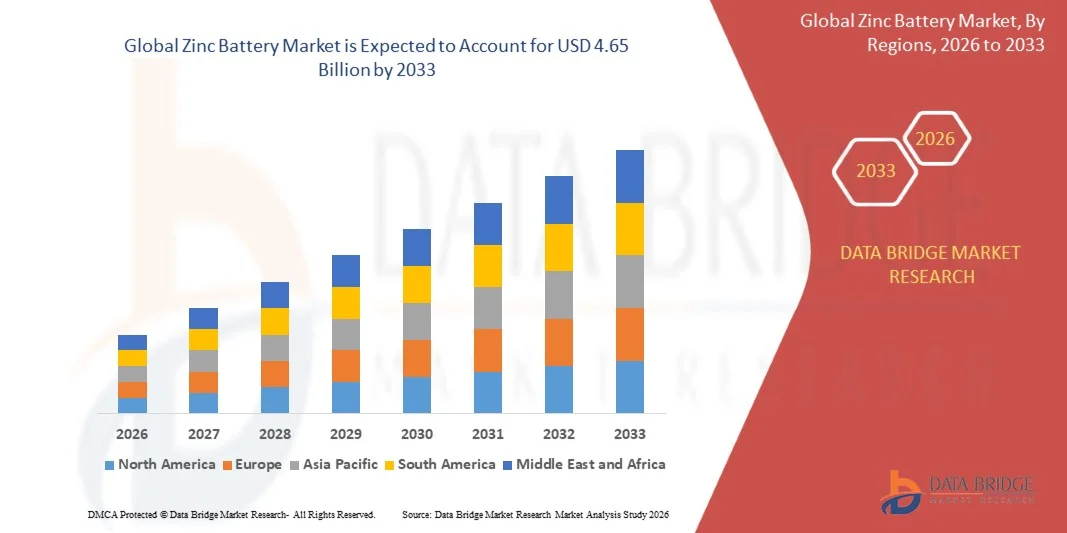
- As per Data Bridge Market Research analysis, the zinc battery market was valued at USD 1.75 billion in 2025 and is projected to reach USD 4.65 billion by 2033, growing at a CAGR of 13.00% from 2026 to 2033.
- The market is experiencing consistent growth driven by rising demand for safe and sustainable energy storage solutions, advancements in zinc-based battery technologies, and expanding applications across grid storage, consumer electronics, and renewable energy integration.
- The increasing demand for reliable energy storage, combined with the growing integration of renewable energy sources and the need for safer alternatives to conventional lithium-ion batteries, is compelling utilities, energy companies, and industrial users to adopt advanced zinc battery technologies. Zinc-air, zinc-ion, and zinc-bromine batteries are gaining traction by offering cost-effective, scalable, and safer energy storage solutions for renewable power integration, backup power, and long-duration energy storage.
Market Size & Forecast
- Global Market Value (2025): USD 1.75 Billion
- Expected Market Value (2033): USD 4.65 Billion
- Forecast CAGR (2026–2033): 13.00%
- Leading Region in 2025: North America
- Fastest Growing Region: Asia Pacific
What are the Major Takeaways of the Zinc Battery Market?
- North America dominated the zinc battery market with the largest revenue share of 34.27% in 2025, supported by growing investments in energy storage infrastructure and increasing demand for safe, long-duration battery technologies.
- Asia-Pacific is expected to be the fastest-growing region at a CAGR of 14.10% from 2026 to 2033, fueled by rapid renewable energy deployment, expanding grid-storage infrastructure, and growing demand for advanced battery technologies.
- The zinc-air battery segment led the market with a 38% share in 2025, driven by its high energy density, long shelf life, lightweight construction, and extensive use in hearing aids and other compact electronic devices.
- Nickel-zinc battery are the fastest-growing type, projected to register a CAGR of 16.7%, reflecting the surge in demand for rechargeable batteries offering high power output and enhanced safety.
- The primary segment dominated the rechargeability category with a 52% revenue share in 2025, led by the established use of zinc-air and zinc-carbon batteries across consumer electronics and other low-power applications
- Consumer electronics accounted for 42% of the market share in 2025, preferred by the established use of zinc batteries in hearing aids, remote controls, flashlights, toys, and other electronic devices.
- The electric vehicle segment is the fastest-growing application category, with a CAGR of 19.6%, driven by increasing research into zinc-based technologies for electric mobility.
Report Scope and Zinc Battery Market Segmentation
|
Attributes |
Zinc Battery Key Market Insights |
|
Segments Covered |
|
|
Countries Covered |
North America
Europe
Asia-Pacific
Middle East and Africa
South America
|
|
Key Market Players |
|
|
Market Opportunities |
|
|
Value Added Data Infosets |
In addition to the insights on market scenarios such as market value, growth rate, segmentation, geographical coverage, and major players, the market reports curated by the Data Bridge Market Research also include import export analysis, production capacity overview, production consumption analysis, price trend analysis, climate change scenario, supply chain analysis, value chain analysis, raw material/consumables overview, vendor selection criteria, PESTLE Analysis, Porter Analysis, and regulatory framework |
What is the Key Trend in the Zinc Battery Market?
- Energy storage developers are increasingly adopting zinc-based batteries for long-duration storage, renewable energy integration, and backup power because of their non-flammable characteristics, abundant materials, and potential for lower-cost stationary storage.
- For instance, in March 2024, the Australian Renewable Energy Agency announced AUD 2.85 million in funding for regional microgrid trials, including a 100 kW/400 kWh zinc-bromine flow battery from Redflow to shift rooftop solar generation into evening demand periods.
- Advances in zinc-ion and zinc-bromine chemistries are improving cycle life, energy density, safety, and operational performance for residential, commercial, and grid-scale energy storage applications.
- Research institutions and battery developers are increasingly demonstrating zinc-ion systems for stationary storage, with emphasis on aqueous electrolytes, improved electrode designs, and enhanced resistance to thermal runaway.
- For instance, in July 2025, the California Energy Commission reported successful testing of a 10 kWh zinc-ion residential energy storage system, with cell-level UL 9540A testing showing no thermal runaway or hazardous gas generation.
- As renewable energy deployment and demand for safer long-duration storage continue to increase, zinc battery technologies are expected to gain greater adoption across grid, residential, commercial, and backup-power applications, strengthening their role as alternatives to conventional lithium-ion systems.
What are the Key Drivers of the Zinc Battery Market?
- The rapid expansion of renewable energy generation and long-duration energy storage requirements has increased demand for zinc batteries capable of storing electricity for extended periods and supporting grid reliability.
- For instance, in July 2024, the U.S. Department of Energy awarded the FUZES project up to USD 49.1 million in federal cost-share support to develop zinc-bromide systems providing 5–10 MW for at least 10 hours, targeting renewable integration and grid resilience.
- Utilities, industrial users, and energy-storage manufacturers are investing in zinc-bromine and zinc-ion technologies because of their non-flammable operation, long-duration capabilities, and potential to reduce dependence on critical battery materials.
- For instance, in December 2024, the U.S. Department of Energy announced a USD 303.5 million loan guarantee for Eos Energy Enterprises to develop zinc-bromine battery manufacturing facilities expected to produce sufficient stationary storage annually for approximately 130,000 U.S. homes.
- With increasing renewable power deployment and the need for safer, scalable, and long-duration energy storage, zinc batteries are expected to remain an important technology for grid modernization, renewable integration, and backup-power applications.
What Factors are Challenging the Growth of the Zinc Battery Market?
- Zinc batteries continue to face technical challenges related to lower energy density, zinc dendrite formation, limited cycle life, and electrolyte-related efficiency losses compared with established lithium-ion technologies.
- For instance, in September 2024, researchers at Central South University published a review in Energy & Environmental Science highlighting that aqueous zinc-ion batteries still face major industrial challenges related to energy density and stability, with laboratory configurations often failing to meet practical requirements for scalable battery production.
- These limitations can increase development costs and create performance barriers for applications requiring high energy density, extended cycle life, and consistently high round-trip efficiency.
- For instance, in November 2023, researchers from the University of Sydney and University of Technology Sydney reported that zinc-bromine batteries have challenges including zinc dendrite growth, zinc dissolution, bromine crossover, corrosion, and relatively low energy density, with flow configurations also requiring electrolyte reservoirs and pumps that increase system complexity.
- The technical development requirements, manufacturing scale-up challenges, and need for additional investment continue to restrict the commercialization of zinc batteries, particularly for applications where energy density, efficiency, and proven long-term performance are critical.
How is the Zinc Battery Market Segmented?
The zinc battery market is segmented on the basis of type, rechargeability, and application.
- By Type
On the basis of type, the zinc battery market is segmented into zinc-air battery, nickel-zinc battery, zinc-silver battery, carbon-zinc battery, zinc-manganese battery, and others. The zinc-air battery segment dominated the market with 38% share in 2025, owing to its high energy density, long shelf life, lightweight construction, and extensive use in hearing aids and other compact electronic devices. Zinc-air batteries use oxygen from the surrounding air as the cathode reactant, reducing the amount of active material required inside the cell. Their established manufacturing base and broad use in primary battery applications continue to support demand. The chemistry also benefits from the wide availability and recyclability of zinc. Increasing interest in zinc-based energy technologies is supporting further development of rechargeable zinc-air systems. These characteristics continue to position zinc-air batteries as the largest type segment.
The nickel-zinc battery segment is projected to register the fastest growth at a CAGR of 16.7% from 2026 to 2033, driven by increasing demand for rechargeable batteries offering high power output and enhanced safety. Nickel-zinc batteries provide a relatively high cell voltage and can deliver strong power performance for demanding applications. They are gaining attention in power tools, automotive applications, telecommunications, and backup power systems. Their rechargeable characteristics provide an advantage over primary zinc battery technologies in applications requiring repeated cycling. Improvements in zinc electrode technology are helping address performance and durability limitations. Growing interest in alternatives to lead-acid and lithium-based technologies is further supporting development. Increasing investment in advanced rechargeable zinc technologies is expected to accelerate adoption of nickel-zinc batteries.
- By Rechargeability
On the basis of rechargeability, the zinc battery market is segmented into primary and secondary. The primary segment dominated the market with 52% share in 2025, supported by the established use of zinc-air and zinc-carbon batteries across consumer electronics and other low-power applications. Primary zinc batteries benefit from their relatively low upfront cost and long shelf life. Zinc-air batteries are widely used in hearing aids, while zinc-carbon batteries remain common in flashlights, toys, remote controls, and other electronic products. Their established distribution networks and mature manufacturing processes support continued market demand. These batteries are particularly suitable for applications where periodic replacement is more practical than recharging. Their broad installed base continues to provide a strong foundation for the primary segment.
The secondary segment is projected to register the fastest growth at a CAGR of 15.8% from 2026 to 2033, driven by increasing demand for rechargeable energy storage technologies. Rechargeable zinc batteries are attracting interest because zinc offers favorable safety, availability, and recyclability characteristics. Nickel-zinc, zinc-ion, and zinc-bromine technologies are being developed for applications ranging from backup power to renewable energy storage. Increasing deployment of renewable electricity is creating demand for scalable and reliable rechargeable storage systems. Research into zinc electrodes, electrolytes, and cathode materials is improving the performance of secondary batteries. Growing efforts to reduce dependence on conventional lithium-based chemistries are further supporting this segment. These developments are expected to accelerate the adoption of secondary zinc batteries across stationary and industrial applications.
- By Application
On the basis of application, the zinc battery market is segmented into electric vehicle, consumer electronics, power tools, and others. The consumer electronics segment dominated the market with 42% share in 2025, driven by the established use of zinc batteries in hearing aids, remote controls, flashlights, toys, and other electronic devices. Zinc-carbon and zinc-air batteries have long been used in consumer products because of their availability and reliable performance. Zinc-air batteries are particularly suited to compact devices requiring lightweight and dependable power. The segment also benefits from established manufacturing and distribution infrastructure. Continued demand for portable electronic and healthcare devices supports the use of zinc-based batteries. The broad range of consumer applications continues to make this the leading application segment.
The electric vehicle segment is projected to witness the fastest growth at a CAGR of 19.6% from 2026 to 2033, driven by increasing research into zinc-based technologies for electric mobility. Zinc batteries are being investigated for transportation applications because of zinc's availability, safety characteristics, and potential cost advantages. Research activities are focusing on improving energy density, rechargeability, cycle life, and power output for mobility applications. Growing interest in alternative battery chemistries is encouraging battery developers to explore zinc-based solutions alongside established lithium-ion technologies. Zinc-air and other rechargeable zinc chemistries are being evaluated for different electric mobility applications. Continued advances in electrode materials and battery architecture could expand their potential use in electric vehicles. These developments are supporting EVs as the fastest-growing application segment.
Which Region Holds the Largest Share of the Zinc Battery Market?
- North America dominated the zinc battery market with the largest revenue share of 34.27% in 2025, supported by growing investments in energy storage infrastructure and increasing demand for safe, long-duration battery technologies.
- The region also benefits from growing renewable energy integration, government support for advanced energy storage technologies, and increasing adoption of zinc-based batteries across utility-scale storage, microgrid, and backup power applications. Rising demand for safe, cost-effective, and sustainable alternatives to lithium-ion batteries continues to strengthen North America’s leadership position in the global zinc battery market
U.S. Zinc Battery Market Insight
The U.S. zinc battery market is witnessing strong growth due to rising investments in long-duration energy storage, grid modernization, and advanced stationary battery technologies. The country's expanding renewable energy infrastructure, along with increasing commercialization of zinc-bromine and zinc-ion systems, is driving demand across utility-scale, industrial, and backup power applications. In addition, government support for domestic battery manufacturing and energy-storage technologies is accelerating zinc battery deployment, with investments in zinc-based battery manufacturing further strengthening the country's market position.
Asia-Pacific Zinc Battery Market Insight
The Asia-Pacific zinc battery market is expected to witness rapid growth, driven by expanding renewable energy capacity, increasing demand for grid-scale energy storage, and rising investments in next-generation battery technologies across countries such as China, Japan, India, and South Korea. Growing research into aqueous zinc-ion batteries, increasing requirements for safe and cost-effective stationary storage, and expanding battery manufacturing capabilities are supporting regional market expansion. In addition, strong research activity and the increasing need for alternatives to lithium-ion technologies are accelerating zinc battery development across the region.
Japan Zinc Battery Market Insight
The Japan zinc battery market is witnessing consistent growth due to rising investments in advanced battery research, energy-storage technologies, and renewable power integration. Japanese research organizations are increasingly developing zinc-anode battery technologies for applications requiring improved safety, lower resource constraints, and reduced costs. Moreover, continued government-backed battery research and the country's focus on developing alternatives to conventional lithium-ion systems are contributing to market development. Growing interest in high-performance and resource-efficient energy-storage technologies is further supporting zinc battery research and commercialization in Japan.
China Zinc Battery Market Insight
The China zinc battery market is growing rapidly, driven by expanding renewable energy deployment, increasing demand for stationary energy storage, and extensive research into aqueous zinc-ion battery technologies. Chinese universities, research institutes, and battery developers are increasingly focusing on improving zinc-ion battery energy density, cycling stability, and commercialization potential. In addition, China's large battery manufacturing ecosystem and growing requirements for safe and cost-effective grid-storage technologies are supporting market development. Continued innovation in zinc-based materials and energy-storage systems is strengthening China's position as an important market for zinc battery technologies.
U.K. Zinc Battery Market Insight
The U.K. zinc battery market is experiencing steady growth, supported by increasing interest in long-duration energy storage, renewable energy integration, and alternative battery chemistries. Research institutions and technology developers are increasingly evaluating zinc-ion batteries for stationary energy storage because of their safety, cost potential, and availability of zinc resources. Growing requirements for grid flexibility and reliable storage to complement renewable electricity generation are contributing to market development. Furthermore, continued research into improving zinc battery energy density, cycle life, and commercial scalability is supporting the country's adoption of advanced zinc-based storage technologies.
Germany Zinc Battery Market Insight
The Germany zinc battery market is expanding steadily due to strong research capabilities, increasing renewable energy deployment, and growing demand for safe and sustainable stationary energy-storage solutions. Research organizations such as Fraunhofer ISE are developing zinc-ion battery technologies based on water-based electrolytes and highly available materials for stationary applications. The country's focus on energy transition, grid stability, and reducing dependence on conventional lithium-ion technologies is supporting zinc battery development. In addition, ongoing industrial research into manufacturing, electrode structures, and modular zinc-ion systems is contributing to the commercialization potential of zinc batteries in Germany.
Which are the Top Companies in Zinc Battery Market?
The zinc battery industry is primarily led by well-established companies, including:
- Eos Energy Enterprises, Inc. (U.S.)
- ZincFive, Inc. (U.S.)
- Urban Electric Power (U.S.)
- Enzinc, Inc. (U.S.)
- Salient Energy Inc. (Canada)
- ZeniPower (Zhuhai Zhi Li) Battery Co., Ltd. (China)
- PMB Battery Technologies UK Limited (U.K.)
- ZNL Energy AS (Norway)
- AZA Battery (Belgium)
- ABOUND Energy (Canada)
- Sthyr Energy Pvt. Ltd. (India)
- ZAF Energy Systems, Inc. (U.S.)
- Cegasa Energía S.L. (Spain)
- American Energy Technologies Company (U.S.)
- Japan Volta Co., Ltd. (Japan)
- Sharp Corporation (Japan)
- Energizer Holdings, Inc. (U.S.)
- Panasonic Corporation (Japan)
- Toshiba Corporation (Japan)
What are Latest Developments in Zinc Battery Market?
- In May 2025, Hindustan Zinc announced advances in research on next-generation zinc-based battery technologies through strategic collaborations with IIT Madras and JNCASR Bengaluru. The research is focused on improving energy efficiency, safety, and operational life while exploring the potential for commercial scalability, supporting the development of zinc-based batteries as alternatives for clean energy storage applications.
- In December 2024, the U.S. Department of Energy announced a USD 303.5 million loan guarantee to Eos Energy Enterprises to support the construction of production lines for its Eos Z3 zinc-bromine battery energy storage systems. The facilities in Pennsylvania are intended to expand domestic manufacturing of long-duration stationary batteries and strengthen the deployment of zinc-bromine technology for grid and industrial energy storage.
- In August 2023, the U.S. Department of Energy announced a conditional commitment for an up to USD 398.6 million loan guarantee to Eos Energy Enterprises for manufacturing next-generation Eos Z3 zinc-bromine battery systems. The planned production lines were designed to increase manufacturing capacity for long-duration grid-scale storage and support renewable energy integration using non-flammable zinc-bromine battery technology.
- In May 2022, researchers at IIT Madras announced the development of mechanically rechargeable zinc-air battery technology aimed at providing an affordable alternative to lithium-ion batteries for electric mobility. The researchers were developing the technology for potential use in two-wheelers and three-wheelers and had filed patents while collaborating with industry partners to advance commercialization.
- In August 2021, KAUST researchers reported a new electrolyte and electrode combination that improved the performance and cycle stability of zinc-ion batteries. The development addressed degradation challenges affecting zinc-ion batteries and demonstrated the potential of improved zinc-based technology for safer and lower-cost stationary energy storage connected to renewable energy systems.

- Interactive Data Analysis Dashboard
- Company Analysis Dashboard for high growth potential opportunities
- Research Analyst Access for customization & queries
- Competitor Analysis with Interactive dashboard
- Latest News, Updates & Trend analysis
- Harness the Power of Benchmark Analysis for Comprehensive Competitor Tracking
Global Zinc Battery Market, Supply Chain Analysis and Ecosystem Framework
To support market growth and help clients navigate the impact of geopolitical shifts, DBMR has integrated in-depth supply chain analysis into its Global Zinc Battery Market research reports. This addition empowers clients to respond effectively to global changes affecting their industries. The supply chain analysis section includes detailed insights such as Global Zinc Battery Market consumption and production by country, price trend analysis, the impact of tariffs and geopolitical developments, and import and export trends by country and HSN code. It also highlights major suppliers with data on production capacity and company profiles, as well as key importers and exporters. In addition to research, DBMR offers specialized supply chain consulting services backed by over a decade of experience, providing solutions like supplier discovery, supplier risk assessment, price trend analysis, impact evaluation of inflation and trade route changes, and comprehensive market trend analysis.
Data collection and base year analysis are done using data collection modules with large sample sizes. The stage includes obtaining market information or related data through various sources and strategies. It includes examining and planning all the data acquired from the past in advance. It likewise envelops the examination of information inconsistencies seen across different information sources. The market data is analysed and estimated using market statistical and coherent models. Also, market share analysis and key trend analysis are the major success factors in the market report. To know more, please request an analyst call or drop down your inquiry.
The key research methodology used by DBMR research team is data triangulation which involves data mining, analysis of the impact of data variables on the market and primary (industry expert) validation. Data models include Vendor Positioning Grid, Market Time Line Analysis, Market Overview and Guide, Company Positioning Grid, Patent Analysis, Pricing Analysis, Company Market Share Analysis, Standards of Measurement, Global versus Regional and Vendor Share Analysis. To know more about the research methodology, drop in an inquiry to speak to our industry experts.
Data Bridge Market Research is a leader in advanced formative research. We take pride in servicing our existing and new customers with data and analysis that match and suits their goal. The report can be customized to include price trend analysis of target brands understanding the market for additional countries (ask for the list of countries), clinical trial results data, literature review, refurbished market and product base analysis. Market analysis of target competitors can be analyzed from technology-based analysis to market portfolio strategies. We can add as many competitors that you require data about in the format and data style you are looking for. Our team of analysts can also provide you data in crude raw excel files pivot tables (Fact book) or can assist you in creating presentations from the data sets available in the report.













