


Zinc Selenide Camera Market Overview
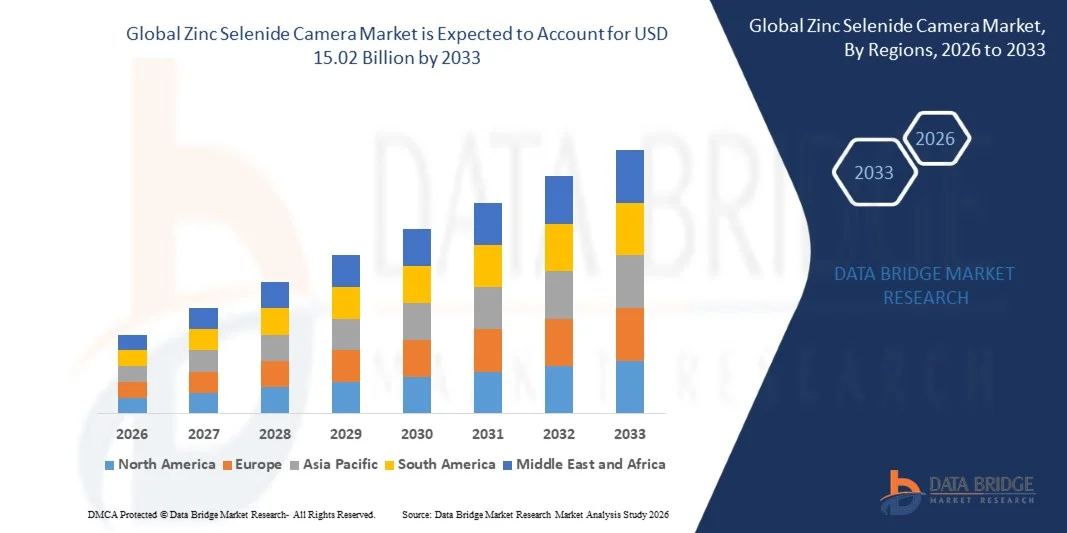
As per Data Bridge Market Research analysis the Zinc Selenide Camera Market was valued at USD 8.91 billion in 2025 and is projected to reach USD 15.02 billion by 2033, growing at a CAGR of 6.75% from 2026 to 2033. The market is experiencing steady growth driven by increasing demand for high-performance infrared imaging systems, expanding adoption of thermal cameras across defense and security applications, and the superior optical transmission properties of zinc selenide in mid-wave and long-wave infrared spectra.
The growing need for advanced surveillance, industrial inspection, medical diagnostics, and automotive sensing solutions is accelerating the adoption of zinc selenide cameras. Zinc selenide optical components enable high-resolution thermal imaging and reliable performance in low-light, smoke, fog, and harsh environmental conditions, making them suitable for critical applications across military, aerospace, manufacturing, and scientific research sectors.
In addition, rising investments in border surveillance, homeland security, predictive maintenance, and non-destructive testing are supporting market expansion. The integration of zinc selenide cameras with artificial intelligence, machine vision, and automated monitoring platforms is further improving detection accuracy, operational efficiency, and real-time decision-making across end-use industries.
Key Market Trends & Insights
- North America dominated the zinc selenide camera market with the largest revenue share in 2025, supported by high defense spending, strong aerospace and semiconductor manufacturing capabilities, and growing deployment of thermal imaging systems for border surveillance, industrial inspection, and critical infrastructure monitoring.
- Asia-Pacific is expected to be the fastest-growing region, recording a CAGR of 7.30% from 2026 to 2033. Growth is driven by rapid industrial automation, rising defense modernization investments, expanding electronics and semiconductor manufacturing, and increasing adoption of infrared cameras across China, Japan, India, and South Korea.
- The 40%-50% segment held the largest market revenue share of approximately 34.6% in 2025, driven by its balanced infrared transmission performance, optical clarity, and suitability for industrial inspection, commercial thermal imaging, and research applications. These camera configurations are increasingly preferred for mid-range infrared imaging systems requiring dependable sensitivity and cost-effective optical performance.
- The 50%-60% segment is projected to register the fastest growth at a CAGR of 7.4% from 2026 to 2033, driven by increasing demand for high-performance thermal imaging systems in military surveillance, target acquisition, medical imaging, and advanced industrial monitoring. Higher-performance zinc selenide camera configurations support enhanced infrared transmission across mid-wave and long-wave infrared bands, with zinc selenide optics typically offering transmission from approximately 0.6 µm to 21 µm and a refractive index of around 2.4 at 10.6 µm.
- The military and defense segment held the largest market revenue share of approximately 35.2% in 2025, driven by growing deployment of thermal imaging cameras in border surveillance, reconnaissance, night vision, target detection, and unmanned systems. Zinc selenide optics are widely used in infrared imaging equipment due to their broad infrared transmission range and low absorption coefficient of approximately 0.0005 cm⁻¹ at 10.6 µm.
- The industrial segment accounted for approximately 27.4% of market revenue in 2025, supported by increasing use of thermal cameras for predictive maintenance, electrical inspection, process monitoring, and non-destructive testing. Industrial operators are deploying infrared imaging systems to identify overheating equipment, insulation failures, and abnormal temperature patterns, supporting reduced downtime and improved equipment reliability.
Market Size & Forecast
- Global Market Value (2025): USD 8.91 Billion
- Expected Market Value (2033): USD 15.02 Billion
- Forecast CAGR (2026–2033): 6.75%
- Leading Region in 2025: North America
- Fastest Growing Region: Asia-Pacific
Report Scope and Zinc Selenide Camera Market Segmentation
|
Attributes |
Zinc Selenide Camera Key Market Insights |
|
Segments Covered |
|
|
Countries Covered |
North America
Europe
Asia-Pacific
Middle East and Africa
South America
|
|
Key Market Players |
• Teledyne Technologies Incorporated (U.S.) |
|
Market Opportunities |
|
|
Value Added Data Infosets |
In addition to the market insights such as market value, growth rate, market segments, geographical coverage, market players, and market scenario, the market report curated by the Data Bridge Market Research team includes in-depth expert analysis, import/export analysis, pricing analysis, production consumption analysis, and pestle analysis. |
Zinc Selenide Camera Market Trends
Trend: Increasing Adoption Of Advanced Infrared Imaging And Thermal Monitoring Systems
The growing deployment of thermal imaging and infrared sensing technologies across defense, industrial inspection, healthcare, and automotive sectors is increasing demand for zinc selenide camera systems. Conventional visible-light cameras are unable to capture thermal signatures in darkness, smoke, fog, and low-visibility operating environments, encouraging end users to adopt infrared cameras equipped with specialized optical materials. Zinc selenide offers a broad infrared transmission range of approximately 0.6 µm to 21 µm, enabling its use in mid-wave infrared and long-wave infrared imaging systems.
In defense and security applications, zinc selenide optical components are being integrated into forward-looking infrared cameras, perimeter surveillance platforms, and target acquisition systems to support round-the-clock monitoring. For instance, zinc selenide lenses with anti-reflective coatings designed for the 8–12 µm wavelength range are used in thermal camera applications, where they support imaging of heat-emitting objects without dependence on ambient light. The material has a refractive index of approximately 2.40 at 10.6 µm and low bulk absorption of less than 0.0005 cm⁻¹ at this wavelength, supporting accurate infrared light focusing and image quality.
The expansion of predictive maintenance programs in manufacturing, power generation, and oil and gas facilities is also supporting market growth. Thermal cameras using zinc selenide windows and lenses are increasingly deployed to identify overheating motors, electrical faults, furnace heat losses, and equipment anomalies before failures occur. In addition, the increasing use of CO₂ laser-based processing systems is creating demand for zinc selenide camera optics, as the material is highly suited for 10.6 µm laser wavelengths and offers strong thermal shock resistance.
Zinc Selenide Camera Market Dynamics
Key Market Driver: Rising Demand For Thermal Imaging In Defense And Industrial Inspection
Defense agencies, border security organizations, and industrial operators are increasingly investing in thermal imaging technologies to improve surveillance capability, asset reliability, and operational safety. Infrared cameras enable the detection of people, vehicles, machinery faults, and heat variations in complete darkness and challenging weather conditions, creating demand for optical materials capable of transmitting long-wave infrared radiation efficiently.
Zinc selenide is increasingly used in thermal imaging camera lenses, protective windows, and beam-splitting components because of its wide transmission capability across infrared wavelengths. For instance, zinc selenide components with broadband anti-reflective coatings covering 3–12 µm can support multispectral and hyperspectral imaging configurations, while 8–12 µm coatings are used for long-wave thermal imaging systems. These characteristics support deployment in military reconnaissance, industrial condition monitoring, medical imaging, and scientific instrumentation.
In industrial facilities, thermal monitoring systems are being used to inspect electrical panels, transformers, rotating equipment, and high-temperature process lines without interrupting operations. Zinc selenide optics can support camera operation in infrared systems where accurate heat detection is required, with commercially available zinc selenide windows offering more than 90% clear aperture and diameter options ranging from 3 mm to 200 mm. The expanding use of automated inspection platforms and unmanned surveillance systems is further increasing demand for high-performance infrared camera assemblies.
Key Restraint/Challenge: High Material Cost And Limited Mechanical Durability
The high cost of optical-grade zinc selenide and the complex manufacturing requirements associated with chemical vapor deposition, precision polishing, and infrared anti-reflective coating processes can limit wider adoption. Zinc selenide camera components require specialized handling and fabrication to maintain optical quality, increasing production costs for camera manufacturers and creating affordability challenges for cost-sensitive industrial and commercial users.
In addition, zinc selenide is relatively soft compared with several alternative infrared optical materials, making it vulnerable to scratches and surface damage during installation and field operation. Zinc selenide has a Knoop hardness of approximately 120 under a 50 g indenter, requiring protective coatings and careful handling to preserve optical performance. Surface defects can increase infrared light scattering and absorption, potentially reducing image clarity and camera reliability in demanding environments.
The material also has high natural reflection losses without anti-reflective coatings. Uncoated zinc selenide can experience reflection losses of approximately 29.1% at 10.6 µm across two surfaces, increasing the need for advanced coating solutions and adding to overall system costs. These limitations can encourage camera manufacturers to evaluate germanium, chalcogenide glass, zinc sulfide, and other infrared optical materials depending on application requirements and operating conditions.
Key Market Opportunity: Integration In Autonomous Systems And Advanced Infrared Analytics
The growing development of autonomous vehicles, unmanned aerial vehicles, robotics, and AI-enabled surveillance platforms is creating opportunities for zinc selenide camera manufacturers. These systems require reliable thermal vision capabilities for object detection, navigation, safety monitoring, and situational awareness in low-light and adverse weather conditions, increasing the need for infrared camera optics with broad transmission and stable thermal properties.
Automotive and mobility technology developers are increasingly exploring thermal camera systems for pedestrian detection, battery thermal monitoring, and enhanced driver assistance applications. For instance, zinc selenide lenses can support infrared camera systems operating in the 3–5 µm and 8–12 µm spectral bands, enabling detection of heat signatures beyond the capabilities of standard visible-light sensors. This supports the development of safer autonomous and semi-autonomous mobility systems operating at night or in poor visibility conditions.
In addition, the expansion of AI-powered industrial analytics is increasing the value of thermal cameras that can provide continuous temperature data for anomaly detection and predictive maintenance. Zinc selenide has a melting point of approximately 1,525°C and thermal conductivity of approximately 18 W m⁻¹ K⁻¹, supporting its suitability for infrared optical applications exposed to elevated temperatures. Advancements in compact thermal sensors, anti-reflective coatings, and machine vision software are expected to expand opportunities for zinc selenide camera systems across aerospace, defense, industrial automation, and smart infrastructure applications.
Zinc Selenide Camera Market Scope
The market is segmented on the basis of type and end use application.
• By Type
On the basis of type, the zinc selenide camera market is segmented into 30%-40%, 40%-50%, 50%-60%, and others. The 40%-50% segment held the largest market revenue share of approximately 34.6% in 2025, driven by its balanced infrared transmission performance, optical clarity, and suitability for industrial inspection, commercial thermal imaging, and research applications. These camera configurations are increasingly preferred for mid-range infrared imaging systems requiring dependable sensitivity and cost-effective optical performance.
The 50%-60% segment is projected to register the fastest growth at a CAGR of 7.4% from 2026 to 2033, driven by increasing demand for high-performance thermal imaging systems in military surveillance, target acquisition, medical imaging, and advanced industrial monitoring. Higher-performance zinc selenide camera configurations support enhanced infrared transmission across mid-wave and long-wave infrared bands, with zinc selenide optics typically offering transmission from approximately 0.6 µm to 21 µm and a refractive index of around 2.4 at 10.6 µm.
• By End Use
On the basis of end use, the zinc selenide camera market is segmented into military and defense, industrial, commercial, medical imaging, and others. The military and defense segment held the largest market revenue share of approximately 35.2% in 2025, driven by growing deployment of thermal imaging cameras in border surveillance, reconnaissance, night vision, target detection, and unmanned systems. Zinc selenide optics are widely used in infrared imaging equipment due to their broad infrared transmission range and low absorption coefficient of approximately 0.0005 cm⁻¹ at 10.6 µm.
The industrial segment accounted for approximately 27.4% of market revenue in 2025, supported by increasing use of thermal cameras for predictive maintenance, electrical inspection, process monitoring, and non-destructive testing. Industrial operators are deploying infrared imaging systems to identify overheating equipment, insulation failures, and abnormal temperature patterns, supporting reduced downtime and improved equipment reliability.
Zinc Selenide Camera Market Regional Analysis
North America Zinc Selenide Camera Market Insight
North America dominated the zinc selenide camera market with the largest revenue share in 2025, supported by substantial defense expenditure, the established presence of aerospace and semiconductor industries, and rising investment in thermal imaging and industrial automation technologies. The region’s demand is further supported by the increasing use of infrared cameras for perimeter surveillance, predictive maintenance, non-destructive testing, and scientific research. Strong adoption of advanced sensing systems across military, energy, and manufacturing applications is establishing zinc selenide cameras as an important component of high-performance infrared imaging infrastructure.
U.S. Zinc Selenide Camera Market Insight
The U.S. zinc selenide camera market captured the largest revenue share in 2025 within North America, fueled by extensive deployment of thermal imaging systems across defense, homeland security, aerospace, and industrial inspection applications. The growing use of unmanned aerial systems, border monitoring platforms, and AI-enabled surveillance systems is increasing demand for infrared cameras capable of operating in darkness, smoke, and low-visibility conditions. Moreover, expanding investments in semiconductor manufacturing, data centers, and advanced production facilities are supporting the adoption of thermal cameras for equipment monitoring and heat anomaly detection.
Europe Zinc Selenide Camera Market Insight
The Europe zinc selenide camera market is expected to witness the fastest growth rate from 2026 to 2033, primarily driven by increasing investment in defense modernization, industrial digitalization, and energy-efficient predictive maintenance solutions. The region’s stringent workplace safety requirements and growing focus on asset reliability are encouraging manufacturers, utilities, and transportation operators to deploy thermal imaging systems. Rising adoption of infrared cameras in building inspection, electrical maintenance, automotive testing, and research laboratories is further supporting market expansion across the region.
U.K. Zinc Selenide Camera Market Insight
The U.K. zinc selenide camera market is expected to witness the fastest growth rate from 2026 to 2033, driven by rising demand for advanced surveillance, defense imaging, and industrial condition monitoring systems. Increasing investment in smart infrastructure, airport security, and critical asset protection is encouraging the deployment of infrared camera technologies. In addition, the growing use of thermal imaging in offshore energy, rail networks, and manufacturing facilities for detecting overheating components and insulation defects is expected to stimulate market growth.
Germany Zinc Selenide Camera Market Insight
The Germany zinc selenide camera market is expected to witness the fastest growth rate from 2026 to 2033, fueled by the country’s strong automotive, machinery, and industrial automation sectors. German manufacturers are increasingly adopting infrared cameras for quality inspection, process control, and predictive maintenance to improve production efficiency and reduce equipment downtime. The integration of zinc selenide camera optics into thermal monitoring systems for electric vehicle battery testing, semiconductor equipment, and high-temperature manufacturing processes is also becoming increasingly prevalent across the country.
Asia-Pacific Zinc Selenide Camera Market Insight
The Asia-Pacific zinc selenide camera market is expected to witness the fastest growth rate from 2026 to 2033, supported by rapid industrialization, rising defense modernization programs, and expanding electronics and semiconductor manufacturing capacity in countries such as China, Japan, and India. The region’s increasing investment in smart cities, automated manufacturing, and critical infrastructure security is driving demand for thermal imaging and infrared sensing technologies. Furthermore, the growing presence of optical component manufacturers and camera assembly facilities is improving the affordability and accessibility of zinc selenide camera systems across regional end-use industries.
Japan Zinc Selenide Camera Market Insight
The Japan zinc selenide camera market is expected to witness the fastest growth rate from 2026 to 2033 due to the country’s advanced electronics, robotics, automotive, and precision manufacturing industries. Japanese manufacturers are increasingly integrating thermal imaging systems into factory automation and quality control operations to identify heat anomalies and maintain high production standards. The increasing use of infrared cameras in semiconductor inspection, medical research, and disaster response applications, combined with the country’s emphasis on technological innovation, is expected to support continued market expansion.
China Zinc Selenide Camera Market Insight
The China zinc selenide camera market accounted for the largest market revenue share in Asia-Pacific in 2025, attributed to rapid growth in industrial automation, defense technology development, and domestic electronics manufacturing. China’s expanding smart manufacturing ecosystem is increasing the deployment of infrared cameras for equipment inspection, thermal process monitoring, and automated quality control. The country’s growing investments in public security, border surveillance, renewable energy infrastructure, and semiconductor fabrication facilities, alongside the availability of domestic optical component suppliers, are key factors propelling the zinc selenide camera market in China.
Zinc Selenide Camera Market Share
The Zinc Selenide Camera industry is primarily led by well-established companies, including:
• Teledyne Technologies Incorporated (U.S.)
• 3M (U.S.)
• ATN Company (U.S.)
• Allied Vision Technologies GmbH (Germany)
• Avon Protection (U.K.)
• Axis Communications AB (Sweden)
• BAE Systems (U.K.)
• Drägerwerk AG & Co. KGaA (Germany)
• Cox Communications, Inc. (U.S.)
• General Starlight Co., Inc. (U.S.)
• L3Harris Technologies, Inc. (U.S.)
• Magnity Technologies Co., Ltd. (South Korea)
• Fluke Corporation (U.S.)
• Leonardo DRS (U.S.)
• Opgal Optronic Industries Ltd. (Israel)

- Interactive Data Analysis Dashboard
- Company Analysis Dashboard for high growth potential opportunities
- Research Analyst Access for customization & queries
- Competitor Analysis with Interactive dashboard
- Latest News, Updates & Trend analysis
- Harness the Power of Benchmark Analysis for Comprehensive Competitor Tracking
Data collection and base year analysis are done using data collection modules with large sample sizes. The stage includes obtaining market information or related data through various sources and strategies. It includes examining and planning all the data acquired from the past in advance. It likewise envelops the examination of information inconsistencies seen across different information sources. The market data is analysed and estimated using market statistical and coherent models. Also, market share analysis and key trend analysis are the major success factors in the market report. To know more, please request an analyst call or drop down your inquiry.
The key research methodology used by DBMR research team is data triangulation which involves data mining, analysis of the impact of data variables on the market and primary (industry expert) validation. Data models include Vendor Positioning Grid, Market Time Line Analysis, Market Overview and Guide, Company Positioning Grid, Patent Analysis, Pricing Analysis, Company Market Share Analysis, Standards of Measurement, Global versus Regional and Vendor Share Analysis. To know more about the research methodology, drop in an inquiry to speak to our industry experts.
Data Bridge Market Research is a leader in advanced formative research. We take pride in servicing our existing and new customers with data and analysis that match and suits their goal. The report can be customized to include price trend analysis of target brands understanding the market for additional countries (ask for the list of countries), clinical trial results data, literature review, refurbished market and product base analysis. Market analysis of target competitors can be analyzed from technology-based analysis to market portfolio strategies. We can add as many competitors that you require data about in the format and data style you are looking for. Our team of analysts can also provide you data in crude raw excel files pivot tables (Fact book) or can assist you in creating presentations from the data sets available in the report.













