


What is the Zirconia Ceramics Market Size and Growth Rate?
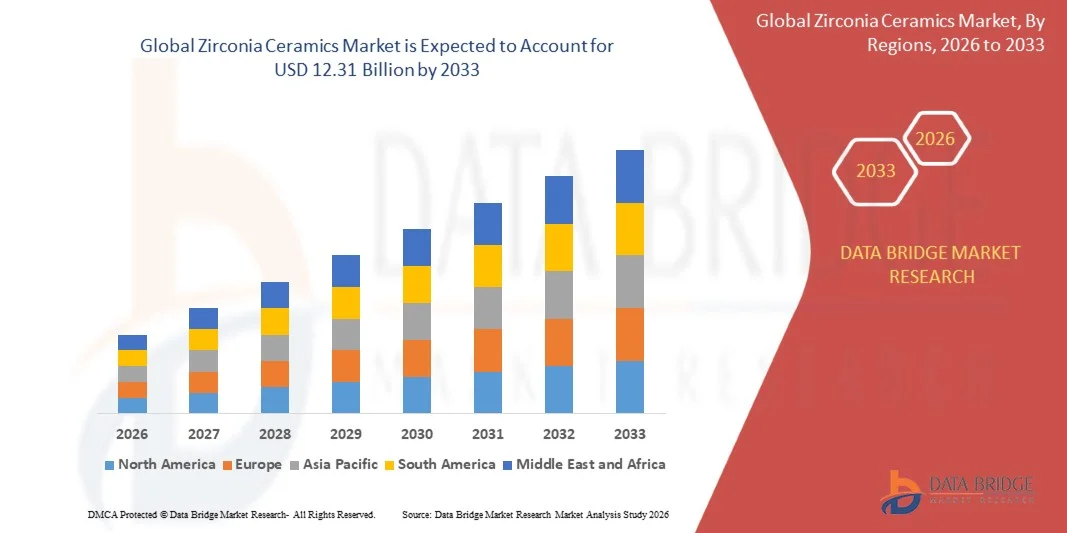
- As per Data Bridge Market Research analysis, the zirconia ceramics market was valued at USD 6.84 billion in 2025 and is projected to reach USD 12.31 billion by 2033, growing at a CAGR of 7.63% from 2026 to 2033.
- The market is experiencing robust growth driven by increasing demand for high-strength, wear-resistant, and biocompatible ceramic materials, rising adoption of zirconia ceramics in dental restorations, medical implants, industrial tooling, electronics, and automotive components, and continuous advancements in advanced ceramic manufacturing technologies.
- The growing utilization of zirconia ceramics in digital dentistry, orthopedic implants, thermal barrier coatings, semiconductor components, and precision engineering, combined with ongoing investments in high-performance materials, spark plasma sintering, and nanostructured zirconia technologies, is accelerating market expansion. Superior fracture toughness, chemical inertness, corrosion resistance, and thermal stability continue to position zirconia ceramics as a preferred material for demanding industrial and healthcare applications.
Market Size & Forecast
- Global Market Value (2025): USD 6.84 Billion
- Expected Market Value (2033): USD 12.31 Billion
- Forecast CAGR (2026–2033): 7.63%
- Leading Region in 2025: North America
- Fastest Growing Region: Asia-Pacific
What are the Major Takeaways of the Zirconia Ceramics Market?
- North America dominated the zirconia ceramics market with the largest revenue share of 38.9% in 2025, supported by strong demand from the healthcare, aerospace, semiconductor, and advanced manufacturing industries, along with widespread adoption of high-performance ceramic materials.
- Asia-Pacific is expected to be the fastest-growing region at a CAGR of 9.0% from 2026 to 2033, fueled by rapid industrialization, expanding electronics manufacturing, increasing healthcare investments, and rising demand across China, Japan, South Korea, and India.
- The partially stabilized zirconia segment led the market with a 58.4% share in 2025, driven by its superior fracture toughness, high flexural strength, and excellent wear resistance, making it suitable for demanding industrial and biomedical applications
- Fully stabilized zirconia is the fastest-growing product type, projected to register a CAGR of 8.8%, reflecting the surge in solid oxide fuel cells (SOFCs), oxygen sensors, thermal barrier coatings, and electronic components
- The isostatic pressing segment dominated the manufacturing process category with a 33.8% revenue share in 2025, led by its ability to produce highly dense and defect-free zirconia ceramic components with uniform mechanical properties.
- Powder accounted for 64.7% of the market share in 2025, preferred by its extensive utilization as the primary raw material for manufacturing zirconia ceramic components across dental, industrial, electronic, and biomedical applications.
- The investment casting segment is the fastest-growing application category, with a CAGR of 8.9%, driven by increasing demand for precision metal casting in aerospace, automotive, defense, and industrial manufacturing.
Report Scope and Zirconia Ceramics Market Segmentation
|
Attributes |
Zirconia Ceramics Key Market Insights |
|
Segments Covered |
|
|
Countries Covered |
North America
Europe
Asia-Pacific
Middle East and Africa
South America
|
|
Key Market Players |
|
|
Market Opportunities |
|
|
Value Added Data Infosets |
In addition to the insights on market scenarios such as market value, growth rate, segmentation, geographical coverage, and major players, the market reports curated by the Data Bridge Market Research also include import export analysis, production capacity overview, production consumption analysis, price trend analysis, climate change scenario, supply chain analysis, value chain analysis, raw material/consumables overview, vendor selection criteria, PESTLE Analysis, Porter Analysis, and regulatory framework. |
What is the Key Trend in the Zirconia Ceramics Market?
- The rapid adoption of digital dentistry and chairside CAD/CAM workflows is significantly increasing demand for high-translucency zirconia ceramics that enable stronger, aesthetic, and single-visit dental restorations.
- For instance, in March 2025, Ivoclar introduced the IPS e.max ZirCAD Prime block at IDS 2025, enabling monolithic zirconia restorations to be speed-sintered in approximately 15 minutes while delivering flexural strength of 1,100 MPa for efficient chairside treatment.
- Advanced multilayer zirconia materials provide enhanced translucency, fracture toughness, and long-term durability while supporting minimally invasive restorative dentistry and improved patient outcomes.
- Dental laboratories and clinicians are increasingly integrating CAD/CAM milling and digital workflows to improve restoration accuracy, reduce production time, and standardize treatment quality.
- For instance, in March 2025, Besmile unveiled its Aconia 3D Master Multilayer Zirconia at IDS 2025, featuring 1,200 MPa flexural strength and fast-sintering capabilities to improve productivity and aesthetics in digital dental laboratories.
- As healthcare providers continue prioritizing digital workflows, aesthetic restorations, and faster treatment delivery, adoption of advanced zirconia ceramics is expected to accelerate, reinforcing their position as a preferred material in modern restorative dentistry.
What are the Key Drivers of the Zirconia Ceramics Market?
- The increasing prevalence of dental disorders, rising implant procedures, and expanding use of CAD/CAM restorative dentistry are substantially increasing demand for high-strength, biocompatible zirconia ceramic materials.
- For instance, in March 2025, researchers published a study in the Journal of Materials Science & Technology demonstrating that 0.2 mol% CaO-doped ceria-stabilized zirconia achieved a fracture toughness of 10.4 MPa·m½, biaxial flexural strength of 1210 ± 43 MPa, and translucency comparable to commercial dental zirconia, highlighting its potential for next-generation dental implant materials.
- Medical device manufacturers, dental laboratories, and advanced ceramic producers are investing in high-performance zirconia materials to improve durability, aesthetics, and long-term clinical performance.
- For instance, in October 2024, researchers from the University of Tokyo directly observed space-charge-induced electric fields at grain boundaries in yttria-stabilized zirconia (YSZ), revealing how grain boundary structure influences ionic conductivity and providing new guidelines for improving solid oxide fuel cell electrolytes and other advanced ceramic materials.
- With healthcare, energy, electronics, and advanced manufacturing industries increasingly adopting high-performance ceramics, zirconia ceramics will remain a critical material for next-generation medical devices and engineering applications.
Which Factors are Challenging the Growth of the Next Generation Tobacco Products Market?
- High manufacturing costs associated with ultra-pure zirconia powders, precision machining, and advanced sintering technologies continue to increase production expenses for premium zirconia ceramic components.
- For instance, in September 2025, researchers published in Ceramics International that producing nanostructured yttria-stabilized zirconia required integrating High-Pressure Torsion (HPT) with Spark Plasma Sintering (SPS) to achieve 99% relative density and superior mechanical properties, highlighting the complexity and high processing costs associated with advanced zirconia ceramic manufacturing.
- These elevated production costs restrict wider adoption among cost-sensitive dental laboratories, healthcare providers, and industrial manufacturers, particularly across emerging economies.
- Manufacturers also face challenges related to processing complexity, quality consistency, and stringent performance requirements for biomedical, aerospace, and semiconductor applications.
- For instance, in July 2025, researchers reported in the Journal of Thermal Analysis and Calorimetry that manufacturing Ce/Nd-doped zirconia ceramics for nuclear applications required high-temperature spark plasma sintering and extensive thermal characterization, demonstrating the demanding processing requirements and production costs of advanced zirconia ceramics.
- The combination of high raw material prices, specialized processing equipment, and rigorous quality standards continues to limit market penetration, particularly for small manufacturers despite rising global demand for advanced zirconia ceramics.
How is the Zirconia Ceramics Market Segmented?
The zirconia ceramics market is segmented on the basis of product type, manufacturing process, form, and application.
- By Product Type
On the basis of product type, the zirconia ceramics market is segmented into fully stabilized zirconia and partially stabilized zirconia. The partially stabilized zirconia (PSZ) segment dominated the market with an estimated share of 58.4% in 2025, owing to its superior fracture toughness, high flexural strength, and excellent wear resistance, making it suitable for demanding industrial and biomedical applications. PSZ is extensively utilized in dental restorations, orthopedic implants, cutting tools, grinding media, and wear-resistant mechanical components. Its transformation toughening mechanism significantly improves crack resistance compared with conventional ceramics. The material also exhibits excellent thermal shock resistance and chemical stability, enabling use in harsh operating environments. Increasing demand from the healthcare, automotive, and advanced manufacturing industries continues to reinforce its market leadership. Continuous improvements in stabilization technologies and material performance further strengthen the dominance of this segment.
The fully stabilized zirconia (FSZ) segment is expected to register the fastest growth at an estimated CAGR of 8.8% from 2026 to 2033, driven by expanding applications in solid oxide fuel cells (SOFCs), oxygen sensors, thermal barrier coatings, and electronic components. Fully stabilized zirconia offers outstanding ionic conductivity, excellent thermal stability, and high corrosion resistance, making it an ideal material for energy and electronics applications. Growing investments in hydrogen energy, fuel cell technologies, and clean energy infrastructure are accelerating product demand. Increasing adoption of advanced ceramic materials in semiconductor manufacturing is further supporting growth. Continuous research focused on improving conductivity and long-term durability is expanding commercial opportunities. Rising emphasis on sustainable energy technologies is expected to drive rapid adoption of FSZ globally.
- By Manufacturing Process
On the basis of manufacturing process, the zirconia ceramics market is segmented into isostatic pressing, injection molding, extrusion, slip casting, dry pressing, hot isostatic pressing (HIP), and spark plasma sintering (SPS). The isostatic pressing segment accounted for an estimated market share of 33.8% in 2025, owing to its ability to produce highly dense and defect-free zirconia ceramic components with uniform mechanical properties. The process is widely adopted for manufacturing dental implants, industrial wear parts, precision engineering components, and biomedical devices requiring exceptional strength and dimensional accuracy. It enables uniform pressure distribution during forming, reducing internal defects and improving reliability. The technology is well established across large-scale ceramic manufacturing facilities due to its high production efficiency. Compatibility with complex geometries and high-performance applications further supports widespread adoption. Its consistent product quality continues to make isostatic pressing the preferred manufacturing process.
The spark plasma sintering (SPS) segment is projected to grow at an estimated CAGR of 9.5% from 2026 to 2033, driven by increasing demand for nanostructured zirconia ceramics with superior density, hardness, and fracture toughness. SPS enables rapid densification at relatively lower temperatures and significantly shorter processing times compared with conventional sintering methods. The technology minimizes grain growth while improving mechanical and functional performance. Increasing research activities focused on advanced ceramics, biomedical implants, and aerospace components are accelerating its commercialization. Growing investments in next-generation ceramic processing technologies are further supporting market expansion. Rising adoption for high-value engineering applications is expected to drive substantial growth.
- By Form
On the basis of form, the zirconia ceramics market is segmented into powder and blocks. The powder segment held an estimated revenue share of 64.7% in 2025, owing to its extensive utilization as the primary raw material for manufacturing zirconia ceramic components across dental, industrial, electronic, and biomedical applications. Zirconia powder provides excellent processing flexibility and enables manufacturers to produce components using multiple forming and sintering techniques. High-purity powders are increasingly demanded for advanced ceramics requiring exceptional strength and reliability. Continuous improvements in powder purity, particle size distribution, and material consistency are enhancing product performance. Growing production of high-performance ceramics is further supporting segment growth. Its broad application across multiple industries continues to maintain market dominance.
The blocks segment is anticipated to expand at an estimated CAGR of 9.2% from 2026 to 2033, driven by the rapid expansion of CAD/CAM digital dentistry and increasing demand for pre-sintered zirconia blocks used in crowns, bridges, veneers, and implant restorations. These blocks offer excellent machining characteristics, high dimensional accuracy, and superior aesthetic properties. Dental laboratories and clinics increasingly prefer zirconia blocks for efficient digital manufacturing workflows. Advancements in multilayer zirconia technology are improving translucency while maintaining high mechanical strength. Growing adoption of chairside restoration systems is further boosting demand. Increasing investments in digital dental infrastructure continue to accelerate segment growth.
- By Application
On the basis of application, the zirconia ceramics market is segmented into refractory materials and casting, advanced ceramics and special products, abrasive material, investment casting, and dye and pigment. The advanced ceramics and special products segment dominated the market with an estimated share of 46.3% in 2025, owing to widespread adoption across dental restorations, orthopedic implants, industrial machinery, semiconductor components, cutting tools, and electronic devices. Zirconia ceramics provide exceptional fracture toughness, wear resistance, chemical inertness, and biocompatibility, making them suitable for high-performance applications. Increasing utilization in healthcare and precision engineering industries continues to support demand. Continuous innovation in advanced ceramic materials is improving product performance and expanding end-use applications. Rising investments in electronics and energy technologies further strengthen market growth. The superior mechanical and thermal properties of zirconia continue to reinforce this segment's leadership.
The investment casting segment is expected to register the fastest growth at an estimated CAGR of 8.9% from 2026 to 2033, driven by increasing demand for precision metal casting in aerospace, automotive, defense, and industrial manufacturing. Zirconia ceramics are widely used for ceramic cores and molds because of their excellent thermal stability, low reactivity, and resistance to molten metals. Increasing production of lightweight, high-performance components is accelerating demand for advanced casting materials. Growth in aerospace engine manufacturing and industrial equipment production is further supporting market expansion. Continuous advancements in precision casting technologies are improving manufacturing efficiency. Rising demand for complex, high-quality cast components is expected to sustain rapid growth in this segment.
Which Region Holds the Largest Share of the Zirconia Ceramics Market?
- North America dominated the zirconia ceramics market with the largest revenue share of 38.9% in 2025, supported by strong demand from the healthcare, aerospace, semiconductor, and advanced manufacturing industries, along with widespread adoption of high-performance ceramic materials.
- The region also benefits from increasing adoption of CAD/CAM digital dentistry, growing investments in advanced ceramic research, expanding utilization of zirconia in fuel cells, industrial wear components, and electronic applications, and continuous technological innovations in high-performance ceramic processing. Rising demand for biocompatible materials and precision-engineered ceramic components continues to strengthen North America's leadership position in the global zirconia ceramics market.
U.S. Zirconia Ceramics Market Insight
The U.S. zirconia ceramics market is witnessing strong growth due to rising demand for advanced dental restorations, medical implants, semiconductor components, and high-performance industrial ceramics. The country's well-established healthcare infrastructure, growing adoption of CAD/CAM digital dentistry, and increasing investments in advanced ceramic manufacturing technologies are driving product demand across healthcare and industrial applications. According to the American College of Prosthodontists, approximately 36 million Americans are edentulous and around 120 million people are missing at least one tooth, supporting sustained demand for zirconia crowns, bridges, and implant restorations. In addition, continuous research in advanced ceramics and increasing utilization of zirconia in aerospace and energy applications are further accelerating market growth.
Asia-Pacific Zirconia Ceramics Market Insight
The Asia-Pacific zirconia ceramics market is expected to witness rapid growth, driven by expanding electronics manufacturing, increasing dental healthcare expenditure, and rising industrialization across China, Japan, South Korea, and India. Growing investments in semiconductor fabrication, electric vehicles, and advanced ceramic materials are supporting regional market expansion. According to SEMI, global semiconductor manufacturing capacity expansion continues to be led by Asia, with China, Taiwan, South Korea, and Japan accounting for the majority of new fabrication investments, creating significant demand for high-purity zirconia ceramic components. In addition, increasing adoption of digital dentistry and precision engineering applications is accelerating zirconia ceramics consumption across the region.
Japan Zirconia Ceramics Market Insight
The Japan zirconia ceramics market is witnessing consistent growth due to rising investments in advanced ceramics, fuel cell technologies, precision electronics, and dental materials. The country's globally recognized ceramic manufacturers continue to develop high-performance yttria-stabilized zirconia for industrial and biomedical applications. In October 2024, researchers from the University of Tokyo directly observed space-charge-induced electric fields at grain boundaries in yttria-stabilized zirconia, providing new insights for improving solid oxide fuel cell electrolytes and advanced ceramic materials. Continuous innovation in ceramic processing and energy-efficient materials is further strengthening Japan's leadership in advanced zirconia technologies.
China Zirconia Ceramics Market Insight
The China zirconia ceramics market is growing rapidly, driven by expanding advanced manufacturing, increasing dental restorations, and rising demand from electronics, aerospace, and industrial machinery sectors. China remains one of the world's largest producers and consumers of advanced ceramic materials, supported by significant investments in high-performance manufacturing. According to the National Bureau of Statistics of China, the country's high-tech manufacturing industry continued to record strong growth during 2024, supporting increasing demand for advanced engineering ceramics, including zirconia-based components. Growing adoption of digital dentistry and precision manufacturing technologies continues to position China among the fastest-growing zirconia ceramics markets globally.
U.K. Zirconia Ceramics Market Insight
The U.K. zirconia ceramics market is experiencing steady growth, supported by increasing adoption of digital dentistry, expanding research in biomaterials, and rising utilization of advanced ceramics across healthcare and precision engineering industries. Universities, dental laboratories, and healthcare providers are increasingly investing in CAD/CAM technologies and zirconia-based restorative materials. According to the Oral Health Foundation, oral diseases remain among the most prevalent chronic health conditions in the U.K., supporting continued demand for durable dental restorative materials such as zirconia. Furthermore, ongoing research in advanced biomaterials and ceramic technologies continues to strengthen market growth across the country.
Germany Zirconia Ceramics Market Insight
The Germany zirconia ceramics market is expanding steadily due to the country's strong dental technology industry, advanced ceramic manufacturing capabilities, and leadership in industrial engineering. German manufacturers continue to invest in high-performance zirconia materials for dental, automotive, industrial, and medical applications. In March 2025, IDS Cologne showcased next-generation multilayer zirconia materials and advanced CAD/CAM technologies from leading manufacturers, highlighting Germany's role as a global innovation hub for digital dentistry and advanced ceramic materials. Continuous advancements in ceramic processing technologies and precision manufacturing are further driving zirconia ceramics adoption across the country.
Which are the Top Companies in Zirconia Ceramics Market?
The zirconia ceramics industry is primarily led by well-established companies, including:
- Tosoh Corporation (Japan)
- CeramTec GmbH (Germany)
- KYOCERA Corporation (Japan)
- Morgan Advanced Materials (U.K.)
- Saint-Gobain Group (France)
- Rauschert GmbH (Germany)
- McDanel Advanced Ceramic Technologies LLC (U.S.)
- Elan Technology, Inc. (U.S.)
- Superior Technical Ceramics Corporation (U.S.)
- INNOVACERA (China)
- Ceradyne, Inc. (U.S.)
- Ortech Advanced Ceramics (U.S.)
- Nishimura Advanced Ceramics Co., Ltd. (Japan)
- Japan Fine Ceramics Co., Ltd. (Japan)
- Precision Ceramics USA (U.S.)
- Jyoti Ceramic Industries Pvt. Ltd. (India)
- NGK INSULATORS, LTD. (Japan)
- Ferro-Ceramic Grinding Inc. (U.S.)
What are Latest Developments in Zirconia Ceramics Market?
- In September 2025, Dentsply Sirona launched the world's first zirconia abutment block that combines high mechanical strength with esthetics for hybrid abutments and hybrid abutment crowns, expanding CAD/CAM implant restorative solutions for digital dentistry.
- In April 2025, KYOCERA Fineceramics Europe announced the launch of its Ceramic Additive Manufacturing (CAM) service in Europe, enabling the production of customized alumina and zirconia ceramic components with complex geometries through ceramic 3D printing. The technology significantly shortens prototype development cycles while maintaining the same material properties as conventionally manufactured zirconia ceramics, supporting advanced industrial, medical, and electronics applications
- In March 2025, Ivoclar introduced the IPS e.max ZirCAD Prime Block at IDS 2025, expanding its zirconia portfolio with a CAD/CAM block capable of approximately 15-minute speed sintering and a flexural strength of 1,100 MPa. The product enables faster chairside fabrication of highly aesthetic monolithic zirconia restorations, supporting the growing adoption of digital dentistry workflows
- In February 2025, Dentsply Sirona introduced the Cercon yo ML multilayer zirconia disc, featuring optimized 4Y/5Y zirconia technology for crowns, bridges, and full-arch restorations. The product combines high strength with enhanced translucency to improve aesthetics and efficiency in digital dental laboratories.
- In September 2021, Kuraray Noritake Dental expanded its KATANA Zirconia portfolio with next-generation multilayer zirconia materials designed to deliver improved translucency, gradient shading, and mechanical strength for monolithic restorations fabricated through CAD/CAM systems. Supported by the company's product announcements and scientific documentation on the KATANA Zirconia series.

- Interactive Data Analysis Dashboard
- Company Analysis Dashboard for high growth potential opportunities
- Research Analyst Access for customization & queries
- Competitor Analysis with Interactive dashboard
- Latest News, Updates & Trend analysis
- Harness the Power of Benchmark Analysis for Comprehensive Competitor Tracking
Global Zirconia Ceramics Market, Supply Chain Analysis and Ecosystem Framework
To support market growth and help clients navigate the impact of geopolitical shifts, DBMR has integrated in-depth supply chain analysis into its Global Zirconia Ceramics Market research reports. This addition empowers clients to respond effectively to global changes affecting their industries. The supply chain analysis section includes detailed insights such as Global Zirconia Ceramics Market consumption and production by country, price trend analysis, the impact of tariffs and geopolitical developments, and import and export trends by country and HSN code. It also highlights major suppliers with data on production capacity and company profiles, as well as key importers and exporters. In addition to research, DBMR offers specialized supply chain consulting services backed by over a decade of experience, providing solutions like supplier discovery, supplier risk assessment, price trend analysis, impact evaluation of inflation and trade route changes, and comprehensive market trend analysis.
Data collection and base year analysis are done using data collection modules with large sample sizes. The stage includes obtaining market information or related data through various sources and strategies. It includes examining and planning all the data acquired from the past in advance. It likewise envelops the examination of information inconsistencies seen across different information sources. The market data is analysed and estimated using market statistical and coherent models. Also, market share analysis and key trend analysis are the major success factors in the market report. To know more, please request an analyst call or drop down your inquiry.
The key research methodology used by DBMR research team is data triangulation which involves data mining, analysis of the impact of data variables on the market and primary (industry expert) validation. Data models include Vendor Positioning Grid, Market Time Line Analysis, Market Overview and Guide, Company Positioning Grid, Patent Analysis, Pricing Analysis, Company Market Share Analysis, Standards of Measurement, Global versus Regional and Vendor Share Analysis. To know more about the research methodology, drop in an inquiry to speak to our industry experts.
Data Bridge Market Research is a leader in advanced formative research. We take pride in servicing our existing and new customers with data and analysis that match and suits their goal. The report can be customized to include price trend analysis of target brands understanding the market for additional countries (ask for the list of countries), clinical trial results data, literature review, refurbished market and product base analysis. Market analysis of target competitors can be analyzed from technology-based analysis to market portfolio strategies. We can add as many competitors that you require data about in the format and data style you are looking for. Our team of analysts can also provide you data in crude raw excel files pivot tables (Fact book) or can assist you in creating presentations from the data sets available in the report.













