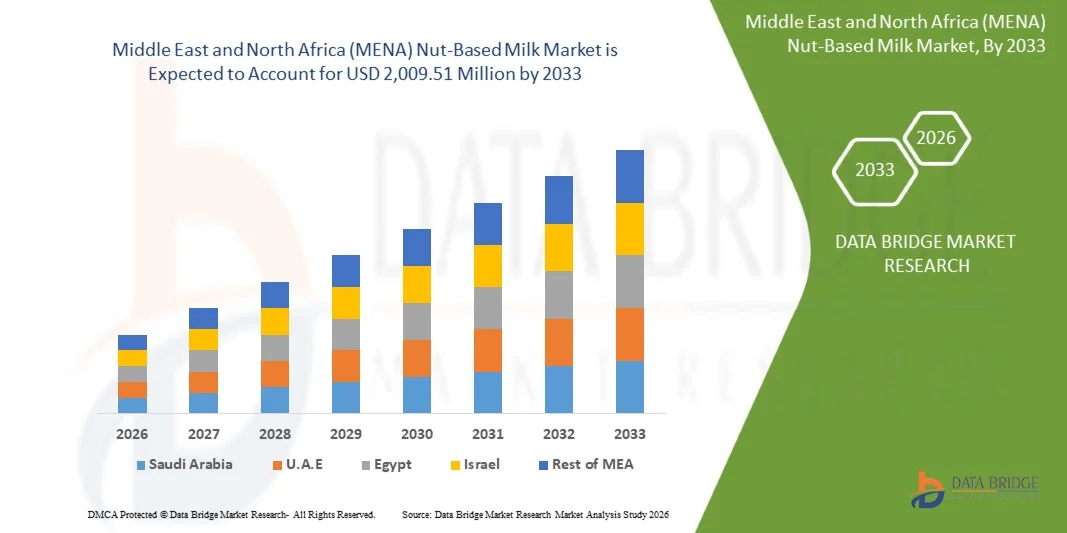
Middle East and North Africa (MENA) Nut-Based Milk Market Size
- The Middle East and North Africa (MENA) nut-based milk market size was valued at USD 734.83 millionin 2025 and is expected to reach USD 2,009.51 millionby 2033, at a CAGR of 13.4% during the forecast period
- The market growth is largely fuelled by the rising consumer preference for plant-based and lactose-free alternatives, coupled with increasing health awareness and adoption of nutritious diets
- Expansion of retail channels, including supermarkets, hypermarkets, and e-commerce platforms, is enhancing product accessibility and boosting market penetration
Middle East and North Africa (MENA) Nut-Based Milk Market Analysis
- Increasing awareness of the benefits of plant-based milk, such as lower cholesterol and improved digestive health, is encouraging consumers to shift from traditional dairy to nut-based alternatives
- Rising disposable incomes, urbanization, and changing lifestyles in the MENA region are accelerating demand for convenient, healthy, and sustainable food options
- Saudi Arabia dominated the MENA nut-based milk market with the largest revenue share in 2025, driven by increasing health awareness and rising adoption of plant-based diets
- U.A.E is expected to witness the highest compound annual growth rate (CAGR) in the Middle East and North Africa (MENA) nut-based milk market due to growing urbanization, higher disposable incomes, and rising adoption of ready-to-drink and flavored nut-based milk products.
- The unflavored segment held the largest market revenue share in 2025, driven by its versatility for both direct consumption and use in recipes and beverages. Unflavored nut-based milk is preferred by health-conscious consumers and foodservice providers due to its neutral taste and adaptability across culinary applications
Report Scope and Middle East and North Africa (MENA) Nut-Based Milk Market Segmentation
|
Attributes |
Middle East and North Africa (MENA) Nut-Based Milk Key Market Insights |
|
Segments Covered |
|
|
Countries Covered |
North America
Europe
Asia-Pacific
Middle East and Africa
South America
|
|
Key Market Players |
|
|
Market Opportunities |
|
|
Value Added Data Infosets |
In addition to the insights on market scenarios such as market value, growth rate, segmentation, geographical coverage, and major players, the market reports curated by the Data Bridge Market Research also include in-depth expert analysis, pricing analysis, brand share analysis, consumer survey, demography analysis, supply chain analysis, value chain analysis, raw material/consumables overview, vendor selection criteria, PESTLE Analysis, Porter Analysis, and regulatory framework. |
Middle East and North Africa (MENA) Nut-Based Milk Market Trends
Rising Demand for Plant-Based and Lactose-Free Beverages
- The growing shift toward plant-based and lactose-free milk alternatives is transforming the MENA nut-based milk market by enabling healthier and more sustainable dietary options. Consumers are increasingly adopting almond, cashew, and other nut-based milk for better nutrition, improved digestibility, and lifestyle preferences, boosting market demand. The trend is further supported by the growing awareness of dietary restrictions, ethical consumption, and environmental sustainability across the region
- The high demand for convenient, ready-to-drink, and fortified nut-based milk products is accelerating adoption across urban and semi-urban regions. These products cater to health-conscious individuals, children, and elderly populations, helping reduce lactose intolerance issues and supporting a balanced diet. Continuous product innovation, including flavored and nutrient-enriched variants, is further driving consumer preference and repeat purchases
- The affordability and wide availability of nut-based milk in supermarkets, hypermarkets, and online retail channels are making these products attractive to a larger consumer base. Improved distribution networks allow frequent consumption without logistical hurdles, contributing to consistent market growth. The rise of e-commerce platforms and home delivery services is also facilitating access for consumers in remote areas, further boosting market penetration
- For instance, in 2023, several retail chains across the U.A.E. and Saudi Arabia reported increased sales of almond and oat milk products after introducing fortified and flavored variants targeted at children and working adults. These offerings improved nutritional intake while expanding consumer adoption. Collaborative campaigns with health influencers and nutritionists amplified consumer engagement and awareness
- While nut-based milk consumption is growing, market expansion depends on continued product innovation, awareness campaigns, and regional distribution strategies to meet diverse consumer preferences. The integration of plant-based milk into cafés, restaurants, and institutional catering also presents a strong growth avenue for manufacturers
Middle East and North Africa (MENA) Nut-Based Milk Market Dynamics
Driver
Growing Health Awareness and Shift Toward Plant-Based Diets
- Increasing awareness of the health benefits of plant-based diets is driving the demand for nut-based milk in MENA. Consumers are prioritizing low-cholesterol, lactose-free, and nutrient-rich alternatives to dairy milk to maintain a healthier lifestyle. Social media, health blogs, and nutrition programs are significantly enhancing consumer knowledge and influencing purchasing behavior.
- Government campaigns and health initiatives promoting nutritious food options are boosting market penetration and encouraging consumption of fortified nut-based milk products. Policies supporting clean label products, functional foods, and dietary diversification are further strengthening market adoption. Nutritional labeling and certification schemes are helping consumers make informed choices, supporting long-term growth.
- Rising consumer preference for vegan and organic products is further supporting market growth, as these products are seen as environmentally sustainable and ethically sourced. The growing trend of eco-conscious lifestyles is motivating consumers to switch from traditional dairy to plant-based alternatives, expanding the target market. Retailers are also expanding shelf space for organic and nut-based milk to meet this rising demand.
- For instance, in 2022, Saudi Arabia and UAE witnessed an increase in fortified almond and cashew milk consumption following awareness programs highlighting benefits for children and elderly populations. Collaborative promotions with nutritionists, wellness apps, and healthcare institutions enhanced visibility and adoption rates.
- While health consciousness and dietary shifts are driving the market, product affordability, taste preferences, and availability across urban and rural areas remain key to sustained adoption. Investments in marketing, distribution infrastructure, and innovative packaging solutions are essential to capture new consumers and retain existing ones.
Restraint/Challenge
High Product Costs and Limited Consumer Awareness in Some Regions
- The higher price of premium nut-based milk compared to traditional dairy milk limits accessibility for price-sensitive consumers in some MENA countries. This is especially true for fortified or flavored variants with added nutrients. Price competition from locally produced alternatives and regional dairy substitutes also poses a challenge to market growth
- In certain rural and semi-urban areas, limited awareness of the nutritional benefits of nut-based milk reduces adoption rates, restricting market growth. Consumers may prefer traditional dairy due to familiarity, cultural habits, or lack of exposure to plant-based options. Educational campaigns and localized marketing strategies are needed to overcome these barriers
- Supply chain and storage limitations for perishable nut-based milk products can affect consistent product availability, leading to reduced consumer trust and occasional stock-outs. Cold chain disruptions, transportation challenges, and regional import restrictions may impact timely delivery, particularly in remote areas. Manufacturers are focusing on expanding cold chain networks and investing in shelf-stable formulations to mitigate these challenges
- For instance, in 2023, distributors in parts of North Africa reported lower sales of almond and cashew milk due to both high prices and limited cold-chain logistics, impacting market penetration. Retailers also observed fluctuating stock levels, influencing consumer loyalty and repeat purchase behavior
- While production and distribution continue to improve, addressing cost barriers, increasing consumer education, and expanding retail and e-commerce presence remain critical to unlock full market potential. Public-private partnerships, targeted promotions, and partnerships with health-focused brands could further drive adoption and long-term growth
Middle East and North Africa (MENA) Nut-Based Milk Market Scope
The market is segmented on the basis of type, product type, form type, end use, and distribution channel.
- By Type
On the basis of type, the MENA nut-based milk market is segmented into flavored and unflavored. The unflavored segment held the largest market revenue share in 2025, driven by its versatility for both direct consumption and use in recipes and beverages. Unflavored nut-based milk is preferred by health-conscious consumers and foodservice providers due to its neutral taste and adaptability across culinary applications.
The flavored segment is expected to witness the fastest growth rate from 2026 to 2033, driven by rising consumer demand for taste-enhanced, ready-to-drink products. Flavored variants, such as chocolate, vanilla, and fruit-infused nut-based milk, are particularly popular among children and young adults, boosting repeat purchases and brand loyalty.
- By Product Type
On the basis of product type, the market is segmented into soy milk, almond milk, coconut milk, rice milk, oat milk, hemp milk, cashew milk, walnut milk, and hazelnut milk. Almond milk held the largest market revenue share in 2025, driven by its high nutritional value, widespread awareness, and easy availability across retail channels. Almond milk is favored by consumers seeking a plant-based alternative rich in vitamins, minerals, and low in cholesterol.
Oat milk is expected to witness the fastest growth rate from 2026 to 2033, fueled by the rising popularity of sustainable and eco-friendly plant-based options. Oat milk’s creamy texture and suitability for beverages and cereals make it a preferred choice among millennials and urban consumers in the MENA region.
- By Form Type
On the basis of form type, the market is segmented into powder and liquid. The liquid segment held the largest market revenue share in 2025, driven by its ready-to-drink convenience and high adoption in households, cafés, and restaurants. Liquid nut-based milk is increasingly preferred due to its ease of consumption, quick serving, and minimal preparation requirements.
The powdered segment is expected to witness the fastest growth rate from 2026 to 2033, propelled by its longer shelf life, portability, and flexibility for reconstitution. Powdered nut-based milk is gaining traction in institutional and industrial applications, as well as among consumers seeking cost-effective storage solutions.
- By End Use
On the basis of end use, the market is segmented into food and beverages, nutraceuticals, baby food, personal care, and pharmaceuticals. The food and beverages segment held the largest market revenue share in 2025, driven by high consumption in smoothies, cereals, coffee, and cooking applications. Nut-based milk is increasingly incorporated into cafés, restaurants, and home kitchens as a dairy alternative.
The nutraceutical segment is expected to witness the fastest growth rate from 2026 to 2033, fueled by the rising demand for fortified and functional beverages. Nut-based milk enriched with vitamins, minerals, and probiotics is becoming popular among health-conscious consumers and individuals with specific dietary needs.
- By Distribution Channel
On the basis of distribution channel, the market is segmented into supermarket and hypermarket, convenience stores, foodservice, specialty retail stores, and online retail. Supermarkets and hypermarkets held the largest market revenue share in 2025, driven by strong brand presence, wide product assortment, and consumer accessibility. These outlets serve as the primary point of purchase for urban and semi-urban consumers.
The online retail segment is expected to witness the fastest growth rate from 2026 to 2033, fueled by increasing digital adoption, convenience of home delivery, and attractive promotional offers. Online platforms are expanding reach to consumers in remote areas while enabling bulk purchases and subscription-based delivery models.
Middle East and North Africa (MENA) Nut-Based Milk Market Regional Analysis
- Saudi Arabia dominated the MENA nut-based milk market with the largest revenue share in 2025, driven by increasing health awareness and rising adoption of plant-based diets
- Consumers in the region highly value the nutritional benefits, lactose-free nature, and versatility of nut-based milk in daily consumption and culinary applications
- This widespread adoption is further supported by strong retail and online distribution networks, urbanization, and rising disposable incomes, establishing nut-based milk as a preferred alternative to traditional dairy products
U.A.E. Nut-Based Milk Market Insight
The U.A.E. nut-based milk market is projected to witness the fastest growth rate from 2026 to 2033, fueled by rising health awareness and demand for premium, fortified, and flavored variants. Consumers are increasingly adopting almond, oat, and other nut-based milk products as part of a balanced diet. The market benefits from a strong retail ecosystem, including supermarkets, specialty stores, and online platforms, which enhances product accessibility. In addition, lifestyle trends favoring plant-based and lactose-free alternatives are further accelerating adoption in the U.A.E.
Middle East and North Africa (MENA) Nut-Based Milk Market Share
The Middle East and North Africa (MENA) nut-based milk industry is primarily led by well-established companies, including:
- Al Ain Dairy (U.A.E.)
- Almarai (Saudi Arabia)
- Al Rawabi Dairy Company (U.A.E.)
- Al Safi Danone (Saudi Arabia)
- Al Khaleej Sugar & Dairy Products (U.A.E.)
- Al Faysal Dairy (Saudi Arabia)
- Al Ain Food & Beverages (U.A.E.)
- Al Watania Agriculture (Saudi Arabia)
- Al Jazira Agriculture & Food Products (Saudi Arabia)
- Al Qudra Food Products (U.A.E.)

- Interactive Data Analysis Dashboard
- Company Analysis Dashboard for high growth potential opportunities
- Research Analyst Access for customization & queries
- Competitor Analysis with Interactive dashboard
- Latest News, Updates & Trend analysis
- Harness the Power of Benchmark Analysis for Comprehensive Competitor Tracking
Mena Nut Based Milk Market, Supply Chain Analysis and Ecosystem Framework
To support market growth and help clients navigate the impact of geopolitical shifts, DBMR has integrated in-depth supply chain analysis into its Mena Nut Based Milk Market research reports. This addition empowers clients to respond effectively to global changes affecting their industries. The supply chain analysis section includes detailed insights such as Mena Nut Based Milk Market consumption and production by country, price trend analysis, the impact of tariffs and geopolitical developments, and import and export trends by country and HSN code. It also highlights major suppliers with data on production capacity and company profiles, as well as key importers and exporters. In addition to research, DBMR offers specialized supply chain consulting services backed by over a decade of experience, providing solutions like supplier discovery, supplier risk assessment, price trend analysis, impact evaluation of inflation and trade route changes, and comprehensive market trend analysis.
Data collection and base year analysis are done using data collection modules with large sample sizes. The stage includes obtaining market information or related data through various sources and strategies. It includes examining and planning all the data acquired from the past in advance. It likewise envelops the examination of information inconsistencies seen across different information sources. The market data is analysed and estimated using market statistical and coherent models. Also, market share analysis and key trend analysis are the major success factors in the market report. To know more, please request an analyst call or drop down your inquiry.
The key research methodology used by DBMR research team is data triangulation which involves data mining, analysis of the impact of data variables on the market and primary (industry expert) validation. Data models include Vendor Positioning Grid, Market Time Line Analysis, Market Overview and Guide, Company Positioning Grid, Patent Analysis, Pricing Analysis, Company Market Share Analysis, Standards of Measurement, Global versus Regional and Vendor Share Analysis. To know more about the research methodology, drop in an inquiry to speak to our industry experts.
Data Bridge Market Research is a leader in advanced formative research. We take pride in servicing our existing and new customers with data and analysis that match and suits their goal. The report can be customized to include price trend analysis of target brands understanding the market for additional countries (ask for the list of countries), clinical trial results data, literature review, refurbished market and product base analysis. Market analysis of target competitors can be analyzed from technology-based analysis to market portfolio strategies. We can add as many competitors that you require data about in the format and data style you are looking for. Our team of analysts can also provide you data in crude raw excel files pivot tables (Fact book) or can assist you in creating presentations from the data sets available in the report.