


What is the Middle East and Africa Vital Signs Monitoring Market Size and Growth Rate?
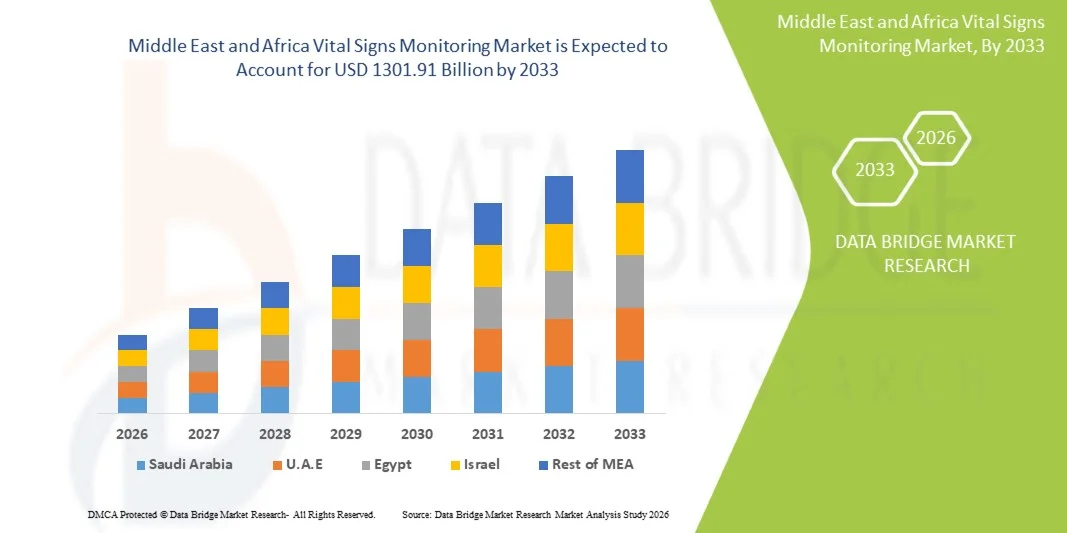
- As per Data Bridge Market Research Analysis the Middle East and Africa Vital Signs Monitoring market size was valued at USD 634.52 Billion in 2025 and is expected to reach USD 1301.91 Billion by 2033, at a CAGR of 9.4% during the forecast period
- Major factors that are expected to boost the growth of the vital signs monitoring market in the forecast period are the rise in the incidence of chronic diseases. Furthermore, the increasing geriatric population is further anticipated to propel the growth of the vital signs monitoring market
Market Size & Forecast
Global Market Value (2025): USD 634.52 Billion
Expected Market Value (2033): USD 1301.91 Billion
Forecast CAGR (2026–2033): 9.4%
What are the Major Takeaways of Vital Signs Monitoring Market?
- The rise in the demand for proactive monitoring and home healthcare is further estimated to cushion the growth of the vital signs monitoring market. On the other hand, the occurrence of counterfeit products and indifference of some monitoring devices is further projected to impede the growth of the vital signs monitoring market in the timeline period
- In addition, the technological developments and innovation of new devices will further provide potential opportunities for the growth of the vital signs monitoring market in the coming years. However, the trouble in the distribution channel because of COVID-19 lockdown might further challenge the growth of the vital signs monitoring market in the near future
- Saudi Arabia dominated the Middle East and Africa Vital Signs Monitoring market with a 39.40% revenue share in 2025, driven by rising healthcare infrastructure investments, increasing hospital expansion projects, and strong government support under Vision 2030 for advanced medical technologies
- The U.A.E. is projected to register the fastest CAGR of 8.95% from 2026 to 2033, driven by rapid growth in private healthcare facilities, rising telemedicine adoption, and increasing demand for advanced patient monitoring systems
- The Blood Pressure Monitoring segment dominated the market with a 39.8% share in 2025, driven by the rising prevalence of hypertension, cardiovascular disorders, and increasing routine health check-ups across hospitals and homecare settings
Report Scope and Vital Signs Monitoring Market Segmentation
|
Attributes |
Vital Signs Monitoring Key Market Insights |
|
Segments Covered |
|
|
Countries Covered |
Middle East and Africa
|
|
Key Market Players |
|
|
Market Opportunities |
|
|
Value Added Data Infosets |
In addition to the insights on market scenarios such as market value, growth rate, segmentation, geographical coverage, and major players, the market reports curated by the Data Bridge Market Research also include in-depth expert analysis, pricing analysis, brand share analysis, consumer survey, demography analysis, supply chain analysis, value chain analysis, raw material/consumables overview, vendor selection criteria, PESTLE Analysis, Porter Analysis, and regulatory framework. |
What is the Key Trend in the Vital Signs Monitoring Market?
“Increasing Shift Toward Remote, Connected, and AI-Enabled Patient Monitoring Solutions”
- The vital signs monitoring market is witnessing strong adoption of wireless, wearable, and remote monitoring devices designed to support hospitals, clinics, and home healthcare settings
- Manufacturers are introducing advanced monitoring systems with real-time data tracking, cloud connectivity, and AI-enabled alerts, along with innovations in portable and multi-parameter devices
- Growing demand for home healthcare and telemedicine services is driving the replacement of conventional standalone devices with integrated digital monitoring platforms
- For instance, companies such as Koninklijke Philips N.V., Masimo, Medtronic, and Nihon Kohden Corporation are developing smart monitoring solutions with enhanced accuracy and connectivity
- Increasing focus on continuous patient monitoring, early diagnosis, and preventive healthcare is accelerating the shift toward innovative vital signs monitoring solutions
- As healthcare systems demand more accurate, portable, and connected devices, Vital Signs Monitoring will remain critical for hospitals, ambulatory centers, and home-based care
What are the Key Drivers of Vital Signs Monitoring Market?
- Rising prevalence of chronic diseases such as hypertension, cardiovascular disorders, diabetes, and respiratory illnesses is driving widespread adoption of vital signs monitoring devices
- For instance, in 2025, leading companies such as Philips, Mindray, and Masimo expanded their smart and portable monitoring product portfolios
- Growing geriatric population and increasing demand for remote patient monitoring (RPM) are significantly boosting global market demand
- Advancements in medical technologies, including AI integration, wireless connectivity, and cloud-based patient dashboards, have strengthened device performance
- Increasing use of home healthcare services and telehealth ecosystems is driving demand for vital signs monitoring as an essential diagnostic and care management tool
- Supported by expanding healthcare infrastructure, rising medical expenditure, and continuous product innovation, the market is expected to witness strong long-term growth
Which Factor is Challenging the Growth of the Vital Signs Monitoring Market?
- High cost of advanced wearable and multi-parameter monitoring devices increases procurement costs and affects adoption, particularly in price-sensitive markets
- For instance, during 2024–2025, increasing demand for AI-enabled and connected healthcare systems raised equipment and software integration costs
- Data privacy concerns and stringent medical device regulatory approvals pose challenges for manufacturers and healthcare providers
- Availability of alternative diagnostic and hospital monitoring platforms creates competitive pressure
- Limited digital infrastructure and interoperability issues with hospital information systems hinder adoption in some regions
- To address these challenges, companies are focusing on cost-effective smart devices, cybersecurity enhancements, and better software integration to expand global adoption of Vital Signs Monitoring
How is the Vital Signs Monitoring Market Segmented?
The market is segmented on the basis of product type, type, portability, and end user.
• By Product Type
On the basis of product type, the vital signs monitoring market is segmented into Blood Pressure Monitoring, Pulse Oximeter, and Temperature Monitoring Device. The Blood Pressure Monitoring segment dominated the market with a 39.8% share in 2025, driven by the rising prevalence of hypertension, cardiovascular disorders, and increasing routine health check-ups across hospitals and homecare settings. These devices are widely used for continuous and periodic monitoring in both clinical and personal healthcare environments. Growing awareness regarding preventive healthcare and chronic disease management is further supporting segment dominance.
The Pulse Oximeter segment is expected to grow at the fastest CAGR from 2026 to 2033, fueled by increasing demand for respiratory monitoring, rising incidence of pulmonary diseases, and growing adoption in home healthcare and ambulatory settings. Rising use in post-surgical recovery and remote patient monitoring is further accelerating growth.
• By Type
On the basis of type, the vital signs monitoring market is segmented into Non-integrated System and Integrated System Vital Signs Monitoring. The Integrated System segment dominated the market with a 58.6% share in 2025, driven by increasing adoption of centralized monitoring systems in hospitals and intensive care units. These systems allow simultaneous monitoring of multiple parameters such as blood pressure, oxygen saturation, temperature, and heart rate, improving clinical efficiency and patient outcomes. Their integration with hospital information systems and electronic health records further strengthens demand.
The Non-integrated System segment is projected to grow at the fastest CAGR from 2026 to 2033, supported by rising demand for affordable standalone monitoring devices in small clinics, diagnostic centers, and home healthcare environments.
• By Portability
On the basis of portability, the vital signs monitoring market is segmented into Standalone and Portable. The Portable segment dominated the market with a 54.3% share in 2025, driven by the increasing demand for wearable and easy-to-carry monitoring devices across home healthcare, ambulatory care, and emergency response applications. Portable devices offer convenience, real-time monitoring, and enhanced patient mobility, making them highly preferred in remote patient care settings.
The Standalone segment is expected to grow at the fastest CAGR from 2026 to 2033, fueled by continued adoption in hospitals, ICUs, and clinical environments where fixed multi-parameter systems are required for continuous monitoring and high patient volumes.
• By End User
On the basis of end user, the vital signs monitoring market is segmented into Hospitals, Ambulatory Centres, Home Healthcare, Clinics, and Others. The Hospitals segment dominated the market with a 46.9% share in 2025, driven by high patient inflow, rising critical care admissions, and widespread use of advanced monitoring systems in emergency rooms, ICUs, and general wards. Increasing healthcare infrastructure investments are further strengthening segment growth.
The Home Healthcare segment is expected to grow at the fastest CAGR from 2026 to 2033, fueled by rising preference for remote patient monitoring, growing geriatric population, and increasing prevalence of chronic diseases requiring regular health assessment. Expanding telehealth services and connected care ecosystems are significantly accelerating adoption.
Which Region Holds the Largest Share of the Vital Signs Monitoring Market?
- Saudi Arabia dominated the Middle East and Africa Vital Signs Monitoring market with a 39.40% revenue share in 2025, driven by rising healthcare infrastructure investments, increasing hospital expansion projects, and strong government support under Vision 2030 for advanced medical technologies
- Growing adoption of multi-parameter monitoring systems, portable diagnostic devices, and home healthcare solutions continues to support market expansion. Increasing focus on digital healthcare transformation and early disease detection is further strengthening regional demand
U.A.E. Vital Signs Monitoring Market Insight
The U.A.E. is projected to register the fastest CAGR of 8.95% from 2026 to 2033, driven by rapid growth in private healthcare facilities, rising telemedicine adoption, and increasing demand for advanced patient monitoring systems. Growing use of wearable health devices, smart hospital solutions, and connected healthcare infrastructure is accelerating market growth across the country
South Africa Vital Signs Monitoring Market Insight
South Africa is emerging as a key market, supported by expanding hospital networks, rising prevalence of chronic diseases, and increasing demand for home-based patient monitoring solutions. Growing healthcare modernization initiatives and improving access to diagnostic services are further driving adoption of vital signs monitoring devices
Egypt Vital Signs Monitoring Market Insight
Egypt is witnessing notable growth, driven by expanding healthcare infrastructure, increasing investments in medical equipment, and rising demand from hospitals and diagnostic centers. Growing focus on preventive healthcare, chronic disease management, and remote patient monitoring is accelerating the use of Vital Signs Monitoring across key end-use sectors
Which are the Top Companies in Vital Signs Monitoring Market?
The vital signs monitoring industry is primarily led by well-established companies, including:
- Welch Allyn (U.S.)
- A&D Company, Limited (Japan)
- Medtronic (Ireland)
- General Electric (U.S.)
- Contec Medical Systems Co., Ltd. (China)
- Masimo (U.S.)
- Mindray DS USA, Inc. (China)
- Nihon Kohden Corporation (Japan)
- Omron Healthcare, Inc. (Japan)
- Koninklijke Philips N.V. (Netherlands)
- Smiths Group plc. (U.K.)
- Drägerwerk AG & Co. KGaA (Germany)
- CAS Medical Systems, Inc. (U.S.)
- OSI Systems, Inc. (U.S.)
- Boston Scientific Corporation (U.S.)
- Hicks Thermometers India Limited (India)
- SunTech Medical, Inc. (U.S.)

- Interactive Data Analysis Dashboard
- Company Analysis Dashboard for high growth potential opportunities
- Research Analyst Access for customization & queries
- Competitor Analysis with Interactive dashboard
- Latest News, Updates & Trend analysis
- Harness the Power of Benchmark Analysis for Comprehensive Competitor Tracking
Data collection and base year analysis are done using data collection modules with large sample sizes. The stage includes obtaining market information or related data through various sources and strategies. It includes examining and planning all the data acquired from the past in advance. It likewise envelops the examination of information inconsistencies seen across different information sources. The market data is analysed and estimated using market statistical and coherent models. Also, market share analysis and key trend analysis are the major success factors in the market report. To know more, please request an analyst call or drop down your inquiry.
The key research methodology used by DBMR research team is data triangulation which involves data mining, analysis of the impact of data variables on the market and primary (industry expert) validation. Data models include Vendor Positioning Grid, Market Time Line Analysis, Market Overview and Guide, Company Positioning Grid, Patent Analysis, Pricing Analysis, Company Market Share Analysis, Standards of Measurement, Global versus Regional and Vendor Share Analysis. To know more about the research methodology, drop in an inquiry to speak to our industry experts.
Data Bridge Market Research is a leader in advanced formative research. We take pride in servicing our existing and new customers with data and analysis that match and suits their goal. The report can be customized to include price trend analysis of target brands understanding the market for additional countries (ask for the list of countries), clinical trial results data, literature review, refurbished market and product base analysis. Market analysis of target competitors can be analyzed from technology-based analysis to market portfolio strategies. We can add as many competitors that you require data about in the format and data style you are looking for. Our team of analysts can also provide you data in crude raw excel files pivot tables (Fact book) or can assist you in creating presentations from the data sets available in the report.













