Middle East and Africa Agricultural Pheromones Market Size
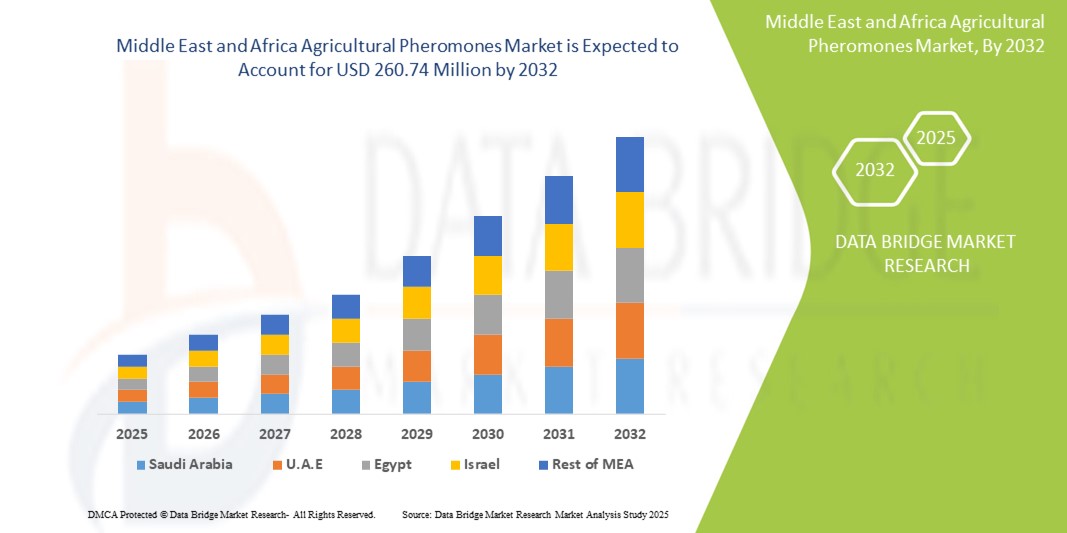
- The Middle East and Africa agricultural pheromones market size was valued at USD 103.08 million in 2024 and is expected to reach USD 260.74 million by 2032, at a CAGR of 12.30% during the forecast period
- The market growth is largely fuelled by the increasing adoption of integrated pest management (IPM) practices, growing awareness regarding the environmental and health hazards of chemical pesticides, and rising demand for sustainable crop protection methods across the region
- In addition, government initiatives promoting organic farming, coupled with rising agricultural exports and technological advancements in pheromone formulations, are contributing significantly to market expansion
Middle East and Africa Agricultural Pheromones Market Analysis
- The agricultural pheromones market in the Middle East and Africa is witnessing steady expansion due to increasing reliance on sustainable crop protection techniques
- Adoption of pheromone-based solutions is growing in high-value crops to reduce chemical pesticide use and improve crop quality
- South Africa dominated the Middle East and Africa agricultural pheromones market in 2024, driven by the country’s strong fruit and nut cultivation sector and its emphasis on sustainable farming practices
- Saudi Arabia is expected to witness the highest compound annual growth rate (CAGR) in the Middle East and Africa agricultural pheromones market due to increasing government initiatives to enhance agricultural productivity, adoption of modern farming technologies, and rising investment in protected farming systems such as greenhouses.
- The sex pheromones segment dominated the market in 2024 due to their high effectiveness in disrupting insect mating cycles, especially in date palm and citrus crops. Their targeted action and eco-safety make them a preferred pest control tool
Report Scope and Middle East and Africa Agricultural Pheromones Market Segmentation
|
Attributes |
Middle East and Africa Agricultural Pheromones Key Market Insights |
|
Segments Covered |
|
|
Countries Covered |
Middle East and Africa
|
|
Key Market Players |
National Agricultural Development Company – NADEC (Saudi Arabia)
|
|
Market Opportunities |
• Expansion of Organic Farming Practices in The Region • Rising Demand for Eco-Friendly Pest Management Solutions |
|
Value Added Data Infosets |
In addition to the insights on market scenarios such as market value, growth rate, segmentation, geographical coverage, and major players, the market reports curated by the Data Bridge Market Research also include import export analysis, production capacity overview, production consumption analysis, price trend analysis, climate change scenario, supply chain analysis, value chain analysis, raw material/consumables overview, vendor selection criteria, PESTLE Analysis, Porter Analysis, and regulatory framework. |
Middle East and Africa Agricultural Pheromones Market Trends
“Rising Shift Toward Mating Disruption Techniques in Crop Protection”
• Farmers in South Africa are increasingly adopting mating disruption techniques in vineyards to control grapevine moths without relying on chemical pesticides
• Technological innovations such as microencapsulated pheromone dispensers are enabling consistent and longer-lasting pest control in open-field tomato farms in Egypt
• The rising focus on sustainable agriculture is encouraging the shift toward pheromone-based pest management as a safer alternative to traditional insecticides
• Agricultural extension programs across the region are actively training farmers on the benefits and application of mating disruption in integrated pest management
• Leading companies are introducing species-specific pheromone formulations that improve effectiveness against pests such as codling moth in apples and tomato leafminer in vegetable crops
Middle East and Africa Agricultural Pheromones Market Dynamics
Driver
“Growing Adoption of Sustainable Agricultural Practices”
- Farmers in the Middle East and Africa are increasingly adopting eco-friendly pest control methods as part of sustainable agricultural practices
- Pheromone-based products offer a targeted, non-toxic solution by disrupting pest mating cycles instead of eliminating insects directly
- Rising global concerns over pesticide-related health and environmental hazards are pushing local governments to promote integrated pest management strategies
- The growth of organic farming and export-oriented horticulture has increased the demand for residue-free pest control alternatives
- For instance, organic date farms in the UAE have widely adopted pheromone traps to meet international export standards
- Training programs, field demonstrations, and improved access to advanced pheromone dispensers are playing a key role in encouraging adoption among farmers in the region
Restraint/Challenge
“Limited Awareness and Technical Knowledge”
- Adoption of agricultural pheromones in the Middle East and Africa is slowed by low awareness and limited technical know-how among small and medium farmers
- Many farmers do not fully understand how to correctly use pheromone traps or mating disruption systems, leading to underperformance and distrust
- Availability issues and poor distribution infrastructure make it difficult for remote areas to access these specialized products consistently
- High initial costs and the need for accurate placement and regular replacement discourage widespread use, especially among resource-limited growers
- For instance, smallholder maize farmers in Kenya often opt for cheaper chemical solutions
- Limited access to expert extension services and integrated pest management training keeps conventional pesticide use prevalent, highlighting the need for targeted education programs and support initiatives across the region
Middle East and Africa Agricultural Pheromones Market Scope
The agricultural pheromones market in the Middle East and Africa is segmented into type, product type, nature, mode of application, species, crop type, function, and distribution channel.
• By Type
On the basis of type, the agricultural pheromones market is segmented into sex pheromones, aggregation pheromones, repellent pheromones, and others. The sex pheromones segment dominated the market in 2024 due to their high effectiveness in disrupting insect mating cycles, especially in date palm and citrus crops. Their targeted action and eco-safety make them a preferred pest control tool.
The repellent pheromones segment is expected to witness the fastest growth rate from 2025 to 2032, supported by the increasing need for low-residue pest control. These pheromones are gaining popularity in vegetable farming for offering a natural deterrent against pest invasions.
• By Product Type
Based on product type, the agricultural pheromones market is segmented into spray, traps, dispensers, and others. The dispensers segment accounted for the largest share in 2024 due to their long duration of efficacy and slow-release properties, often used in orchards and vineyards.
The traps segment is expected to witness the fastest growth rate from 2025 to 2032, as farmers adopt low-maintenance pest monitoring systems. Traps are widely used in tomato and pepper cultivation due to their easy deployment and cost-effectiveness.
• By Nature
On the basis of nature, the agricultural pheromones market is segmented into synthetic and organic. The synthetic segment held the largest market share in 2024, driven by better product availability, affordability, and proven consistency across crops such as maize and cotton.
The organic segment is expected to witness the fastest growth rate from 2025 to 2032, with rising consumer demand for chemical-free food production. Organic pheromones are gaining adoption in certified organic farms producing fruits and vegetables.
• By Mode of Application
On the basis of mode of application, the agricultural pheromones market is segmented into dispensers, traps, spray, and others. The dispensers segment led the market in 2024 due to widespread usage in large-scale fruit farms, providing continuous release and reduced labor.
The spray segment is expected to witness the fastest growth rate from 2025 to 2032, driven by its application in cereal crops such as sorghum and millet where broad and uniform coverage is essential.
• By Species
Based on species, the agricultural pheromones market is segmented into codling moth, bollworms, fruit fly, leafrollers, and others. The fruit fly segment dominated the market in 2024, particularly in countries such as Egypt and South Africa where stone and citrus fruits are heavily cultivated.
The bollworms segment is expected to witness the fastest growth rate from 2025 to 2032, mainly in cotton-producing regions where resistance to chemical pesticides is rising.
• By Crop Type
On the basis of crop type, the agricultural pheromones market is segmented into field crops, orchard crops, vegetables, and others. Orchard crops held the largest share in 2024 due to strong adoption in citrus, mango, and pomegranate farms where mating disruption is commonly used.
The Vegetables is expected to witness the fastest growth rate from 2025 to 2032, supported by increasing greenhouse production in countries such as Kenya and Morocco, and the need for low-residue pest solutions.
• By Function
By function, the agricultural pheromones market is segmented into mating disruption, mass trapping, and detection and monitoring. The mating disruption segment dominated the market in 2024, widely used across fruit plantations to reduce insect reproduction and infestation levels.
Detection and monitoring is expected to witness the fastest growth rate from 2025 to 2032, supported by precision farming initiatives and increasing reliance on integrated pest management practices for pest tracking.
• By Distribution Channel
On the basis of distribution channel, the agricultural pheromones market is segmented into direct sales, retail sales, and online sales. Direct sales led the market in 2024 due to bulk purchases by commercial farms and long-term contracts with agricultural suppliers.
Online sales is expected to witness the fastest growth rate from 2025 to 2032, enabled by digital platforms improving product accessibility, particularly in remote regions and for smallholder farmers across the region.
Middle East and Africa Agricultural Pheromones Market Regional Analysis
• South Africa dominated the Middle East and Africa agricultural pheromones market in 2024, driven by the country’s strong fruit and nut cultivation sector and its emphasis on sustainable farming practices
• The demand for environmentally friendly pest control in vineyards, citrus farms, and stone fruit plantations is supporting the large-scale adoption of pheromone-based solutions across South Africa’s commercial agriculture landscape
Saudi Arabia Agricultural Pheromones Market Insight
Saudi is expected to witness the fastest growth rate from 2025 to 2032, supported by national initiatives promoting advanced farming methods and food security. The country's increasing investment in greenhouse agriculture and protected crop production is fueling the uptake of pheromone traps and mating disruption tools as safe and effective pest management alternatives
Middle East and Africa Agricultural Pheromones Market Share
The Middle East and Africa Agricultural Pheromones industry is primarily led by well-established companies, including:
- ICIPE – International Centre of Insect Physiology and Ecology (Kenya)
- Dudutech Integrated Pest Management (Kenya)
- Insect Science (Pty) Ltd (South Africa)
- Kenya Biologics Ltd (Kenya)
- National Agricultural Development Company – NADEC (Saudi Arabia)
- Arabian Agricultural Services Company – ARASCO (Saudi Arabia)

- Interactive Data Analysis Dashboard
- Company Analysis Dashboard for high growth potential opportunities
- Research Analyst Access for customization & queries
- Competitor Analysis with Interactive dashboard
- Latest News, Updates & Trend analysis
- Harness the Power of Benchmark Analysis for Comprehensive Competitor Tracking
Data collection and base year analysis are done using data collection modules with large sample sizes. The stage includes obtaining market information or related data through various sources and strategies. It includes examining and planning all the data acquired from the past in advance. It likewise envelops the examination of information inconsistencies seen across different information sources. The market data is analysed and estimated using market statistical and coherent models. Also, market share analysis and key trend analysis are the major success factors in the market report. To know more, please request an analyst call or drop down your inquiry.
The key research methodology used by DBMR research team is data triangulation which involves data mining, analysis of the impact of data variables on the market and primary (industry expert) validation. Data models include Vendor Positioning Grid, Market Time Line Analysis, Market Overview and Guide, Company Positioning Grid, Patent Analysis, Pricing Analysis, Company Market Share Analysis, Standards of Measurement, Global versus Regional and Vendor Share Analysis. To know more about the research methodology, drop in an inquiry to speak to our industry experts.
Data Bridge Market Research is a leader in advanced formative research. We take pride in servicing our existing and new customers with data and analysis that match and suits their goal. The report can be customized to include price trend analysis of target brands understanding the market for additional countries (ask for the list of countries), clinical trial results data, literature review, refurbished market and product base analysis. Market analysis of target competitors can be analyzed from technology-based analysis to market portfolio strategies. We can add as many competitors that you require data about in the format and data style you are looking for. Our team of analysts can also provide you data in crude raw excel files pivot tables (Fact book) or can assist you in creating presentations from the data sets available in the report.