


Middle East and Africa AI in Bioinformatics Market Overview
The Middle East and Africa AI in bioinformatics market was valued at USD 198.13 million in 2025 and is projected to reach USD 1,750.12 million by 2033, growing at a CAGR of 31.3% from 2026 to 2033. The market is witnessing steady growth driven by increasing investments in genomics research, expanding adoption of artificial intelligence in life sciences, and growing demand for precision medicine and data-driven healthcare solutions.
The rising prevalence of genetic disorders, cancer, and infectious diseases across the region, coupled with government initiatives supporting biotechnology innovation and digital health transformation, is encouraging research institutions, healthcare providers, and pharmaceutical companies to integrate AI-powered bioinformatics platforms. Advanced machine learning algorithms, cloud-based bioinformatics tools, and high-throughput sequencing technologies are increasingly being utilized to accelerate drug discovery, genomic analysis, biomarker identification, and personalized treatment development, enabling more efficient and accurate biological data interpretation.
Key Market Trends & Insights
- Saudi Arabia dominated the Middle East and Africa AI in bioinformatics market with the largest revenue share of 31.84% in 2025, supported by significant investments in genomics programs, biotechnology research, and national healthcare digitalization initiatives.
- The Software segment led the market with a 58.43% share in 2025, driven by the widespread adoption of AI-enabled bioinformatics platforms across genomics research, precision medicine, and pharmaceutical development activities.
- United Arab Emirates (UAE) is expected to be the fastest-growing country at a CAGR of 18.4% from 2026 to 2033, fueled by expanding precision medicine initiatives, growing AI adoption in healthcare, and increased investments in life sciences innovation.
- Services are the fastest-growing offering type, projected to register a CAGR of 19.2%, reflecting the surge in demand for outsourced bioinformatics expertise and AI implementation support.
- The Machine Learning segment dominated the vehicle type category with a 47.86% revenue share in 2025, led by its extensive use in disease prediction, genomic analysis, biomarker identification, and drug discovery applications.
- Bioinformatics Platforms accounted for 44.72% of the market, preferred by increasing demand for integrated solutions capable of storing, managing, and analyzing vast biological datasets.
- The Chemoinformatics & Drug Design segment is the fastest-growing application category, with a CAGR of 21.3%, driven by the increasing application of AI technologies in pharmaceutical research and development.
Market Size & Forecast
- Global Market Value (2025): USD 198.13 Million
- Expected Market Value (2033): USD 1,750.12 Million
- Forecast CAGR (2026–2033): 31.3%
- Leading Country in 2025: Saudi Arabia
- Fastest Growing Country: United Arab Emirates
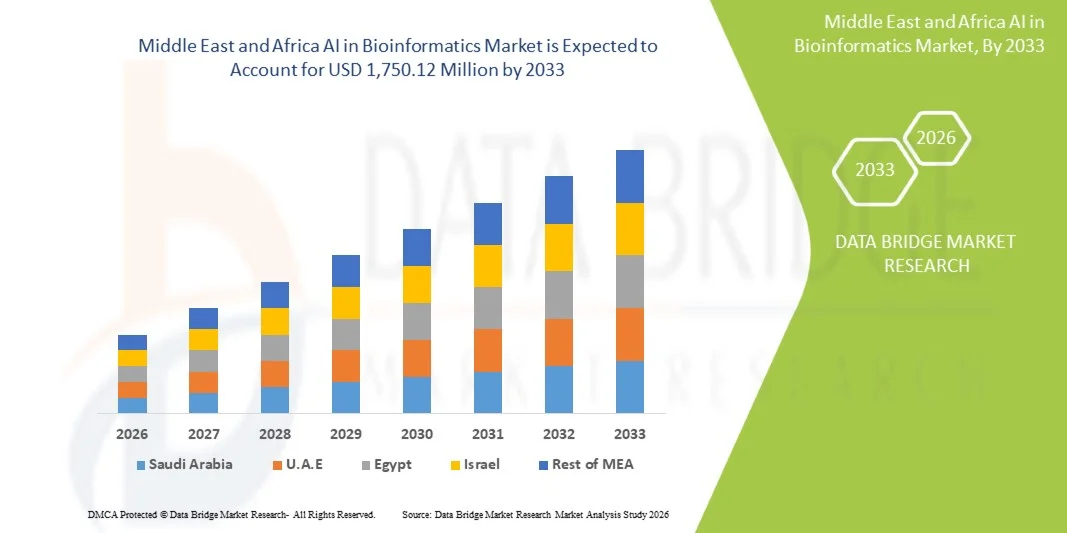
Report Scope and Middle East and Africa AI in Bioinformatics Market Segmentation
|
Attributes |
Middle East and Africa AI in Bioinformatics Key Market Insights |
|
Segments Covered |
|
|
Countries Covered |
Middle East and Africa · Saudi Arabia · U.A.E. · South Africa · Egypt · Israel · Rest of Middle East and Africa |
|
Key Market Players |
· Illumina, Inc. (U.S.) · Thermo Fisher Scientific Inc. (U.S.) · QIAGEN (Netherlands) · Agilent Technologies, Inc. (U.S.) · PerkinElmer (U.S.) · DNAnexus, Inc. (U.S.) · Partek Incorporated (U.S.) · SOPHiA GENETICS SA (Switzerland) · Geneious Prime (New Zealand) · Biomatters Ltd. (New Zealand) · BGI Group (China) · GeneGo Inc. (U.S.) · Genedata AG (Switzerland) · Insilico Medicine Hong Kong Limited (Hong Kong) · BenevolentAI (U.K.) · Oxford Nanopore Technologies plc (U.K.) · Fabric Genomics, Inc. (U.S.) · Tempus AI, Inc. (U.S.) · L7 Informatics, Inc. (U.S.) · Seven Bridges Genomics Inc. (U.S.) |
|
Market Opportunities |
· Expansion of precision medicine programs · Increasing adoption of AI in drug discovery · Growth of cross-border genomic data sharing initiatives |
|
Value Added Data Infosets |
In addition to the insights on market scenarios such as market value, growth rate, segmentation, geographical coverage, and major players, the market reports curated by the Data Bridge Market Research also include in-depth expert analysis, patient epidemiology, pipeline analysis, pricing analysis, and regulatory framework. |
Middle East and Africa AI in Bioinformatics Market Trends
Trend: Expansion of AI-Driven Genomics and Precision Medicine Programs
Healthcare organizations, research institutes, and biotechnology companies across the Middle East and Africa are increasingly adopting AI-powered bioinformatics platforms to accelerate genomic analysis, identify disease-associated biomarkers, and support precision medicine initiatives. The integration of machine learning algorithms enables faster interpretation of large-scale biological datasets, improving diagnostic accuracy and therapeutic decision-making. National genome projects and collaborative research programs are similarly leveraging advanced bioinformatics tools to strengthen population health studies, while cloud computing technologies provide scalable environments that facilitate efficient data processing and cross-border scientific collaboration. For instance, in February 2025, Qatar Genome Programme expanded its AI-enabled genomic data analysis capabilities to accelerate precision medicine research and population-scale genetic studies.
Middle East and Africa AI in Bioinformatics Market Dynamics
Key Market Driver: Rising Investments in Genomics Research and Precision Healthcare
The rapid expansion of genomics initiatives and precision healthcare programs has created substantial demand for AI-powered bioinformatics solutions that can analyze complex biological datasets, identify genetic variations, and support personalized treatment development. Healthcare providers, research institutions, pharmaceutical companies, and government agencies are deploying advanced bioinformatics platforms as a core component of their research and clinical workflows, reducing analysis time, improving data accuracy, and accelerating discoveries in disease diagnosis, drug development, and translational medicine.
For instance, in October 2023, Department of Health – Abu Dhabi announced initiatives supporting genomics and precision medicine programs that rely on advanced AI-driven data analysis technologies.
Key Restraint/Challenge: Limited Bioinformatics Infrastructure and Skilled Workforce Availability
A significant restraint in the Middle East and Africa AI in bioinformatics market is the limited availability of advanced computational infrastructure and experienced bioinformatics professionals. Modern AI-driven bioinformatics platforms require high-performance computing resources, specialized software environments, and multidisciplinary expertise in biology, data science, and artificial intelligence, demanding considerable investment in technology and workforce development. The challenge extends to ongoing system upgrades, data management requirements, and technical training programs, making widespread adoption difficult for smaller research institutions, universities, and healthcare organizations across developing markets.
For instance, the continued concentration of advanced genomic computing facilities within a limited number of research hubs across the region highlights the broader challenge of scaling AI-enabled bioinformatics capabilities beyond well-funded organizations.
Key Market Opportunity: Adoption of AI for Drug Discovery and Multi-Omics Data Analysis
The integration of artificial intelligence into bioinformatics workflows presents a significant market opportunity. AI-enabled platforms can accelerate target identification, predict molecular interactions, and support comprehensive analysis of genomics, proteomics, and transcriptomics datasets. The development of cloud-based bioinformatics ecosystems and collaborative research networks is further expanding access to advanced analytical capabilities, opening growth opportunities across pharmaceutical research, academic institutions, and healthcare systems throughout the Middle East and Africa. For instance, in June 2024, Mohammed Bin Rashid University of Medicine and Health Sciences expanded collaborations focused on genomics and AI-assisted biomedical research, supporting the advancement of data-driven healthcare innovation in the region.
Middle East and Africa AI in Bioinformatics Market Scope
The Middle East and Africa AI in bioinformatics market is segmented on the basis of offering, type, products and services, application, and sector.
- By Offering
On the basis of offering, the Middle East and Africa AI in bioinformatics market is segmented into software, services, and others. The Software segment dominated the market with a 58.43% share in 2025, owing to the widespread adoption of AI-enabled bioinformatics platforms across genomics research, precision medicine, and pharmaceutical development activities. These solutions provide advanced capabilities for biological data management, predictive analytics, and large-scale genomic interpretation. Research institutions increasingly depend on software platforms to improve workflow efficiency and accelerate discoveries. Integration of machine learning algorithms with sequencing technologies is enhancing analytical accuracy. Growing investments in digital health infrastructure and biotechnology innovation are further supporting demand. The scalability and flexibility of software-based solutions continue to strengthen their leadership position across the regional market.
The Services segment is projected to register the fastest growth at a CAGR of 19.2% from 2026 to 2033, driven by rising demand for outsourced bioinformatics expertise and AI implementation support. Many healthcare organizations and research centers lack specialized in-house capabilities to manage complex biological datasets. Service providers offer consulting, data interpretation, workflow optimization, and customized analytical solutions. Growing collaborations between biotechnology companies and academic institutions are increasing service adoption. Expanding genomics projects and precision medicine initiatives are further accelerating demand. The increasing complexity of bioinformatics research is expected to create sustained opportunities for service providers throughout the forecast period.
- By Type
On the basis of type, the Middle East and Africa AI in bioinformatics market is segmented into machine learning, deep learning, and others. The Machine Learning segment dominated the market with a 47.86% share in 2025, driven by its extensive use in disease prediction, genomic analysis, biomarker identification, and drug discovery applications. Machine learning models enable researchers to identify patterns within large biological datasets more efficiently than conventional analytical methods. The technology is widely utilized across healthcare institutions, biotechnology firms, and academic research organizations. Increasing investment in precision medicine programs is strengthening demand for machine learning tools. These solutions also help improve predictive accuracy and reduce research timelines. Their versatility and broad applicability continue to support market leadership.
The Deep Learning segment is anticipated to witness the fastest growth at a CAGR of 20.1% from 2026 to 2033, owing to its superior capability in processing complex and high-dimensional biological datasets. Deep learning algorithms are increasingly used for protein structure prediction, molecular modeling, and multi-omics analysis. Advances in computing infrastructure and cloud-based AI environments are facilitating broader adoption. Pharmaceutical companies are leveraging deep learning to accelerate therapeutic development and target identification. The technology supports improved accuracy in complex biological interpretations. Rising demand for personalized healthcare and advanced drug discovery solutions is expected to drive significant growth.
- By Products and Services
On the basis of products and services, the Middle East and Africa AI in bioinformatics market is segmented into knowledge management tools, bioinformatics platforms, and bioinformatics services. The Bioinformatics Platforms segment dominated the market with a 44.72% share in 2025, owing to increasing demand for integrated solutions capable of storing, managing, and analyzing vast biological datasets. These platforms support genomics research, sequencing analysis, drug development, and precision medicine initiatives. Their ability to combine multiple analytical tools within a single environment improves operational efficiency and research productivity. Academic institutions and pharmaceutical companies are increasingly adopting comprehensive platform solutions. Continuous technological advancements are improving performance and scalability. Growing investments in biotechnology research are further strengthening segment growth.
The Bioinformatics Services segment is projected to register the fastest growth at a CAGR of 19.5% from 2026 to 2033, driven by increasing reliance on external expertise for advanced biological data analysis. Organizations are seeking specialized service providers to manage large-scale genomic projects and AI-driven research programs. These services help reduce infrastructure costs and improve analytical efficiency. Rising demand for customized solutions and project-specific support is supporting market expansion. Growth in clinical research and biotechnology innovation is creating additional opportunities. Increasing complexity of multi-omics datasets is expected to sustain long-term demand for bioinformatics services.
- By Application
On the basis of application, the Middle East and Africa AI in bioinformatics market is segmented into genomics, microarrays, system biology, text mining, chemoinformatics & drug design, proteomics, transcriptomics, DNA sequencing, metabolomics, and others. The Genomics segment led the market with a 29.68% share in 2025, driven by growing investments in genome sequencing projects and precision medicine programs. AI-powered bioinformatics tools are extensively used to identify genetic variations, disease-associated biomarkers, and therapeutic targets. Governments and healthcare organizations are increasingly supporting genomics-based healthcare initiatives. Advances in next-generation sequencing technologies are generating larger volumes of biological data requiring sophisticated analytical solutions. Genomics remains a key focus area for biotechnology research across the region. Its critical role in personalized medicine continues to support segment dominance.
The Chemoinformatics & Drug Design segment is expected to witness the fastest growth at a CAGR of 21.3% from 2026 to 2033, owing to the increasing application of AI technologies in pharmaceutical research and development. These solutions enable rapid identification of potential drug candidates and prediction of molecular interactions. AI-driven drug design significantly reduces development costs and accelerates research timelines. Pharmaceutical companies are increasingly investing in computational drug discovery platforms. Growing focus on targeted therapies and precision medicine is further supporting adoption. Expanding biotechnology research activities across the region are expected to drive continued growth.
- By Sector
On the basis of sector, the Middle East and Africa AI in bioinformatics market is segmented into medical biotechnology, animal biotechnology, plant biotechnology, environmental biotechnology, forensic biotechnology, and others. The Medical Biotechnology segment dominated the market with a 51.24% share in 2025, driven by extensive use of AI-powered bioinformatics solutions in disease diagnosis, genomic medicine, and drug development. Healthcare organizations are increasingly adopting advanced analytical tools to improve treatment outcomes and accelerate biomedical research. Rising prevalence of chronic diseases and genetic disorders is encouraging investment in innovative healthcare technologies. Government initiatives supporting healthcare modernization are also contributing to growth. Advances in sequencing and computational biology are increasing demand for sophisticated analytical platforms. The segment remains the largest contributor to overall market revenue.
The Environmental Biotechnology segment is projected to register the fastest growth at a CAGR of 18.7% from 2026 to 2033, owing to growing interest in environmental monitoring, sustainability research, and biodiversity conservation programs. AI-enabled bioinformatics tools are increasingly used to analyze environmental DNA, microbial populations, and ecosystem health indicators. Governments and research institutions are investing in advanced technologies to address climate and environmental challenges. These solutions support efficient assessment of pollution, natural resources, and ecological changes. Increasing awareness regarding sustainable development is boosting adoption. Expanding environmental research initiatives across the region are expected to create significant growth opportunities for this segment.
Middle East and Africa AI in Bioinformatics Market Regional Analysis
Saudi Arabia dominated the Middle East and Africa AI in bioinformatics market with the largest revenue share of 31.84% in 2025, supported by significant investments in genomics programs, biotechnology research, and national healthcare digitalization initiatives. The country also benefits from strong government support for healthcare digitalization, increasing adoption of artificial intelligence in life sciences, and the presence of large-scale national genome programs. Growing utilization of AI-powered bioinformatics platforms across genomic analysis, drug discovery, and clinical research applications continues to accelerate market growth. Rising focus on personalized healthcare, biomedical innovation, and advanced data analytics further strengthens Saudi Arabia’s leadership position in the regional market.
The Saudi Arabia AI in Bioinformatics Market Insight
The Saudi Arabia AI in Bioinformatics market is witnessing strong growth due to rising investments in genomics research programs, precision medicine initiatives, and biotechnology innovation. The country’s expanding healthcare infrastructure, along with increasing adoption of artificial intelligence, machine learning, and cloud-based bioinformatics platforms, is driving demand across research, clinical, and pharmaceutical applications. In addition, growing emphasis on personalized healthcare, national genome projects, and advanced disease diagnostics is accelerating the adoption of AI-powered bioinformatics solutions across healthcare institutions and research organizations.
United Arab Emirates (UAE) AI in Bioinformatics Market Insight
The UAE AI in Bioinformatics market is experiencing steady growth, supported by increasing adoption of advanced technologies in healthcare research, genomics, and biotechnology applications. Rising investments in precision medicine programs and growing demand for efficient biological data analysis solutions are contributing to market growth. Furthermore, integration of artificial intelligence, machine learning, and cloud computing technologies is improving research efficiency and accelerating innovation, positioning the UAE as a key biotechnology and healthcare innovation hub in the region.
South Africa AI in Bioinformatics Market Insight
The South Africa AI in Bioinformatics market is expanding steadily due to the country’s strong research ecosystem, increasing healthcare modernization efforts, and growing utilization of advanced analytical technologies. Research institutions, universities, and healthcare organizations are increasingly adopting AI-powered bioinformatics solutions for genomic studies, disease research, and drug development activities. Continuous advancements in computational biology, increasing investments in life sciences research, and growing focus on precision healthcare are further supporting market growth in South Africa.
Kuwait AI in Bioinformatics Market Insight
The Kuwait AI in Bioinformatics market is growing steadily, driven by increasing healthcare digitalization, expanding biotechnology research activities, and rising government support for innovation in medical sciences. Growing adoption of AI-powered bioinformatics tools across healthcare and academic institutions is improving biological data analysis and research efficiency. In addition, increasing focus on precision medicine, disease prevention strategies, and advanced healthcare infrastructure development is supporting market growth.
Middle East and Africa AI in Bioinformatics Market Share
The Middle East and Africa AI in bioinformatics industry is primarily led by well-established companies, including:
- Illumina, Inc. (U.S.)
- Thermo Fisher Scientific Inc. (U.S.)
- QIAGEN (Netherlands)
- Agilent Technologies, Inc. (U.S.)
- PerkinElmer (U.S.)
- DNAnexus, Inc. (U.S.)
- Partek Incorporated (U.S.)
- SOPHiA GENETICS SA (Switzerland)
- Geneious Prime (New Zealand)
- Biomatters Ltd. (New Zealand)
- BGI Group (China)
- GeneGo Inc. (U.S.)
- Genedata AG (Switzerland)
- Insilico Medicine Hong Kong Limited (Hong Kong)
- BenevolentAI (U.K.)
- Oxford Nanopore Technologies plc (U.K.)
- Fabric Genomics, Inc. (U.S.)
- Tempus AI, Inc. (U.S.)
- L7 Informatics, Inc. (U.S.)
- Seven Bridges Genomics Inc. (U.S.)
Latest Developments in Middle East and Africa AI in Bioinformatics Market
- In December 2024, Sidra Medicine concluded its Precision Medicine and the Future of Genomics (PMFG 2024) Summit in Doha, bringing together global experts to discuss advancements in genomics, biomedical innovation, and precision medicine. The event highlighted Qatar’s growing role as a biomedical innovation hub and emphasized the integration of AI, genomic analytics, and bioinformatics technologies to support next-generation healthcare research and personalized medicine initiatives across the region
- In June 2024, NVIDIA signed an agreement with Ooredoo to deploy advanced AI infrastructure across data centers in Qatar, Oman, Kuwait, and other regional markets. The deployment provides organizations with access to high-performance AI computing resources that can support computational biology, genomic research, bioinformatics workflows, and large-scale life sciences data analysis. The initiative significantly strengthens the AI infrastructure available for bioinformatics applications across the Middle East
- In May 2024, the Qatar Precision Health Institute was officially launched by Qatar Foundation to accelerate precision medicine and genomics research using advanced data analytics, genomics, and AI-driven bioinformatics capabilities. The institute builds on more than a decade of genomics research through the Qatar Genome Programme and aims to translate large-scale genomic and multi-omics data into personalized healthcare solutions for the Arab population. This development strengthens the region’s bioinformatics ecosystem and expands opportunities for AI-enabled genomic analysis and precision medicine research
- In August 2023, researchers from the AI and Bioinformatics Department at King Abdullah International Medical Research Center published research assessing the use of bioinformatics in genome research across Saudi Arabia. The study highlighted increasing adoption of bioinformatics technologies and the growing importance of AI-driven genomic analysis within the Kingdom’s expanding precision medicine and genomics ecosystem. The findings reflected rising institutional investment in bioinformatics capabilities and workforce development
- In March 2022, the African BioGenome Project expanded efforts to sequence and analyze the genomes of Africa’s biodiversity while simultaneously building genomics and bioinformatics capacity across the continent. The initiative brought together African scientists and institutions to strengthen genomic data generation, computational biology capabilities, and bioinformatics infrastructure. The project represents a major advancement for AI-enabled genomic research and biological data analysis across Africa

- Interactive Data Analysis Dashboard
- Company Analysis Dashboard for high growth potential opportunities
- Research Analyst Access for customization & queries
- Competitor Analysis with Interactive dashboard
- Latest News, Updates & Trend analysis
- Harness the Power of Benchmark Analysis for Comprehensive Competitor Tracking
Data collection and base year analysis are done using data collection modules with large sample sizes. The stage includes obtaining market information or related data through various sources and strategies. It includes examining and planning all the data acquired from the past in advance. It likewise envelops the examination of information inconsistencies seen across different information sources. The market data is analysed and estimated using market statistical and coherent models. Also, market share analysis and key trend analysis are the major success factors in the market report. To know more, please request an analyst call or drop down your inquiry.
The key research methodology used by DBMR research team is data triangulation which involves data mining, analysis of the impact of data variables on the market and primary (industry expert) validation. Data models include Vendor Positioning Grid, Market Time Line Analysis, Market Overview and Guide, Company Positioning Grid, Patent Analysis, Pricing Analysis, Company Market Share Analysis, Standards of Measurement, Global versus Regional and Vendor Share Analysis. To know more about the research methodology, drop in an inquiry to speak to our industry experts.
Data Bridge Market Research is a leader in advanced formative research. We take pride in servicing our existing and new customers with data and analysis that match and suits their goal. The report can be customized to include price trend analysis of target brands understanding the market for additional countries (ask for the list of countries), clinical trial results data, literature review, refurbished market and product base analysis. Market analysis of target competitors can be analyzed from technology-based analysis to market portfolio strategies. We can add as many competitors that you require data about in the format and data style you are looking for. Our team of analysts can also provide you data in crude raw excel files pivot tables (Fact book) or can assist you in creating presentations from the data sets available in the report.













