


What is the Middle East and Africa Airless Dispenser Market Size and Growth Rate?
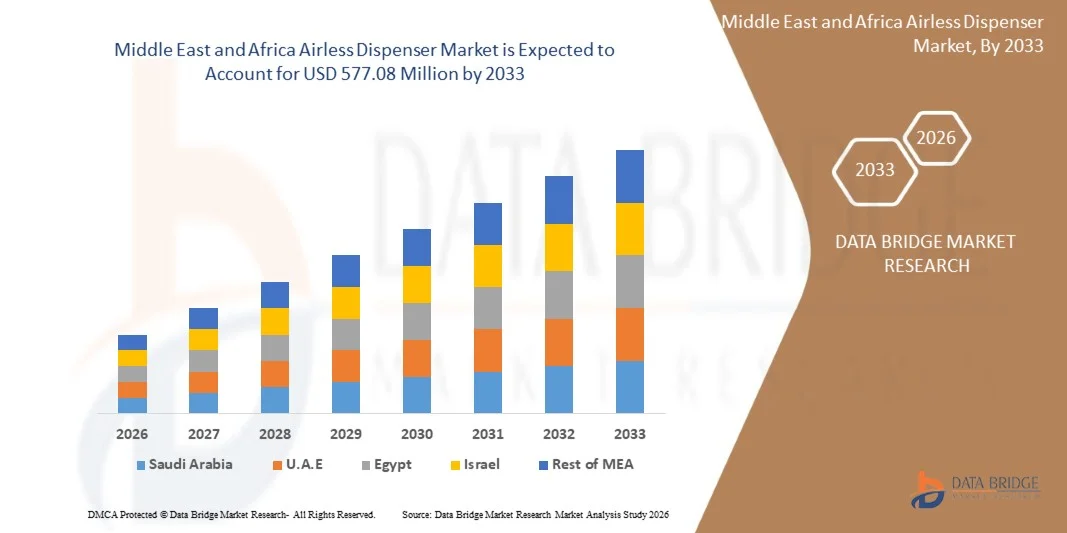
- As per Data Bridge Market Research Analysis the Middle East and Africa Airless Dispenser Market size was valued at USD 384.69 million in 2025 and is expected to reach USD 577.08 million by 2033, at a CAGR of 5.20% during the forecast period.
- The market growth is largely driven by increasing consumer preference for hygiene-focused and contamination-free packaging, along with advancements in airless dispenser technology that improve product preservation and user experience.
- Furthermore, rising demand from the personal care, pharmaceutical, and cosmetic industries for sustainable, convenient, and premium packaging solutions is positioning airless dispensers as the preferred choice. These factors are accelerating market adoption, thereby significantly boosting the industry's growth.
Market Size and Forecast:
- Global Market Value (2025): USD 384.69 million
- Expected Market Value (2033): USD 577.08 million
- Forecast CAGR (2026–2033): 5.20%
How Middle East and Africa Airless Dispenser Market Analysed?
- Airless dispensers, providing contamination-free and precise product delivery, are increasingly essential in personal care, pharmaceutical, and cosmetic packaging due to their ability to preserve product integrity, extend shelf life, and enhance user convenience.
- The rising demand for airless dispensers is primarily driven by consumer preference for hygiene-focused, sustainable, and premium packaging solutions, along with growing awareness of product safety and efficiency.
- U.A.E. dominated the Middle East and Africa Airless Dispenser Market with the largest revenue share of 32.2% in 2025, attributed to high consumer awareness of premium packaging, strong presence of leading personal care and pharmaceutical brands, and rapid adoption of innovative dispensing technologies, with the U.S. witnessing significant integration of airless dispensers in skincare and pharmaceutical products due to advancements in pump design and material innovation.
- Saudi Arabia is expected to be the fastest-growing region in the Middle East and Africa Airless Dispenser Market during the forecast period, supported by increasing urbanization, rising disposable incomes, and a growing preference for luxury and hygiene-focused products.
- The pumps segment dominated the market with the largest revenue share of 46.5% in 2025, driven by its widespread adoption across cosmetic and personal care products, ease of use, and compatibility with various formulations.
Report Scope and Middle East and Africa Airless Dispenser Market Segmentation
|
Attributes |
Airless Dispenser Key Market Insights |
|
Segments Covered |
|
|
Countries Covered |
Middle East and Africa
|
|
Key Market Players |
|
|
Market Opportunities |
|
|
Value Added Data Infosets |
In addition to the insights on market scenarios such as market value, growth rate, segmentation, geographical coverage, and major players, the market reports curated by the Data Bridge Market Research also include import export analysis, production capacity overview, production consumption analysis, price trend analysis, climate change scenario, supply chain analysis, value chain analysis, raw material/consumables overview, vendor selection criteria, PESTLE Analysis, Porter Analysis, and regulatory framework. |
What are the Middle East and Africa Airless Dispenser Market Trends?
“Enhanced User Experience Through Smart and Automated Dispensing”
- A significant and accelerating trend in the Middle East and Africa Airless Dispenser Market is the increasing adoption of smart and automated dispensing technologies that optimize product delivery, minimize waste, and enhance user convenience. These systems are increasingly being integrated with IoT-enabled devices and mobile applications, allowing users to control and monitor product usage remotely.
- For instance, certain premium skincare airless dispensers now come with Bluetooth connectivity and companion apps, enabling users to track product usage, set dosage limits, and receive refill alerts. Similarly, some pharmaceutical airless dispensers allow caregivers to monitor medication dispensing schedules in real time, improving adherence and safety.
- Smart integration enables features such as automated portion control, usage pattern analysis, and personalized dispensing recommendations. For example, some cosmetic brands are introducing airless dispensers that adjust the amount of product dispensed based on the user’s historical usage, helping to reduce product wastage and optimize user experience.
- The integration of airless dispensers with digital platforms and mobile apps facilitates centralized control and monitoring, allowing users to manage multiple dispensers across household or commercial settings through a single interface. This creates a more connected, automated, and efficient experience for both consumers and businesses.
- This trend toward intelligent, automated, and connected dispensing solutions is fundamentally reshaping user expectations for hygiene, convenience, and product sustainability. Consequently, companies such as Albea, Amcor, and Berry Global are developing smart airless dispensers with app-enabled monitoring, customizable dosing, and IoT connectivity to meet rising consumer demand.
- The demand for airless dispensers with smart and automated features is growing rapidly across the personal care, pharmaceutical, and cosmetic sectors, as consumers increasingly prioritize hygiene, convenience, and sustainable usage.
Middle East and Africa Airless Dispenser Market Dynamics
Driver
“Growing Need Due to Hygiene, Product Safety, and Premiumization”
- The increasing consumer focus on hygiene, product preservation, and premium packaging solutions is a significant driver for the heightened demand for airless dispensers in the Middle East and Africa.
- For instance, in 2025, Amcor introduced advanced airless pump technology for skincare and pharmaceutical products that minimizes contamination and maximizes product shelf life. Such innovations by key companies are expected to accelerate market growth during the forecast period.
- As consumers become more aware of product contamination risks and seek better preservation of sensitive formulations, airless dispensers offer advanced features such as vacuum-sealed pumping mechanisms, precise dosing, and airtight sealing, providing a compelling upgrade over traditional packaging solutions.
- Furthermore, the growing popularity of premium cosmetics, skincare, and pharmaceutical products is driving the adoption of airless dispensers, as these systems offer a sophisticated, user-friendly, and sustainable packaging option that aligns with brand positioning and consumer expectations.
- The convenience of precise product dispensing, extended shelf life, and reduction of product waste are key factors propelling the adoption of airless dispensers across personal care, pharmaceutical, and cosmetic sectors. The trend towards eco-friendly and refillable designs, along with increasing availability of affordable options, further contributes to market growth.
Restraint/Challenge
“Concerns Regarding High Production Costs and Material Limitations”
- High production costs and limitations related to materials used in airless dispensers pose significant challenges to broader market adoption. Manufacturing airless systems with high-quality, durable, and chemical-resistant components can be expensive, impacting product pricing.
- For instance, premium airless dispensers with multi-layered pump mechanisms and UV-protective materials often come at a higher cost, limiting adoption in price-sensitive regions.
- Addressing these challenges through cost-efficient production methods, use of recyclable or sustainable materials, and innovation in dispenser design is crucial for wider consumer acceptance. Companies such as Albea, Amcor, and Berry Global emphasize material innovation and durability in their products to enhance consumer confidence.
- While prices for basic airless dispensers are gradually decreasing, the perceived premium for advanced, high-performance systems can still hinder widespread adoption, especially in emerging markets or among cost-conscious consumers.
- Overcoming these challenges through innovation in affordable, sustainable, and high-quality airless dispenser solutions will be vital for sustained growth in the Middle East and Africa market.
Middle East and Africa Airless Dispenser Market Scope
The airless dispenser market is segmented into five notable segments which are based on the product type, material, packaging type, distribution channel and end-user.
• By Product Type
On the basis of product type, the market is segmented into pumps, twist & click, and droppers. The pumps segment dominated the market with the largest revenue share of 46.5% in 2025, driven by its widespread adoption across cosmetic and personal care products, ease of use, and compatibility with various formulations. Pumps offer precise dosing, hygienic dispensing, and minimal product wastage, making them highly preferred by consumers and manufacturers alike.
The twist & click segment is expected to witness the fastest CAGR of 22.1% from 2026 to 2033, fueled by rising adoption in premium skincare and serums where innovative and aesthetically pleasing packaging is prioritized. The convenience of one-handed operation and modern design features also support its increasing popularity.
• By Material
On the basis of material, the market is segmented into plastic, glass, metal, and others. The plastic segment accounted for the largest market revenue share of 52.3% in 2025, attributed to its lightweight nature, cost-effectiveness, and versatility across cosmetic, pharmaceutical, and food applications. Plastic dispensers also allow for easier customization in terms of color, shape, and branding, appealing to manufacturers targeting mass-market consumers.
The glass segment is expected to register the fastest CAGR of 21.8% from 2026 to 2033, driven by premium product lines in cosmetics and skincare that emphasize luxury, sustainability, and recyclability. Glass provides an eco-friendly alternative and enhances product perception for high-end consumers.
• By Packaging Type
On the basis of packaging type, the market is segmented into bottles, jars, and tubes. The bottles segment dominated the market with a revenue share of 48.7% in 2025, largely due to its suitability for liquid and semi-liquid products such as lotions, serums, and hand sanitizers. Bottles also support advanced dispensing mechanisms and preserve product integrity by preventing contamination.
The tubes segment is projected to witness the fastest CAGR of 23.0% from 2026 to 2033, driven by rising demand in travel-size and personal care products that prioritize convenience, portability, and minimal spillage. Flexible tube designs also support innovative branding and sustainable packaging trends.
• By Distribution Channel
On the basis of distribution channel, the market is segmented into cosmetic stores, pharmacies, supermarkets/hypermarkets, e-commerce, specialty stores, and others. The cosmetic stores segment held the largest market revenue share of 40.2% in 2025, due to the high visibility of premium cosmetic and skincare brands and direct consumer engagement in physical stores.
The e-commerce segment is expected to witness the fastest CAGR of 25.5% from 2025 to 2032, fueled by growing online shopping trends, increased digital marketing by brands, and convenience of doorstep delivery. The proliferation of online marketplaces and direct-to-consumer platforms further supports rapid growth in this segment.
• By End-User
On the basis of end-user, the market is segmented into cosmetics, medical, food & beverages, and others. The cosmetics segment dominated the market with a revenue share of 55.1% in 2025, driven by the increasing adoption of skincare, haircare, and personal care products that require hygienic and efficient dispensing solutions.
The medical segment is anticipated to witness the fastest CAGR of 22.7% from 2026 to 2033, driven by rising demand for contamination-free dispensing in pharmaceutical formulations, vaccines, and therapeutic liquids. Stringent regulatory requirements for hygiene and precise dosing further accelerate adoption in healthcare applications.
Middle East and Africa Airless Dispenser Market Regional Analysis
- U.A.E. dominated the airless dispenser market with the largest revenue share of 32.2% in 2025, driven by rising demand for premium cosmetic and personal care products, increasing awareness of hygienic packaging, and growing adoption of innovative dispensing solutions.
- Consumers in the region increasingly prefer airless dispensers for their ability to maintain product integrity, prevent contamination, and provide precise dosing, especially in skincare, cosmetics, and medical applications.
- This widespread adoption is further supported by expanding urbanization, higher disposable incomes in key countries, and the rising popularity of e-commerce and organized retail channels, establishing airless dispensers as a preferred packaging solution for both mass-market and luxury products.
Saudi Arabia Airless Dispenser Market Insight
The Saudi Arabia airless dispenser market captured the largest revenue share of 35% in 2025 within the Middle East, driven by rising consumer demand for premium skincare, cosmetic, and personal care products. Consumers are increasingly prioritizing hygienic and contamination-free packaging solutions that preserve product efficacy. The presence of international beauty brands, coupled with the growth of e-commerce and modern retail channels, is further propelling market expansion. Additionally, government initiatives promoting health, hygiene, and quality standards in personal care products are supporting the adoption of airless dispensers in both retail and professional applications such as dermatology clinics and luxury spas.
U.A.E. Airless Dispenser Market Insight
The U.A.E. airless dispenser market is anticipated to grow at a substantial CAGR during the forecast period, fueled by high consumer preference for luxury cosmetics, skincare products, and hygienic packaging. Rapid urbanization, a tech-savvy population, and flourishing e-commerce and retail infrastructure are facilitating market adoption. Airless dispensers are increasingly favored for premium products due to their ability to provide precise dosing, maintain product integrity, and offer a premium user experience. The country’s strong tourism and hospitality sectors also contribute to market demand.
South Africa Airless Dispenser Market Insight
The South Africa airless dispenser market is poised for steady growth, driven by the rising adoption of personal care and cosmetic products and growing awareness of hygiene and product safety. Expanding organized retail networks, pharmacies, and e-commerce platforms, along with increasing disposable incomes, are supporting market penetration. Airless dispensers are particularly popular in skincare, medical, and cosmetic segments, where product preservation, contamination prevention, and convenience are critical. The demand is also bolstered by increasing interest in eco-friendly and reusable packaging solutions.
Egypt Airless Dispenser Market Insight
The Egypt airless dispenser market is expected to witness significant growth during the forecast period, driven by increasing awareness of hygiene and contamination-free packaging, coupled with the growing consumption of cosmetic and personal care products. Rising urbanization, expanding retail channels, and the growth of e-commerce platforms are enabling wider market access. Airless dispensers are particularly gaining traction in skincare, pharmaceutical, and premium cosmetic applications, where product preservation and precise dispensing are essential. The increasing adoption of modern and imported beauty products is further boosting demand in the country.
Which are the Top Companies in Middle East and Africa Airless Dispenser Market?
The Airless Dispenser industry is primarily led by well-established companies, including:
- AptarGroup (U.S.)
- Albéa (France)
- Amcor plc (Switzerland)
- Gerresheimer AG (Germany)
- ALPLA Group (Austria)
- SGD Pharma (France)
- Berry Global, Inc. (U.S.)
- WestRock Company (U.S.)
- RPC Group (U.K.)
- Silgan Holdings Inc. (U.S.)
- Pack Plus Co. Ltd. (India)
- O.Berk Company (U.S.)
- Quadpack Industries S.A. (Spain)
- Cosmopak Ltd. (U.K.)
- Can-Pack S.A. (Poland)
- Reverdia (Netherlands)
- Airless Co. Ltd. (China)
- Zibo Pack Technology (China)
- Aptar Beauty + Home (U.S.)
- Nipro Corporation (Japan)
What are the Recent Developments in Middle East and Africa Airless Dispenser Market?
- In April 2024, LuxAsia Cosmetics launched its new line of airless dispensers in the UAE, designed to enhance product hygiene and shelf life for premium skincare and cosmetic brands. The initiative underscores the company’s commitment to providing innovative packaging solutions that preserve product efficacy while elevating the consumer experience. By leveraging advanced dispensing technology, LuxAsia aims to meet the growing demand for contamination-free, user-friendly packaging in the rapidly expanding Middle East and Africa airless dispenser market.
- In March 2024, ProPack Solutions, a regional packaging manufacturer based in Saudi Arabia, introduced its Twist & Click airless dispenser series for medical and cosmetic applications. The dispensers feature precise dosing mechanisms and durable materials, catering to both commercial and residential customers. This development highlights ProPack’s focus on delivering high-quality, hygienic packaging solutions that align with market trends favoring premium and sustainable products.
- In March 2024, Cosmetix Innovations deployed a new airless dispenser system for Egypt’s growing skincare market, aiming to improve product protection and enhance user convenience. The initiative demonstrates Cosmetix’s commitment to providing innovative, safe, and eco-conscious packaging solutions for a range of cosmetic and personal care products, responding to rising consumer demand for hygiene-focused dispensers.
- In February 2024, Afripack LLC, a leading supplier of airless dispensers in South Africa, announced a strategic partnership with leading beauty retailers to expand the adoption of airless packaging in both cosmetics and skincare segments. This collaboration is designed to improve product accessibility, ensure contamination-free dispensing, and support the distribution of high-end personal care products.
- In January 2024, GlamorTech, a global packaging solutions provider, launched its premium glass airless dispenser collection in Saudi Arabia, featuring sustainable materials and a sleek design aimed at luxury cosmetics brands. This launch highlights GlamorTech’s focus on innovation, sustainability, and consumer convenience, providing brands with differentiated, hygienic, and aesthetically appealing packaging options in the Middle East and Africa market.

- Interactive Data Analysis Dashboard
- Company Analysis Dashboard for high growth potential opportunities
- Research Analyst Access for customization & queries
- Competitor Analysis with Interactive dashboard
- Latest News, Updates & Trend analysis
- Harness the Power of Benchmark Analysis for Comprehensive Competitor Tracking
Middle East And Africa Airless Dispenser Market, Supply Chain Analysis and Ecosystem Framework
To support market growth and help clients navigate the impact of geopolitical shifts, DBMR has integrated in-depth supply chain analysis into its Middle East And Africa Airless Dispenser Market research reports. This addition empowers clients to respond effectively to global changes affecting their industries. The supply chain analysis section includes detailed insights such as Middle East And Africa Airless Dispenser Market consumption and production by country, price trend analysis, the impact of tariffs and geopolitical developments, and import and export trends by country and HSN code. It also highlights major suppliers with data on production capacity and company profiles, as well as key importers and exporters. In addition to research, DBMR offers specialized supply chain consulting services backed by over a decade of experience, providing solutions like supplier discovery, supplier risk assessment, price trend analysis, impact evaluation of inflation and trade route changes, and comprehensive market trend analysis.
Data collection and base year analysis are done using data collection modules with large sample sizes. The stage includes obtaining market information or related data through various sources and strategies. It includes examining and planning all the data acquired from the past in advance. It likewise envelops the examination of information inconsistencies seen across different information sources. The market data is analysed and estimated using market statistical and coherent models. Also, market share analysis and key trend analysis are the major success factors in the market report. To know more, please request an analyst call or drop down your inquiry.
The key research methodology used by DBMR research team is data triangulation which involves data mining, analysis of the impact of data variables on the market and primary (industry expert) validation. Data models include Vendor Positioning Grid, Market Time Line Analysis, Market Overview and Guide, Company Positioning Grid, Patent Analysis, Pricing Analysis, Company Market Share Analysis, Standards of Measurement, Global versus Regional and Vendor Share Analysis. To know more about the research methodology, drop in an inquiry to speak to our industry experts.
Data Bridge Market Research is a leader in advanced formative research. We take pride in servicing our existing and new customers with data and analysis that match and suits their goal. The report can be customized to include price trend analysis of target brands understanding the market for additional countries (ask for the list of countries), clinical trial results data, literature review, refurbished market and product base analysis. Market analysis of target competitors can be analyzed from technology-based analysis to market portfolio strategies. We can add as many competitors that you require data about in the format and data style you are looking for. Our team of analysts can also provide you data in crude raw excel files pivot tables (Fact book) or can assist you in creating presentations from the data sets available in the report.













