


What is the Middle East and Africa Angioplasty Balloons MarketSize and Growth Rate?
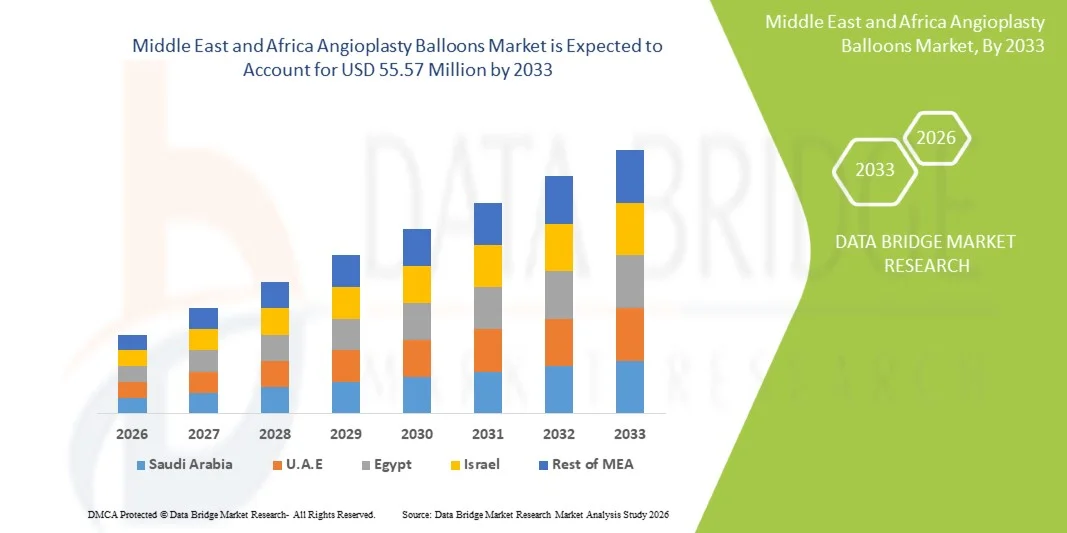
- As per Data Bridge Market Research Analysis theMiddle East and Africa angioplasty balloons market size was valued at USD 37.59 million in 2025 and is expected to reach USD 55.57 million by 2033, at a CAGR of 5.01% during the forecast period
- The market growth is primarily driven by rising prevalence of cardiovascular diseases, increased healthcare expenditure, and expanding access to advanced interventional cardiology procedures across hospitals and specialized cardiac centers in the region
- In addition, growing awareness among physicians and patients about minimally invasive treatments, coupled with technological innovations in balloon catheter design and drug-eluting balloon therapies, is positioning angioplasty balloons as a preferred treatment option. These combined factors are accelerating adoption and utilization, thereby fueling substantial growth in the market
Market Size & Forecast
- Global Market Value (2025): USD 37.59 million
- Expected Market Value (2033): USD 55.57 million
- Forecast CAGR (2026–2033): 5.01%
What are the Major Takeaways of Middle East and Africa Angioplasty Balloons Market?
- Angioplasty balloons, used in percutaneous coronary interventions to restore blood flow in occluded arteries, are becoming increasingly essential in modern interventional cardiology procedures across both hospital and specialized cardiac care settings due to their minimally invasive nature, precision, and improved patient outcomes.
- The rising demand for angioplasty balloons is primarily driven by the increasing prevalence of cardiovascular diseases, expanding healthcare infrastructure, and growing awareness among physicians and patients about advanced treatment options such as Drug-Coated Balloons (DCBs) and specialty balloons.
- Saudi Arabia dominated the Middle East and Africa angioplasty balloons market in 2025 with a market share of 35.1%, supported by high investments in healthcare, the expansion of specialized cardiac centers, and widespread adoption of advanced catheterization procedures
- United Arab Emirates (UAE) is expected to be the fastest-growing country during the forecast period due to government initiatives in healthcare modernization, increasing number of cardiac intervention facilities, and rising patient awareness of minimally invasive treatment options
- Drug-Coated Balloon (DCB) Angioplasty segment dominated the Middle East and Africa angioplasty balloons market in 2025 with a 43.8% share, driven by its clinical advantages in reducing restenosis, enhancing vessel patency, and offering improved long-term outcomes compared to conventional balloons
Report Scope and Middle East and Africa Angioplasty Balloons Market Segmentation
|
Attributes |
Middle East and Africa Angioplasty Balloons Key Market Insights |
|
Segments Covered |
|
|
Countries Covered |
Middle East and Africa
|
|
Key Market Players |
|
|
Market Opportunities |
|
|
Value Added Data Infosets |
In addition to the insights on market scenarios such as market value, growth rate, segmentation, geographical coverage, and major players, the market reports curated by the Data Bridge Market Research also include in-depth expert analysis, patient epidemiology, pipeline analysis, pricing analysis, and regulatory framework |
What is the Key Trend in the Middle East and Africa Angioplasty Balloons Market?
“Advancements in Drug-Coated Balloon Technology and Precision Devices”
- A significant and accelerating trend in the MEA angioplasty balloons market is the growing adoption of Drug-Coated Balloons (DCBs) and specialty balloon catheters that improve procedural outcomes and reduce restenosis rates in patients undergoing percutaneous coronary interventions
- For instance, the latest generation of SeQuent® Please DCB integrates advanced drug-eluting coatings with ultra-low profile balloon design, allowing for more effective treatment of small and complex lesions in coronary arteries
- DCB and specialty balloon innovations enable interventional cardiologists to treat challenging lesions more efficiently while minimizing vascular injury and improving long-term patency. For instance, the use of DCBs in in-stent restenosis cases has shown significantly improved clinical outcomes compared to conventional balloons
- The integration of precision-engineered balloon designs with imaging guidance, such as optical coherence tomography (OCT) or intravascular ultrasound (IVUS), facilitates accurate lesion preparation and optimal balloon deployment, enhancing procedural safety and efficacy
- This trend toward more clinically effective, user-friendly, and technologically advanced angioplasty balloons is fundamentally reshaping physician preferences and treatment protocols. Consequently, companies such as B. Braun are developing DCBs with enhanced drug delivery profiles and improved trackability for complex vascular interventions
- The demand for advanced angioplasty balloon technologies is growing rapidly across both tertiary hospitals and specialized cardiac centers, as healthcare providers increasingly prioritize improved patient outcomes and minimally invasive interventions
- Continuous R&D by medical device manufacturers in MEA is leading to hybrid balloons and coated technologies that combine mechanical dilatation with localized drug delivery, further enhancing procedural efficacy and adoption
What are the Key Drivers of Middle East and Africa Angioplasty Balloons Market?
Driver
“Increasing Cardiovascular Disease Burden and Healthcare Investments”
- The rising prevalence of cardiovascular diseases, coupled with expanding healthcare infrastructure and interventional cardiology facilities, is a significant driver for the heightened demand for angioplasty balloons in MEA
- For instance, in April 2025, Medtronic launched new DCB solutions in UAE hospitals to enhance treatment efficacy for coronary artery disease, reflecting increasing investment in advanced cardiac care
- As healthcare systems in countries such as Saudi Arabia and UAE modernize, hospitals are adopting minimally invasive angioplasty procedures that reduce patient recovery time and improve outcomes, driving balloon catheter adoption
- Furthermore, growing awareness among cardiologists and patients about advanced interventional treatments and clinical benefits of DCBs is making angioplasty balloons an integral component of cardiac care
- The expansion of public and private hospital networks, increasing medical device distribution channels, and availability of training for interventional procedures are key factors propelling angioplasty balloon adoption in the MEA region
- For instance, cardiology conferences in the Middle East are increasingly featuring workshops on DCBs, educating physicians on advanced procedural techniques and driving adoption
- Rising government healthcare spending in countries such as Saudi Arabia and UAE is funding modern cardiac centers, directly boosting procurement and use of angioplasty balloons in clinical practice
Restraint/Challenge
“High Device Costs and Regulatory Compliance Hurdles”
- The relatively high cost of advanced angioplasty balloons, including DCBs and specialty devices, poses a significant challenge to broader market penetration in developing MEA countries
- For instance, hospitals and smaller clinics in regions such as North Africa may be hesitant to adopt premium balloon technologies due to budget constraints, limiting access to advanced interventional solutions
- Addressing regulatory requirements for medical devices across multiple countries in MEA, including safety certifications and local approvals, is crucial for market expansion. For instance, delays in obtaining approvals from health authorities can slow product launches and distribution
- Furthermore, physician training and adoption challenges, coupled with the perceived complexity of new balloon technologies, may hinder rapid market uptake despite clinical advantages
- Overcoming these challenges through cost optimization, streamlined regulatory approvals, and physician education programs will be vital for sustained growth of the angioplasty balloons market in the MEA region
- For instance, some hospitals are implementing shared procurement strategies and bulk purchasing of DCBs to reduce costs and increase availability for patients
- Inconsistent reimbursement policies and limited insurance coverage in certain MEA countries may discourage hospitals from adopting high-cost angioplasty balloons, posing a barrier to market growth
How is the Middle East and Africa Angioplasty Balloons Market Segmented?
The market is segmented on the basis of type, material, balloon type, disease indication, and end user.
- By Type
On the basis of type, the MEA angioplasty balloons market is segmented into Plain Old Balloon Angioplasty (POBA), Drug-Coated Balloon (DCB) Angioplasty, Cutting Balloons, Scoring Balloons, and Stent Graft Balloon Catheter. The Drug-Coated Balloon (DCB) Angioplasty segment dominated the market in 2025 with the largest revenue share of 43.8%, driven by its clinical advantage in reducing restenosis and improving long-term vessel patency. Interventional cardiologists prefer DCBs for in-stent restenosis and small vessel disease due to the combination of mechanical dilatation and localized drug delivery. Hospitals in Saudi Arabia and UAE have widely adopted DCBs to standardize coronary interventions, increasing procedural success rates. Moreover, the DCB segment benefits from continuous technological innovations, including ultra-thin coatings and enhanced drug release profiles. Physicians and patients increasingly favor DCBs over conventional balloons for predictable outcomes and minimal repeat interventions.
The Cutting Balloons segment is anticipated to witness the fastest growth rate of 7.8% CAGR from 2026 to 2033, fueled by their ability to treat highly fibrotic or calcified lesions that are resistant to conventional balloons. Cutting balloons allow precise scoring of arterial plaque, improving stent deployment and reducing vessel trauma. The adoption is driven by the growing prevalence of complex coronary lesions in aging populations across UAE, Egypt, and South Africa. Hospitals and specialty cardiac centers are incorporating cutting balloons in complex PCI procedures for better procedural efficacy. Physician preference for devices that minimize complications and improve long-term outcomes is further driving market uptake.
- By Material
On the basis of material, the market is segmented into nylon, polyurethane, silicone urethane co-polymers, and others. The Nylon segment dominated the market in 2025 due to its proven mechanical strength, flexibility, and compatibility with a variety of balloon sizes and pressures, making it suitable for standard coronary angioplasty procedures. Nylon balloons are widely used in Saudi Arabia and UAE cardiac centers due to cost-effectiveness and reliability during routine interventions. Hospitals favor nylon balloons for their predictable expansion characteristics and compatibility with multiple catheter systems. Physicians prefer nylon for both pre-dilatation and post-dilatation procedures due to its balanced compliance. The segment also benefits from well-established supply chains and availability across MEA markets. Nylon’s versatility across lesion types further cements its dominance.
The Silicone Urethane Co-Polymers segment is expected to witness the fastest CAGR from 2026 to 2033, driven by their enhanced trackability, low profile, and improved drug-coating capabilities. These materials are increasingly used in advanced DCBs and specialty balloons, particularly in UAE and Egypt. The material’s superior biocompatibility reduces the risk of vessel injury and improves procedural safety. Hospitals are adopting silicone urethane balloons for complex lesions and small vessel interventions. The growth is also supported by ongoing R&D for hybrid materials that combine strength with controlled drug release.
- By Balloon Type
On the basis of balloon type, the market is segmented into semi-compliant and non-compliant balloons. The Non-Compliant segment dominated the market in 2025, owing to its ability to deliver precise dilation at high pressures without overexpansion, which is critical in stent deployment and high-risk lesion interventions. Non-compliant balloons are preferred in UAE, Saudi Arabia, and South African cardiac centers for both pre- and post-stenting procedures. Hospitals and cath labs rely on non-compliant balloons for predictable outcomes in complex coronary and peripheral angioplasty cases. Physicians favor this segment for calcified lesions and in high-precision interventions. Non-compliant balloons provide reproducible diameters and enhanced procedural safety. Continuous innovations in material design and balloon coatings further enhance their adoption.
The Semi-Compliant segment is expected to witness the fastest growth rate from 2026 to 2033, driven by their flexibility to adapt to variable vessel sizes and reduce vessel trauma during inflation. Semi-compliant balloons are increasingly adopted for venous and peripheral angioplasty procedures across Egypt and South Africa. Their ability to gradually expand reduces procedural complications and improves safety. Hospitals value semi-compliant balloons for multi-vessel interventions and lesion preparation prior to stenting. The segment is also growing due to increasing physician preference for patient-specific, flexible interventions.
- By Disease Indication
On the basis of disease indication, the market is segmented into coronary angioplasty, venous angioplasty, carotid angioplasty, renal artery angioplasty, and peripheral angioplasty. The Coronary Angioplasty segment dominated the MEA market in 2025 with a market share of 55%, driven by the high prevalence of coronary artery disease and increased awareness of minimally invasive treatment options. Hospitals and cath labs in Saudi Arabia and UAE perform the majority of coronary interventions using DCBs, cutting, and semi-compliant balloons. The segment benefits from government-led healthcare initiatives and advanced interventional cardiology programs. Physicians prefer coronary angioplasty for rapid symptom relief and improved patient outcomes. The segment’s dominance is further supported by continuous product innovations and training workshops for interventional cardiologists.
The Peripheral Angioplasty segment is expected to witness the fastest CAGR from 2026 to 2033, driven by rising peripheral artery disease cases in aging populations across Egypt and South Africa. Hospitals are increasingly investing in specialty balloons and DCBs for limb salvage procedures. Physicians favor these interventions to improve circulation and reduce amputations. Growing awareness among patients regarding early diagnosis and minimally invasive options is also driving adoption. The segment benefits from enhanced catheter technologies and drug-coating innovations.
- By End User
On the basis of end user, the market is segmented into cath labs, hospitals, specialty clinics, ambulatory surgery centers, and diagnostic centers. The Hospitals segment dominated the MEA angioplasty balloons market in 2025 with the largest revenue share of 50%, owing to their comprehensive cardiac care facilities and capacity to perform high-volume interventional procedures. Hospitals in Saudi Arabia, UAE, and Egypt have advanced cath labs and specialized teams for coronary, peripheral, and complex lesion interventions. They invest in high-end DCBs, cutting balloons, and non-compliant balloons to standardize care. Hospitals also benefit from government funding and insurance coverage supporting advanced angioplasty procedures. The segment is supported by trained cardiologists and access to continuous product innovations.
The Specialty Clinics segment is expected to witness the fastest CAGR from 2026 to 2033, driven by the growing number of outpatient cardiac care centers and interventional cardiology-focused facilities in Egypt, UAE, and South Africa. Specialty clinics are adopting DCBs and cutting balloons for targeted interventions with faster patient turnover. They offer flexible care models and minimally invasive procedures that reduce hospital stay. Physicians increasingly prefer specialty clinics for elective interventions and follow-up care. Rising patient awareness and preference for personalized care are accelerating adoption in this segment
Which Region Holds the Largest Share of the Middle East and Africa Angioplasty Balloons Market?
- Saudi Arabia dominated the Middle East and Africa angioplasty balloons market in 2025 with a market share of 35.1%, supported by high investments in healthcare, the expansion of specialized cardiac centers, and widespread adoption of advanced catheterization procedures
- Patients and hospitals in the region highly value advanced angioplasty balloons, particularly Drug-Coated Balloons (DCBs) and cutting balloons, for their improved clinical outcomes, reduced restenosis rates, and procedural precision
- This widespread adoption is further supported by strong government healthcare investments, modern hospital networks, and increasing physician training in interventional cardiology, establishing Saudi Arabia as the leading hub for angioplasty balloon usage across the MEA region
The Saudi Arabia Angioplasty Balloons Market Insight
The Saudi Arabia angioplasty balloons market captured the largest revenue share of 35.1% in 2025, driven by the increasing prevalence of cardiovascular diseases and rapid expansion of interventional cardiology infrastructure. Hospitals and specialized cardiac centers are increasingly adopting Drug-Coated Balloons (DCBs) and cutting balloons for minimally invasive procedures. Growing awareness among physicians and patients about improved procedural outcomes and reduced restenosis rates is fueling market growth. Government investments in healthcare modernization, along with training programs for interventional cardiologists, further accelerate adoption. The integration of advanced imaging guidance with balloon interventions is enhancing procedural precision and efficiency.
United Arab Emirates (UAE) Angioplasty Balloons Market Insight
The UAE angioplasty balloons market is expected to grow at a noteworthy CAGR during the forecast period, supported by modernization of healthcare facilities and establishment of advanced cardiac centers. Rising patient awareness about minimally invasive cardiac procedures is driving demand for DCBs, scoring balloons, and non-compliant balloons. For instance, hospitals in Dubai and Abu Dhabi are incorporating state-of-the-art catheterization labs to improve patient outcomes. The growing focus on preventive cardiology and early interventions contributes to increasing procedural volumes. Private healthcare expansion and government initiatives to improve cardiovascular care are also stimulating market growth.
Egypt Angioplasty Balloons Market Insight
The Egypt angioplasty balloons market is anticipated to expand at a substantial CAGR during the forecast period, fueled by rising prevalence of coronary artery disease and increasing healthcare infrastructure. Hospitals and specialty clinics in major cities such as Cairo and Alexandria are adopting advanced balloon technologies, including DCBs and cutting balloons, to improve procedural efficacy. Growing awareness among patients about minimally invasive treatments and favorable government health programs are driving demand. Increasing private healthcare investments and collaborations with medical device manufacturers enhance access to advanced devices. The adoption of modern catheterization techniques and interventional cardiology training further supports market growth.
South Africa Angioplasty Balloons Market Insight
The South Africa angioplasty balloons market is poised to grow at the fastest CAGR during the forecast period, driven by increasing cardiovascular disease incidence and improving access to advanced cardiac interventions. Hospitals and specialty cardiac centers in Johannesburg and Cape Town are expanding interventional cardiology services, incorporating DCBs, cutting, and semi-compliant balloons. Physician training programs and workshops are enhancing procedural adoption and standardization. Growing patient awareness about minimally invasive procedures and reduced recovery time is contributing to market expansion. Partnerships with international device manufacturers are improving technology availability and affordability across the region.
Which are the Top Companies in Middle East and Africa Angioplasty Balloons Market?
The Middle East and Africa Angioplasty Balloons industry is primarily led by well-established companies, including:
- Abbott (U.S.)
- Boston Scientific Corporation (U.S.)
- Medtronic (Ireland)
- Terumo Corporation (Japan)
- Cook (U.S.)
- BIOTRONIK (Germany)
- MicroPort Scientific (China)
- Lepu Medical Technology (China)
- Nipro Medical Corporation (Japan)
- Philips (Netherlands)
- B. Braun SE (Germany)
- Stryker (U.S.)
- AngioDynamics, Inc. (U.S.)
- Hexacath (France)
- Jotec AG (Germany)
- Panmed US (U.S.)
- Terumo Aortic (Japan)
- Teleflex Medical (U.S.)
- Angioslide (Brazil)
- Atrium Medical (U.S.)
What are the Recent Developments in Middle East and Africa Angioplasty Balloons Market?
- In March 2025, Boston Scientific initiated the AGENT DCB STANCE trial a large, head‑to‑head study comparing the AGENT drug‑coated balloon against standard care with drug‑eluting stents or balloon angioplasty. This ongoing study (expected to complete in 2028) could shape future clinical practice related to angioplasty balloons worldwide, including MEA
- In May 2024, King Fahd Armed Forces Hospital in Saudi Arabia began offering an innovative angioplasty‑based procedure using the DynamX bioadaptor implant, a novel approach for treating coronary artery disease. This procedure involves minimally invasive angioplasty with a dynamic implant designed to restore the artery’s natural motion and improve blood flow while reducing complications compared to traditional stents
- In March 2024, Boston Scientific Corporation received US FDA approval for its AGENT™ Drug‑Coated Balloon (DCB) the first coronary DCB approved to treat in‑stent restenosis (ISR) in patients with coronary artery disease. This global approval is significant for DCB adoption in interventional cardiology markets including the Middle East and Africa, where such advanced balloon technologies are increasingly used
- In March 2024, In the UAE angioplasty balloons context, Boston Scientific’s AGENT™ DCB received regulatory attention and was highlighted as approved for treating coronary in‑stent restenosis a milestone influencing interventional cardiology device uptake in UAE hospitals and potentially MEA markets
- In October 2023, Boston Scientific published positive 12‑month results from the AGENT IDE clinical trial, demonstrating that its AGENT DCB showed superiority over uncoated balloon angioplasty in reducing target lesion failure for coronary ISR boosting confidence in drug‑coated balloon performance globally

- Interactive Data Analysis Dashboard
- Company Analysis Dashboard for high growth potential opportunities
- Research Analyst Access for customization & queries
- Competitor Analysis with Interactive dashboard
- Latest News, Updates & Trend analysis
- Harness the Power of Benchmark Analysis for Comprehensive Competitor Tracking
Data collection and base year analysis are done using data collection modules with large sample sizes. The stage includes obtaining market information or related data through various sources and strategies. It includes examining and planning all the data acquired from the past in advance. It likewise envelops the examination of information inconsistencies seen across different information sources. The market data is analysed and estimated using market statistical and coherent models. Also, market share analysis and key trend analysis are the major success factors in the market report. To know more, please request an analyst call or drop down your inquiry.
The key research methodology used by DBMR research team is data triangulation which involves data mining, analysis of the impact of data variables on the market and primary (industry expert) validation. Data models include Vendor Positioning Grid, Market Time Line Analysis, Market Overview and Guide, Company Positioning Grid, Patent Analysis, Pricing Analysis, Company Market Share Analysis, Standards of Measurement, Global versus Regional and Vendor Share Analysis. To know more about the research methodology, drop in an inquiry to speak to our industry experts.
Data Bridge Market Research is a leader in advanced formative research. We take pride in servicing our existing and new customers with data and analysis that match and suits their goal. The report can be customized to include price trend analysis of target brands understanding the market for additional countries (ask for the list of countries), clinical trial results data, literature review, refurbished market and product base analysis. Market analysis of target competitors can be analyzed from technology-based analysis to market portfolio strategies. We can add as many competitors that you require data about in the format and data style you are looking for. Our team of analysts can also provide you data in crude raw excel files pivot tables (Fact book) or can assist you in creating presentations from the data sets available in the report.













