


What is the Middle East and Africa Artificial Intelligence (AI) in Drug Discovery Size and Overview ?
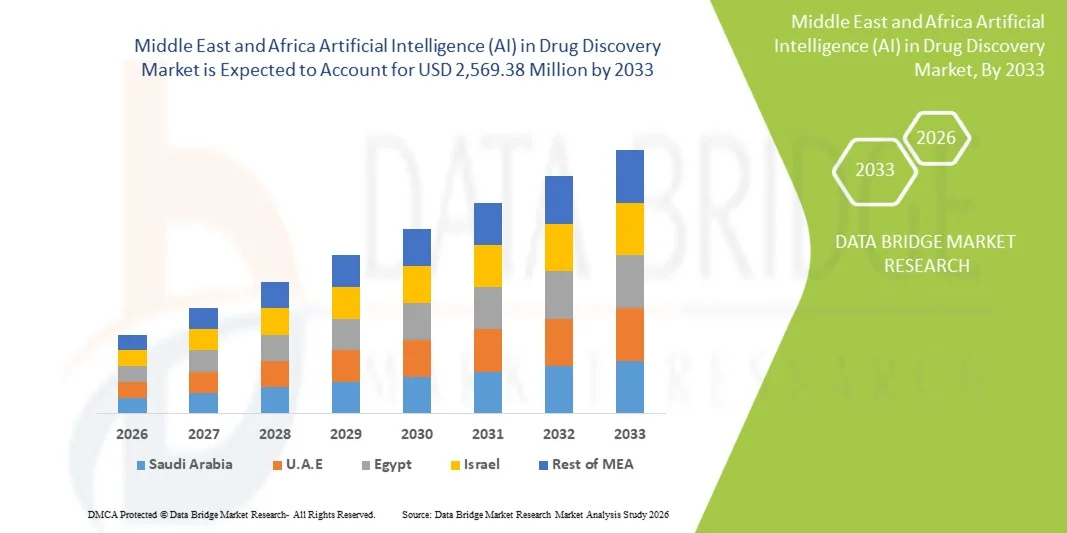
As per Data Bridge Market Research Analysis the Middle East and Africa Artificial Intelligence (AI) in drug discovery market was valued at USD 117.20 million in 2025 and is projected to reach USD 2,569.38 million by 2033, growing at a CAGR of 47.1% from 2026 to 2033. The market is witnessing steady expansion driven by increasing investment in healthcare digitalization, growing interest in precision medicine, and rising adoption of AI-enabled platforms to accelerate drug discovery timelines and reduce R&D costs.
The region is experiencing growing collaborations between pharmaceutical companies, research institutions, and technology providers to integrate AI, machine learning, and big data analytics into early-stage drug development. Governments across the Middle East are actively supporting healthcare innovation initiatives, while select African markets are gradually adopting advanced computational biology tools. The increasing burden of chronic diseases, along with the need for faster and more cost-efficient drug development processes, is encouraging stakeholders to shift toward AI-powered drug discovery solutions, enhancing target identification, lead optimization, and clinical trial efficiency.
Market Size & Forecast
- Global Market Value (2025): USD 117.20 Million
- Expected Market Value (2033): USD 2,569.38 Million
- Forecast CAGR (2026–2033): 47.1%
- Leading Country in 2025: Saudi Arabia
- Fastest Growing Country: United Arab Emirates
What are the Major Takeaways of Middle East and Africa Artificial Intelligence (AI) in Drug Discovery ?
- Saudi Arabia dominated the Middle East and Africa Artificial Intelligence (AI) in drug discovery market with the largest revenue share of 28.6% in 2025, supported by strong government-backed healthcare innovation programs and rapid expansion of biotech research infrastructure.
- The Novel Drug Candidates segment led the market with a 38.9% share in 2025, driven by strong adoption of AI models in early-stage drug discovery to identify new therapeutic molecules across oncology and metabolic diseases
- United Arab Emirates is expected to be the fastest-growing country at a CAGR of 19.8% from 2026 to 2033, fueled by investments in AI-powered healthcare ecosystems, precision medicine initiatives, and collaborations with global pharmaceutical companies.
- Drug Optimization and Repurposing are the fastest-growing application type, projected to register a CAGR of 22.6%, reflecting the surge in demand for cost-effective and time-efficient drug development strategies.
- The Machine Learning segment dominated the technology category with a 46.1% revenue share in 2025, led by its strong capability in pattern recognition, molecular screening, and predictive analytics for drug discovery workflows.
- Small Molecule accounted for 47.5% of the market, preferred by its wide applicability, lower development cost, and strong historical datasets that enhance AI model training accuracy.
- The Services segment is the fastest-growing offering category, with a CAGR of 22.3%, driven by rising demand for AI consulting, managed services, and data analytics support in drug discovery projects.
Report Scope and Middle East and Africa Artificial Intelligence (AI) in Drug Discovery Market Segmentation
|
Attributes |
Middle East and Africa Artificial Intelligence (AI) in Drug Discovery Key Market Insights |
|
Segments Covered |
|
|
Countries Covered |
Middle East and Africa
|
|
Key Market Players |
|
|
Market Opportunities |
|
|
Value Added Data Infosets |
In addition to the insights on market scenarios such as market value, growth rate, segmentation, geographical coverage, and major players, the market reports curated by the Data Bridge Market Research also include in-depth expert analysis, patient epidemiology, pipeline analysis, pricing analysis, and regulatory framework. |
What is the Key Trend in the Middle East and Africa Artificial Intelligence (AI) in Drug Discovery ?
Trend: Expansion of AI-Driven Precision Medicine Initiatives
Pharmaceutical companies and research institutes across the region are increasingly adopting AI-powered platforms to support precision medicine, enabling faster identification of disease biomarkers and patient-specific treatment pathways. Governments are investing in national genomics programs and digital health infrastructure, accelerating integration of machine learning in early-stage drug discovery workflows, while collaborations with global biotech firms are strengthening computational research capabilities for oncology and rare disease research. For instance, Israel’s national genomics and AI drug discovery programs are supporting large-scale biomarker mapping and targeted therapy development.
Middle East and Africa Artificial Intelligence (AI) in Drug Discovery Market Dynamics
Key Market Driver: Rising Investment in Healthcare Digitalization and Biotech Innovation
The growing focus on healthcare modernization and biotechnology development is significantly driving AI adoption in drug discovery across MEA countries, particularly in Gulf nations. Governments and private investors are funding AI-based research hubs, fostering partnerships between pharmaceutical companies and technology providers to accelerate drug development cycles and reduce R&D costs. This is further supported by increasing disease burden and demand for faster therapeutic solutions. For instance, Saudi Arabia’s Vision 2030 healthcare transformation program is actively promoting AI integration in pharmaceutical research and drug discovery pipelines.
Key Restraint/Challenge: Limited Research Infrastructure and High Implementation Costs
Despite strong growth potential, the market faces challenges due to uneven research infrastructure development and the high cost of implementing advanced AI drug discovery platforms. Many countries in Africa lack access to high-performance computing systems, skilled data scientists, and large-scale biomedical datasets required for effective AI model training. In addition, smaller biotech firms face financial constraints in adopting end-to-end AI-enabled drug discovery systems. For instance, several research institutions in South Africa still rely on traditional computational methods due to limited funding for advanced AI infrastructure.
Key Market Opportunity: Expansion of Cloud-Based AI Drug Discovery Platforms
The increasing adoption of cloud computing and scalable AI platforms presents a major opportunity for expanding drug discovery capabilities across MEA markets. Cloud-based solutions reduce infrastructure costs, enable cross-border collaboration, and provide access to advanced computational tools for startups and research organizations. This is further supported by growing partnerships between global cloud service providers and regional healthcare ecosystems, enhancing data accessibility and analytical efficiency. For instance, UAE-based biotech accelerators are increasingly leveraging cloud AI platforms to support early-stage drug discovery and virtual screening programs.
How is the Middle East and Africa Artificial Intelligence (AI) in Drug Discovery Segmented ?
The Middle East and Africa Artificial Intelligence (AI) in drug discovery market is segmented on the basis of application, technology, drug type, offering, indication, and end use.
- By Application
On the basis of application, the Middle East and Africa Artificial Intelligence (AI) in drug discovery market is segmented into novel drug candidates, drug optimization and repurposing, preclinical testing and approval, drug monitoring, target and pathway identification, disease mechanism understanding, data aggregation and hypothesis generation, and de novo drug design. The Novel Drug Candidates segment dominated the market with a 38.9% share in 2025, driven by strong adoption of AI models in early-stage drug discovery to identify new therapeutic molecules across oncology and metabolic diseases. Pharmaceutical companies in Israel and Saudi Arabia are increasingly using AI-driven screening platforms to accelerate hit identification and reduce experimental costs. Growing availability of genomic, proteomic, and chemical datasets is further strengthening model accuracy. AI-enabled platforms are also improving prediction of drug-likeness and toxicity profiles. Increasing focus on innovation-led drug pipelines is supporting segment dominance. Expanding collaboration between biotech firms and academic institutes is further enhancing discovery efficiency.
The Drug Optimization and Repurposing segment is expected to grow at the fastest CAGR of 22.6% from 2026 to 2033, driven by rising demand for cost-effective and time-efficient drug development strategies. AI algorithms are increasingly being used to identify new therapeutic uses for existing drugs, significantly reducing development risk and regulatory timelines. Countries such as the UAE and South Africa are actively supporting drug repurposing initiatives to address unmet medical needs. Machine learning models are improving molecular modification and dosage optimization processes. Growing focus on rare and chronic diseases is further accelerating adoption. Expansion of real-world data integration is strengthening predictive capabilities in this segment.
- By Technology
On the basis of technology, the market is segmented into machine learning, deep learning, natural language processing (NLP), and others. The Machine Learning segment dominated the market with a 46.1% share in 2025, driven by its strong capability in pattern recognition, molecular screening, and predictive analytics for drug discovery workflows. ML models are widely used in target identification, compound screening, and toxicity prediction across pharmaceutical pipelines. Countries such as Saudi Arabia and Israel are heavily investing in ML-enabled research platforms. Growing availability of structured biomedical datasets is enhancing model performance. Integration with cloud-based computing systems is further improving scalability. Continuous adoption in early drug discovery stages ensures sustained leadership.
The Deep Learning segment is expected to grow at the fastest CAGR of 21.9% from 2026 to 2033, driven by its ability to analyze complex biological data such as protein folding, genomic sequences, and multi-omics datasets. Deep learning models are increasingly used in structure-based drug design and biomarker discovery. Rising computational power and cloud infrastructure expansion in UAE and Israel are enabling advanced model training. Collaboration between AI startups and pharmaceutical companies is accelerating innovation. Increasing demand for high-precision predictive models is further boosting adoption. The segment is becoming essential for next-generation drug discovery workflows.
- By Drug Type
On the basis of drug type, the market is segmented into small molecules and large molecules (biologics). The Small Molecule segment dominated the market with a 47.5% share in 2025, driven by its wide applicability, lower development cost, and strong historical datasets that enhance AI model training accuracy. Pharmaceutical companies in Saudi Arabia and South Africa prefer small molecule pipelines for chronic disease treatment development. AI tools are widely used for molecular optimization, binding affinity prediction, and toxicity assessment. Increasing focus on generic drug development further strengthens adoption. Strong integration with computational chemistry platforms supports dominance. Continuous demand in oncology and cardiovascular diseases sustains market leadership.
The Large Molecule (Biologics) segment is expected to grow at the fastest CAGR of 20.8% from 2026 to 2033, driven by increasing demand for targeted therapies and precision medicine. AI is playing a key role in antibody design, protein engineering, and biologic optimization. Countries such as Israel and the UAE are heavily investing in biologics-focused research ecosystems. Rising prevalence of cancer and autoimmune diseases is accelerating demand. Advanced simulation tools are improving biologic stability and efficacy prediction. Expanding partnerships between global pharma firms and regional biotech companies are further boosting growth.
- By Offering
On the basis of offering, the market is segmented into software and services. The Software segment dominated the market with a 58.2% share in 2025, driven by widespread adoption of AI platforms, predictive modeling tools, and cloud-based drug discovery software across pharmaceutical companies. Software solutions enable scalable analysis of large biomedical datasets and integration of multi-omics data. Countries such as Saudi Arabia and Israel are rapidly deploying AI software platforms in research institutions. Increasing demand for automation in drug discovery workflows is further strengthening adoption. Continuous upgrades in AI algorithms and computing capabilities support dominance. Strong ecosystem development in biotech hubs enhances software penetration.
The Services segment is expected to grow at the fastest CAGR of 22.3% from 2026 to 2033, driven by rising demand for AI consulting, managed services, and data analytics support in drug discovery projects. Pharmaceutical companies are increasingly outsourcing AI integration and model development to specialized service providers. Countries such as the UAE and South Africa are emerging as key service outsourcing hubs. Growing complexity of AI workflows is increasing reliance on expert services. Expansion of CRO partnerships is further accelerating growth. Rising need for customized AI solutions is strengthening service adoption.
- By Indication
On the basis of indication, the market is segmented into immuno-oncology, neurodegenerative diseases, cardiovascular diseases, metabolic diseases, and others. The Immuno-Oncology segment dominated the market with a 41.2% share in 2025, driven by high cancer prevalence and strong investment in precision oncology research across Israel, Saudi Arabia, and UAE. AI is widely used for tumor profiling, biomarker discovery, and immunotherapy optimization. Increasing adoption of genomic sequencing is improving treatment targeting. Strong collaboration between biotech firms and academic institutions is accelerating innovation. Growing demand for personalized cancer therapies further strengthens dominance. Continuous funding for oncology research supports market leadership.
The Neurodegenerative Diseases segment is expected to grow at the fastest CAGR of 21.7% from 2026 to 2033, driven by increasing prevalence of Alzheimer’s, Parkinson’s, and other neurological disorders. AI models are being used for early diagnosis, biomarker identification, and drug target discovery. Countries such as Israel and UAE are investing in brain research and neuroinformatics programs. Growing aging population is increasing disease burden across MEA. Advances in neuroimaging and computational biology are improving research accuracy. Expanding clinical research collaborations are further supporting growth.
- By End Use
On the basis of end use, the market is segmented into contract research organizations (CROs), pharmaceutical & biotechnology companies, research centers & academic institutes, and others. The Pharmaceutical & Biotechnology Companies segment dominated the market with a 50.4% share in 2025, driven by strong adoption of AI-driven drug discovery platforms and increasing investment in R&D digital transformation. Companies in Saudi Arabia, Israel, and UAE are actively deploying AI tools for target identification and molecule optimization. Growing competition in global pharmaceutical innovation is pushing adoption. Availability of large-scale biomedical datasets enhances efficiency. Strong partnerships with AI vendors support implementation. Continuous expansion of digital R&D pipelines ensures dominance.
The Contract Research Organizations (CROs) segment is expected to grow at the fastest CAGR of 22.0% from 2026 to 2033, driven by rising outsourcing of drug discovery and clinical research activities. CROs are increasingly integrating AI tools to offer faster and more cost-efficient services to global pharma clients. Countries such as South Africa and UAE are emerging as CRO hubs. AI adoption is improving predictive accuracy and reducing operational costs. Increasing demand for end-to-end drug development services is boosting growth. Strong collaboration with pharmaceutical companies is accelerating expansion.
Which Region Holds the Largest Share of the Middle East and Africa Artificial Intelligence (AI) in Drug Discovery ?
Saudi Arabia dominated the Middle East and Africa Artificial Intelligence (AI) in Drug Discovery market with the largest revenue share of 28.6% in 2025, supported by strong government-backed healthcare innovation programs and rapid expansion of biotech research infrastructure. The country benefits from large-scale national initiatives focused on digital health, precision medicine, and genomic research, which are accelerating adoption of AI in early-stage drug discovery. Strong collaborations between government bodies, global pharmaceutical companies, and AI technology providers are further enhancing research capabilities. Growing focus on oncology, metabolic, and rare disease research is also driving demand for advanced computational drug discovery platforms. Expanding adoption of machine learning and deep learning tools across research institutions is improving efficiency in target identification and molecule screening. Continuous investment in healthcare innovation under long-term national development strategies is reinforcing Saudi Arabia’s dominant position in the regional market.
The Saudi Arabia Artificial Intelligence (AI) in Drug Discovery Market Insight
Saudi Arabia dominates the Middle East and Africa Artificial Intelligence (AI) in Drug Discovery market, driven by strong government-backed healthcare transformation programs, expanding biotechnology infrastructure, and increasing investment in AI-enabled pharmaceutical research. The country’s focus on precision medicine, genomics, and digital health innovation is significantly boosting adoption of AI platforms in drug discovery workflows. In addition, collaborations with global pharmaceutical companies and AI technology providers are strengthening research capabilities and accelerating innovation. Continuous funding under national development strategies is further reinforcing Saudi Arabia’s leadership in the regional market.
United Arab Emirates Artificial Intelligence (AI) in Drug Discovery Market Insight
The United Arab Emirates Artificial Intelligence (AI) in Drug Discovery market is experiencing rapid growth due to strong investments in AI-driven healthcare ecosystems, smart research infrastructure, and biotechnology innovation hubs. Increasing adoption of cloud-based AI platforms and advanced analytics tools is supporting faster drug screening and development processes. The country’s emphasis on precision medicine and strategic partnerships with global pharma and tech companies is further accelerating market expansion. Moreover, growing focus on innovation-led healthcare transformation is positioning the UAE as a key emerging hub in the regional market.
Nigeria Artificial Intelligence (AI) in Drug Discovery Market Insight
The Nigeria Artificial Intelligence (AI) in Drug Discovery market is gradually emerging, supported by increasing focus on healthcare innovation, rising disease burden, and growing interest in digital health technologies. Academic and research institutions are beginning to adopt AI-based tools for data analysis, drug repurposing, and early-stage biomedical research. Collaborations with international organizations and global pharmaceutical companies are helping improve access to advanced computational platforms. In addition, expanding government attention toward strengthening healthcare infrastructure is encouraging early adoption of AI-driven research solutions. Growing investment in healthtech startups is further supporting long-term market development in the country.
South Africa Artificial Intelligence (AI) in Drug Discovery Market Insight
The South Africa Artificial Intelligence (AI) in Drug Discovery market is growing steadily due to increasing adoption of digital health technologies, rising pharmaceutical research activity, and growing focus on addressing high disease burden. AI platforms are being increasingly used in academic and research institutions for target identification, drug repurposing, and data-driven biomedical research. However, limited infrastructure in some areas is being offset by rising international collaborations and funding support. Growing emphasis on improving healthcare outcomes and research capabilities is supporting long-term market development.
Which are the Top Companies in Middle East and Africa Artificial Intelligence (AI) in Drug Discovery ?
The Middle East and Africa Artificial Intelligence (AI) in drug discovery industry is primarily led by well-established companies, including:
- Insilico Medicine (U.S.)
- M42 (U.A.E.)
- G42 Healthcare (U.A.E.)
- BenevolentAI (U.K.)
- Exscientia (U.K.)
- Isomorphic Labs (U.K.)
- Schrödinger, Inc. (U.S.)
- Atomwise Inc. (U.S.)
- Recursion Pharmaceuticals (U.S.)
- Cyclica Inc. (Canada)
- Valo Health (U.S.)
- Owkin (France)
- CytoReason (Israel)
- Quris AI (Israel)
- Teva Pharmaceutical Industries Ltd. (Israel)
- BioXcel Therapeutics (U.S.)
- XtalPi Inc. (China)
- Deep Genomics Inc. (Canada)
- Iktos (France)
- Verge Genomics (U.S.)
What are Latest Developments in Middle East and Africa Artificial Intelligence (AI) in Drug Discovery ?
- In October 2024, G42 Healthcare in the UAE expanded its collaborations with global technology and life sciences partners to strengthen AI-powered biomedical research and drug discovery capabilities. The initiative utilizes advanced machine learning models, genomic datasets, and high-performance computing infrastructure to accelerate target identification and drug development processes. This development reinforces the UAE’s leadership in AI-driven healthcare innovation across the region. It also enhances the country’s ability to support precision medicine and large-scale pharmaceutical research
- In May 2024, M42, a UAE-based health technology company, expanded its AI healthcare ecosystem by advancing partnerships focused on genomics, data analytics, and AI-enabled drug discovery solutions. The initiative integrates machine learning models with large-scale clinical and biomedical datasets to improve disease target identification and therapeutic development. This expansion highlights the UAE’s strategic push toward building a digitally driven healthcare and life sciences ecosystem. It also supports faster, more efficient drug development through advanced computational platforms
- In September 2023, Insilico Medicine announced the expansion of its AI-driven drug discovery capabilities with the establishment of a new research and development center in Abu Dhabi, UAE, in collaboration with local healthcare and innovation partners. The center focuses on leveraging generative AI for target identification, molecular design, and lead optimization to accelerate early-stage drug discovery processes. This development strengthens the UAE’s position as a growing hub for biotechnology and computational drug research. It also reflects increasing regional investment in AI-powered precision medicine and life sciences innovation
- In March 2022, King Abdullah University of Science and Technology (KAUST) in Saudi Arabia expanded its research initiatives in computational biology and AI-driven drug discovery through enhanced collaborations with global academic and research institutions. The initiative focuses on applying artificial intelligence and high-performance computing to study molecular interactions and accelerate biomedical discovery. This development supports Saudi Arabia’s broader healthcare innovation and research diversification goals. It also strengthens national capabilities in precision medicine and advanced drug research
- In July 2021, Teva Pharmaceuticals, based in Israel, advanced its digital transformation strategy by integrating AI and advanced analytics into its drug discovery and development processes. The company has been using data-driven platforms to improve efficiency in research workflows and enhance decision-making in early-stage drug development. This initiative reflects Israel’s strong position in pharmaceutical innovation and computational life sciences. It also supports faster identification of new therapeutic opportunities and improved R&D productivity

- Interactive Data Analysis Dashboard
- Company Analysis Dashboard for high growth potential opportunities
- Research Analyst Access for customization & queries
- Competitor Analysis with Interactive dashboard
- Latest News, Updates & Trend analysis
- Harness the Power of Benchmark Analysis for Comprehensive Competitor Tracking
Data collection and base year analysis are done using data collection modules with large sample sizes. The stage includes obtaining market information or related data through various sources and strategies. It includes examining and planning all the data acquired from the past in advance. It likewise envelops the examination of information inconsistencies seen across different information sources. The market data is analysed and estimated using market statistical and coherent models. Also, market share analysis and key trend analysis are the major success factors in the market report. To know more, please request an analyst call or drop down your inquiry.
The key research methodology used by DBMR research team is data triangulation which involves data mining, analysis of the impact of data variables on the market and primary (industry expert) validation. Data models include Vendor Positioning Grid, Market Time Line Analysis, Market Overview and Guide, Company Positioning Grid, Patent Analysis, Pricing Analysis, Company Market Share Analysis, Standards of Measurement, Global versus Regional and Vendor Share Analysis. To know more about the research methodology, drop in an inquiry to speak to our industry experts.
Data Bridge Market Research is a leader in advanced formative research. We take pride in servicing our existing and new customers with data and analysis that match and suits their goal. The report can be customized to include price trend analysis of target brands understanding the market for additional countries (ask for the list of countries), clinical trial results data, literature review, refurbished market and product base analysis. Market analysis of target competitors can be analyzed from technology-based analysis to market portfolio strategies. We can add as many competitors that you require data about in the format and data style you are looking for. Our team of analysts can also provide you data in crude raw excel files pivot tables (Fact book) or can assist you in creating presentations from the data sets available in the report.













