


Middle East and Africa At-Home Testing Kits Market Overview
The Middle East and Africa At-Home Testing Kits market was valued at USD 590.00 million in 2025 and is projected to reach USD 839.03 million by 2033, growing at a CAGR of 4.5% from 2026 to 2033. The market is experiencing steady growth driven by increasing consumer awareness of preventive healthcare, rising demand for convenient diagnostic solutions, and expanding access to self-testing technologies across the region.
The growing prevalence of chronic and infectious diseases, coupled with increasing healthcare digitization and efforts to reduce pressure on healthcare facilities, is encouraging consumers and healthcare providers to adopt at-home testing solutions. Rapid diagnostic kits for pregnancy, glucose monitoring, infectious diseases, and wellness screening are gaining traction across both urban and semi-urban populations. In addition, improvements in test accuracy, user-friendly designs, and wider availability through pharmacies and e-commerce channels are supporting market expansion, while government initiatives promoting early disease detection and remote healthcare services continue to strengthen adoption across the Middle East and Africa.
Key Market Trends & Insights
- Saudi Arabia dominated the Middle East and Africa At-Home Testing Kits market with the largest revenue share of 24.86% in 2025, supported by high healthcare spending, strong retail pharmacy networks, and increasing adoption of self-diagnostic healthcare solutions.
- The Diabetes segment led the market with a 29.84% share in 2025, driven by the growing prevalence of diabetes across Gulf countries and several African nations.
- South Africa is expected to be the fastest-growing country at a CAGR of 5.3% from 2026 to 2033, fueled by expanding healthcare access, increasing consumer awareness, and improving availability of affordable self-testing kits.
- Infectious Diseases are the fastest-growing test type, projected to register a CAGR of 5.8%, reflecting the surge in awareness of early disease detection and preventive healthcare practices.
- The Strip segment dominated the type category with a 36.27% revenue share in 2025, led by its affordability, ease of use, and widespread application in glucose monitoring, pregnancy testing, and infectious disease detection
- Adult accounted for 61.42% of the market, preferred by the high prevalence of chronic diseases, infectious conditions, and reproductive health monitoring requirements among the adult population.
- The Saliva segment is the fastest-growing sample type category, with a CAGR of 6.1%, driven by the increasing demand for non-invasive testing methods.
Market Size & Forecast
- Global Market Value (2025): USD 590.00 Million
- Expected Market Value (2033): USD 839.03 Million
- Forecast CAGR (2026–2033): 4.5%
- Leading Country in 2025: Saudi Arabia
- Fastest Growing Country: South Africa
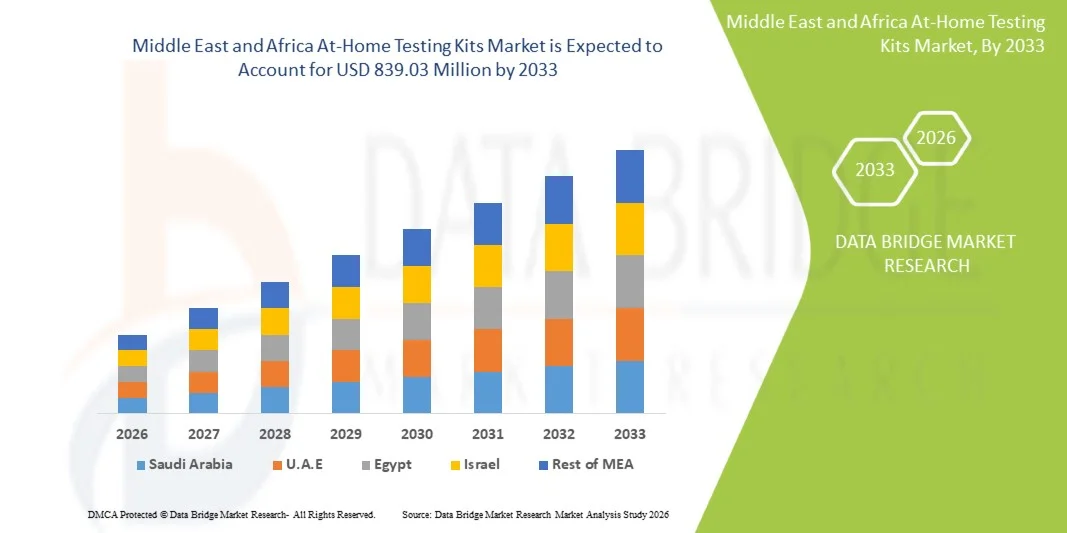
Report Scope and Middle East and Africa At-Home Testing Kits Market Segmentation
|
Attributes |
Middle East and Africa At-Home Testing Kits Key Market Insights |
|
Segments Covered |
|
|
Countries Covered |
Middle East and Africa · Saudi Arabia · U.A.E. · South Africa · Egypt · Israel · Rest of Middle East and Africa |
|
Key Market Players |
· Abbott (U.S.) · F. Hoffmann-La Roche Ltd (Switzerland) · Siemens Healthineers AG (Germany) · BD (U.S.) · Danaher (U.S.) · OraSure Technologies, Inc. (U.S.) · BIOMÉRIEUX (France) · QIAGEN (Netherlands) · Trinity Biotech plc (Ireland) · Acon Laboratories, Inc. (U.S.) · iHealth Labs Inc. (U.S.) · ARKRAY, Inc. (Japan) · Ascensia Diabetes Care Holdings AG (Switzerland) · Nova Biomedical Corporation (U.S.) · SD BIOSENSOR, INC. (South Korea) · Bionime Corporation (Taiwan) · EKF Diagnostics Holdings plc (U.K.) · MedMira Inc. (Canada) · Chembio Diagnostics, Inc. (U.S.) · PTS Diagnostics (U.S.) |
|
Market Opportunities |
· Expansion of self-testing kits for chronic disease management · Growing adoption of telehealth-integrated diagnostic solutions · Increasing penetration of affordable rapid diagnostic kits in underserved rural areas |
|
Value Added Data Infosets |
In addition to the insights on market scenarios such as market value, growth rate, segmentation, geographical coverage, and major players, the market reports curated by the Data Bridge Market Research also include in-depth expert analysis, patient epidemiology, pipeline analysis, pricing analysis, and regulatory framework. |
Middle East and Africa At-Home Testing Kits Market Trends
Trend: Rising Demand for Digital and Connected Self-Testing Solutions
Consumers across the Middle East and Africa are increasingly adopting digitally connected at-home testing kits that enable real-time health monitoring, result tracking, and remote physician consultations without visiting healthcare facilities. The integration of smartphone applications allows users to store test results, receive personalized health insights, and share diagnostic information with healthcare providers seamlessly. Healthcare companies are similarly expanding connected testing portfolios to improve patient engagement and support preventive healthcare initiatives, while advancements in mobile health technologies are creating more accessible and user-friendly self-testing experiences. For instance, in March 2025, healthcare providers across the Gulf region expanded digital health programs that integrate home-testing kits with telemedicine platforms, enabling patients to share diagnostic results directly with physicians for remote care management.
Middle East and Africa At-Home Testing Kits Market Dynamics
Key Market Driver: Growing Focus on Preventive Healthcare and Early Disease Detection
The increasing prevalence of chronic and infectious diseases has created substantial demand for at-home testing kits that support early diagnosis, continuous health monitoring, and timely medical intervention. Healthcare authorities, diagnostic manufacturers, and healthcare providers are promoting self-testing solutions as a practical approach to reducing healthcare burdens, improving patient outcomes, and expanding access to essential diagnostic services. The availability of rapid, easy-to-use testing kits is helping consumers take a proactive role in managing health conditions while supporting broader public health objectives. For instance, in February 2025, public health campaigns across Saudi Arabia and the UAE continued promoting self-testing and home monitoring solutions for diabetes management and infectious disease screening to strengthen early detection initiatives.
Key Restraint/Challenge: Limited Awareness and Uneven Healthcare Accessibility
A significant restraint in the Middle East and Africa at-home testing kits market is the limited awareness of self-diagnostic products and uneven access to healthcare infrastructure across several developing economies. Many consumers remain unfamiliar with the benefits, accuracy, and proper usage of at-home testing solutions, while distribution challenges and affordability concerns restrict product availability in rural and underserved communities. The overall adoption barrier extends to limited healthcare literacy, regulatory variations, and inconsistent reimbursement frameworks, making widespread market penetration difficult in certain areas.
For instance, in January 2025, healthcare stakeholders in several Sub-Saharan African countries reported that limited consumer education and constrained diagnostic distribution networks continued to hinder broader adoption of at-home testing products.
Key Market Opportunity: Expansion of Telehealth-Integrated Diagnostic Ecosystems
The integration of telehealth services with at-home diagnostic testing presents a significant market opportunity. Connected testing platforms can enable remote consultations, facilitate secure result sharing, and support continuous patient monitoring across diverse healthcare settings. The development of affordable digital health ecosystems and mobile healthcare applications is further expanding access to diagnostic services, opening growth opportunities across underserved populations in the Middle East and Africa while strengthening preventive and remote healthcare delivery models. For instance, in April 2025, digital healthcare companies in Saudi Arabia and the United Arab Emirates expanded telehealth platforms with integrated home-testing capabilities, supporting virtual consultations and remote diagnostic monitoring services.
Middle East and Africa At-Home Testing Kits Market Scope
The Middle East and Africa At-Home Testing Kits market is segmented on the basis of test type, type, age, sample type, usage, and distribution channels.
- By Test Type
On the basis of test type, the Middle East and Africa At-Home Testing Kits market is segmented into pregnancy test, HIV test kit, diabetes, infectious diseases, glucose tests, ovulation predictor test kit, drug abuse test kit, and others. The Diabetes segment dominated the market with a 29.84% share in 2025, driven by the growing prevalence of diabetes across Gulf countries and several African nations. Increasing awareness regarding regular glucose monitoring and disease management has significantly boosted demand for self-testing solutions. Consumers prefer home-based diabetic testing due to convenience, affordability, and ease of use. Government initiatives promoting early diagnosis and chronic disease management are further supporting adoption. The availability of technologically advanced monitoring kits through pharmacies and online channels has improved accessibility. The rising burden of lifestyle-related disorders continues to strengthen the segment's leading position across the region.
The Infectious Diseases segment is projected to register the fastest growth at a CAGR of 5.8% from 2026 to 2033, driven by increasing awareness of early disease detection and preventive healthcare practices. Consumers are increasingly utilizing rapid home-based diagnostic kits for infectious disease screening due to convenience and reduced dependency on healthcare facilities. Growing investments in public health programs and disease surveillance initiatives are supporting product penetration. Advancements in rapid diagnostic technologies are improving test accuracy and user confidence. The expansion of e-commerce and pharmacy distribution networks is further enhancing accessibility. Rising demand for decentralized healthcare solutions is expected to accelerate segment growth throughout the forecast period.
- By Type
On the basis of type, the market is segmented into cassette, strip, midstream, test panel, dip card, and others. The Strip segment dominated the market with a 36.27% share in 2025 owing to its affordability, ease of use, and widespread application in glucose monitoring, pregnancy testing, and infectious disease detection. Strip-based kits are highly preferred because they offer rapid results while requiring minimal technical expertise. Their cost-effectiveness makes them accessible across both developed and developing healthcare markets within the region. Manufacturers continue to improve strip sensitivity and reliability through technological advancements. Strong retail pharmacy availability further contributes to their widespread adoption. The segment benefits from high-volume demand among routine self-testing users.
The Test Panel segment is anticipated to witness the fastest growth at a CAGR of 5.9% from 2026 to 2033, supported by increasing demand for multi-parameter diagnostic testing. These products enable users to evaluate multiple health indicators simultaneously, improving testing efficiency and convenience. Growing consumer interest in comprehensive health screening is accelerating adoption. Healthcare providers are also recommending advanced home-testing solutions for chronic disease monitoring. Continuous innovation in diagnostic panel technologies is improving accuracy and usability. Expanding awareness regarding preventive healthcare is expected to further drive market growth.
- By Age
On the basis of age, the market is segmented into pediatric, adult, and geriatric. The Adult segment dominated the market with a 61.42% share in 2025 due to the high prevalence of chronic diseases, infectious conditions, and reproductive health monitoring requirements among the adult population. Adults represent the largest user base for glucose tests, pregnancy tests, and disease screening kits. Increasing health consciousness and preventive healthcare practices are driving product adoption. Growing utilization of home healthcare solutions is reducing dependency on hospital-based testing. The segment also benefits from higher purchasing power and healthcare awareness. Rising demand for convenient diagnostic solutions continues to reinforce its market leadership.
The Geriatric segment is projected to be the fastest-growing segment at a CAGR of 5.6% during the forecast period, driven by the increasing aging population and rising incidence of chronic health conditions. Elderly individuals require frequent monitoring for diabetes, cardiovascular diseases, and other long-term illnesses. Home-based testing provides a convenient and accessible alternative to repeated hospital visits. Advancements in easy-to-use diagnostic devices are improving adoption among older adults. Government initiatives focused on elderly healthcare management are further supporting market growth. Increasing demand for home healthcare services is expected to accelerate segment expansion.
- By Sample Type
On the basis of sample type, the market is segmented into urine, blood, saliva, and other sample types. The Blood segment dominated the market with a 45.18% share in 2025 owing to its extensive use in glucose monitoring, infectious disease detection, and chronic disease management applications. Blood-based tests provide high diagnostic accuracy and are widely trusted by both consumers and healthcare professionals. The increasing prevalence of diabetes across the region significantly contributes to segment demand. Technological advancements have made blood collection simpler and less invasive. Strong product availability through pharmacies and healthcare retailers further supports growth. The segment remains essential for routine self-monitoring and disease management.
The Saliva segment is expected to register the fastest growth at a CAGR of 6.1% from 2026 to 2033, driven by increasing demand for non-invasive testing methods. Saliva-based diagnostics offer greater user comfort and eliminate the need for needles or blood collection procedures. Continuous technological advancements are improving the accuracy and reliability of saliva-based testing solutions. Rising consumer preference for painless and convenient diagnostic methods is supporting adoption. Healthcare providers are increasingly recognizing saliva testing as a viable alternative for various applications. Growing innovation in rapid diagnostics is expected to accelerate segment growth.
- By Usage
On the basis of usage, the market is segmented into disposable and reusable. The Disposable segment dominated the market with a 72.64% share in 2025 due to its convenience, hygiene benefits, and widespread utilization in pregnancy tests, infectious disease kits, and rapid diagnostic applications. Single-use products reduce contamination risks and ensure testing accuracy. Consumers prefer disposable kits because they require minimal maintenance and provide immediate usability. Manufacturers continue introducing affordable products to meet growing demand. Strong adoption in both household and clinical settings contributes to market leadership. Regulatory emphasis on safety and infection prevention further supports segment growth.
The Reusable segment is projected to witness the fastest growth at a CAGR of 5.7% during the forecast period, supported by increasing demand for cost-efficient long-term monitoring solutions. Reusable testing devices are particularly gaining traction in diabetes and chronic disease management applications. Technological advancements are enhancing durability, accuracy, and connectivity features. Integration with digital health platforms is improving patient monitoring and healthcare outcomes. Growing awareness regarding sustainability is also supporting product adoption. The segment is expected to benefit from increasing healthcare digitization across the region.
- By Distribution Channels
On the basis of distribution channels, the market is segmented into retail pharmacies, drug store, supermarket/hypermarket, and online pharmacies. The Retail Pharmacies segment dominated the market with a 56.35% share in 2025 owing to widespread consumer trust, product availability, and access to professional guidance. Pharmacies remain the preferred purchasing channel for self-testing products across the Middle East and Africa. Consumers often rely on pharmacists for product recommendations and usage instructions. Strong geographic presence and established healthcare networks contribute to high sales volumes. Manufacturers continue strengthening partnerships with pharmacy chains to improve product accessibility. The segment maintains its leading position through convenience and reliability.
The Online Pharmacies segment is anticipated to register the fastest growth at a CAGR of 6.1% from 2026 to 2033, driven by increasing internet penetration and expanding e-commerce adoption. Consumers are increasingly purchasing diagnostic kits online due to convenience, product variety, and home delivery services. Digital healthcare platforms are improving accessibility across urban and semi-urban populations. Competitive pricing and promotional offers further encourage online purchases. The growing integration of telehealth services with e-commerce platforms is enhancing customer engagement. Rising digital transformation across the healthcare sector is expected to significantly support segment growth.
Middle East and Africa At-Home Testing Kits Market Regional Analysis
Saudi Arabia dominated the Middle East and Africa At-Home Testing Kits market with the largest revenue share of 24.86% in 2025, supported by high healthcare spending, strong retail pharmacy networks, and increasing adoption of self-diagnostic healthcare solutions. The country also benefits from advanced healthcare infrastructure, increasing adoption of home-based diagnostics, and government initiatives focused on early disease detection and chronic disease management. Rising prevalence of diabetes and other lifestyle-related disorders is significantly driving demand for regular self-monitoring solutions. Expanding telehealth services and digital health platforms are further improving accessibility to at-home testing kits across the country. Continuous healthcare modernization efforts and increasing consumer preference for convenient diagnostic solutions continue to strengthen Saudi Arabia’s leadership position in the Middle East and Africa market.
The Saudi Arabia At-Home Testing Kits Market Insight
The Saudi Arabia At-Home Testing Kits market is witnessing strong growth due to rising healthcare awareness, increasing prevalence of chronic diseases, and growing adoption of self-diagnostic solutions. The country’s advanced healthcare infrastructure, expanding retail pharmacy network, and strong government focus on preventive healthcare are driving demand across various testing categories. In addition, increasing utilization of digital health platforms, telemedicine services, and home-based monitoring solutions is accelerating adoption of at-home testing kits among consumers and healthcare providers.
United Arab Emirates At-Home Testing Kits Market Insight
The United Arab Emirates At-Home Testing Kits market is experiencing steady growth, supported by rising consumer awareness regarding preventive healthcare, increasing healthcare digitization, and growing adoption of home-based diagnostic technologies. Increasing investments in healthcare innovation and growing demand for convenient, rapid, and accurate testing solutions are contributing to market growth. Furthermore, integration of telehealth services, digital health applications, and connected diagnostic devices is improving healthcare accessibility and testing efficiency, positioning the UAE as a key innovation hub in the regional at-home testing kits industry.
South Africa At-Home Testing Kits Market Insight
The South Africa At-Home Testing Kits market is expanding steadily due to the country’s improving healthcare infrastructure, rising disease burden, and increasing adoption of self-testing technologies. Healthcare providers, pharmacies, and public health organizations are increasingly promoting home-based testing solutions for disease screening and chronic condition monitoring. Continuous advancements in rapid diagnostics, digital healthcare integration, and increasing focus on early disease detection are further driving market growth in South Africa.
Egypt At-Home Testing Kits Market Insight
The Egypt At-Home Testing Kits market is witnessing consistent growth due to rising healthcare awareness, increasing prevalence of chronic diseases, and expanding access to diagnostic technologies. Healthcare providers, pharmacies, and diagnostic companies are increasingly promoting self-testing products for routine health monitoring and early disease detection. Moreover, increasing adoption of digital healthcare services and the country’s focus on improving healthcare accessibility are further contributing to market growth.
Middle East and Africa At-Home Testing Kits Market Share
The Middle East and Africa At-Home Testing Kits industry is primarily led by well-established companies, including:
- Abbott (U.S.)
- Hoffmann-La Roche Ltd (Switzerland)
- Siemens Healthineers AG (Germany)
- BD (U.S.)
- Danaher (U.S.)
- OraSure Technologies, Inc. (U.S.)
- BIOMÉRIEUX (France)
- QIAGEN (Netherlands)
- Trinity Biotech plc (Ireland)
- Acon Laboratories, Inc. (U.S.)
- iHealth Labs Inc. (U.S.)
- ARKRAY, Inc. (Japan)
- Ascensia Diabetes Care Holdings AG (Switzerland)
- Nova Biomedical Corporation (U.S.)
- SD BIOSENSOR, INC. (South Korea)
- Bionime Corporation (Taiwan)
- EKF Diagnostics Holdings plc (U.K.)
- MedMira Inc. (Canada)
- Chembio Diagnostics, Inc. (U.S.)
- PTS Diagnostics (U.S.)
Latest Developments in Middle East and Africa At-Home Testing Kits Market
- In October 2025, Roche announced the Middle East launch of its Accu-Chek® SmartGuide continuous glucose monitoring solution, introducing AI-enabled predictive glucose monitoring capabilities for diabetes patients. The platform provides real-time glucose tracking and predictive alerts, strengthening home-based diabetes management across Saudi Arabia, Kuwait, Qatar, and other regional markets. The development reflects increasing demand for advanced at-home monitoring technologies
- In May 2025, ProvenMed and Dr. Nutrition announced the launch of Livv®, the UAE’s first AI-powered home urine testing kit, designed to provide consumers with real-time health monitoring and digital diagnostic insights from home. The solution combines smartphone-enabled analytics with at-home urine testing, supporting preventive healthcare and personalized wellness management. The launch highlights the growing adoption of AI-integrated self-testing technologies across the Middle East
- In June 2024, OraSure Technologies expanded support for HIV self-testing initiatives through its OraQuick® HIV Self-Test programs, aimed at increasing access to convenient at-home HIV screening solutions. The company emphasized the role of self-testing in improving early diagnosis and connecting users to healthcare services. The initiative reinforced growing adoption of home-based infectious disease testing worldwide, including African markets
- In April 2024, Labcorp received U.S. FDA Emergency Use Authorization for its Mpox PCR Test Home Collection Kit, enabling patients to collect samples at home for mpox testing. The development expanded access to infectious disease diagnostics and highlighted growing industry focus on decentralized testing models. The innovation supports broader adoption of home-based testing solutions for emerging infectious diseases
- In March 2023, Medical Diagnostech launched South Africa’s first COVID-19 Antigen Self-Test with the HealthPulse TestNow mobile application, providing consumers with rapid at-home testing and digital result management capabilities. The product was developed with support from the South African Medical Research Council and other national organizations. The launch strengthened local manufacturing capabilities and expanded access to self-testing technologies across South Africa

- Interactive Data Analysis Dashboard
- Company Analysis Dashboard for high growth potential opportunities
- Research Analyst Access for customization & queries
- Competitor Analysis with Interactive dashboard
- Latest News, Updates & Trend analysis
- Harness the Power of Benchmark Analysis for Comprehensive Competitor Tracking
Data collection and base year analysis are done using data collection modules with large sample sizes. The stage includes obtaining market information or related data through various sources and strategies. It includes examining and planning all the data acquired from the past in advance. It likewise envelops the examination of information inconsistencies seen across different information sources. The market data is analysed and estimated using market statistical and coherent models. Also, market share analysis and key trend analysis are the major success factors in the market report. To know more, please request an analyst call or drop down your inquiry.
The key research methodology used by DBMR research team is data triangulation which involves data mining, analysis of the impact of data variables on the market and primary (industry expert) validation. Data models include Vendor Positioning Grid, Market Time Line Analysis, Market Overview and Guide, Company Positioning Grid, Patent Analysis, Pricing Analysis, Company Market Share Analysis, Standards of Measurement, Global versus Regional and Vendor Share Analysis. To know more about the research methodology, drop in an inquiry to speak to our industry experts.
Data Bridge Market Research is a leader in advanced formative research. We take pride in servicing our existing and new customers with data and analysis that match and suits their goal. The report can be customized to include price trend analysis of target brands understanding the market for additional countries (ask for the list of countries), clinical trial results data, literature review, refurbished market and product base analysis. Market analysis of target competitors can be analyzed from technology-based analysis to market portfolio strategies. We can add as many competitors that you require data about in the format and data style you are looking for. Our team of analysts can also provide you data in crude raw excel files pivot tables (Fact book) or can assist you in creating presentations from the data sets available in the report.













