


Middle East and Africa Automated Container Terminal Market Size
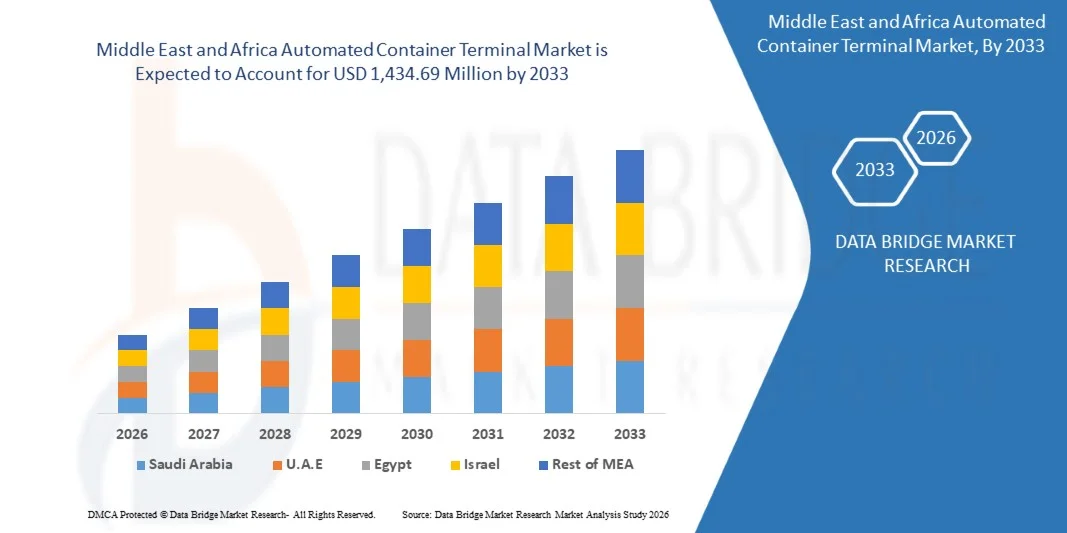
- The Middle East and Africa Automated Container Terminal Market was valued at USD 872.86 million in 2025 and is expected to reach USD 1,434.69 million by 2033, at a CAGR of 6.5% during the forecast period
- The market growth is primarily driven by the rising adoption of digital port infrastructure, expanding port capacity, and increasing investments in smart logistics and automation technologies across major maritime hubs such as the U.A.E., Saudi Arabia, and South Africa
- Additionally, government-backed initiatives promoting smart port development, coupled with the expansion of specialized container handling facilities and growing participation of global terminal operators such as DP World and APM Terminals, are further accelerating market expansion.
- The region is witnessing a surge in automation adoption including Automated Guided Vehicles (AGVs), Automated Stacking Cranes (ASCs), and advanced Terminal Operating Systems (TOS) to enhance throughput efficiency, reduce operational costs, and minimize carbon emissions in line with sustainability goals.
Middle East and Africa Automated Container Terminal Market Analysis
- The Automated Container Terminal market is experiencing steady growth, driven by The surge in international trade has led to higher container throughput, Proliferation of automation, robotics, and AI in port operations, Sustainability initiatives promoting energy-efficient and low-emission terminals, and Rising government investments and incentives for smart port initiatives.
- However, High upfront investment and installation costs, compliance with stringent regional regulations and safety standard, and Operational Disruptions During Transition & complexity associated with automation systems remain key restraints, while Expansion of automated terminals in emerging markets, Integration with smart logistics solutions and port community systems, Growing adoption of electric and hybrid automated equipment for sustainability present significant growth opportunities
- U.A.E. is expected to dominate the Middle East and Africa Automated Container Terminal Market with the largest revenue share of 35.44% in 2026, supported by strong government initiatives for port modernization, large-scale investments in smart port infrastructure, and the rapid adoption of automation and digitalization technologies across major terminals. The U.A.E.’s flagship ports Jebel Ali (Dubai), Khalifa Port (Abu Dhabi), and Port Rashid have implemented advanced systems such as automated stacking cranes (ASCs), automated guided vehicles (AGVs), and AI-based terminal operating systems (TOS) to enhance efficiency and sustainability. Furthermore, the participation of leading global technology providers like ABB, Konecranes, and Siemens, alongside strategic projects led by DP World and AD Ports Group, reinforces the U.A.E.’s position as a regional leader in port automation and smart logistics integration.
- U.A.E. is expected to be the fastest-growing region in the Middle East and Africa Automated Container Terminal Market during the forecast period with a CAGR of 7.5%, fueled by large-scale investments in port automation, rising trade volumes, and strong government support for developing smart and sustainable port infrastructure. Major hubs such as Jebel Ali Port and Khalifa Port are adopting AI, IoT, automated cranes, and digital twin technologies to boost operational efficiency and sustainability. Collaboration between domestic tech providers and global automation leaders is further accelerating the deployment of next-generation automated terminals across the country.
- The Semi-Automated Terminals segment is expected to dominate the Middle East and Africa Automated Container Terminal Market with a market share of 55.89% in 2026, driven by their cost-effectiveness, operational flexibility, and ease of integration with existing port infrastructure. Semi-automation allows ports to gradually transition toward full automation while retaining manual oversight, minimizing implementation risks and costs. The growing use of automated stacking cranes (ASCs) and remote-controlled yard equipment, combined with an increasing emphasis on efficiency, safety, and productivity, is driving the segment’s strong adoption across key ports in the region.
Report Scope and Middle East and Africa Automated Container Terminal Market Segmentation
|
Attributes |
Middle East and Africa Automated Container Terminal Key Market Insights |
|
Segments Covered |
|
|
Countries Covered |
Middle East and Africa
|
|
Key Market Players |
|
|
Market Opportunities |
|
|
Value Added Data Infosets |
In addition to the insights on market scenarios such as market value, growth rate, segmentation, geographical coverage, and major players, the market reports curated by the Data Bridge Market Research also include industry analysis & futuristic scenario, penetration and growth prospect mapping, competitor key pricing strategies (prominent players), technology analysis, company profiling, competitive analysis. |
Middle East and Africa Automated Container Terminal Market Trends
“Expansion of automated terminals in emerging markets”
- The rapid growth in trade volumes and the increasing demand for efficient port operations in emerging markets are creating a significant opportunity for ACT market players. By developing greenfield and brownfield automated container terminals, these regions can enhance port efficiency, accommodate larger vessels, and strengthen their integration into global supply chains.
- Expansion into emerging markets enables equipment manufacturers, software vendors, and service integrators to leverage first-mover advantages, deploy modern automation technologies, and achieve greater operational scalability. Investments in advanced cranes, Automated Guided Vehicles (AGVs), Terminal Operating Systems (TOS), and digital logistics platforms are transforming ports into modern, efficient hubs capable of handling surging container traffic while reducing costs and dwell times.
- In September 2025, Reuters reported that the Colombo West International Terminal (Sri Lanka), operated by a consortium led by Adani Group, expanded its fully automated terminal capacity to handle up to 3.2 million containers annually, ahead of schedule, strengthening regional logistics capabilities
- Thus, the expansion of automated terminals in emerging markets is establishing these regions as key growth drivers for the ACT market. By implementing advanced automation technologies, emerging-market ports are modernizing infrastructure, reducing operational bottlenecks, and improving global competitiveness, paving the way for sustained industry growth.
Middle East and Africa Automated Container Terminal Market Dynamics
Driver
“The surge in international trade has led to higher container throughput”
- The continuous expansion of global trade has significantly increased the volume of containerized cargo moving across international borders, thereby driving demand for efficient, automated container-handling solutions. As seaborne trade remains the backbone of global commerce, ports worldwide are under growing pressure to enhance throughput capacity, reduce vessel turnaround time, and improve overall terminal efficiency. Automated Container Terminals (ACTs) have emerged as a vital solution to address these operational demands by leveraging robotics, AI, and advanced logistics technologies.
- Rising globalization, coupled with the growth of e-commerce and cross-border supply chains, is further accelerating the need for automation in port operations. Automated cranes, driverless vehicles, and digital port management systems are increasingly being deployed to handle large container volumes with precision and minimal human intervention.
- In October 2024, according to the United Nations Conference on Trade and Development (UNCTAD, 2024), global maritime trade volumes grew by 2.4% in 2023, with containerized trade accounting for over 60% of seaborne cargo, emphasizing the critical need for automated port infrastructure
- In November 2024, A report by Hamburg Port Consulting highlights that automation and digitalisation are becoming essential to modern port operations, as rising cargo volumes demand higher efficiency
- In addition, the increasing complexity of global logistics networks and the expansion of free trade zones are compelling ports to adopt next-generation automated systems to remain competitive. Automation not only supports higher container throughput but also ensures greater operational accuracy, sustainability, and adaptability to fluctuating trade demands. As international maritime trade continues to surge, automation technologies such as AGVs, automated stacking cranes, and digital twin-based monitoring systems are becoming indispensable for optimizing performance and reducing operational bottlenecks.
- Thus, the surge in international trade volumes and the growing need for efficient container handling are propelling the adoption of automated container terminals globally, solidifying automation as a key pillar for future-ready, resilient, and high-performing port operations.
Restraint/Challenge
“High upfront investment and installation costs”
Despite the growing adoption of automation technologies across global ports, the high upfront investment and installation costs remain a significant restraining factor in the Middle East and Africa Automated Container Terminal Market. Developing fully or semi-automated terminals requires substantial capital for advanced machinery, such as Automated Guided Vehicles (AGVs), Automated Stacking Cranes (ASCs), and sophisticated Terminal Operating Systems (TOS), as well as for integrating supporting digital infrastructure and energy systems. These expenses often exceed hundreds of millions of dollars, posing a major restraint, particularly for medium- and small-scale ports with limited budgets or uncertain cargo throughput.
- Moreover, automation projects typically involve complex retrofitting and long installation timelines, which can disrupt ongoing operations and extend Return-On-Investment (ROI) periods. While automation promises long-term operational efficiency and labor savings, the high initial Capital Expenditure (CAPEX) and integration risks often deter terminal operators from adopting full-scale automation solutions. Consequently, many ports opt for phased or hybrid automation models instead of complete overhauls.
- In January 2024, Port Technology International reported that 62% of terminal professionals identified high initial investment requirements as the primary barrier to automation deployment in container terminals
- In June 2023, PortEconomics highlighted that automation retrofits in existing terminals often face complex integration issues, further increasing project costs and limiting flexibility post-installation.
- Thus, while terminal automation promises long-term benefits such as enhanced productivity, labor optimization, and sustainability, the significant upfront financial burden and complex installation processes remain key restraints for market growth. Overcoming these challenges will depend on adopting innovative financing mechanisms, phased automation models, and increased public–private collaboration to make automation financially viable for ports of all sizes in the coming years.
Middle East and Africa Automated Container Terminal Market Scope
The market is segmented on the basis of degree of automation, project type, offering, end user, and distribution channel.
- By Degree of Automation
On the basis of Degree of Automation, the Middle East and Africa Automated Container Terminal Market is segmented into Semi-Automated Terminals and Fully Automated Terminals. In 2026, the Semi-Automated Terminals segment is expected to dominate the market with a 55.89% market share, driven by their cost-effectiveness, operational flexibility, gradual integration of automation with manual oversight, and the growing adoption of automated stacking cranes (ASCs) and remote-controlled yard equipment, which enhance efficiency, safety, and productivity while minimizing transition risks and implementation costs.
- By Project Type
On the basis of Project Type, the Middle East and Africa Automated Container Terminal Market is segmented into Brownfield and Greenfield. In 2026, the Brownfield segment is expected to dominate with a 56.90% market share, driven by the upgrading and modernization of existing port infrastructure, integration of advanced automation technologies into operational terminals, cost-effectiveness compared to building new terminals, and the need to enhance efficiency, reduce vessel turnaround times, and meet growing container throughput demands.
The Greenfield segment is the fastest-growing segment in the Middle East and Africa Automated Container Terminal Market, with a CAGR of 7.0%, driven by the development of new, state-of-the-art terminals equipped with advanced automation technologies, increasing international trade volumes, strong government support for port infrastructure expansion, and the need for efficient, scalable, and sustainable terminal operations.
- By Offering
On the basis of Offering, the Middle East and Africa Automated Container Terminal Market is segmented into Equipment, Software, Services. In 2026, the Equipment segment is expected to dominate the market with 55.85% market share, driven by the growing deployment of automated stacking cranes (ASCs), automated guided vehicles (AGVs), remote-controlled yard equipment, and quay cranes, as well as increasing investments in port modernization, rising container volumes, and the demand for higher operational efficiency and safety in terminal operations.
Software is the fastest-growing segment with a CAGR of 7.3% in the Middle East and Africa Automated Container Terminal Market driven by rising adoption of advanced terminal operating systems (TOS), real-time data analytics, AI and IoT-enabled solutions, and the growing need for efficient cargo management, predictive maintenance, and seamless port community integration.
- By End User
On the basis of end user, the market is segmented into public and private. In 2026, the public segment is expected to dominate the market with 61.41% market share, driven by the government-led port authorities, large-scale infrastructure investments, national trade facilitation initiatives, modernization of strategic ports, adoption of automation to improve efficiency and safety, long-term funding stability, and policy support aimed at enhancing global connectivity and economic growth.
Private is the fastest-growing segment with CAGR of 6.9% in the market driven by rising private terminal concessions, public–private partnerships, demand for operational efficiency, faster decision-making, return-on-investment focus, adoption of advanced automation technologies, competitive pressure to reduce costs, improve throughput, and deliver higher service reliability.
- By Distribution Channel
On the basis of distribution channel, the market is segmented into direct channel and indirect channel. In 2026, the direct channel segment is expected to dominate the market with 69.55% market share, driven by the strong relationships between terminal operators and automation solution providers, customized system integration requirements, reduced procurement costs, direct technical support, long-term service contracts, and the need for seamless implementation of complex, high-value automation solutions.
Middle East and Africa Automated Container Terminal Market Regional Analysis
- The U.A.E. is expected to dominate the Middle East and Africa Automated Container Terminal Market with the largest revenue share of 35.44% in 2026, supported by their cost-effectiveness, operational flexibility, gradual integration of automation with manual oversight, and the growing adoption of automated stacking cranes (ASCs) and remote-controlled yard equipment, which enhance efficiency, safety, and productivity while minimizing transition risks and implementation costs.
- U.A.E. is expected to be the fastest-growing region in the Middle East and Africa Automated Container Terminal Market during the forecast period with a CAGR of 7.5%, fueled by large-scale investments in port automation, rapid expansion of trade volumes, strong government initiatives for developing smart and sustainable port infrastructure, and the adoption of advanced digital technologies such as AI, IoT, and digital twin systems. Additionally, collaborations between domestic technology providers and global automation companies are accelerating the deployment of next-generation automated terminals across the country.
Saudi Arabia Middle East and Africa Automated Container Terminal Market Insight
The Saudi Arabia Middle East and Africa Automated Container Terminal Market plays a significant role in the Middle East and Africa region, driven by government initiatives under Saudi Vision 2030 aimed at transforming the kingdom into a global logistics hub, modernization of key ports such as Jeddah Islamic Port, King Abdulaziz Port in Dammam, and King Abdullah Port, adoption of advanced automation technologies including automated stacking cranes (ASCs), AI-driven terminal operating systems (TOS), and smart gate solutions, as well as increasing container throughput and collaborations with global port operators and technology providers.
South Africa Middle East and Africa Automated Container Terminal Market Insight
The South Africa Middle East and Africa Automated Container Terminal Market is projected to grow steadily, supported by ongoing modernization initiatives by Transnet Port Terminals (TPT), adoption of automated stacking cranes (ASCs) and remote-controlled quay cranes, implementation of smart port technologies and predictive maintenance solutions, investments in digital logistics infrastructure, and strategic partnerships with global automation providers such as Kalmar, ABB, and Siemens. Key ports including the Port of Durban, Port of Ngqura, and Cape Town Container Terminal are leading this transformation to enhance efficiency, reduce vessel turnaround times, and support the region’s growing trade volumes.
The Major Market Leaders Operating in the Market Are:
- TOTAL SOFT BANK LTD. (South Korea)
- INFORM SOFTWARE (Germany)
- Logstar ERP. (India)
- Tideworks (U.S.)
- Loginno Logistic Innovation ltd. (Israel)
- World Crane Services FZE (U.A.E.)
- STARCOMM SYSTEMS (U.K.)
- Kalmar Corporation (Finland)
- Cargotec Corporation (Finland)
- Konecranes Plc (Finland)
- Shanghai Zhenhua Heavy Industries Co., Ltd. (China)
- LIEBHERR Group (Switzerland)
- ABB Ltd. (Switzerland)
- HAPAG LLOYD (Germany)
- APM Terminals (Netherlands)
- BECKHOFF AUTOMATION GMBH & CO. KG (Germany)
- Künz GmbH (Austria)
- CyberLogitec Co., Ltd. (Korea)
- Camco Technologies NV (Belgium)
- IDENTEC SOLUTIONS AG (Austria)
- ORBCOMM Inc. (U.S.)
- ORBITA PORTS & TERMINALS acquired by TMEIC PORT TECHNOLOGIES, S.L. (Japan)
- PACECO Corp. (U.S.)
Latest Developments in Middle East and Africa Automated Container Terminal Market
- In October 2025, Hapag-Lloyd and DP World renewed their long-term partnership at the Port of Santos in Brazil. This extension secures collaboration for the next decade and includes a major expansion of the terminal, increasing quay length and annual handling capacity, which will allow Hapag-Lloyd to handle larger vessels and deliver new services for customers.
- In September 2025, Hiab Corporation signed a partnership with Forterra to accelerate the development of autonomous trucking and load handling solutions. This aims to elevate autonomous capabilities, enhancing sustainability and safety in logistics workflows.
- In September 2025, Liebherr and TPT entered into a 10-year strategic partnership agreement aimed at modernizing and enhancing efficiency across South Africa’s port operations. The agreement includes the supply of four large STS cranes for the Port of Durban and 48 rubber-tyred gantry (RTG) cranes for the Durban and Cape Town terminals, along with a 20-year asset management program to ensure long-term reliability of the equipment.
- In November 2024, Shanghai Zhenhua Heavy Industries Co., Ltd. (ZPMC) entered into a strategic cooperation agreement with Cavotec SA, marking a significant step toward advancing sustainability and innovation in port and terminal infrastructure globally. This partnership combines ZPMC’s expertise in manufacturing heavy-duty port equipment with Cavotec’s specialized technologies in automation and electrification. Together, they aim to develop cutting-edge solutions that improve the efficiency and environmental performance of ports, such as reducing emissions through electrified equipment and enhancing operational automation. By leveraging the strengths of both companies, the collaboration seeks to support the global maritime industry’s transition toward greener, smarter, and more sustainable port operations.
- In December 2024, Konecranes completed the acquisition of Rotterdam-based Peinemann Port Services BV and Peinemann Container Handling BV after receiving approval from the Dutch competition authority. The acquisition, valued at an undisclosed amount, added approximately 100 employees and strengthened Konecranes' position in the Netherlands, particularly in the Rotterdam area.

- Interactive Data Analysis Dashboard
- Company Analysis Dashboard for high growth potential opportunities
- Research Analyst Access for customization & queries
- Competitor Analysis with Interactive dashboard
- Latest News, Updates & Trend analysis
- Harness the Power of Benchmark Analysis for Comprehensive Competitor Tracking
Table of Content
1 INTRODUCTION
1.1 OBJECTIVES OF THE STUDY
1.2 MARKET DEFINITION
1.3 OVERVIEW
1.4 LIMITATIONS
1.5 MARKETS COVERED
2 MARKET SEGMENTATION
2.1 MARKETS COVERED
2.2 GEOGRAPHICAL SCOPE
2.3 YEARS CONSIDERED FOR THE STUDY
2.4 CURRENCY AND PRICING
2.5 DBMR TRIPOD DATA VALIDATION MODEL
2.6 MULTIVARIATE MODELING
2.7 PRIMARY INTERVIEWS WITH KEY OPINION LEADERS
2.8 DBMR MARKET POSITION GRID
2.9 DBMR VENDOR SHARE ANALYSIS
2.1 SECONDARY SOURCES
2.11 ASSUMPTIONS
3 EXECUTIVE SUMMARY
4 PREMIUM INSIGHTS
4.1 INDUSTRY ANALYSIS & FUTURISTIC SCENARIO
4.2 PENETRATION AND GROWTH PROSPECT MAPPING
4.3 COMPETITOR KEY PRICING STRATEGIES (PROMINENT PLAYERS)
4.4 TECHNOLOGY ANALYSIS – MIDDLE EAST AND AFRICA AUTOMATED CONTAINER TERMINAL MARKET
4.4.1 KEY TECHNOLOGIES
4.4.2 COMPLEMENTARY TECHNOLOGIES
4.4.3 ADJACENT TECHNOLOGIES
4.5 COMPANY PROFILING
4.5.1 HAPAG-LLOYD AG
4.5.1.1 LIST OF ACQUISITION
4.5.1.2 SHAREHOLDING PATTERN
4.5.1.3 COMPANY’S COMPETITORS AND ALTERNATIVES
4.5.1.4 BUSINESS MODEL
4.5.1.5 HOW THE COMPANY MAKES MONEY CANVAS
4.5.1.5.1 COMPANY CUSTOMER SEGMENTS
4.5.1.5.2 COMPANY VALUE PROPOSITIONS
4.5.1.5.3 COMPANY CHANNELS
4.5.1.5.4 COMPANY CUSTOMER RELATIONSHIPS
4.5.1.5.5 COMPANY REVENUE STREAMS
4.5.1.5.6 COMPANY KEY RESOURCES
4.5.1.5.7 COMPANY KEY ACTIVITIES
4.5.1.5.8 COMPANY KEY PARTNERS
4.5.1.5.9 COMPANY A COST STRUCTURE
4.5.1.5.10 COMPANY SWOT ANALYSIS
4.5.2 KONECRANES
4.5.2.1 LIST OF ACQUISITION
4.5.2.2 SHAREHOLDING PATTERN
4.5.2.3 COMPANY’S COMPETITORS AND ALTERNATIVES
4.5.2.4 BUSINESS MODEL
4.5.2.5 HOW THE COMPANY MAKES MONEY CANVAS
4.5.2.5.1 COMPANY CUSTOMER SEGMENTS
4.5.2.5.2 COMPANY VALUE PROPOSITIONS
4.5.2.5.3 COMPANY CHANNELS
4.5.2.5.4 COMPANY CUSTOMER RELATIONSHIPS
4.5.2.5.5 COMPANY REVENUE STREAMS
4.5.2.5.6 COMPANY KEY RESOURCES
4.5.2.5.7 COMPANY KEY ACTIVITIES
4.5.2.5.8 COMPANY KEY PARTNERS
4.5.2.5.9 COMPANY A COST STRUCTURE
4.5.2.5.10 COMPANY SWOT ANALYSIS
4.6 COMPETITIVE ANALYSIS
5 MARKET OVERVIEW
5.1 DRIVERS
5.1.1 THE SURGE IN INTERNATIONAL TRADE HAS LED TO HIGHER CONTAINER THROUGHPUT
5.1.2 PROLIFERATION OF AUTOMATION, ROBOTICS, AND AI IN PORT OPERATIONS
5.1.3 SUSTAINABILITY INITIATIVES PROMOTING ENERGY-EFFICIENT AND LOW-EMISSION TERMINALS
5.1.4 RISING GOVERNMENT INVESTMENTS AND INCENTIVES FOR SMART PORT INITIATIVES
5.2 RESTRAINTS
5.2.1 HIGH UPFRONT INVESTMENT AND INSTALLATION COSTS
5.2.2 COMPLIANCE WITH STRINGENT REGIONAL REGULATIONS AND SAFETY STANDARDS
5.3 OPPORTUNITIES
5.3.1 EXPANSION OF AUTOMATED TERMINALS IN EMERGING MARKETS
5.3.2 INTEGRATION WITH SMART LOGISTICS SOLUTIONS AND PORT COMMUNITY SYSTEMS
5.3.3 GROWING ADOPTION OF ELECTRIC AND HYBRID AUTOMATED EQUIPMENT FOR SUSTAINABILITY
5.4 CHALLENGES
5.4.1 CYBERSECURITY RISKS ASSOCIATED WITH DIGITAL PORT INFRASTRUCTURE
5.4.2 SYSTEM INTEROPERABILITY WITH LEGACY EQUIPMENT AND MULTI-VENDOR SOLUTIONS
6 MIDDLE EAST AND AFRICA AUTOMATED CONTAINER TERMINAL MARKET, BY DEGREE OF AUTOMATION
6.1 MIDDLE EAST AND AFRICA AUTOMATED CONTAINER TERMINAL MARKET, BY DEGREE OF AUTOMATION, 2018-2033 (USD THOUSAND)
6.1.1 SEMI-AUTOMATED TERMINALS
6.1.2 FULLY AUTOMATED TERMINALS
7 MIDDLE EAST AND AFRICA AUTOMATED CONTAINER TERMINAL MARKET, BY PROJECT TYPE
7.1 MIDDLE EAST AND AFRICA AUTOMATED CONTAINER TERMINAL MARKET, BY PROJECT TYPE, 2018-2033 (USD THOUSAND)
7.1.1 BROWNFIELD PROJECTS
7.1.1.1 BROWNFIELD PROJECTS, BY TYPE
7.1.1.1.1 END-TO-END BROWNFIELD PROJECTS TERMINAL AUTOMATION
7.1.1.1.2 YARD-ONLY AUTOMATION RETROFITS
7.1.1.1.3 LANDSIDE / GATE AUTOMATION UPGRADES
7.1.1.1.4 QUAY CRANE AUTOMATION RETROFITS
7.1.2 GREENFIELD PROJECTS
7.1.2.1 GREENFIELD PROJECTS, BY TYPE
7.1.2.1.1 FULLY AUTOMATED GREENFIELD PROJECTS TERMINALS
7.1.2.1.2 SEMI-AUTOMATED GREENFIELD PROJECTS TERMINALS
7.1.2.1.3 PHASED GREENFIELD PROJECTS AUTOMATION
8 MIDDLE EAST AND AFRICA AUTOMATED CONTAINER TERMINAL MARKET, BY OFFERING
8.1 MIDDLE EAST AND AFRICA AUTOMATED CONTAINER TERMINAL MARKET, BY OFFERING, 2018-2033 (USD THOUSAND)
8.1.1 EQUIPMENT
8.1.1.1 EQUIPMENT, BY TYPE
8.1.1.1.1 AUTOMATED & REMOTE-CONTROLLED CRANES
8.1.1.1.2 AUTOMATED HORIZONTAL TRANSPORT
8.1.1.1.3 GATE & LANDSIDE AUTOMATION EQUIPMENT
8.1.1.1.4 OTHERS
8.1.2 SOFTWARE
8.1.2.1 SOFTWARE, BY TYPE
8.1.2.1.1 EQUIPMENT CONTROL SYSTEMS (ECS) & FLEET MANAGEMENT
8.1.2.1.2 TERMINAL OPERATING SYSTEMS (TOS)
8.1.2.1.3 AUTOMATION & ORCHESTRATION PLATFORMS
8.1.2.1.4 DIGITAL TWIN & SIMULATION TOOLS
8.1.2.1.5 GATE & COMMUNITY PLATFORMS
8.1.2.1.6 OTHERS
8.1.3 SERVICES
8.1.3.1 SERVICE, BY TYPE
8.1.3.1.1 PROFESSIONAL SERVICES
8.1.3.1.2 MANAGED SERVICES
9 MIDDLE EAST AND AFRICA AUTOMATED CONTAINER TERMINAL MARKET, BY END USER
9.1 MIDDLE EAST AND AFRICA AUTOMATED CONTAINER TERMINAL MARKET, BY END USER, 2018-2033 (USD THOUSAND)
9.1.1 PUBLIC
9.1.1.1 PUBLIC, BY APPLICATION
9.1.1.1.1 PORT INFRASTRUCTURE MODERNIZATION
9.1.1.1.2 TRADE FACILITATION & CUSTOMS AUTOMATION
9.1.1.1.3 SAFETY & COMPLIANCE AUTOMATION
9.1.1.1.4 SMART NATIONAL LOGISTICS CORRIDORS
9.1.1.1.5 PUBLIC–PRIVATE PARTNERSHIP (PPP) CO-MANAGED TERMINALS
9.1.1.1.6 OTHERS
9.1.2 PRIVATE
9.1.2.1 PRIVATE, BY APPLICATION
9.1.2.1.1 HIGH-VOLUME AUTOMATED CONTAINER HANDLING
9.1.2.1.2 AUTOMATED LOGISTICS & INTERMODAL HUBS
9.1.2.1.3 CARRIER-OWNED SMART TERMINALS
9.1.2.1.4 SUBSCRIPTION & MANAGED TERMINAL AUTOMATION SERVICES
10 MIDDLE EAST AND AFRICA AUTOMATED CONTAINER TERMINAL MARKET, BY DISTRIBUTION CHANNEL
10.1 MIDDLE EAST AND AFRICA AUTOMATED CONTAINER TERMINAL MARKET, BY DISTRIBUTION CHANNEL, 2018-2033 (USD THOUSAND)
10.1.1 DIRECT CHANNEL
10.1.2 INDIRECT CHANNEL
10.1.2.1 INDIRECT CHANNEL, BY TYPE
10.1.2.1.1 SYSTEM INTEGRATORS
10.1.2.1.2 VALUE-ADDED RESELLERS (VAR)
10.1.2.1.3 OTHERS
11 MIDDLE EAST AND AFRICA AUTOMATED CONTAINER TERMINAL MARKET, BY REGION
11.1 MIDDLE EAST AND AFRICA
11.1.1 U.A.E
11.1.2 SAUDI ARABIA
11.1.3 SOUTH AFRICA
11.1.4 EGYPT
11.1.5 ISRAEL
11.1.6 REST OF MIDDLE EAST & AFRICA
12 MIDDLE EAST AND AFRICA AUTOMATED CONTAINER TERMINAL MARKET, COMPANY LANDSCAPE
12.1 COMPANY SHARE ANALYSIS: GLOBAL
13 SWOT ANALYSIS
14 COMPANY PROFILES
14.1 LIEBHERR
14.1.1 COMPANY SNAPSHOT
14.1.2 REVENUE ANALYSIS
14.1.3 COMPANY SHARE ANALYSIS
14.1.4 PRODUCT PORTFOLIO
14.1.5 RECENT DEVELOPMENT
14.2 BECKHOFF AUTOMATION
14.2.1 COMPANY SNAPSHOT
14.2.2 COMPANY SHARE ANALYSIS
14.2.3 PRODUCT PORTFOLIO
14.2.4 RECENT DEVELOPMENT
14.3 SHANGHAI ZHENHUA HEAVY INDUSTRIES CO., LTD.
14.3.1 COMPANY SNAPSHOTS
14.3.2 REVENUE ANALYSIS
14.3.3 COMPANY SHARE ANALYSIS
14.3.4 PRODUCT PORTFOLIO
14.3.5 RECENT DEVELOPMENT
14.4 KONECRANES
14.4.1 COMPANY SNAPSHOT
14.4.2 REVENUE ANALYSIS
14.4.3 COMPANY SHARE ANALYSIS
14.4.4 PRODUCT PORTFOLIO
14.4.5 RECENT DEVELOPMENT
14.5 KALMAR CORPORATION
14.5.1 COMPANY SNAPSHOT
14.5.2 REVENUE ANALYSIS
14.5.3 COMPANY SHARE ANALYSIS
14.5.4 PRODUCT PORTFOLIO
14.5.5 RECENT DEVELOPMENT
14.6 ABB
14.6.1 COMPANY SNAPSHOT
14.6.2 REVENUE ANALYSIS
14.6.3 PRODUCT PORTFOLIO
14.6.4 RECENT DEVELOPMENT
14.7 APM TERMINALS
14.7.1 COMPANY SNAPSHOT
14.7.2 REVENUE ANALYSIS
14.7.3 PRODUCT PORTFOLIO
14.7.4 RECENT DEVELOPMENT
14.8 CAMCO TECHNOLOGIES
14.8.1 COMPANY SNAPSHOT
14.8.2 REVENUE ANALYSIS
14.8.3 PRODUCT PORTFOLIO
14.8.4 RECENT DEVELOPMENT
14.9 CLT
14.9.1 COMPANY SNAPSHOT
14.9.2 PRODUCT PORTFOLIO
14.9.3 RECENT DEVELOPMENT
14.1 HIAB CORPORATION (SUBSIDIARY OF CARGOTEC)
14.10.1 COMPANY SNAPSHOT
14.10.2 REVENUE ANALYSIS
14.10.3 PRODUCT PORTFOLIO
14.10.4 RECENT DEVELOPMENT
14.11 HAPAG-LLOYD AG
14.11.1 COMPANY SNAPSHOT
14.11.2 REVENUE ANALYSIS
14.11.3 PRODUCT PORTFOLIO
14.11.4 RECENT DEVELOPMENT
14.12 INFYZ.COM.
14.12.1 COMPANY SNAPSHOT
14.12.2 PRODUCT PORTFOLIO
14.12.3 RECENT DEVELOPMENT
14.13 INFORM SOFTWARE
14.13.1 COMPANY SNAPSHOT
14.13.2 PRODUCT PORTFOLIO
14.13.3 RECENT DEVELOPMENT
14.14 IDENTEC SOLUTIONS AG
14.14.1 COMPANY SNAPSHOT
14.14.2 PRODUCT PORTFOLIO
14.14.3 RECENT DEVELOPMENT
14.15 KÜNZ GMBH
14.15.1 COMPANY SNAPSHOT
14.15.2 PRODUCT PORTFOLIO
14.15.3 RECENT DEVELOPMENT
14.16 LOGSTAR ERP.
14.16.1 COMPANY SNAPSHOT
14.16.2 PRODUCT PORTFOLIO
14.16.3 RECENT DEVELOPMENT
14.17 LOGINNO LOGISTIC INNOVATION LTD.
14.17.1 COMPANY SNAPSHOT
14.17.2 PRODUCT PORTFOLIO
14.17.3 RECENT DEVELOPMENT
14.18 ORBCOMM
14.18.1 COMPANY SNAPSHOT
14.18.2 PRODUCT PORTFOLIO
14.18.3 RECENT DEVELOPMENT
14.19 PACECO CORP.
14.19.1 COMPANY SNAPSHOT
14.19.2 PRODUCT PORTFOLIO
14.19.3 RECENT DEVELOPMENT
14.2 STARCOM GPS MIDDLE EAST AND AFRICA SOLUTIONS
14.20.1 COMPANY SNAPSHOT
14.20.2 PRODUCT PORTFOLIO
14.20.3 ECENT DEVELOPMENT
14.21 TMEIC
14.21.1 COMPANY SNAPSHOT
14.21.2 PRODUCT PORTFOLIO
14.21.3 RECENT DEVELOPMENT
14.22 TIDEWORKS.
14.22.1 COMPANY SNAPSHOT
14.22.2 PRODUCT PORTFOLIO
14.22.3 RECENT DEVELOPMENT
14.23 TOTAL SOFT BANK LTD.
14.23.1 COMPANY SNAPSHOT
14.23.2 REVENUE ANALYSIS
14.23.3 PRODUCT PORTFOLIO
14.24 WCS CONSULTANCY
14.24.1 COMPANY SNAPSHOT
14.24.2 PRODUCT PORTFOLIO
14.24.3 RECENT DEVELOPMENT
15 QUESTIONNAIRE
16 RELATED REPORTS
List of Table
TABLE 1 INDUSTRY ANALYSIS AND FUTURISTIC SCENARIO OF THE MIDDLE EAST AND AFRICA AUTOMATED CONTAINER TERMINAL MARKET
TABLE 2 MIDDLE EAST AND AFRICA AUTOMATED CONTAINER TERMINAL MARKET, BY DEGREE OF AUTOMATION, 2018-2033 (USD THOUSAND)
TABLE 3 MIDDLE EAST AND AFRICA SEMI-AUTOMATED TERMINALS IN AUTOMATED CONTAINER TERMINAL MARKET, BY REGION, 2018-2033 (USD THOUSAND)
TABLE 4 MIDDLE EAST AND AFRICA FULLY AUTOMATED TERMINALS IN AUTOMATED CONTAINER TERMINAL MARKET, BY REGION, 2018-2033 (USD THOUSAND)
TABLE 5 MIDDLE EAST AND AFRICA AUTOMATED CONTAINER TERMINAL MARKET, BY PROJECT TYPE, 2018-2033 (USD THOUSAND)
TABLE 6 MIDDLE EAST AND AFRICA BROWNFIELD PROJECTS IN AUTOMATED CONTAINER TERMINAL MARKET, BY REGION, 2018-2033 (USD THOUSAND)
TABLE 7 MIDDLE EAST AND AFRICA BROWNFIELD PROJECTS IN AUTOMATED CONTAINER TERMINAL MARKET, BY TYPE, 2018-2033 (USD THOUSAND)
TABLE 8 MIDDLE EAST AND AFRICA GREENFIELD PROJECTS IN AUTOMATED CONTAINER TERMINAL MARKET, BY REGION, 2018-2033 (USD THOUSAND)
TABLE 9 MIDDLE EAST AND AFRICA GREENFIELD PROJECTS IN AUTOMATED CONTAINER TERMINAL MARKET, BY TYPE, 2018-2033 (USD THOUSAND)
TABLE 10 MIDDLE EAST AND AFRICA AUTOMATED CONTAINER TERMINAL MARKET, BY OFFERING, 2018-2033 (USD THOUSAND)
TABLE 11 MIDDLE EAST AND AFRICA EQUIPMENT IN AUTOMATED CONTAINER TERMINAL MARKET, BY REGION, 2018-2033 (USD THOUSAND)
TABLE 12 MIDDLE EAST AND AFRICA EQUIPMENT IN AUTOMATED CONTAINER TERMINAL MARKET, BY TYPE, 2018-2033 (USD THOUSAND)
TABLE 13 MIDDLE EAST AND AFRICA SOFTWARE IN AUTOMATED CONTAINER TERMINAL MARKET, BY REGION, 2018-2033 (USD THOUSAND)
TABLE 14 MIDDLE EAST AND AFRICA SOFTWARE IN AUTOMATED CONTAINER TERMINAL MARKET, BY TYPE, 2018-2033 (USD THOUSAND)
TABLE 15 MIDDLE EAST AND AFRICA SERVICES IN AUTOMATED CONTAINER TERMINAL MARKET, BY REGION, 2018-2033 (USD THOUSAND)
TABLE 16 MIDDLE EAST AND AFRICA SERVICES IN AUTOMATED CONTAINER TERMINAL MARKET, BY TYPE, 2018-2033 (USD THOUSAND)
TABLE 17 MIDDLE EAST AND AFRICA PROFESSIONAL SERVICES IN AUTOMATED CONTAINER TERMINAL MARKET, BY TYPE, 2018-2033 (USD THOUSAND)
TABLE 18 MIDDLE EAST AND AFRICA AUTOMATED CONTAINER TERMINAL MARKET, BY END USER, 2018-2033 (USD THOUSAND)
TABLE 19 MIDDLE EAST AND AFRICA PUBLIC IN AUTOMATED CONTAINER TERMINAL MARKET, BY REGION, 2018-2033 (USD THOUSAND)
TABLE 20 MIDDLE EAST AND AFRICA PUBLIC IN AUTOMATED CONTAINER TERMINAL MARKET, BY APPLICATION, 2018-2033 (USD THOUSAND)
TABLE 21 MIDDLE EAST AND AFRICA PRIVATE IN AUTOMATED CONTAINER TERMINAL MARKET, BY REGION, 2018-2033 (USD THOUSAND)
TABLE 22 MIDDLE EAST AND AFRICA PRIVATE IN AUTOMATED CONTAINER TERMINAL MARKET, BY APPLICATION, 2018-2033 (USD THOUSAND)
TABLE 23 MIDDLE EAST AND AFRICA AUTOMATED CONTAINER TERMINAL MARKET, BY DISTRIBUTION CHANNEL, 2018-2033 (USD THOUSAND)
TABLE 24 MIDDLE EAST AND AFRICA DIRECT CHANNEL IN AUTOMATED CONTAINER TERMINAL MARKET, BY REGION, 2018-2033 (USD THOUSAND)
TABLE 25 MIDDLE EAST AND AFRICA INDIRECT CHANNEL IN AUTOMATED CONTAINER TERMINAL MARKET, BY REGION, 2018-2033 (USD THOUSAND)
TABLE 26 MIDDLE EAST AND AFRICA INDIRECT CHANNEL IN AUTOMATED CONTAINER TERMINAL MARKET, BY TYPE, 2018-2033 (USD THOUSAND)
TABLE 27 MIDDLE EAST & AFRICA AUTOMATED CONTAINER TERMINAL MARKET, BY COUNTRY, 2018-2033 (USD THOUSAND)
TABLE 28 MIDDLE EAST AND AFRICA AUTOMATED CONTAINER TERMINAL MARKET, BY DEGREE OF AUTOMATION, 2018-2033 (USD THOUSAND)
TABLE 29 MIDDLE EAST AND AFRICA AUTOMATED CONTAINER TERMINAL MARKET, BY PROJECT TYPE, 2018-2033 (USD THOUSAND)
TABLE 30 MIDDLE EAST AND AFRICA BROWNFIELD PROJECTS IN AUTOMATED CONTAINER TERMINAL MARKET, BY TYPE, 2018-2033 (USD THOUSAND)
TABLE 31 MIDDLE EAST AND AFRICA GREENFIELD PROJECTS IN AUTOMATED CONTAINER TERMINAL MARKET, BY TYPE, 2018-2033 (USD THOUSAND)
TABLE 32 MIDDLE EAST AND AFRICA AUTOMATED CONTAINER TERMINAL MARKET, BY OFFERING, 2018-2033 (USD THOUSAND)
TABLE 33 MIDDLE EAST AND AFRICA EQUIPMENT IN AUTOMATED CONTAINER TERMINAL MARKET, BY TYPE, 2018-2033 (USD THOUSAND)
TABLE 34 MIDDLE EAST AND AFRICA SOFTWARE IN AUTOMATED CONTAINER TERMINAL MARKET, BY TYPE, 2018-2033 (USD THOUSAND)
TABLE 35 MIDDLE EAST AND AFRICA SERVICES IN AUTOMATED CONTAINER TERMINAL MARKET, BY TYPE, 2018-2033 (USD THOUSAND)
TABLE 36 MIDDLE EAST AND AFRICA PROFESSIONAL SERVICES IN AUTOMATED CONTAINER TERMINAL MARKET, BY TYPE, 2018-2033 (USD THOUSAND)
TABLE 37 MIDDLE EAST AND AFRICA AUTOMATED CONTAINER TERMINAL MARKET, BY END USER, 2018-2033 (USD THOUSAND)
TABLE 38 MIDDLE EAST AND AFRICA PUBLIC IN AUTOMATED CONTAINER TERMINAL MARKET, BY APPLICATION, 2018-2033 (USD THOUSAND)
TABLE 39 MIDDLE EAST AND AFRICA PRIVATE IN AUTOMATED CONTAINER TERMINAL MARKET, BY APPLICATION, 2018-2033 (USD THOUSAND)
TABLE 40 MIDDLE EAST AND AFRICA AUTOMATED CONTAINER TERMINAL MARKET, BY DISTRIBUTION CHANNEL, 2018-2033 (USD THOUSAND)
TABLE 41 MIDDLE EAST AND AFRICA INDIRECT CHANNEL IN AUTOMATED CONTAINER TERMINAL MARKET, BY TYPE, 2018-2033 (USD THOUSAND)
TABLE 42 U.A.E (USD THOUSAND)
TABLE 43 U.A.E AUTOMATED CONTAINER TERMINAL MARKET, BY DEGREE OF AUTOMATION, 2018-2033 (USD THOUSAND)
TABLE 44 U.A.E AUTOMATED CONTAINER TERMINAL MARKET, BY PROJECT TYPE, 2018-2033 (USD THOUSAND)
TABLE 45 U.A.E BROWNFIELD PROJECTS IN AUTOMATED CONTAINER TERMINAL MARKET, BY TYPE, 2018-2033 (USD THOUSAND)
TABLE 46 U.A.E GREENFIELD PROJECTS IN AUTOMATED CONTAINER TERMINAL MARKET, BY TYPE, 2018-2033 (USD THOUSAND)
TABLE 47 U.A.E AUTOMATED CONTAINER TERMINAL MARKET, BY OFFERING, 2018-2033 (USD THOUSAND)
TABLE 48 U.A.E EQUIPMENT IN AUTOMATED CONTAINER TERMINAL MARKET, BY TYPE, 2018-2033 (USD THOUSAND)
TABLE 49 U.A.E SOFTWARE IN AUTOMATED CONTAINER TERMINAL MARKET, BY TYPE, 2018-2033 (USD THOUSAND)
TABLE 50 U.A.E SERVICES IN AUTOMATED CONTAINER TERMINAL MARKET, BY TYPE, 2018-2033 (USD THOUSAND)
TABLE 51 U.A.E PROFESSIONAL SERVICES IN AUTOMATED CONTAINER TERMINAL MARKET, BY TYPE, 2018-2033 (USD THOUSAND)
TABLE 52 U.A.E AUTOMATED CONTAINER TERMINAL MARKET, BY END USER, 2018-2033 (USD THOUSAND)
TABLE 53 U.A.E PUBLIC IN AUTOMATED CONTAINER TERMINAL MARKET, BY APPLICATION, 2018-2033 (USD THOUSAND)
TABLE 54 U.A.E PRIVATE IN AUTOMATED CONTAINER TERMINAL MARKET, BY APPLICATION, 2018-2033 (USD THOUSAND)
TABLE 55 U.A.E AUTOMATED CONTAINER TERMINAL MARKET, BY DISTRIBUTION CHANNEL, 2018-2033 (USD THOUSAND)
TABLE 56 U.A.E INDIRECT CHANNEL IN AUTOMATED CONTAINER TERMINAL MARKET, BY TYPE, 2018-2033 (USD THOUSAND)
TABLE 57 SAUDI ARABIA (USD THOUSAND)
TABLE 58 SAUDI ARABIA AUTOMATED CONTAINER TERMINAL MARKET, BY DEGREE OF AUTOMATION, 2018-2033 (USD THOUSAND)
TABLE 59 SAUDI ARABIA AUTOMATED CONTAINER TERMINAL MARKET, BY PROJECT TYPE, 2018-2033 (USD THOUSAND)
TABLE 60 SAUDI ARABIA BROWNFIELD PROJECTS IN AUTOMATED CONTAINER TERMINAL MARKET, BY TYPE, 2018-2033 (USD THOUSAND)
TABLE 61 SAUDI ARABIA GREENFIELD PROJECTS IN AUTOMATED CONTAINER TERMINAL MARKET, BY TYPE, 2018-2033 (USD THOUSAND)
TABLE 62 SAUDI ARABIA AUTOMATED CONTAINER TERMINAL MARKET, BY OFFERING, 2018-2033 (USD THOUSAND)
TABLE 63 SAUDI ARABIA EQUIPMENT IN AUTOMATED CONTAINER TERMINAL MARKET, BY TYPE, 2018-2033 (USD THOUSAND)
TABLE 64 SAUDI ARABIA SOFTWARE IN AUTOMATED CONTAINER TERMINAL MARKET, BY TYPE, 2018-2033 (USD THOUSAND)
TABLE 65 SAUDI ARABIA SERVICES IN AUTOMATED CONTAINER TERMINAL MARKET, BY TYPE, 2018-2033 (USD THOUSAND)
TABLE 66 SAUDI ARABIA PROFESSIONAL SERVICES IN AUTOMATED CONTAINER TERMINAL MARKET, BY TYPE, 2018-2033 (USD THOUSAND)
TABLE 67 SAUDI ARABIA AUTOMATED CONTAINER TERMINAL MARKET, BY END USER, 2018-2033 (USD THOUSAND)
TABLE 68 SAUDI ARABIA PUBLIC IN AUTOMATED CONTAINER TERMINAL MARKET, BY APPLICATION, 2018-2033 (USD THOUSAND)
TABLE 69 SAUDI ARABIA PRIVATE IN AUTOMATED CONTAINER TERMINAL MARKET, BY APPLICATION, 2018-2033 (USD THOUSAND)
TABLE 70 SAUDI ARABIA AUTOMATED CONTAINER TERMINAL MARKET, BY DISTRIBUTION CHANNEL, 2018-2033 (USD THOUSAND)
TABLE 71 SAUDI ARABIA INDIRECT CHANNEL IN AUTOMATED CONTAINER TERMINAL MARKET, BY TYPE, 2018-2033 (USD THOUSAND)
TABLE 72 SOUTH AFRICA (USD THOUSAND)
TABLE 73 SOUTH AFRICA AUTOMATED CONTAINER TERMINAL MARKET, BY DEGREE OF AUTOMATION, 2018-2033 (USD THOUSAND)
TABLE 74 SOUTH AFRICA AUTOMATED CONTAINER TERMINAL MARKET, BY PROJECT TYPE, 2018-2033 (USD THOUSAND)
TABLE 75 SOUTH AFRICA BROWNFIELD PROJECTS IN AUTOMATED CONTAINER TERMINAL MARKET, BY TYPE, 2018-2033 (USD THOUSAND)
TABLE 76 SOUTH AFRICA GREENFIELD PROJECTS IN AUTOMATED CONTAINER TERMINAL MARKET, BY TYPE, 2018-2033 (USD THOUSAND)
TABLE 77 SOUTH AFRICA AUTOMATED CONTAINER TERMINAL MARKET, BY OFFERING, 2018-2033 (USD THOUSAND)
TABLE 78 SOUTH AFRICA EQUIPMENT IN AUTOMATED CONTAINER TERMINAL MARKET, BY TYPE, 2018-2033 (USD THOUSAND)
TABLE 79 SOUTH AFRICA SOFTWARE IN AUTOMATED CONTAINER TERMINAL MARKET, BY TYPE, 2018-2033 (USD THOUSAND)
TABLE 80 SOUTH AFRICA SERVICES IN AUTOMATED CONTAINER TERMINAL MARKET, BY TYPE, 2018-2033 (USD THOUSAND)
TABLE 81 SOUTH AFRICA PROFESSIONAL SERVICES IN AUTOMATED CONTAINER TERMINAL MARKET, BY TYPE, 2018-2033 (USD THOUSAND)
TABLE 82 SOUTH AFRICA AUTOMATED CONTAINER TERMINAL MARKET, BY END USER, 2018-2033 (USD THOUSAND)
TABLE 83 SOUTH AFRICA PUBLIC IN AUTOMATED CONTAINER TERMINAL MARKET, BY APPLICATION, 2018-2033 (USD THOUSAND)
TABLE 84 SOUTH AFRICA PRIVATE IN AUTOMATED CONTAINER TERMINAL MARKET, BY APPLICATION, 2018-2033 (USD THOUSAND)
TABLE 85 SOUTH AFRICA AUTOMATED CONTAINER TERMINAL MARKET, BY DISTRIBUTION CHANNEL, 2018-2033 (USD THOUSAND)
TABLE 86 SOUTH AFRICA INDIRECT CHANNEL IN AUTOMATED CONTAINER TERMINAL MARKET, BY TYPE, 2018-2033 (USD THOUSAND)
TABLE 87 EGYPT (USD THOUSAND)
TABLE 88 EGYPT AUTOMATED CONTAINER TERMINAL MARKET, BY DEGREE OF AUTOMATION, 2018-2033 (USD THOUSAND)
TABLE 89 EGYPT AUTOMATED CONTAINER TERMINAL MARKET, BY PROJECT TYPE, 2018-2033 (USD THOUSAND)
TABLE 90 EGYPT BROWNFIELD PROJECTS IN AUTOMATED CONTAINER TERMINAL MARKET, BY TYPE, 2018-2033 (USD THOUSAND)
TABLE 91 EGYPT GREENFIELD PROJECTS IN AUTOMATED CONTAINER TERMINAL MARKET, BY TYPE, 2018-2033 (USD THOUSAND)
TABLE 92 EGYPT AUTOMATED CONTAINER TERMINAL MARKET, BY OFFERING, 2018-2033 (USD THOUSAND)
TABLE 93 EGYPT EQUIPMENT IN AUTOMATED CONTAINER TERMINAL MARKET, BY TYPE, 2018-2033 (USD THOUSAND)
TABLE 94 EGYPT SOFTWARE IN AUTOMATED CONTAINER TERMINAL MARKET, BY TYPE, 2018-2033 (USD THOUSAND)
TABLE 95 EGYPT SERVICES IN AUTOMATED CONTAINER TERMINAL MARKET, BY TYPE, 2018-2033 (USD THOUSAND)
TABLE 96 EGYPT PROFESSIONAL SERVICES IN AUTOMATED CONTAINER TERMINAL MARKET, BY TYPE, 2018-2033 (USD THOUSAND)
TABLE 97 EGYPT AUTOMATED CONTAINER TERMINAL MARKET, BY END USER, 2018-2033 (USD THOUSAND)
TABLE 98 EGYPT PUBLIC IN AUTOMATED CONTAINER TERMINAL MARKET, BY APPLICATION, 2018-2033 (USD THOUSAND)
TABLE 99 EGYPT PRIVATE IN AUTOMATED CONTAINER TERMINAL MARKET, BY APPLICATION, 2018-2033 (USD THOUSAND)
TABLE 100 EGYPT AUTOMATED CONTAINER TERMINAL MARKET, BY DISTRIBUTION CHANNEL, 2018-2033 (USD THOUSAND)
TABLE 101 EGYPT INDIRECT CHANNEL IN AUTOMATED CONTAINER TERMINAL MARKET, BY TYPE, 2018-2033 (USD THOUSAND)
TABLE 102 ISRAEL (USD THOUSAND)
TABLE 103 ISRAEL AUTOMATED CONTAINER TERMINAL MARKET, BY DEGREE OF AUTOMATION, 2018-2033 (USD THOUSAND)
TABLE 104 ISRAEL AUTOMATED CONTAINER TERMINAL MARKET, BY PROJECT TYPE, 2018-2033 (USD THOUSAND)
TABLE 105 ISRAEL BROWNFIELD PROJECTS IN AUTOMATED CONTAINER TERMINAL MARKET, BY TYPE, 2018-2033 (USD THOUSAND)
TABLE 106 ISRAEL GREENFIELD PROJECTS IN AUTOMATED CONTAINER TERMINAL MARKET, BY TYPE, 2018-2033 (USD THOUSAND)
TABLE 107 ISRAEL AUTOMATED CONTAINER TERMINAL MARKET, BY OFFERING, 2018-2033 (USD THOUSAND)
TABLE 108 ISRAEL EQUIPMENT IN AUTOMATED CONTAINER TERMINAL MARKET, BY TYPE, 2018-2033 (USD THOUSAND)
TABLE 109 ISRAEL SOFTWARE IN AUTOMATED CONTAINER TERMINAL MARKET, BY TYPE, 2018-2033 (USD THOUSAND)
TABLE 110 ISRAEL SERVICES IN AUTOMATED CONTAINER TERMINAL MARKET, BY TYPE, 2018-2033 (USD THOUSAND)
TABLE 111 ISRAEL PROFESSIONAL SERVICES IN AUTOMATED CONTAINER TERMINAL MARKET, BY TYPE, 2018-2033 (USD THOUSAND)
TABLE 112 ISRAEL AUTOMATED CONTAINER TERMINAL MARKET, BY END USER, 2018-2033 (USD THOUSAND)
TABLE 113 ISRAEL PUBLIC IN AUTOMATED CONTAINER TERMINAL MARKET, BY APPLICATION, 2018-2033 (USD THOUSAND)
TABLE 114 ISRAEL PRIVATE IN AUTOMATED CONTAINER TERMINAL MARKET, BY APPLICATION, 2018-2033 (USD THOUSAND)
TABLE 115 ISRAEL AUTOMATED CONTAINER TERMINAL MARKET, BY DISTRIBUTION CHANNEL, 2018-2033 (USD THOUSAND)
TABLE 116 ISRAEL INDIRECT CHANNEL IN AUTOMATED CONTAINER TERMINAL MARKET, BY TYPE, 2018-2033 (USD THOUSAND)
TABLE 117 REST OF MIDDLE EAST & AFRICA (USD THOUSAND)
TABLE 118 REST OF MIDDLE EAST AND AFRICA AUTOMATED CONTAINER TERMINAL MARKET, BY DEGREE OF AUTOMATION, 2018-2033 (USD THOUSAND)
TABLE 119 REST OF MIDDLE EAST AND AFRICA AUTOMATED CONTAINER TERMINAL MARKET, BY PROJECT TYPE, 2018-2033 (USD THOUSAND)
TABLE 120 REST OF MIDDLE EAST AND AFRICA BROWNFIELD PROJECTS IN AUTOMATED CONTAINER TERMINAL MARKET, BY TYPE, 2018-2033 (USD THOUSAND)
TABLE 121 REST OF MIDDLE EAST AND AFRICA GREENFIELD PROJECTS IN AUTOMATED CONTAINER TERMINAL MARKET, BY TYPE, 2018-2033 (USD THOUSAND)
TABLE 122 REST OF MIDDLE EAST AND AFRICA AUTOMATED CONTAINER TERMINAL MARKET, BY OFFERING, 2018-2033 (USD THOUSAND)
TABLE 123 REST OF MIDDLE EAST AND AFRICA EQUIPMENT IN AUTOMATED CONTAINER TERMINAL MARKET, BY TYPE, 2018-2033 (USD THOUSAND)
TABLE 124 REST OF MIDDLE EAST AND AFRICA SOFTWARE IN AUTOMATED CONTAINER TERMINAL MARKET, BY TYPE, 2018-2033 (USD THOUSAND)
TABLE 125 REST OF MIDDLE EAST AND AFRICA SERVICES IN AUTOMATED CONTAINER TERMINAL MARKET, BY TYPE, 2018-2033 (USD THOUSAND)
TABLE 126 REST OF MIDDLE EAST AND AFRICA PROFESSIONAL SERVICES IN AUTOMATED CONTAINER TERMINAL MARKET, BY TYPE, 2018-2033 (USD THOUSAND)
TABLE 127 REST OF MIDDLE EAST AND AFRICA AUTOMATED CONTAINER TERMINAL MARKET, BY END USER, 2018-2033 (USD THOUSAND)
TABLE 128 REST OF MIDDLE EAST AND AFRICA PUBLIC IN AUTOMATED CONTAINER TERMINAL MARKET, BY APPLICATION, 2018-2033 (USD THOUSAND)
TABLE 129 REST OF MIDDLE EAST AND AFRICA PRIVATE IN AUTOMATED CONTAINER TERMINAL MARKET, BY APPLICATION, 2018-2033 (USD THOUSAND)
TABLE 130 REST OF MIDDLE EAST AND AFRICA AUTOMATED CONTAINER TERMINAL MARKET, BY DISTRIBUTION CHANNEL, 2018-2033 (USD THOUSAND)
TABLE 131 REST OF MIDDLE EAST AND AFRICA INDIRECT CHANNEL IN AUTOMATED CONTAINER TERMINAL MARKET, BY TYPE, 2018-2033 (USD THOUSAND)
List of Figure
FIGURE 1 MIDDLE EAST AND AFRICA AUTOMATED CONTAINER TERMINAL MARKET
FIGURE 2 MIDDLE EAST AND AFRICA AUTOMATED CONTAINER TERMINAL MARKET: DATA TRIANGULATION
FIGURE 3 MIDDLE EAST AND AFRICA AUTOMATED CONTAINER TERMINAL MARKET: DROC ANALYSIS
FIGURE 4 MIDDLE EAST AND AFRICA AUTOMATED CONTAINER TERMINAL MARKET: MIDDLE EAST AND AFRICA VS REGIONAL MARKET ANALYSIS
FIGURE 5 MIDDLE EAST AND AFRICA AUTOMATED CONTAINER TERMINAL MARKET: COMPANY RESEARCH ANALYSIS
FIGURE 6 MIDDLE EAST AND AFRICA AUTOMATED CONTAINER TERMINAL MARKET: MULTIVARIATE MODELLING
FIGURE 7 SWOT ANALYSIS
FIGURE 8 MIDDLE EAST AND AFRICA AUTOMATED CONTAINER TERMINAL MARKET: INTERVIEW DEMOGRAPHICS
FIGURE 9 MIDDLE EAST AND AFRICA AUTOMATED CONTAINER TERMINAL MARKET: DBMR MARKET POSITION GRID
FIGURE 10 MIDDLE EAST AND AFRICA AUTOMATED CONTAINER TERMINAL MARKET: VENDOR SHARE ANALYSIS
FIGURE 11 EXECUTIVE SUMMARY
FIGURE 12 MIDDLE EAST AND AFRICA AUTOMATED CONTAINER TERMINAL MARKET: SEGMENTATION
FIGURE 13 STRATEGIC DECISIONS
FIGURE 14 TWO SEGMENTS COMPRISE THE MIDDLE EAST AND AFRICA AUTOMATED CONTAINER TERMINAL MARKET, BY PROJECT TYPE
FIGURE 15 THE SURGE IN INTERNATIONAL TRADE HAS LED TO HIGHER CONTAINER THROUGHPUT. IT IS EXPECTED TO DRIVE THE MIDDLE EAST AND AFRICA AUTOMATED CONTAINER TERMINAL MARKET IN THE FORECAST PERIOD OF 2026 TO 2033
FIGURE 16 SEMI-AUTOMATED SEGMENT IS EXPECTED TO ACCOUNT FOR THE LARGEST MARKET SHARE OF THE MIDDLE EAST AND AFRICA AUTOMATED CONTAINER TERMINAL MARKET IN 2025 AND 2033
FIGURE 17 DRIVERS, RESTRAINTS, OPPORTUNITIES, AND CHALLENGES OF MIDDLE EAST AND AFRICA AUTOMATED CONTAINER TERMINAL MARKET
FIGURE 18 MIDDLE EAST AND AFRICA AUTOMATED CONTAINER TERMINAL MARKET: BY DEGREE OF AUTOMATION, 2025
FIGURE 19 MIDDLE EAST AND AFRICA AUTOMATED CONTAINER TERMINAL MARKET: BY PROJECT TYPE, 2025
FIGURE 20 MIDDLE EAST AND AFRICA AUTOMATED CONTAINER TERMINAL MARKET: BY OFFERING, 2025
FIGURE 21 MIDDLE EAST AND AFRICA AUTOMATED CONTAINER TERMINAL MARKET: BY END USER, 2025
FIGURE 22 MIDDLE EAST AND AFRICA AUTOMATED CONTAINER TERMINAL MARKET: BY DISTRIBUTION CHANNEL, 2025
FIGURE 23 MIDDLE EAST AND AFRICA AUTOMATED CONTAINER TERMINAL MARKET: SNAPSHOT (2025)
FIGURE 24 MIDDLE EAST AND AFRICA AUTOMATED CONTAINER TERMINAL MARKET: COMPANY SHARE 2024 (%)

Data collection and base year analysis are done using data collection modules with large sample sizes. The stage includes obtaining market information or related data through various sources and strategies. It includes examining and planning all the data acquired from the past in advance. It likewise envelops the examination of information inconsistencies seen across different information sources. The market data is analysed and estimated using market statistical and coherent models. Also, market share analysis and key trend analysis are the major success factors in the market report. To know more, please request an analyst call or drop down your inquiry.
The key research methodology used by DBMR research team is data triangulation which involves data mining, analysis of the impact of data variables on the market and primary (industry expert) validation. Data models include Vendor Positioning Grid, Market Time Line Analysis, Market Overview and Guide, Company Positioning Grid, Patent Analysis, Pricing Analysis, Company Market Share Analysis, Standards of Measurement, Global versus Regional and Vendor Share Analysis. To know more about the research methodology, drop in an inquiry to speak to our industry experts.
Data Bridge Market Research is a leader in advanced formative research. We take pride in servicing our existing and new customers with data and analysis that match and suits their goal. The report can be customized to include price trend analysis of target brands understanding the market for additional countries (ask for the list of countries), clinical trial results data, literature review, refurbished market and product base analysis. Market analysis of target competitors can be analyzed from technology-based analysis to market portfolio strategies. We can add as many competitors that you require data about in the format and data style you are looking for. Our team of analysts can also provide you data in crude raw excel files pivot tables (Fact book) or can assist you in creating presentations from the data sets available in the report.













