


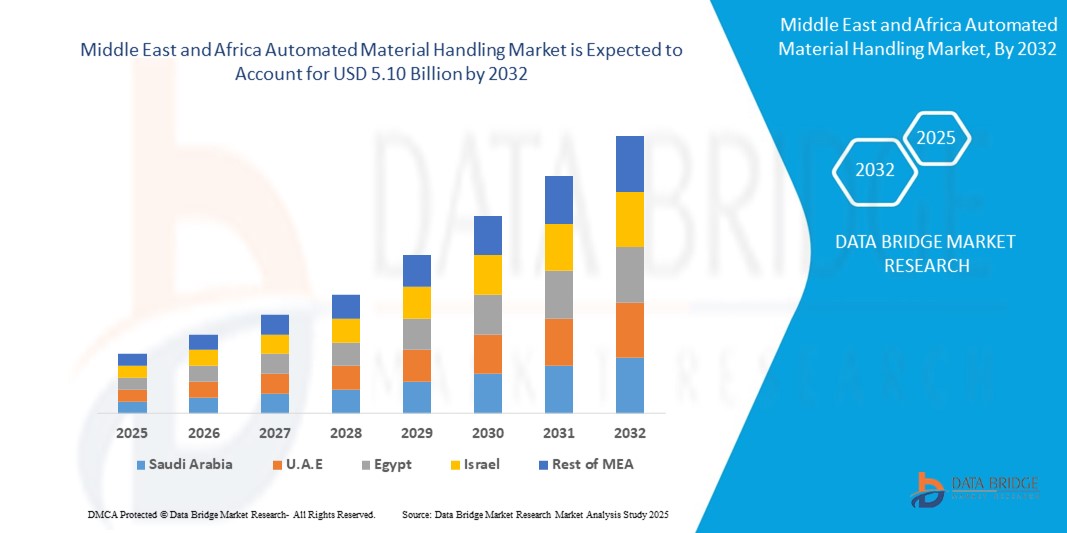
Middle East and Africa Automated Material Handling Market Size
- The Middle East and Africa Automated Material Handling Market size was valued at USD 2.90 Billion in 2024 and is expected to reach USD 5.10 Billion by 2032, at a CAGR of 8.40% during the forecast period
- The rapid growth of e-commerce has significantly increased demand for efficient warehouse automation and fulfillment solutions, driving widespread adoption of automated material handling systems.
Middle East and Africa Automated Material Handling Market Analysis
- The surge in e-commerce has intensified the need for efficient order fulfillment processes. Automated systems like conveyor belts, robotic pickers, and sorting technologies are being adopted to handle increased order volumes and meet consumer expectations for rapid delivery. This trend is particularly evident in the United States, where the robust e-commerce ecosystem is encouraging distribution centers to implement innovative and flexible automated solutions.
- The incorporation of Artificial Intelligence (AI) and the Internet of Things (IoT) into AMH systems is revolutionizing operations. These technologies enable real-time monitoring, predictive maintenance, and intelligent decision-making, leading to optimized material flow and reduced downtime. In U.A.E, for instance, AI and Machine Learning are increasingly being integrated into AMH solutions to improve operational efficiency.
- Saudi Arabia dominates the Middle East and Africa Automated Material Handling Market with the largest revenue share of 45.01% in 2025, Increasing labor costs and persistent shortages of skilled workers are pushing companies to automate material handling tasks, reducing reliance on human labor and improving operational stability.
- U.A.E is expected to be the fastest growing region in the Middle East and Africa Automated Material Handling Market during the forecast period due to Businesses are investing in automation to optimize supply chain efficiency and build resilience against disruptions, ensuring faster and more reliable movement of goods.
- The Software segment is anticipated to hold the largest market share of 61.2% in the Middle East and Africa Automated Material Handling Market during the forecast period due to continuous improvements in robotics, artificial intelligence, sensors, and software integration are enhancing the capabilities, flexibility, and affordability of automated material handling equipment.
Report Scope and Middle East and Africa Automated Material Handling Market Segmentation
|
Attributes |
Middle East and Africa Automated Material Handling Market Insights |
|
Segments Covered |
|
|
Countries Covered |
Middle East and Africa
|
|
Key Market Players |
|
|
Market Opportunities |
|
|
Value Added Data Infosets |
In addition to the insights on market scenarios such as market value, growth rate, segmentation, geographical coverage, and major players, the market reports curated by the Data Bridge Market Research also include import export analysis, production capacity overview, production consumption analysis, price trend analysis, climate change scenario, supply chain analysis, value chain analysis, raw material/consumables overview, vendor selection criteria, PESTLE Analysis, Porter Analysis, and regulatory framework. |
Middle East and Africa Automated Material Handling Market Trends
“Accelerated Adoption Driven by Industry 4.0 and Technological Innovation”
- The Middle East and Africa (MEA) automated material handling market is experiencing rapid transformation as industries across the region embrace Industry 4.0 and advanced automation solutions. The integration of robotics, IoT, AI-driven systems, and machine learning is enabling smarter, more efficient material movement, storage, and retrieval processes. These technologies are not only optimizing operational workflows but also improving workplace safety and reducing human error, leading to measurable gains in productivity and operational efficiency.
- A significant trend is the convergence of automated material handling solutions with Internet of Things (IoT) devices and cloud-based platforms. This integration enables real-time monitoring, predictive maintenance, and centralized control over diverse warehouse assets. As a result, businesses can achieve greater visibility into their logistics processes and respond swiftly to dynamic market demands.
- Digitalization of supply chain processes is a key trend, with companies integrating AMH systems to improve scalability and flexibility. IoT-enabled sensors, real-time data analytics, and AI-powered control mechanisms are being deployed to optimize resource allocation, enable predictive maintenance, and support centralized management of logistics operations.
- There is a growing demand for modular and scalable automated systems that can adapt to changing business needs. Companies are prioritizing solutions that offer flexibility, such as autonomous mobile robots (AMRs) and collaborative robots (cobots), which can be easily redeployed or reconfigured as warehouse layouts and workflows evolve.
- The retail sector, particularly with the surge of e-commerce and investments in tourism and hospitality, is a major driver of AMH adoption in the region. Nearly a quarter of AMH revenue in MEA is sourced from retail, as companies invest in automated storage and retrieval systems (ASRS) and warehouse automation to meet growing consumer demand and support rapid order fulfillment. Manufacturing remains the dominant application segment, leveraging automation to modernize production lines and enhance supply chain resilience.
- The Gulf Cooperation Council (GCC) countries, including the UAE and Saudi Arabia, dominate the regional market due to advanced manufacturing infrastructure, strategic economic diversification, and strong government support for technological innovation. North Africa, meanwhile, is emerging as the fastest-growing region, propelled by expanding manufacturing sectors, rising investments in technological infrastructure, and the adoption of advanced automation solutions in new industrial zones.
Middle East and Africa Automated Material Handling Market Dynamics
Driver
“Rising Demand for Automated and Precise Material Handling in Logistics and Industrial Sectors”
- The rapid expansion of e-commerce, urbanization, and industrialization in the Middle East and Africa (MEA) is fueling demand for efficient and reliable material handling solutions, especially in large warehouses, ports, and manufacturing plants.
- For instance, in early 2025, DP World, a leading UAE-based logistics company, announced the deployment of autonomous guided vehicles (AGVs) and robotic palletizers at Jebel Ali Port to optimize cargo movement and reduce manual handling errors.
- Automated material handling systems—including conveyor systems, automated storage and retrieval systems (AS/RS), and robotics—enable warehouses and distribution centers to achieve higher throughput, reduce labor costs, and minimize errors.
- This trend is further accelerated by labor shortages and rising wages, prompting companies to invest in automation for sustained productivity and competitiveness.
Restraint/Challenge
“High Initial Capital Investment and Integration Complexity”
- Automated material handling solutions often require substantial upfront investments in advanced robotics, control software, and supporting infrastructure, which can be a significant barrier for small and medium-sized enterprises (SMEs).
- For example, in 2025, several mid-sized logistics firms in U.A.E postponed automation projects due to the high costs associated with retrofitting legacy warehouses and integrating new systems with existing IT infrastructure.
- The complexity of integrating diverse hardware and software platforms, along with the need for skilled personnel to manage and maintain automated systems, can lead to longer implementation timelines and increased operational risk.
- Additionally, disruptions during the transition phase—such as system downtime or workflow bottlenecks—can impact short-term productivity, making some organizations hesitant to adopt automation at scale.
Middle East and Africa Automated Material Handling Market Scope
The market is segmented on the Offering, System Type, Product Type, Function, Industry.
|
Segmentation |
Sub-Segmentation |
|
By Offering |
|
|
By System Type |
|
|
By Product Type |
|
|
By Function |
|
|
By Industry |
|
|
Key Market Players |
|
Middle East and Africa Automated Material Handling Market Scope
The market is segmented on the basis of offering, System Type, Product Type, Function, Industry.
- By offering
On the basis of offering, the Middle East and Africa Automated Material Handling Market is segmented into Hardware, Software, Services. The Software system segment dominates the largest market revenue share of 42.1% in 2025, The Software segment is driven by the rapid growth of e-commerce has significantly increased demand for efficient warehouse automation and fulfillment solutions, driving widespread adoption of automated material handling systems.
The Software segment is anticipated to witness the fastest growth rate of 20.1% from 2025 to 2032, Increasing labor costs and persistent shortages of skilled workers are pushing companies to automate material handling tasks, reducing reliance on human labor and improving operational stability.
- By System Type
On the basis of System Type, the Middle East and Africa Automated Material Handling Market is segmented into Bulk Load Material Handling Systems, Unit Load Material Handling Systems. The surge in e-commerce and expansion of the retail sector are fueling demand for automated material handling (AMH) solutions, especially as online shopping and order customization become more prevalent.
The Unit Load Material Handling Systems segment is expected to witness the fastest CAGR from 2025 to 2032 Semiconductor qubits are driven by businesses are investing in automation to optimize supply chain efficiency and build resilience against disruptions, ensuring faster and more reliable movement of goods.
- By Product Type
On the basis of Product Type, the Middle East and Africa Automated Material Handling Market is segmented Robots, Automated Storage and Retrieval System (ASRS). The Robots held the largest market revenue share in 2025, Continuous improvements in robotics, artificial intelligence, sensors, and software integration are enhancing the capabilities, flexibility, and affordability of automated material handling equipment.
The Automated Storage and Retrieval System (ASRS) segment is expected to witness the fastest CAGR from 2025 to 2032, The integration of Industry 4.0 principles—such as IoT, data analytics, and smart manufacturing.
- By Function
On the basis of Function, the Middle East and Africa Automated Material Handling Market is segmented into Storage, Transportation. The Storage held the largest market revenue share in 2025, Storage deployment is driven by labor costs and persistent shortages of skilled workers are pushing companies to automate material handling tasks, reducing reliance on human labor and improving operational stability.
The Transportation segment is expected to witness the fastest CAGR from 2025 to 2032, industries like automotive, food and beverage, pharmaceuticals, and logistics are increasingly adopting automation to boost productivity and maintain competitiveness.
- By Industry
On the basis of Industry, the Middle East and Africa Automated Material Handling Market is segmented into Automotive, Semiconductor and Electronics, Metals and Heavy machinery, Pharmaceuticals, Food and Beverages, Retail, Construction, E-commerce, Chemicals, Paper, Others. Consumer expectations for rapid delivery, especially in e-commerce, are driving investments in high-speed automated systems for picking, sorting, and shipping.
The Semiconductor and Electronics segment is expected to witness the fastest CAGR from 2025 to 2032, Automated storage and retrieval systems (ASRS) and compact conveyor solutions help businesses maximize warehouse space and increase storage density without expanding physical footprints.
Saudi Arabia Automated Material Handling Market Insight
The Saudi Arabia Middle East and Africa Automated Material Handling Market captured the largest revenue share of 44.01% within Saudi Arabia in 2025, Saudi Arabia is driving Automated Material Handling through Vision 2030, Major industries like automotive, food and beverage, pharmaceuticals, and logistics are increasingly adopting automation to boost productivity and maintain competitiveness.
U.A.E Automated Material Handling Market Insight
The U.A.E Middle East and Africa Automated Material Handling Market is poised to grow at the fastest CAGR of over 24.1% in 2025, The U.A.E is accelerating Automated Material Handling development through strong governmental support and advanced research centers like the Technology Innovation Institute. Consumer expectations for rapid delivery, especially in e-commerce, are driving investments in high-speed automated systems for picking, sorting, and shipping.
Middle East and Africa Automated Material Handling Market Share
The Middle East and Africa Automated Material Handling is primarily led by well-established companies, including:
- GreyOrange
- Geekplus Technology Co., Ltd.
- Eiratech Robotics Ltd.
- Scallog
- Dematic
- Witron
- TGW Logistics Group
- KNAPP AG
- Mecalux
- S.A., Arcadis NV
- Conveyco (Pty) Ltd
- Naumann/Hobbs Material Handling
- Daifuku Co., Ltd.
- IAM Robotics
- Material Handling Systems
- Swisslog Holding AG
- SCHAEFER SYSTEMS INTERNATIONAL PVT LTD
- Amber Industries
- Advanced Automation Systems, Inc.
- Taylor Material Handling
- Conveyor
- L3Harris Technologies, Inc.
Latest Developments in Middle East and Africa Automated Material Handling Market
- In December 2021, Dematic completed a new automated distribution center for the Landmark Group in Dubai, enabling the consolidation of logistics activities from five manual sites into a single automated hub.
- In October 2024, GreenBox Systems, a joint venture between SoftBank and Symbotic, announced a $144 million investment to construct an automated warehouse in Jackson, Georgia, set to open in late 2025. Utilizing advanced automation technology, including AI and vision-enabled robots, GreenBox warehouses minimize human involvement in sorting, packing, and shipping.
- In 2024, ArcBest Corporation introduced the Vaux Freight Movement System, a suite of hardware and software that transforms the processes of loading, unloading, and transferring freight in warehouses, docks, and on the road. The system allows trailers to be unloaded in under five minutes, reducing driver wait times and improving dock utilization.
- In November 2021, Germany-based Lödige Industries partnered with SPIMACO to modernize its pharmaceutical facility in Qassim by adding an automated high-bay storage and distribution center.

- Interactive Data Analysis Dashboard
- Company Analysis Dashboard for high growth potential opportunities
- Research Analyst Access for customization & queries
- Competitor Analysis with Interactive dashboard
- Latest News, Updates & Trend analysis
- Harness the Power of Benchmark Analysis for Comprehensive Competitor Tracking
Middle East And Africa Automated Material Handling Market, Supply Chain Analysis and Ecosystem Framework
To support market growth and help clients navigate the impact of geopolitical shifts, DBMR has integrated in-depth supply chain analysis into its Middle East And Africa Automated Material Handling Market research reports. This addition empowers clients to respond effectively to global changes affecting their industries. The supply chain analysis section includes detailed insights such as Middle East And Africa Automated Material Handling Market consumption and production by country, price trend analysis, the impact of tariffs and geopolitical developments, and import and export trends by country and HSN code. It also highlights major suppliers with data on production capacity and company profiles, as well as key importers and exporters. In addition to research, DBMR offers specialized supply chain consulting services backed by over a decade of experience, providing solutions like supplier discovery, supplier risk assessment, price trend analysis, impact evaluation of inflation and trade route changes, and comprehensive market trend analysis.
Data collection and base year analysis are done using data collection modules with large sample sizes. The stage includes obtaining market information or related data through various sources and strategies. It includes examining and planning all the data acquired from the past in advance. It likewise envelops the examination of information inconsistencies seen across different information sources. The market data is analysed and estimated using market statistical and coherent models. Also, market share analysis and key trend analysis are the major success factors in the market report. To know more, please request an analyst call or drop down your inquiry.
The key research methodology used by DBMR research team is data triangulation which involves data mining, analysis of the impact of data variables on the market and primary (industry expert) validation. Data models include Vendor Positioning Grid, Market Time Line Analysis, Market Overview and Guide, Company Positioning Grid, Patent Analysis, Pricing Analysis, Company Market Share Analysis, Standards of Measurement, Global versus Regional and Vendor Share Analysis. To know more about the research methodology, drop in an inquiry to speak to our industry experts.
Data Bridge Market Research is a leader in advanced formative research. We take pride in servicing our existing and new customers with data and analysis that match and suits their goal. The report can be customized to include price trend analysis of target brands understanding the market for additional countries (ask for the list of countries), clinical trial results data, literature review, refurbished market and product base analysis. Market analysis of target competitors can be analyzed from technology-based analysis to market portfolio strategies. We can add as many competitors that you require data about in the format and data style you are looking for. Our team of analysts can also provide you data in crude raw excel files pivot tables (Fact book) or can assist you in creating presentations from the data sets available in the report.













