




Middle East And Africa Cocoa Products Market
Market Size in USD Million
CAGR :
% 
 USD
750.20 Million
USD
957.74 Million
2024
2032
USD
750.20 Million
USD
957.74 Million
2024
2032
 Forecast Period Forecast Period |
2025 –2032 |
 Market Size (Base Year) Market Size (Base Year) |
USD 750.20 Million |
 Market Size (Forecast Year) Market Size (Forecast Year) |
USD 957.74 Million |
 CAGR CAGR |
% |
| Major Markets Players |
|
Middle East and Africa Cocoa Products Market Size
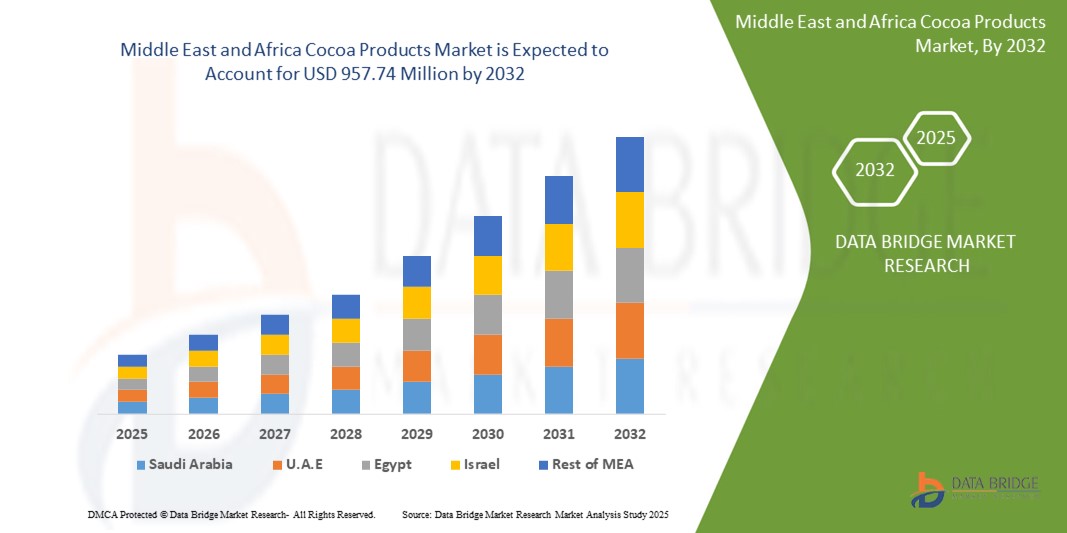
- The global Middle East and Africa cocoa products market size was valued at USD 750.20 million in 2024 and is expected to reach USD 957.74 million by 2032, at a CAGR of 3.10% during the forecast period
- The market growth is largely fuelled by the rising demand for chocolate confectioneries, expanding middle-class population with increased disposable income, and growing awareness of the health benefits of cocoa-based products
- In addition, the increasing penetration of Western-style bakeries and cafes, along with the rapid urbanization and evolving food preferences in emerging economies such as India, China, and Indonesia, is supporting market expansion
Middle East and Africa Cocoa Products Market Analysis
- The region is witnessing strong growth in cocoa products consumption, driven by changing dietary habits, increasing demand for premium chocolate, and rising urbanization
- In addition, the growth of the health and wellness trend has encouraged the consumption of dark chocolate and low-sugar cocoa products, further stimulating market demand across the region
- South Africa cocoa products market captured the largest revenue share in the Middle East and Africa region in 2024, driven by rising demand for chocolate confectionery, increasing urbanization, and growing consumer interest in premium and functional cocoa-based products
- Saudi Arabia is expected to witness the highest compound annual growth rate (CAGR) in the Middle East and Africa cocoa products market due to rising disposable incomes, growing Western dietary influence, increased health awareness, and expanding retail infrastructure supporting the demand for high-quality and wellness-focused cocoa products
- Forastero cocoa segment dominated the market with the largest revenue share in 2024, primarily due to its widespread cultivation, high yield, and cost-effectiveness. This type of cocoa is commonly used in mass-market chocolate products and processed goods, making it a preferred choice among commercial manufacturers
Report Scope and Middle East and Africa Cocoa Products Market Segmentation
|
Attributes |
Middle East and Africa Cocoa Products Key Market Insights |
|
Segments Covered |
|
|
Countries Covered |
Middle East and Africa
|
|
Key Market Players |
|
|
Market Opportunities |
• Rising Demand for Organic and Ethically Sourced Cocoa Ingredients |
|
Value Added Data Infosets |
In addition to the insights on market scenarios such as market value, growth rate, segmentation, geographical coverage, and major players, the market reports curated by the Data Bridge Market Research also include in-depth expert analysis, pricing analysis, brand share analysis, consumer survey, demography analysis, supply chain analysis, value chain analysis, raw material/consumables overview, vendor selection criteria, PESTLE Analysis, Porter Analysis, and regulatory framework. |
Middle East and Africa Cocoa Products Market Trends
Cocoa Products Market Trends
“Rising Preference for Premium and Artisanal Chocolate Products”
- Consumers across the Middle East and Africa are increasingly opting for premium and handcrafted chocolate products due to evolving taste preferences and growing interest in artisanal offerings
- Growth in disposable income and greater exposure to Western confectionery culture are driving demand for high-quality, bean-to-bar chocolates across urban centers in the region
- Brands are launching origin-specific and ethically sourced cocoa products to cater to both luxury and wellness-focused segments
- Unique flavor innovations such as cardamom, rose, pistachio, and sea salt-infused chocolates are gaining popularity among consumers seeking novel taste experiences
- For instance, in South Africa, local chocolatiers have introduced single-origin, artisanal dark chocolates made from ethically sourced beans, appealing to premium and sustainability-driven consumers
Middle East and Africa Cocoa Products Market Dynamics
Driver
“Increasing Health Awareness Boosting Demand for Functional Cocoa Products”
- Health-conscious consumers in the Middle East and Africa are driving demand for cocoa products rich in flavonoids and antioxidants
- Cocoa is increasingly incorporated into functional foods such as protein bars, nutritional shakes, and dietary supplements across the region
- Rising middle-class population and growing wellness awareness in countries such as the UAE and South Africa are fuelling demand for dark chocolate and low-sugar cocoa variants
- Manufacturers are innovating with clean-label, organic, and high-cocoa-content products to cater to the region’s health-focused demographic
- For instance, in the UAE, local brands have introduced premium dark chocolate lines emphasizing heart health and antioxidant benefits, targeting the region’s growing fitness-conscious consumer base
Restraint/Challenge
“Volatility in Cocoa Prices and Supply Chain Disruptions”
- Global cocoa price fluctuations due to weather issues and political instability impact input costs for cocoa product manufacturers in the Middle East and Africa
- Heavy reliance on cocoa imports exposes the region to foreign exchange risks and shipping delays, affecting production timelines and cost efficiency
- Supply chain disruptions, such as port congestion and transportation bottlenecks, create challenges in sourcing raw cocoa ingredients across the region
- Small and medium-sized enterprises (SMEs) in the Middle East and Africa struggle to manage price volatility, affecting their profitability and long-term competitiveness
- For instance, during the COVID-19 pandemic, several Middle Eastern and African countries experienced cocoa supply shortages due to disrupted imports and rising global cocoa prices
Middle East and Africa Cocoa Products Market Scope
The market is segmented into five notable segments based on type of cocoa, product type, source, application, and distribution channel.
• By Type of Cocoa
On the basis of type of cocoa, the Middle East and Africa cocoa products market is segmented into Forastero cocoa, Criollo cocoa, and Trinitario cocoa. The Forastero cocoa segment dominated the market with the largest revenue share in 2024, primarily due to its widespread cultivation, high yield, and cost-effectiveness. This type of cocoa is commonly used in mass-market chocolate products and processed goods, making it a preferred choice among commercial manufacturers.
The Criollo cocoa segment is expected to witness the fastest growth rate from 2025 to 2032, driven by increasing demand for premium and single-origin chocolate. Criollo beans are known for their fine flavor profile and are being increasingly adopted by artisanal and gourmet chocolate brands across countries such as Japan and Australia, where consumers are showing greater interest in high-quality, ethically sourced cocoa products.
• By Product Type
On the basis of product type, the market is segmented into cocoa butter, cocoa beans, cocoa powder & cake, cocoa liquor & paste, cocoa nibs, and others. The cocoa powder & cake segment held the largest market revenue share in 2024, driven by its extensive use in bakery, confectionery, and beverage applications. It is widely used by both commercial and household consumers for its affordability and versatility.
The cocoa butter segment is expected to witness the fastest growth rate from 2025 to 2032, owing to rising use in chocolates, cosmetics, and skincare formulations. The growing demand for clean-label and natural beauty products across Middle East and Africa has particularly increased cocoa butter’s relevance in the personal care and cosmetics industry.
• By Source
On the basis of source, the market is segmented into inorganic and organic. The inorganic segment accounted for the highest revenue share in 2024, supported by its established supply chains, cost-efficiency, and availability for large-scale manufacturing needs. Inorganic cocoa products are commonly utilized in high-volume commercial food and beverage processing.
The organic segment is expected to witness the fastest growth rate from 2025 to 2032, driven by increasing health consciousness, rising preference for chemical-free and sustainably sourced ingredients, and the proliferation of organic product offerings across retail channels in India, China, and Australia.
• By Application
On the basis of application, the Middle East and Africa cocoa products market is segmented into food & beverages, dietary supplements, personal care & cosmetics, and others. The food & beverages segment led the market in 2024 with the highest revenue share, attributed to the wide application of cocoa in chocolates, confectionery, dairy products, and ready-to-drink beverages.
The dietary supplements segment is expected to witness the fastest growth rate from 2025 to 2032, propelled by the expanding wellness trend and the increased inclusion of cocoa extracts in functional foods and nutraceuticals. Consumers in urban centers across Japan and South Korea are increasingly opting for cocoa-enriched supplements aimed at improving heart health and mood.
• By Distribution Channel
On the basis of distribution channel, the market is segmented into direct and indirect. The indirect segment dominated the market in 2024, backed by the growing reach of supermarkets, hypermarkets, convenience stores, and online platforms. The increasing popularity of e-commerce platforms and food delivery apps in Middle East and Africa has made cocoa-based products more accessible to consumers.
The direct segment is expected to witness the fastest growth rate from 2025 to 2032, particularly among business-to-business buyers, including food manufacturers and cosmetic companies sourcing cocoa ingredients directly from processors and certified cocoa cooperatives for greater quality control and traceability.
Middle East and Africa Cocoa Products Market Regional Analysis
- The South Africa cocoa products market captured the largest revenue share in the Middle East and Africa region in 2024, driven by rising demand for chocolate confectionery, increasing urbanization, and growing consumer interest in premium and functional cocoa-based products
- The country’s well-established food and beverage industry, combined with an expanding middle class, is fueling domestic cocoa consumption. In addition, South African manufacturers are increasingly focusing on value-added offerings such as dark chocolate, cocoa beverages, and wellness-oriented snacks
- The presence of organized retail chains and e-commerce platforms is further enhancing product accessibility and encouraging market growth across both urban and semi-urban areas
Saudi Arabia Cocoa Products Market Insight
The Saudi Arabia cocoa products market is expected to witness the fastest growth rate from 2025 to 2032, supported by changing consumer lifestyles, rising health awareness, and increasing demand for high-quality cocoa-based products. The growing popularity of Western confectionery, combined with investments in food manufacturing and retail modernization, is driving market expansion. Moreover, the country’s young population and rising interest in functional and gourmet chocolate products are accelerating adoption across foodservice and retail channels.
Middle East and Africa Cocoa Products Market Share
The Middle East and Africa Cocoa Products industry is primarily led by well-established companies, including:
- Plot Enterprise Ghana Ltd (Ghana)
- Cocoa Processing Company Limited (Ghana)
- Niche Cocoa Industry Ltd (Ghana)
- Ghana Cocoa Board – COCOBOD (Ghana)
- Tulip Cocoa Processing Ltd (Nigeria)
- FoodPro Limited (Nigeria)
- Afrotropic Cocoa Processing Ltd (Ghana)
- Barfoods Ltd (Kenya)
- Tiger Brands (South Africa)
- Crown Cocoa Products Ltd (Nigeria)
SKU-
Get online access to the report on the World's First Market Intelligence Cloud

- Interactive Data Analysis Dashboard
- Company Analysis Dashboard for high growth potential opportunities
- Research Analyst Access for customization & queries
- Competitor Analysis with Interactive dashboard
- Latest News, Updates & Trend analysis
- Harness the Power of Benchmark Analysis for Comprehensive Competitor Tracking
Table of Content
1 INTRODUCTION
1.1 OBJECTIVES OF THE STUDY
1.2 MARKET DEFINITION
1.3 OVERVIEW OF MIDDLE EAST AND AFRICA COCOA PRODUCTS MARKET
1.4 CURRENCY AND PRICING
1.5 LIMITATION
1.6 MARKETS COVERED
2 MARKET SEGMENTATION
2.1 KEY TAKEAWAYS
2.2 ARRIVING AT THE MIDDLE EAST AND AFRICA COCOA PRODUCTS MARKET SIZE
2.2.1 VENDOR POSITIONING GRID
2.2.2 TECHNOLOGY LIFE LINE CURVE
2.2.3 MARKET GUIDE
2.2.4 COMPANY POSITIONING GRID
2.2.5 COMAPANY MARKET SHARE ANALYSIS
2.2.6 MULTIVARIATE MODELLING
2.2.7 DEMAND AND SUPPLY-SIDE VARIABLES
2.2.8 TOP TO BOTTOM ANALYSIS
2.2.9 STANDARDS OF MEASUREMENT
2.2.10 VENDOR SHARE ANALYSIS
2.2.11 DATA POINTS FROM KEY PRIMARY INTERVIEWS
2.2.12 DATA POINTS FROM KEY SECONDARY DATABASES
2.3 MIDDLE EAST AND AFRICA COCOA PRODUCTS MARKET: RESEARCH SNAPSHOT
2.4 ASSUMPTIONS
3 MARKET OVERVIEW
3.1 DRIVERS
3.2 RESTRAINTS
3.3 OPPORTUNITIES
3.4 CHALLENGES
4 EXECUTIVE SUMMARY
5 PREMIUM INSIGHTS
5.1 VALUE CHAIN ANALYSIS
5.2 SUPPLY CHAIN ANALYSIS
5.3 IMPORT-EXPORT ANALYSIS
5.4 PORTER’S FIVE FORCES ANALYSIS
5.4.1 BARGAINING POWER OF SUPPLIERS
5.4.2 BARGAINING POWER OF BUYERS/CONSUMERS
5.4.3 THREAT OF NEW ENTRANTS
5.4.4 THREAT OF SUBSTITUTE PRODUCTS
5.4.5 INTENSITY OF COMPETITIVE RIVALRY
5.5 RAW MATERIAL SOURCING ANALYSIS
5.6 OVERVIEW OF TECHNOLOGICAL INNOVATIONS
5.7 INDUSTRY TRENDS AND FUTURE PERSPECTIVE
5.8 GROWTH STRATEGIES ADOPTED BY KEY MARKET PLAYERS
5.9 FACTORS INFLUENCING PURCHASING DECISION OF END-USERS
6 IMPACT OF ECONOMIC SLOW DOWN ON MARKET
6.1 IMPACT ON PRICE
6.2 IMPACT ON SUPPLY CHAIN
6.3 IMPACT ON SHIPMENT
6.4 IMPACT ON COMPANY’S STRATEGIC DECISIONS
7 REGULATORY FRAMEWORK AND GUIDELINES
8 PRICING INDEX (PRICE AT B2B END & PRICES AT FOB)
9 MIDDLE EAST CHOCOLATE CONSUMPTION, BY COUNTRY, 2022-2031, (USD MILLION) (KILO TONS)
9.1.1 SOUTH AFRICA
9.1.2 U.A.E.
9.1.3 EGYPT
9.1.4 JORDAN
9.1.5 MOROCCO
9.1.6 SAUDI ARABIA
9.1.7 BAHRAIN
9.1.8 OMAN
9.1.9 QATAR
9.1.10 KUWAIT
9.1.11 REST OF MIDDLE EAST AND AFRICA
10 PRODUCTION CAPACITY OF KEY MANUFACTURERES
11 BRAND OUTLOOK
11.1 COMPARATIVE BRAND ANALYSIS
11.2 PRODUCT VS BRAND OVERVIEW
12 MIDDLE EAST AND AFRICA COCOA PRODUCTS MARKET, BY PRODUCT TYPE, (2022-2031) (USD MILLION) (KILO TONS)
12.1 OVERVIEW
12.2 COCOA BUTTER
12.2.1 COCOA BUTTER, BY TYPE
12.2.1.1. PARTIALLY DEODORIZED
12.2.1.2. FULLY DEODORIZED
12.3 COCOA POWDER
12.3.1 COCOA POWDER, BY TYPE
12.3.1.1. NATURALLY PROCESSED COCOA POWDER
12.3.1.2. BENSDROP DUTCH PROCESS COCOA POWDER
12.3.1.3. BROWN ALKALIZED COCOA POWDER
12.3.1.4. REDDISH BROWN ALKALIZED COCOA POWDER
12.3.1.5. RED ALKALIZED COCOA POWDER
12.3.1.6. BLACK ALKALIZED COCOA POWDER
12.3.1.7. DOUBLE DUTCH COCOA BLEND
12.3.1.8. COCOA ROUGE POWDER
12.4 COCOA LIQUOR & PASTE
12.4.1 COCOA LIQUOR & PASTE, BY FORM
12.4.1.1. BLOCKS
12.4.1.2. INGOTS
12.4.1.3. EASY-TO-MELT LIQUOR THINS
12.5 COCOA NIBS
12.6 COCOA LIQUID EXTRACTS
12.7 OTHERS
13 MIDDLE EAST AND AFRICA COCOA PRODUCTS, BY COCOA BEAN TYPE, (2022-2031) (USD MILLION)
13.1 OVERVIEW
13.2 FORASTERO COCOA
13.3 CRIOLLO COCOA
13.4 TRINITARIO COCOA
13.5 OTHERS
14 MIDDLE EAST AND AFRICA COCOA PRODUCTS, BY COCOA COLOR, (2022-2031) (USD MILLION)
14.1 OVERVIEW
14.2 BROWN
14.2.1 LIGHT BROWN
14.2.2 DARK BROWN
14.3 RED
14.3.1 LIGHT RED
14.3.2 DARK RED
15 MIDDLE EAST AND AFRICA COCOA PRODUCTS MARKET, BY NATURE, (2022-2031) (USD MILLION)
15.1 OVERVIEW
15.2 CONVENTIONAL
15.3 ORGANIC
16 MIDDLE EAST AND AFRICA COCOA PRODUCTS MARKET, BY APPLICATION, (2022-2031) (USD MILLION)
16.1 OVERVIEW
16.2 FOOD AND BEVERAGES
16.2.1 CONFECTIONERY
16.2.1.1. CONFECTIONERY, BY TYPE
16.2.1.1.1. CHOCOLATE
16.2.1.1.1.1 WHITE CHOCOLATES
16.2.1.1.1.2 DARK CHOCOLATES
16.2.1.1.1.3 MILK CHOCOLATES
16.2.1.1.2. HARD-BOILED SWEETS
16.2.1.1.3. MINTS
16.2.1.1.4. GUMS & JELLIES
16.2.1.1.5. CHOCOLATE SYRUPS
16.2.1.1.6. CARAMELS & TOFFEES
16.2.1.1.7. OTHERS
16.2.2 BAKERY PRODUCTS
16.2.2.1. BAKERY PRODUCT, BY TYPE
16.2.2.1.1. BREAD & ROLLS
16.2.2.1.2. CAKES, PASTRIES & TRUFFLE
16.2.2.1.3. BISCUIT
16.2.2.1.4. TART & PIES
16.2.2.1.5. BROWNIES
16.2.2.1.6. COOKIES & CRACKERS
16.2.2.1.7. OTHERS
16.2.3 DAIRY PRODUCTS
16.2.3.1. SDAIRY PRODUCTS, BY TYPE
16.2.3.1.1. YOGURT
16.2.3.1.2. ICE CREAM
16.2.3.1.3. DAIRY DESSERTS
16.2.3.1.4. OTHERS
16.2.4 PROCESSED FOODS
16.2.5 FUNCTIONAL FOODS
16.2.6 DRESSINGS
16.2.7 SPORTS NUTRITION
16.2.8 DAIRY ALTERNATIVE
16.2.8.1. DAIRY ALTERNATIVE, BY TYPE
16.2.8.1.1. DAIRY MILK ALTERNATIVE
16.2.8.1.2. DAIRY YOGURT ALTERNATIVE
16.2.8.1.3. DAIRY ICE CREAM ALTERNATIVE
16.2.8.1.4. OTHERS
16.2.8.2. FOOD, BY PRODUCT TYPE
16.2.8.2.1. COCOA BUTTER
16.2.8.2.2. COCOA POWDER
16.2.8.2.3. COCOA LIQUOR & PASTE
16.2.8.2.4. COCOA NIBS
16.2.8.2.5. COCOA LIQUID EXTRACTS
16.2.8.2.6. OTHERS
16.2.9 BEVERAGES
16.2.9.1. BEVERAGES, BY TYPE
16.2.9.1.1. ALCOHOLIC
16.2.9.1.1.1 ALCOHOLIC, BY TYPE
16.2.9.1.1.1.1. RUM
16.2.9.1.1.1.2. WHIISKEY
16.2.9.1.1.1.3. BEER
16.2.9.1.1.1.4. VODKA
16.2.9.1.1.1.5. WINE
16.2.9.1.1.1.6. CHAMPAYGNE
16.2.9.1.1.1.7. OTHERS
16.2.9.2. NON-ALCOHOLIC
16.2.9.2.1. NON-ALCOHOLIC, BY TYPE
16.2.9.2.1.1 RTD COFFEE
16.2.9.2.1.2 FLAVOURED DAIRY MILK
16.2.9.2.1.3 FLAVORED PLANT-BASED MILK
16.2.9.2.1.4 SPORTS DRINKS
16.2.9.2.1.5 SMOOTHIES
16.2.9.2.1.6 OTHERS
16.2.9.3. BEVERAGES, BY PRODUCT TYPE
16.2.9.3.1. COCOA BUTTER
16.2.9.3.2. COCOA POWDER
16.2.9.3.3. COCOA LIQUOR & PASTE
16.2.9.3.4. COCOA NIBS
16.2.9.3.5. COCOA LIQUID EXTRACTS
16.2.9.3.6. OTHERS
16.3 PERSONAL CARE
16.3.1 PERSONAL CARE, BY TYPE
16.3.1.1. SKIN CARE
16.3.1.1.1. MOISTURIZER & LOTIN
16.3.1.1.2. SERUM
16.3.1.1.3. CREAM
16.3.1.1.4. MASSAGE OIL
16.3.1.1.5. SCRUB
16.3.1.1.6. SOAP & BODYWASH
16.3.1.1.7. LIP CARE PRODUCTS
16.3.1.1.8. OTHERS
16.3.1.2. HAIR CARE
16.3.1.2.1. SERUM & OINTMENTS
16.3.1.2.2. CONDITIONER
16.3.1.2.3. SHAMPOO
16.3.1.2.4. OTHERS
16.3.2 PERSONAL CARE PRODUCTS, BY PRODUCT TYPE
16.3.2.1. COCOA BUTTER
16.3.2.2. COCOA POWDER
16.3.2.3. COCOA LIQUOR & PASTE
16.3.2.4. COCOA NIBS
16.3.2.5. COCOA LIQUID EXTRACTS
16.3.2.6. OTHERS
16.4 PHARMACEUTICALS
16.4.1 PHARMACEUTICALS , BY TYPE
16.4.1.1. SYRUPS
16.4.1.2. CHEWABLE TABLETS
16.4.1.3. SUSPENSIONS OR GUMS
16.4.1.4. OTHERS
16.4.2 PHARMACEUTICALS , BY PRODUCT TYPE
16.4.2.1. COCOA BUTTER
16.4.2.2. COCOA POWDER
16.4.2.3. COCOA LIQUOR & PASTE
16.4.2.4. COCOA NIBS
16.4.2.5. COCOA LIQUID EXTRACTS
16.4.2.6. OTHERS
16.5 COSMETIC
16.5.1 COSMETIC, BY TYPE
16.5.1.1. RUMINANT FEED
16.5.1.2. POULTRY FEED
16.5.1.3. SWINE FEED
16.5.1.4. AQUAFEED
16.5.2 COSMETIC, BY PRODUCT TYPE
16.5.2.1. COCOA BUTTER
16.5.2.2. COCOA POWDER
16.5.2.3. COCOA LIQUOR & PASTE
16.5.2.4. COCOA NIBS
16.5.2.5. COCOA LIQUID EXTRACTS
16.5.2.6. OTHERS
16.6 OTHERS
17 MIDDLE EAST AND AFRICA COCOA PRODUCTS MARKET, BY DISTRIBUTION CHANNEL, 2022-2031 (USD MILLION)
17.1 OVERVIEW
17.2 DIRECT SALES
17.3 INDIRECT SALES
17.3.1 OFFLINE
17.3.1.1. SUPERMARKETS/HYPERMARKETS
17.3.1.2. CONVENIENCE STORES
17.3.1.3. SPECIALTY STORES
17.3.1.4. OTHERS
17.3.2 ONLINE
17.3.2.1. COMPANY OWNED WEBSITES
17.3.2.2. 3RD PARTY WEBSITES
18 MIDDLE EAST AND AFRICA COCOA PRODUCTS MARKET, COMPANY LANDSCAPE
18.1 COMPANY SHARE ANALYSIS: MIDDLE EAST AND AFRICA
18.2 MERGERS & ACQUISITIONS
18.3 NEW PRODUCT DEVELOPMENT & APPROVALS
18.4 EXPANSIONS & PARTNERSHIP
18.5 REGULATORY CHANGES
19 MIDDLE EAST AND AFRICA COCOA PRODUCTS MARKET, BY COUNTRY, (2022-2031) (USD MILLION) (KILO TONS)
OVERVIEW (ALL SEGMENTATION PROVIDED ABOVE IS REPRESNTED IN THIS CHAPTER BY COUNTRY)
19.1 MIDDLE EAST AND AFRICA
19.1.1 SOUTH AFRICA
19.1.2 U.A.E.
19.1.3 EGYPT
19.1.4 JORDAN
19.1.5 MOROCCO
19.1.6 SAUDI ARABIA
19.1.7 BAHRAIN
19.1.8 OMAN
19.1.9 QATAR
19.1.10 KUWAIT
19.1.11 REST OF MIDDLE EAST AND AFRICA
20 MIDDLE EAST AND AFRICA COCOA PRODUCTS MARKET, SWOT & DBMR ANALYSIS
21 MIDDLE EAST AND AFRICA COCOA PRODUCTS MARKET, COMPANY PROFILES
21.1 THE HERSHEY COMPANY
21.1.1 COMPANY OVERVIEW
21.1.2 REVENUE ANALYSIS
21.1.3 PRODUCT PORTFOLIO
21.1.4 RECENT DEVELOPMENTS
21.2 OLAM INTERNATIONAL LIMITED
21.2.1 COMPANY OVERVIEW
21.2.2 REVENUE ANALYSIS
21.2.3 PRODUCT PORTFOLIO
21.2.4 RECENT DEVELOPMENTS
21.3 CARGILL, INCORPORATED
21.3.1 COMPANY OVERVIEW
21.3.2 REVENUE ANALYSIS
21.3.3 PRODUCT PORTFOLIO
21.3.4 RECENT DEVELOPMENTS
21.4 BARRY CALLEBAUT
21.4.1 COMPANY OVERVIEW
21.4.2 REVENUE ANALYSIS
21.4.3 PRODUCT PORTFOLIO
21.4.4 RECENT DEVELOPMENTS
21.5 NESTLÉ S.A.
21.5.1 COMPANY OVERVIEW
21.5.2 REVENUE ANALYSIS
21.5.3 PRODUCT PORTFOLIO
21.5.4 RECENT DEVELOPMENTS
21.6 ALTINMARKA
21.6.1 COMPANY OVERVIEW
21.6.2 REVENUE ANALYSIS
21.6.3 PRODUCT PORTFOLIO
21.6.4 RECENT DEVELOPMENTS
21.7 PLOT GHANA
21.7.1 COMPANY OVERVIEW
21.7.2 REVENUE ANALYSIS
21.7.3 PRODUCT PORTFOLIO
21.7.4 RECENT DEVELOPMENTS
21.8 MONER COCOA, S.A.
21.8.1 COMPANY OVERVIEW
21.8.2 REVENUE ANALYSIS
21.8.3 PRODUCT PORTFOLIO
21.8.4 RECENT DEVELOPMENTS
21.9 KERRY GROUP PLC
21.9.1 COMPANY OVERVIEW
21.9.2 REVENUE ANALYSIS
21.9.3 PRODUCT PORTFOLIO
21.9.4 RECENT DEVELOPMENTS
21.1 PURATOS
21.10.1 COMPANY OVERVIEW
21.10.2 REVENUE ANALYSIS
21.10.3 PRODUCT PORTFOLIO
21.10.4 RECENT DEVELOPMENTS
NOTE: THE COMPANIES PROFILED IS NOT EXHAUSTIVE LIST AND IS AS PER OUR PREVIOUS CLIENT REQUIREMENT. WE PROFILE MORE THAN 100 COMPANIES IN OUR STUDY AND HENCE THE LIST OF COMPANIES CAN BE MODIFIED OR REPLACED ON REQUEST
22 RELATED REPORTS
23 CONCLUSION
24 QUESTIONNAIRE
25 ABOUT DATA BRIDGE MARKET RESEARCH

Middle East And Africa Cocoa Products Market, Supply Chain Analysis and Ecosystem Framework
To support market growth and help clients navigate the impact of geopolitical shifts, DBMR has integrated in-depth supply chain analysis into its Middle East And Africa Cocoa Products Market research reports. This addition empowers clients to respond effectively to global changes affecting their industries. The supply chain analysis section includes detailed insights such as Middle East And Africa Cocoa Products Market consumption and production by country, price trend analysis, the impact of tariffs and geopolitical developments, and import and export trends by country and HSN code. It also highlights major suppliers with data on production capacity and company profiles, as well as key importers and exporters. In addition to research, DBMR offers specialized supply chain consulting services backed by over a decade of experience, providing solutions like supplier discovery, supplier risk assessment, price trend analysis, impact evaluation of inflation and trade route changes, and comprehensive market trend analysis.
Research Methodology
Data collection and base year analysis are done using data collection modules with large sample sizes. The stage includes obtaining market information or related data through various sources and strategies. It includes examining and planning all the data acquired from the past in advance. It likewise envelops the examination of information inconsistencies seen across different information sources. The market data is analysed and estimated using market statistical and coherent models. Also, market share analysis and key trend analysis are the major success factors in the market report. To know more, please request an analyst call or drop down your inquiry.
The key research methodology used by DBMR research team is data triangulation which involves data mining, analysis of the impact of data variables on the market and primary (industry expert) validation. Data models include Vendor Positioning Grid, Market Time Line Analysis, Market Overview and Guide, Company Positioning Grid, Patent Analysis, Pricing Analysis, Company Market Share Analysis, Standards of Measurement, Global versus Regional and Vendor Share Analysis. To know more about the research methodology, drop in an inquiry to speak to our industry experts.
Customization Available
Data Bridge Market Research is a leader in advanced formative research. We take pride in servicing our existing and new customers with data and analysis that match and suits their goal. The report can be customized to include price trend analysis of target brands understanding the market for additional countries (ask for the list of countries), clinical trial results data, literature review, refurbished market and product base analysis. Market analysis of target competitors can be analyzed from technology-based analysis to market portfolio strategies. We can add as many competitors that you require data about in the format and data style you are looking for. Our team of analysts can also provide you data in crude raw excel files pivot tables (Fact book) or can assist you in creating presentations from the data sets available in the report.












