


Middle East and Africa Collagen Market Overview
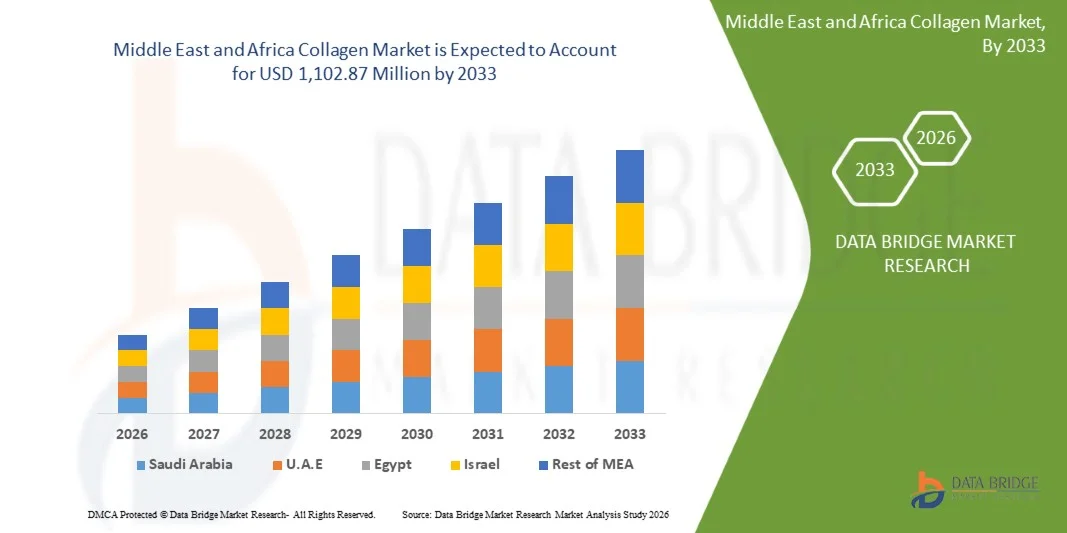
As per Data Bridge Market Research Analysis the Middle East and Africa collagen market was valued at USD 729.62 million in 2025 and is projected to reach USD 1,102.87 million by 2033, growing at a CAGR of 5.30% from 2026 to 2033. . The regional market is supported by rising use of collagen in food products, nutraceuticals, dietary supplements, cosmetics, personal care, animal feed, laboratory applications and functional ingredients.
Demand is being strengthened by the growing popularity of beauty-from-within products, protein-enriched nutrition, joint-health supplements, sports nutrition, and clean-label wellness formulations. Collagen ingredients are used as texturizers, stabilizers, emulsifiers and functional proteins, allowing manufacturers to position them across mainstream food, beverage and supplement categories as well as premium beauty and personal care products.
Market Size and Forecast
- Global Market Value (2025): USD 729.62 million
- Estimated Current Market Value (2033): USD 1,102.87 million
- Forecast CAGR (2022-2029): 5.30%
- Leading country: Saudi Arabia
- Fastest growing region: U.A.E.
Key Market Trends and Insights
- Saudi Arabia dominated the smart lock market with the largest revenue share in 2025, due to its large consumer base, high GDP, expanding modern retail and pharmacy networks, and rising demand for health, beauty, functional food, and dietary-supplement products.
- U.A.E. is expected to witness the fastest growth rate from 2026 to 2033 because it serves as a major beauty, wellness, retail, tourism, e-commerce, and distribution hub. Premium collagen powders, sachets, gummies, liquid shots, and skin-health supplements are widely promoted through pharmacies, supermarkets, beauty stores, wellness clinics, and digital platforms.
- The gelatin segment held the largest market revenue share of approximately 66.4% in 2025, driven by its extensive use as a gelling, texturizing, stabilizing, binding, and capsule-forming ingredient across food, pharmaceutical, laboratory, animal-feed, and personal-care applications.
- The hydrolyzed collagen and collagen peptide segment is projected to register the fastest growth at a CAGR of approximately 6.20% from 2026 to 2033, driven by strong solubility and increasing use in beauty-from-within, sports nutrition, joint-health, functional beverage, and healthy-aging products.
- The Type I segment held the largest market revenue share of approximately 46.7% in 2025, driven by its association with skin, bone, tendon, ligament, and connective-tissue applications and its wide availability from bovine and marine sources.
- The Type II segment is projected to register the fastest growth at a CAGR of approximately 6.10% from 2026 to 2033, driven by increasing adoption in joint-health, cartilage-support, mobility, and active-aging supplements.
Report Scope and Middle East and Africa Collagen Market Segmentation
|
Attributes |
Middle East and Africa Collagen Key Market Insights |
|
Segments Covered |
|
|
Countries Covered |
Middle East and Africa
|
|
Key Market Players |
|
|
Market Opportunities |
|
|
Value Added Data Infosets |
In addition to the insights on market scenarios such as market value, growth rate, segmentation, geographical coverage, and major players, the market reports curated by the Data Bridge Market Research also include in-depth expert analysis, pricing analysis, brand share analysis, consumer survey, demography analysis, supply chain analysis, value chain analysis, raw material/consumables overview, vendor selection criteria, PESTLE Analysis, Porter Analysis, and regulatory framework. |
Middle East and Africa Collagen Market Trends
Trend: Expansion Of Beauty-From-Within And Functional Nutrition Products
Growing consumer interest in beauty, wellness, healthy aging, and preventive nutrition is accelerating the adoption of collagen-based products across the Middle East and Africa. Collagen is increasingly evolving from a traditional protein ingredient into a premium functional component used in skin health, hair care, joint support, sports nutrition, and metabolic wellness applications. Manufacturers are expanding product portfolios with powders, gummies, stick packs, ready-to-drink beverages, capsules, and sachets that offer convenience while supporting daily wellness routines.
Strong beauty and wellness spending in Gulf countries, increasing awareness of nutricosmetics, rising disposable incomes, and growing demand for scientifically supported ingredients are further strengthening market demand. For instance, in April 2025, GELITA highlighted clinical findings demonstrating that its VERISOL Bioactive Collagen Peptides improved skin hydration, elasticity, and wrinkle-related outcomes. The development reflects the growing preference for evidence-based collagen ingredients and encourages regional brands to expand premium beauty-from-within product offerings. The continued convergence of beauty, nutrition, and preventive healthcare is expected to reinforce long-term demand for collagen products, positioning manufacturers to benefit from growing consumer interest in wellness-focused supplementation across Saudi Arabia, the U.A.E., and other regional markets.
Middle East and Africa Collagen Market Dynamics
Key Market Driver: Growing Use Of Collagen In Food, Supplements, And Cosmetics
The market is primarily driven by the expanding application of collagen and gelatin across food products, beverages, dietary supplements, nutraceuticals, cosmetics, personal care products, pharmaceuticals, and laboratory applications. Gelatin provides functional benefits such as gelling, stabilization, binding, and capsule production, while collagen peptides are increasingly incorporated into products targeting beauty, joint health, bone strength, sports performance, and healthy aging.
Rising disposable incomes, expanding pharmacy and e-commerce distribution networks, and increasing consumer awareness of wellness products are supporting regional demand. Leading ingredient suppliers continue introducing technologies that enable collagen incorporation into a wider range of consumer products. For instance, GELITA has expanded collagen-peptide solutions for high-protein gummies, nutrition bars, capsules, and clean-label formulations, helping manufacturers develop innovative products with enhanced protein content and processing efficiency. As collagen becomes increasingly integrated into mainstream food, supplement, and personal-care applications, manufacturers are expected to benefit from sustained demand driven by product diversification, functional nutrition trends, and continued innovation across the region.
Key Restraint/Challenge: Animal-Source Sensitivity, Certification Costs, And Regulatory Compliance
Collagen manufacturers remain highly dependent on animal-derived raw materials, including bovine, porcine, poultry, and marine sources. This dependence increases the importance of source traceability, halal certification, sustainability documentation, disease-control records, and consistent quality management. Compliance with these requirements can increase testing costs, supplier qualification expenses, certification procedures, and import-clearance complexities.
Regulatory authorities across the region maintain strict requirements regarding animal-derived ingredients and health supplements. Saudi Arabian and U.A.E. regulatory frameworks require supporting documentation and halal certification for many collagen and gelatin products, particularly when animal-origin ingredients are involved. In addition, premium marine collagen and branded peptide ingredients often carry higher costs that may limit affordability among price-sensitive consumers. Despite strong market demand, certification requirements, regulatory complexity, source transparency concerns, and raw-material price fluctuations are expected to remain significant challenges, increasing operational costs and potentially slowing market expansion throughout the forecast period.
Key Market Opportunity: Halal-Certified Marine Collagen And Targeted Collagen Peptides
Governments, consumers, and manufacturers are increasingly prioritizing halal-certified, traceable, and scientifically validated wellness products, creating significant opportunities for collagen suppliers across the region. Marine collagen offers an attractive premium alternative for consumers seeking non-porcine sources, while halal-certified bovine collagen continues to support mass-market food, supplement, beverage, and personal-care applications. Convenient delivery formats such as powders, gummies, ready-to-drink beverages, and sachets are further expanding market accessibility.
Industry participants are increasingly developing specialized collagen peptide formulations targeting specific health outcomes beyond traditional beauty and joint-health applications. For instance, in 2024, Rousselot launched Nextida GC, a collagen-peptide composition designed to support post-meal glucose management, while Darling Ingredients announced plans to combine Rousselot and PB Leiner within a broader collagen and gelatin platform. These developments reflect growing investment in science-based and targeted collagen solutions. As demand for halal-certified, sustainably sourced, and function-specific collagen products continues to expand, manufacturers offering validated health benefits, strong traceability, and differentiated formulations are expected to capture substantial long-term growth opportunities across Saudi Arabia, the U.A.E., South Africa, and other high-potential regional markets.
Middle East and Africa Collagen Market Scope
The Middle East and Africa collagen market is segmented on the basis of product type, type, form, source, product category, function and application.
-
By Product Type
On the basis of product type, the market is divided into gelatin, hydrolyzed collagen, native collagen, collagen peptide and others. The gelatin segment held the largest market revenue share of approximately 66.4% in 2025, driven by its extensive use as a gelling, texturizing, stabilizing, binding, and capsule-forming ingredient across food, pharmaceutical, laboratory, animal-feed, and personal-care applications.
The hydrolyzed collagen and collagen peptide segment is projected to register the fastest growth at a CAGR of approximately 6.20% from 2026 to 2033, driven by strong solubility and increasing use in beauty-from-within, sports nutrition, joint-health, functional beverage, and healthy-aging products.
- By Type
On the basis of type, the market is divided into Type I, Type II, Type III and Type IV. The Type I segment held the largest market revenue share of approximately 46.7% in 2025, driven by its association with skin, bone, tendon, ligament, and connective-tissue applications and its wide availability from bovine and marine sources.
The Type II segment is projected to register the fastest growth at a CAGR of approximately 6.10% from 2026 to 2033, driven by increasing adoption in joint-health, cartilage-support, mobility, and active-aging supplements.
- By Form
On the basis of form, the market is divided into powder and liquid. The powder segment held the largest market revenue share of approximately 68.0% in 2025, driven by ease of storage, transport, dosing, flavoring, blending, and use in jars, sachets, stick packs, protein mixes, and functional beverages.
The liquid segment is projected to register the fastest growth at a CAGR of approximately 6.00% from 2026 to 2033, driven by demand for ready-to-consume beauty shots, wellness drinks, and convenient premium supplement formats.
- By Source
On the basis of source, the market is divided into bovine, poultry, porcine, marine and others. The bovine segment held the largest market revenue share of approximately 38.4% in 2025, driven by established raw-material availability, cost efficiency, and broad use in gelatin, collagen peptides, food, supplement, medical, and personal-care products.
The marine segment is projected to register the fastest growth at a CAGR of 5.70% from 2026 to 2033, driven by premium beauty positioning, demand for alternative animal sources, sustainability narratives, and growing interest in clean-label and source-sensitive collagen products.
- By Product Category
On the basis of product category, the market is divided into GMO and non-GMO. The GMO segment held the largest market revenue share of approximately 54.0% in 2025, driven by its established use in mainstream dietary-supplement and processed-food supply chains and the broader availability of conventionally sourced ingredients.
The non-GMO segment is projected to register the fastest growth at a CAGR of approximately 5.90% from 2026 to 2033, driven by clean-label purchasing, transparent sourcing, premium wellness positioning, and consumer preference for minimally processed ingredient claims.
- By Function
On the basis of function, the market is divided into texture, stabilizer, emulsifier, binding and others. The texture segment held the largest market revenue share of approximately 42.0% in 2025, driven by the ability of collagen and gelatin to improve mouthfeel, viscosity, gel structure, chewability, and product stability in confectionery, dairy, desserts, gummies, and processed foods.
The emulsifier segment is projected to register the fastest growth at a CAGR of approximately 5.80% from 2026 to 2033, driven by expanding use in complex food, nutraceutical, beverage, and cosmetic formulations requiring improved ingredient dispersion and stability.
- By Application
On the basis of application, the market is divided into food products, beverages, nutraceuticals and dietary supplements, cosmetics and personal care, animal feed, laboratory tests and others. The food products segment held the largest market revenue share of approximately 49.8% in 2025, driven by wide use of gelatin and collagen in confectionery, dairy, bakery, meat products, desserts, gummies, processed foods, and protein-enriched formulations.
The nutraceuticals and dietary supplements segment is projected to register the fastest growth at a CAGR of approximately 5.61% from 2026 to 2033, driven by rising demand for skin, joint, bone, sports, healthy-aging, and beauty-from-within products across pharmacy, retail, and online channels.
Middle East and Africa Collagen Market Regional Analysis
Saudi Arabia Collagen Market Insight – Dominated Country
Saudi Arabia dominated the smart lock market with the largest revenue share in 2025, due to its large consumer base, high GDP, expanding modern retail and pharmacy networks, and rising demand for health, beauty, functional food, and dietary-supplement products. Collagen powders, gummies, capsules, protein products, and beauty-from-within supplements are gaining relevance among younger consumers, active adults, and healthy-aging populations. The market also benefits from strong interest in halal-certified ingredients and clear animal-source documentation, which favors suppliers able to provide certified bovine or marine collagen with reliable traceability. Continued wellness investment and broader e-commerce access are expected to support the country's leading position through 2033.
UAE Collagen Market Insight – Fastest Growing Country
The U.A.E. is expected to witness the fastest growth rate from 2026 to 2033 because it serves as a major beauty, wellness, retail, tourism, e-commerce, and distribution hub. Premium collagen powders, sachets, gummies, liquid shots, and skin-health supplements are widely promoted through pharmacies, supermarkets, beauty stores, wellness clinics, and digital platforms. The country's diverse expatriate population and openness to international brands create a favorable test market for new formulations and premium formats. Growth will increasingly depend on strong product registration, halal documentation for animal-derived ingredients, claims substantiation, and differentiated consumer positioning.
Middle East and Africa Collagen Market Share
The Middle East and Africa collagen market is primarily led by well-established companies, including:
- ConnOils LLC (U.A.E.)
- Best Collagen (South Africa)
- Health Connection Wholefoods (South Africa)
- Vital Health Foods (South Africa)
- Dis-Chem Health (South Africa)
- Nativa (South Africa)
- NeoLife South Africa (South Africa)
- Nutritional Performance Labs (South Africa)
- Forever Living Products South Africa (South Africa)
- Pharma Natura (South Africa)
- Coyne Healthcare (South Africa)
- Gulf Nutraceuticals FZE (U.A.E.)
Latest Developments in Middle East and Africa Collagen Market
- In June 2026, Darling Ingredients announced that the U.S. Patent and Trademark Office granted a patent for Nextida GC, a specific collagen peptide ingredient developed to support healthy after-meal blood-sugar response. The development highlights the movement of collagen innovation beyond traditional skin and joint categories toward targeted metabolic-wellness applications.
- In December 2025, Darling Ingredients and Tessenderlo Group signed a definitive agreement to combine the Rousselot and PB Leiner collagen and gelatin businesses in a new company. The planned platform is intended to strengthen scale, innovation, supply capabilities, and growth in collagen-based health, wellness, nutrition, and functional-ingredient markets.
- In April 2025, GELITA reported new clinical evidence for its VERISOL Bioactive Collagen Peptides, including improved skin hydration alongside established elasticity and wrinkle-related benefits. The update supports evidence-based beauty-from-within product development and creates additional positioning opportunities for collagen supplement brands in premium Middle Eastern markets.

- Interactive Data Analysis Dashboard
- Company Analysis Dashboard for high growth potential opportunities
- Research Analyst Access for customization & queries
- Competitor Analysis with Interactive dashboard
- Latest News, Updates & Trend analysis
- Harness the Power of Benchmark Analysis for Comprehensive Competitor Tracking
Middle East And Africa Collagen Market, Supply Chain Analysis and Ecosystem Framework
To support market growth and help clients navigate the impact of geopolitical shifts, DBMR has integrated in-depth supply chain analysis into its Middle East And Africa Collagen Market research reports. This addition empowers clients to respond effectively to global changes affecting their industries. The supply chain analysis section includes detailed insights such as Middle East And Africa Collagen Market consumption and production by country, price trend analysis, the impact of tariffs and geopolitical developments, and import and export trends by country and HSN code. It also highlights major suppliers with data on production capacity and company profiles, as well as key importers and exporters. In addition to research, DBMR offers specialized supply chain consulting services backed by over a decade of experience, providing solutions like supplier discovery, supplier risk assessment, price trend analysis, impact evaluation of inflation and trade route changes, and comprehensive market trend analysis.
Data collection and base year analysis are done using data collection modules with large sample sizes. The stage includes obtaining market information or related data through various sources and strategies. It includes examining and planning all the data acquired from the past in advance. It likewise envelops the examination of information inconsistencies seen across different information sources. The market data is analysed and estimated using market statistical and coherent models. Also, market share analysis and key trend analysis are the major success factors in the market report. To know more, please request an analyst call or drop down your inquiry.
The key research methodology used by DBMR research team is data triangulation which involves data mining, analysis of the impact of data variables on the market and primary (industry expert) validation. Data models include Vendor Positioning Grid, Market Time Line Analysis, Market Overview and Guide, Company Positioning Grid, Patent Analysis, Pricing Analysis, Company Market Share Analysis, Standards of Measurement, Global versus Regional and Vendor Share Analysis. To know more about the research methodology, drop in an inquiry to speak to our industry experts.
Data Bridge Market Research is a leader in advanced formative research. We take pride in servicing our existing and new customers with data and analysis that match and suits their goal. The report can be customized to include price trend analysis of target brands understanding the market for additional countries (ask for the list of countries), clinical trial results data, literature review, refurbished market and product base analysis. Market analysis of target competitors can be analyzed from technology-based analysis to market portfolio strategies. We can add as many competitors that you require data about in the format and data style you are looking for. Our team of analysts can also provide you data in crude raw excel files pivot tables (Fact book) or can assist you in creating presentations from the data sets available in the report.













