


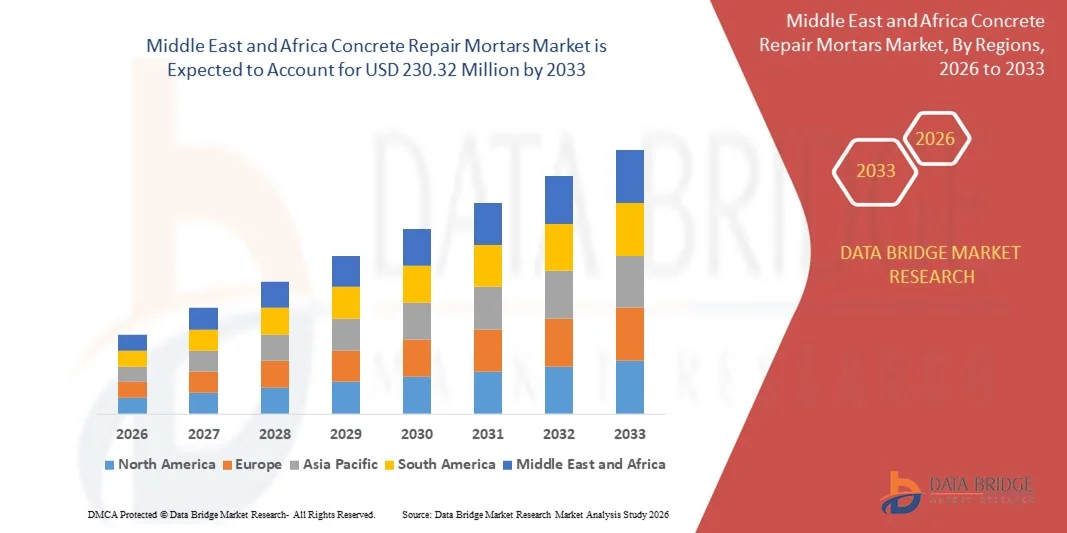
What is the Middle East and Africa Concrete Repair Mortars Market Size and Growth Rate?
- The Middle East and Africa concrete repair mortars market size was valued at USD 160.72 million in 2025 and is expected to reach USD 230.32 million by 2033, at a CAGR of 4.6% during the forecast period
- Increase in demand of environmentally friendly building materials act as a driver for the concrete repair mortars market. Lack of skilled and qualified labour is acting as a restraint for the growth of the concrete repair mortars market
What are the Major Takeaways of Concrete Repair Mortars Market?
- Growing demographics expected to bring opportunities for the significant growth for the concrete repair mortars market. Incompatibilities between the repair mortar and the host concrete are challenging the growth of the concrete repair mortars market
- Saudi Arabia dominated the Middle East concrete repair mortars market with a revenue share of 42.1% in 2025, driven by large-scale urban redevelopment, residential construction, and infrastructure projects across major cities such as Riyadh, Jeddah, and Dammam
- Egypt is projected to register the fastest CAGR of 10.02% from 2026 to 2033, driven by rapid urban expansion, growing multi-storey housing projects, and government-backed infrastructure programs, including bridges, highways, and metro lines
- The Cementitious Concrete Repair Mortars segment dominated the market with an estimated 54.7% share in 2025, driven by their affordability, wide availability, ease of application, and suitability for large-scale structural repair works
Report Scope and Concrete Repair Mortars Market Segmentation
|
Attributes |
Concrete Repair Mortars Key Market Insights |
|
Segments Covered |
|
|
Countries Covered |
Middle East and Africa
|
|
Key Market Players |
|
|
Market Opportunities |
|
|
Value Added Data Infosets |
In addition to the insights on market scenarios such as market value, growth rate, segmentation, geographical coverage, and major players, the market reports curated by the Data Bridge Market Research also include in-depth expert analysis, pricing analysis, brand share analysis, consumer survey, demography analysis, supply chain analysis, value chain analysis, raw material/consumables overview, vendor selection criteria, PESTLE Analysis, Porter Analysis, and regulatory framework. |
What is the Key Trend in the Concrete Repair Mortars Market?
Increasing Shift Toward High-Strength, Fast-Curing, and Sustainable Concrete Repair Mortars
- The concrete repair mortars market is witnessing rapid adoption of fast-setting, polymer-modified, and fiber-reinforced repair materials designed to support quicker construction cycles, extended durability, and reduced downtime in infrastructure restoration projects
- Manufacturers are introducing low-shrinkage, high-adhesion, and sulfate-resistant mortars that deliver improved structural integrity, enhanced workability, and long-term performance across residential, commercial, and industrial repair applications
- Growing focus on eco-friendly formulations, including low-carbon cement blends, recycled aggregates, and VOC-free additives, is strengthening sustainable construction practices globally
- For instance, companies such as Sika, MAPEI, Saint-Gobain Weber, Fosroc, and MC-Bauchemie are developing high-performance mortars with rapid curing, corrosion protection, and improved bond strength for bridges, tunnels, buildings, and industrial infrastructure
- Rising demand for infrastructure rehabilitation, aging building restoration, and preventive maintenance is accelerating adoption across the U.S., Europe, and Middle East and Africa
- As infrastructure becomes older and more repair-intensive, Concrete Repair Mortars will remain essential for long-lasting structural performance, reduced maintenance costs, and sustainable construction outcomes
What are the Key Drivers of Concrete Repair Mortars Market?
- Rising global focus on infrastructure refurbishment, including bridges, highways, water structures, and industrial facilities, is significantly increasing demand for Concrete Repair Mortars
- For instance, in 2025, companies such as Sika, MAPEI, and Fosroc expanded their portfolios of polymer-modified and fiber-reinforced mortars to support large-scale rehabilitation projects across Europe and Middle East and Africa
- Growing awareness of structural durability, corrosion prevention, and long-term asset protection is propelling adoption of advanced repair materials with improved compressive strength and bonding performance
- Technological advancements such as nano-modified cementitious systems, low-carbon mortars, and crack-resistant formulations are enhancing repair efficiency and service life
- Rising investments in transportation infrastructure, urban redevelopment, industrial upgrades, and smart city construction further strengthen market adoption
- Supported by increasing construction activities, stricter quality standards, and the need to extend the life of aging structures, the Concrete Repair Mortars market is projected to experience strong long-term growth
Which Factor is Challenging the Growth of the Concrete Repair Mortars Market?
- High costs associated with premium repair mortars, specialized additives, and skilled installation often limit adoption among small contractors and low-budget projects
- For instance, during 2024–2025, rising prices of cement, polymers, silica, and high-performance fillers increased production and application costs for several global brands
- Technical challenges such as incorrect surface preparation, poor mixing practices, and improper application techniques can compromise structural performance, increasing the need for trained labor
- Low awareness about material compatibility, durability standards, and testing requirements in developing economies slows market penetration
- Competition from low-cost, unbranded, and substandard repair materials creates pricing pressure and reduces market differentiation for certified products
- To overcome these challenges, companies are focusing on contractor training programs, advanced application tools, cost-efficient formulations, and awareness initiatives to ensure broader adoption of high-quality Concrete Repair Mortars worldwide
How is the Concrete Repair Mortars Market Segmented?
The market is segmented on the basis of type, grade, application method, and industry.
- By Type
The concrete repair mortars market is segmented into Cementitious Concrete Repair Mortars, Epoxy Concrete Repair Mortars, and Epoxy Resin-Based Concrete. The Cementitious Concrete Repair Mortars segment dominated the market with an estimated 54.7% share in 2025, driven by their affordability, wide availability, ease of application, and suitability for large-scale structural repair works. Their excellent workability, compatibility with existing concrete, and strong adhesion make them the preferred choice for bridges, buildings, tunnels, and general rehabilitation projects.
The Epoxy Concrete Repair Mortars segment is expected to grow at the fastest CAGR from 2026 to 2033, supported by rising demand for high-strength, chemical-resistant, and fast-curing repair materials in industrial and heavy-load environments. Increasing adoption in marine structures, chemical plants, parking decks, and corrosion-exposed areas—combined with superior mechanical performance and long-term durability—continues to accelerate segment growth.
- By Grade
The concrete repair mortars market is classified into Structural and Non-Structural grades. The Structural grade segment dominated the market with approximately 61.3% share in 2025, owing to its critical role in strengthening load-bearing elements, restoring damaged infrastructure, and enhancing the mechanical integrity of aging concrete structures. Structural mortars offer high compressive strength, crack resistance, and long-service performance, making them widely used in bridges, highways, industrial floors, and reinforced concrete frameworks.
The Non-Structural grade segment is projected to grow at the fastest CAGR during 2026–2033, driven by increasing demand for cosmetic repairs, surface finishing, and minor defect remediation in commercial and residential buildings. Growth in interior renovations, façade repairs, protective coatings, and aesthetic restorations—combined with rising adoption in cost-sensitive urban housing projects—continues to boost segment expansion across emerging and developed markets.
- By Application Method
The concrete repair mortars market is segmented into Hand Applied Concrete Repair Mortars, Machine Applied/Sprayed Concrete Repair Mortars, Poured/Flow Applied Concrete Repairs (Re-Casting), Levelling/Fairing Mortars, and Protective Surface Coatings. The Hand Applied segment dominated the market with an estimated 46.8% share in 2025, driven by its widespread use in residential repairs, small-scale structural restoration, patching applications, and maintenance projects. Its simplicity, low equipment requirement, and suitability for contractors and small teams strengthen adoption globally.
The Machine Applied/Sprayed Concrete Repair Mortars segment is expected to grow at the fastest CAGR from 2026 to 2033, propelled by large-scale infrastructure rehabilitation, tunnel restoration, bridge decking, dam repairs, and industrial facility upgrades. High application speed, uniform coverage, reduced labor time, and suitability for high-thickness repairs make sprayed mortars ideal for government-funded and commercial infrastructure projects.
- By Industry
The concrete repair mortars market is segmented into Residential, Commercial, Industrial, and Infrastructure. The Infrastructure segment dominated the market with an estimated 39.2% share in 2025, supported by increasing investments in bridge rehabilitation, road maintenance, urban transit upgrades, water-retaining structures, and government-driven infrastructure renewal programs. Rising aging infrastructure worldwide continues to create significant demand for durable, high-performance repair mortars.
The Industrial segment is projected to grow at the fastest CAGR from 2026 to 2033, driven by rising demand for corrosion-resistant, chemical-resistant, and high-strength mortars in manufacturing plants, petrochemical facilities, marine environments, and power generation units. Expansion of heavy industries, modernization of factories, and regulatory focus on structural safety are further accelerating the adoption of advanced repair solutions across the industrial sector.
Which Region Holds the Largest Share of the Concrete Repair Mortars Market?
- Saudi Arabia dominated the Middle East concrete repair mortars market with a revenue share of 42.1% in 2025, driven by large-scale urban redevelopment, residential construction, and infrastructure projects across major cities such as Riyadh, Jeddah, and Dammam
- Rapid expansion of highways, metro systems, and industrial zones, coupled with growing demand for coastal and desert-adapted structures, continues to drive adoption of advanced cementitious and epoxy repair mortars
- Government initiatives focusing on sustainable urban planning, water-resilient structures, and long-lasting concrete maintenance further reinforce Saudi Arabia’s regional leadership. Increasing use of polymer-modified, fiber-reinforced, and fast-setting mortars in bridges, high-rise buildings, and public infrastructure strengthens the country’s dominance in the Middle East Concrete Repair Mortars market
Egypt Concrete Repair Mortars Market Insight
Egypt is projected to register the fastest CAGR of 10.02% from 2026 to 2033, driven by rapid urban expansion, growing multi-storey housing projects, and government-backed infrastructure programs, including bridges, highways, and metro lines. Rising awareness of structural safety, crack prevention, and long-term durability is increasing adoption of cementitious and epoxy-based repair mortars. Mechanized application methods, such as sprayed and poured repairs, are gaining popularity for large-scale construction and renovation projects. Expanding private construction activity and refurbishment of aging concrete structures further accelerate Egypt’s growth trajectory in the Middle East and Africa Concrete Repair Mortars market.
South Africa Concrete Repair Mortars Market Insight
South Africa shows steady demand due to ongoing maintenance and rehabilitation of bridges, dams, and industrial facilities, along with urban infrastructure development in Johannesburg, Cape Town, and Durban. Concrete repair mortars, including polymer-modified and epoxy-based solutions, are preferred for their durability, crack resistance, and adhesion properties. Increasing adoption of machine-applied and sprayed repair techniques, along with growing construction investments, continues to strengthen market growth across residential, commercial, and infrastructure applications in the region.
Which are the Top Companies in Concrete Repair Mortars Market?
The concrete repair mortars industry is primarily led by well-established companies, including:
- Sika AG (Switzerland)
- MAPEI S.p.A. (Italy)
- Saint-Gobain Weber (France)
- Fosroc, Inc. (U.A.E.)
- The Euclid Chemical Company (U.S.)
- MC-Bauchemie (Germany)
- Remmers (UK) Limited (U.K.)
- Aquafin (Germany)
- Chembond Chemicals Limited (India)
- Pidilite Industries Ltd. (India)
- Master Builders Inc. (U.S.)
- Dayton Superior Corporation (U.S.)
- Normet (Finland)
What are the Recent Developments in Global Concrete Repair Mortars Market?
- In April 2025, Sika inaugurated its fourth manufacturing facility in Kazakhstan, establishing a state-of-the-art plant in Ust-Kamenogorsk equipped with production lines for mortar products, concrete repair mortars, and concrete admixtures along with an advanced laboratory, reinforcing the company’s long-term expansion strategy in Central Asia and strengthening its regional production capabilities for sustainable growth
- In April 2024, Mapei Group launched “The Zero Line,” a new generation of eco-friendly concrete repair mortars developed to improve structural performance while significantly reducing environmental impact, reflecting the company’s commitment to sustainable construction solutions and supporting broader adoption of green repair technologies worldwide
- In June 2023, Fosroc appointed Mannai Trading Co. WLL as its exclusive distributor in Qatar, creating a strategic partnership aimed at enhancing the availability of high-performance construction chemicals with a focus on environmentally responsible practices and ensuring stronger market presence across the Qatari construction sector
- In May 2023, Sika AG completed the acquisition of MBCC Group, expanding its global footprint and strengthening its comprehensive range of construction solutions to address diverse project requirements and reinforcing its position as a leading player in the global construction chemicals market

- Interactive Data Analysis Dashboard
- Company Analysis Dashboard for high growth potential opportunities
- Research Analyst Access for customization & queries
- Competitor Analysis with Interactive dashboard
- Latest News, Updates & Trend analysis
- Harness the Power of Benchmark Analysis for Comprehensive Competitor Tracking
Middle East And Africa Concrete Repair Mortars Market, Supply Chain Analysis and Ecosystem Framework
To support market growth and help clients navigate the impact of geopolitical shifts, DBMR has integrated in-depth supply chain analysis into its Middle East And Africa Concrete Repair Mortars Market research reports. This addition empowers clients to respond effectively to global changes affecting their industries. The supply chain analysis section includes detailed insights such as Middle East And Africa Concrete Repair Mortars Market consumption and production by country, price trend analysis, the impact of tariffs and geopolitical developments, and import and export trends by country and HSN code. It also highlights major suppliers with data on production capacity and company profiles, as well as key importers and exporters. In addition to research, DBMR offers specialized supply chain consulting services backed by over a decade of experience, providing solutions like supplier discovery, supplier risk assessment, price trend analysis, impact evaluation of inflation and trade route changes, and comprehensive market trend analysis.
Data collection and base year analysis are done using data collection modules with large sample sizes. The stage includes obtaining market information or related data through various sources and strategies. It includes examining and planning all the data acquired from the past in advance. It likewise envelops the examination of information inconsistencies seen across different information sources. The market data is analysed and estimated using market statistical and coherent models. Also, market share analysis and key trend analysis are the major success factors in the market report. To know more, please request an analyst call or drop down your inquiry.
The key research methodology used by DBMR research team is data triangulation which involves data mining, analysis of the impact of data variables on the market and primary (industry expert) validation. Data models include Vendor Positioning Grid, Market Time Line Analysis, Market Overview and Guide, Company Positioning Grid, Patent Analysis, Pricing Analysis, Company Market Share Analysis, Standards of Measurement, Global versus Regional and Vendor Share Analysis. To know more about the research methodology, drop in an inquiry to speak to our industry experts.
Data Bridge Market Research is a leader in advanced formative research. We take pride in servicing our existing and new customers with data and analysis that match and suits their goal. The report can be customized to include price trend analysis of target brands understanding the market for additional countries (ask for the list of countries), clinical trial results data, literature review, refurbished market and product base analysis. Market analysis of target competitors can be analyzed from technology-based analysis to market portfolio strategies. We can add as many competitors that you require data about in the format and data style you are looking for. Our team of analysts can also provide you data in crude raw excel files pivot tables (Fact book) or can assist you in creating presentations from the data sets available in the report.













