Contraceptive Market Overview
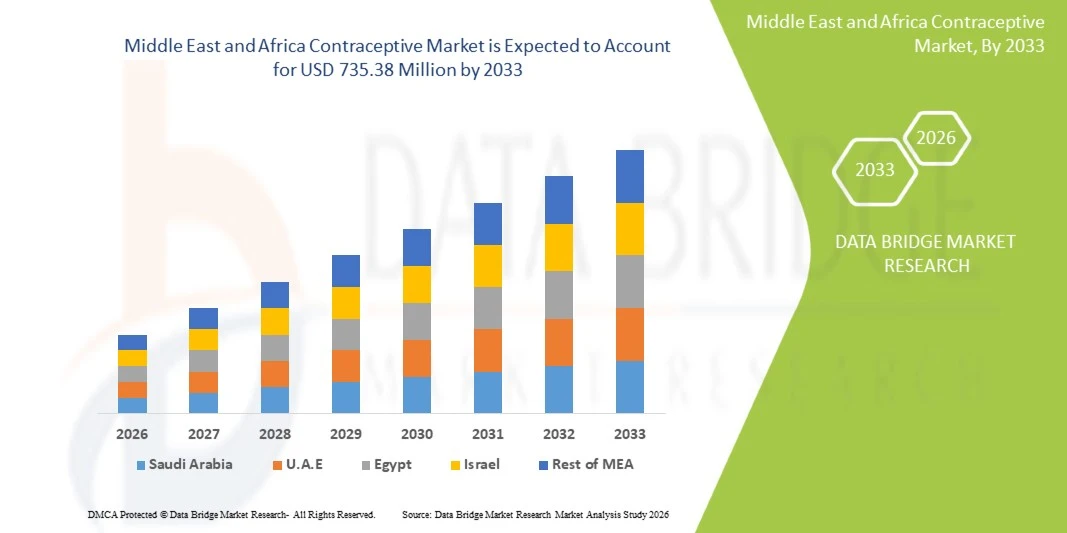
The Middle East and Africa Contraceptive Market was valued at USD 538.31 Million in 2025 and is projected to reach USD 735.38 Million by 2033, growing at a CAGR of 3.95% from 2026 to 2033. Contraceptives include pharmaceutical products and medical devices, such as oral contraceptive pills, injectable contraceptives, condoms, intrauterine devices (IUDs), implants, patches, vaginal rings, and emergency contraceptives. Growing demand for convenient, reliable, and reversible birth control methods is supporting market development across diverse population groups. Increasing access to reproductive healthcare services, government-supported family planning programs, and educational campaigns is further contributing to the adoption of contraceptive products.
Furthermore, advancements in contraceptive formulations, growing interest in long-acting reversible contraceptives, and expanding distribution through retail pharmacies, healthcare facilities, and online platforms are creating opportunities for market participants. Pharmaceutical companies and medical device manufacturers are focusing on product innovation, improved user convenience, and broader access to contraceptive options. However, affordability barriers, social stigma, regulatory differences, and disparities in healthcare access continue to influence market development. Increasing emphasis on reproductive health education and family planning is expected to support the growth of the Middle East and Africa Contraceptive Market during the forecast period.
Market Size & Forecast
- Middle East & Africa Market Value (2025): USD 538.31 Million
- Expected Market Value (2033): USD 735.38 Million
- Forecast CAGR (2026–2033): 3.95%
- Leading Country in 2025: South Africa
- Fastest Growing Country: Oman
Key Market Trends & Insights
- The South Africa dominated the Middle East and Africa Contraceptive Market with the largest revenue share of 10.35% in 2025, supported by established healthcare infrastructure, increasing awareness of reproductive health, and widespread availability of contraceptive products. Strong access to family planning services, retail pharmacies, and prescription-based healthcare, along with growing adoption of modern contraceptive methods, further strengthened countryal market demand.
- The contraceptive drug segment dominated the market with a 59.30% share in 2025, driven by the widespread use of oral contraceptive pills, injectable contraceptives, and emergency contraceptive drugs. Their availability through pharmacies and healthcare facilities, ease of administration, and suitability for different reproductive health needs supported the segment's leading position.
- The Onam is expected to be the fastest-growing country in the Middle East and Africa Contraceptive Market, registering a CAGR of 5.99% during 2026–2033. Growth is supported by increasing awareness of family planning, expanding reproductive healthcare initiatives, and improving access to contraceptive products. Government programs and healthcare organizations promoting pregnancy prevention are further contributing to countryal market development.
- The progestin-only contraceptives segment dominated the market with a 49.05% share in 2025, supported by demand for hormonal contraceptive options that do not contain estrogen. Their availability in different formulations, including pills, injectables, and implants, provides flexibility for users with varying contraceptive needs and supports adoption across reproductive healthcare settings.
- The short-acting reversible contraceptives segment dominated the market with a 57.17% share in 2025, owing to the widespread use of oral contraceptive pills, condoms, and other reversible birth control methods. Their accessibility, convenience, and flexibility in discontinuation support adoption among individuals seeking pregnancy prevention options that can be managed according to personal preferences and family planning needs.
- The Oral segment dominated the market with a 40.77% share in 2025, driven by the widespread adoption of oral contraceptive pills and their convenient administration. The availability of combined and progestin-only formulations, established consumer familiarity, and broad distribution through pharmacies and healthcare providers continue to support demand for oral contraceptive products.
- The female contraceptives segment dominated the market with an 86.01% share in 2025, supported by the broad availability of established contraceptive options, including oral pills, injectables, implants, intrauterine devices, patches, and vaginal rings. Increasing awareness of reproductive health, access to family planning services, and demand for effective pregnancy prevention methods further strengthened the segment's leading position.
Report Scope and Contraceptive Market Segmentation
|
Attributes |
Contraceptive Key Market Insights |
|
Segments Covered |
|
|
Countries Covered |
Middle East & Africa
|
|
Key Market Players |
|
|
Market Opportunities |
|
|
Value Added Data Infosets |
In addition to the insights on market scenarios such as market value, growth rate, segmentation, geographical coverage, and major players, the market reports curated by the Data Bridge Market Research also include in-depth expert analysis, patient epidemiology, pipeline analysis, pricing analysis, and regulatory framework. |
Contraceptive Market Trends
Trend: Advancements in Contraceptive Formulations and Expansion of Long-Acting Reversible Contraceptives
The Middle East and Africa Contraceptive Market is increasingly focusing on product innovation, improved user convenience, and the development of diverse contraceptive options to address changing reproductive healthcare needs. Manufacturers are advancing hormonal formulations, reusable vaginal contraceptive systems, transdermal patches, and long-acting reversible contraceptives (LARCs) to provide individuals with more flexible pregnancy prevention options. Growing awareness of family planning, increasing demand for non-daily contraceptive methods, and expanding access to reproductive healthcare services are supporting product development across the market. In addition, research into non-hormonal contraception and male contraceptive options is broadening the scope of innovation. Collaborations between pharmaceutical companies, medical device manufacturers, and research organizations are further supporting the development and commercialization of new contraceptive technologies.
For instance,
- In July 2026, Viatris Inc.received ASIA-PACIFIC FDA approval for Gwyn Lo, a once-weekly combined hormonal contraceptive patch containing norelgestromin and ethinyl estradiol. The product introduced a low-dose estrogen option for eligible women seeking a reversible, non-invasive contraceptive method.
- In April 2026, Duchesnay launched Ringza in ASIA-PACIFIC in collaboration with the Population Council. The reusable contraceptive vaginal system is designed for use for up to one year, providing a patient-controlled and reversible alternative to contraceptive methods requiring more frequent administration.
- In February 2026, Contraline and the Population Council entered into a Middle East & Africa exclusive licensing agreement for the NEST male contraceptive gel. The once-daily topical formulation combines segesterone acetate with testosterone and is being developed as a reversible hormonal contraceptive option for men.
Overall, these developments highlight the growing importance of contraceptive innovation, user convenience, and diversification of available birth control methods in the Middle East and Africa Contraceptive Market. The introduction of new delivery systems, including weekly patches and reusable vaginal rings, is expanding options for women, while research into male contraceptives is addressing unmet needs in reproductive healthcare. Continued investment in research and development, regulatory approvals, and collaborations between pharmaceutical companies and research organizations is expected to support product innovation and market growth during the forecast period.
Middle East and Africa Contraceptive Market Dynamics
Key Market Driver: Growing Demand for Convenient Contraceptive Options and Advancements in Reproductive Healthcare
The Middle East and Africa Contraceptive Market is increasingly focusing on developing convenient, effective, and user-friendly contraceptive options to address diverse reproductive health needs. Manufacturers are expanding product portfolios across oral contraceptive pills, vaginal rings, contraceptive patches, intrauterine devices (IUDs), implants, and other hormonal and non-hormonal methods. Growing awareness of family planning, increasing demand for reversible contraception, and improvements in reproductive healthcare access are supporting the adoption of modern contraceptive products. In addition, advancements in contraceptive formulations, extended-duration protection, and alternative delivery systems are creating opportunities for product innovation. Pharmaceutical companies and healthcare organizations are also exploring new approaches to male contraception, non-hormonal birth control, and improved user convenience. These developments are encouraging manufacturers to strengthen research and development activities and broaden access to contraceptive options across different markets.
For instance,
- In October 2025, the Australian Government announced improved access to affordable contraceptive options through the Pharmaceutical Benefits Scheme (PBS), including the listing of NuvaRing from 1 November 2025. The initiative aimed to reduce costs and expand access to alternatives to daily oral contraceptive pills.
- In February 2026, Contraline and the Population Council executed a Middle East & Africa exclusive licensing agreement for the NES/T male contraceptive gel. The agreement supported the transition of the investigational product toward late-stage development and future regulatory evaluation, highlighting progress in expanding reversible male contraceptive options.
- In April 2026, Duchesnay announced the Canadian launch of Ringza, a reusable contraceptive vaginal system developed in collaboration with the Population Council. Designed for use for up to 13 menstrual cycles, the product highlighted the growing focus on patient-controlled contraception and longer-duration contraceptive solutions.
- In September 2026, the World Health Organization (WHO) introduced guidance aimed at expanding access to safe and effective contraceptive methods, including future male contraceptives. The initiative highlighted the importance of broadening contraceptive choices, supporting informed decision-making, and encouraging innovation in reproductive healthcare.
Overall, these developments highlight the growing importance of contraceptive innovation, affordability, convenience, and expanded access to reproductive healthcare in the Middle East and Africa Contraceptive Market. Increasing demand for patient-controlled products, reusable delivery systems, and new male contraceptive options is encouraging pharmaceutical companies and healthcare organizations to invest in product development and accessibility initiatives. Continued advancements in contraceptive technologies, alongside supportive healthcare policies and family planning programs, are expected to support market development during the forecast period.
Key Restraint/Challenge: Growing Demand for Innovative Contraceptive Methods and Improved Accessibility
The Middle East and Africa Contraceptive Market is increasingly focusing on the development of innovative contraceptive methods, improved product convenience, and expanded access to reproductive healthcare. Manufacturers are developing advanced hormonal formulations, long-acting reversible contraceptives (LARCs), and non-hormonal alternatives to address diverse user preferences and reproductive health requirements. Growing awareness of family planning, the prevention of unintended pregnancies, and the importance of reproductive health is supporting the adoption of oral contraceptive pills, vaginal rings, intrauterine devices (IUDs), implants, and contraceptive patches. In addition, improvements in drug delivery technologies, product design, and digital healthcare services are helping improve user convenience and access to contraceptive information. Increasing interest in hormone-free options and male contraceptive research is further encouraging innovation across the market.
For instance,
- In April 2026, Duchesnay introduced Ringza, a reusable contraceptive vaginal system in ASIA-PACIFIC, in collaboration with the Population Council. The launch highlighted continued innovation in vaginal contraceptive delivery and the development of reusable options for pregnancy prevention.
- In February 2026, Contraline and the Population Council entered into a Middle East & Africa exclusive licensing agreement for a male contraceptive gel. The agreement highlighted ongoing research into additional male contraceptive options and efforts to broaden the range of available birth control methods.
- In June 2025, ASKA Pharmaceutical launched Slinda 28 Tablets, a drospirenone-based oral contraceptive, in Japan. The launch reflected continued development and commercialization of hormonal contraceptive options to address women's reproductive healthcare needs.
Overall, these developments highlight the growing importance of contraceptive innovation, user convenience, and broader access to reproductive healthcare in the Middle East and Africa Contraceptive Market. Increasing demand for reliable and reversible birth control methods is encouraging manufacturers to invest in improved formulations, alternative delivery systems, and new contraceptive technologies. Continued product development, public health initiatives, and collaboration between pharmaceutical companies and reproductive health organizations are expected to support market growth during the forecast period.
Key Market Opportunity: Growing Demand for Innovative Contraceptive Methods and Expanded Reproductive Healthcare Access
The Middle East and Africa Contraceptive Market is increasingly focusing on the development of innovative contraceptive methods, improved user convenience, and expanded access to reproductive healthcare services. Manufacturers are developing advanced hormonal and non-hormonal contraceptive products, including oral contraceptive pills, vaginal rings, patches, intrauterine devices (IUDs), and long-acting reversible contraceptives (LARCs), to address diverse reproductive health needs. Growing awareness of family planning, rising demand for effective pregnancy prevention, and increasing interest in user-controlled contraceptive options are supporting product adoption. In addition, advances in contraceptive formulations, reusable delivery systems, and male contraceptive research are creating opportunities for product innovation. Collaborations among pharmaceutical companies, healthcare organizations, and research institutions are further supporting the development and commercialization of new contraceptive solutions.
For instance,
- In June 2025, ASKA Pharmaceutical launched Slinda 28 Tablets, a drospirenone-based, progestin-only oral contraceptive in Japan. The launch expanded the availability of contraceptive options and highlighted the continued development of hormonal products designed to address diverse reproductive healthcare needs.
- In October 2025, ASKA Pharmaceutical obtained marketing authorization for NORLEVO as an over-the-counter emergency contraceptive in Japan, with Daiichi Sankyo Healthcare preparing to handle distribution and sales. The development highlighted efforts to improve access to emergency contraception and broaden the availability of pregnancy-prevention options.
- In September 2026, the World Health Organization (WHO) published its first target product profiles for novel male contraceptive methods. The guidance outlined development priorities related to safety, effectiveness, reversibility, acceptability, and affordability, supporting research into additional contraceptive options for men.
Overall, these developments highlight the growing importance of contraceptive innovation, expanded product accessibility, and diversification of reproductive healthcare options in the Middle East and Africa Contraceptive Market. Increasing demand for convenient oral contraceptives, accessible emergency contraception, and potential male contraceptive methods is encouraging pharmaceutical companies and research organizations to expand their product portfolios and development pipelines. Continued investment in research, improved distribution channels, and greater awareness of family planning are expected to support market development during the forecast period.
Middle East and Africa Contraceptive Market Scope
The Middle East and Africa Contraceptive Market is segmented into eight notable segments based on product type, hormonal composition, duration of action, route of administration, gender, prescription status, age group, end user, and distribution channel.
- By product type
On the basis of product type, the Middle East and Africa Contraceptive Market is segmented into contraceptive drugs, contraceptive devices, and contraceptive spermicides & adjunct products. In 2025, the contraceptive drugs segment is expected to dominate the Middle East and Africa Contraceptive Market with a market share of 59.30%, driven by the growing demand for reliable pregnancy prevention methods, increasing awareness of reproductive health, and the availability of diverse products such as condoms, intrauterine devices (IUDs), contraceptive implants, and diaphragms. Their effectiveness, accessibility, and suitability for different reproductive health needs are supporting segment growth.
The contraceptive devices segment is projected to register the fastest CAGR of 4.58% from 2026 to 2033, owing to increasing demand for non-hormonal contraceptive options, rising adoption of long-acting reversible contraceptives, and continuous improvements in product design, safety, and user convenience. Expanding family planning initiatives, improved access to reproductive healthcare services, and growing awareness of different contraceptive methods are also expected to support segment growth during the forecast period.
- By hormonal composition
On the basis of hormonal composition, the Middle East and Africa Contraceptive Market is segmented into estrogen + progestin combination contraceptives, progestin-only contraceptives, non-hormonal contraceptives, and other hormonal contraceptives. In 2025, the progestin-only contraceptives segment is expected to dominate the Middle East and Africa Contraceptive Market with a market share of 49.05%, driven by increasing demand for estrogen-free contraceptive options, growing awareness of reproductive health, and the availability of diverse formulations, such as progestin-only pills, injections, and implants. Their suitability for individuals who cannot use estrogen-containing contraceptives, along with expanding access through healthcare providers and pharmacies, is supporting segment growth.
The progestin-only contraceptives segment is projected to register the fastest CAGR of 4.96% from 2026 to 2033, owing to ongoing innovation in hormonal delivery systems, increasing demand for convenient and effective pregnancy prevention methods, and growing interest in alternatives to conventional oral contraceptive pills. Advancements in formulations and delivery methods, combined with rising awareness of personalized contraceptive choices and improved access to reproductive healthcare services, are expected to create further growth opportunities for this segment during the forecast period.
- By duration of action
On the basis of duration of action, the Middle East and Africa Contraceptive Market is segmented into short-acting reversible contraceptives, intermediate-acting contraceptives, long-acting reversible contraceptives (LARC), and permanent contraception. In 2025, the short-acting reversible contraceptives segment is expected to dominate the Middle East and Africa Contraceptive Market with a market share of 57.17%, owing to the widespread availability of oral contraceptive pills, condoms, and emergency contraceptives, along with their affordability, convenience, and flexibility of use. Growing awareness of pregnancy prevention, easy access through retail pharmacies and online platforms, and the ability to discontinue or change methods according to individual reproductive plans are further supporting segment dominance.
The long-acting reversible contraceptives (LARC) segment is expected to experience the fastest CAGR of 5.35% from 2026 to 2033, owing to increasing demand for highly effective, long-term pregnancy prevention methods, such as intrauterine devices (IUDs) and contraceptive implants. Their extended duration of protection, reduced need for frequent administration, and reversibility are encouraging adoption among individuals seeking convenient family planning options. Increasing healthcare provider recommendations, improved awareness of LARC methods, and expanding access to reproductive health services are also expected to support segment growth during the forecast period.
- By route of administration
On the basis of route of administration, the Middle East and Africa Contraceptive Market is segmented into oral, injectable, transdermal, vaginal, intrauterine, subdermal, external application, and other routes. In 2025, the oral segment is expected to dominate the Middle East and Africa Contraceptive Market with a market share of 40.77%, owing to the widespread availability of oral contraceptive pills, ease of administration, and convenience for routine pregnancy prevention. The availability of combination and progestin-only formulations, established distribution networks through retail pharmacies and online platforms, and growing awareness of reproductive health are further supporting segment dominance. In addition, the ability to discontinue oral contraceptives without a clinical procedure and the availability of different formulations to meet individual healthcare needs are contributing to their continued adoption.
The intrauterine segment is expected to experience the fastest CAGR of 5.41% from 2026 to 2033, owing to increasing demand for long-acting, reversible, and highly effective contraceptive methods, particularly contraceptive implants placed beneath the skin. These implants provide extended pregnancy prevention without requiring daily administration, making them a convenient option for individuals seeking reliable family planning solutions. Growing awareness of long-acting reversible contraceptives (LARCs), increasing healthcare provider recommendations, and improvements in implant design and insertion techniques are further supporting adoption.
- By gender
On the basis of gender, the Middle East and Africa Contraceptive Market is segmented into female contraceptives and male contraceptives. In 2025, the female contraceptives segment is expected to dominate the Middle East and Africa Contraceptive Market with a market share of 86.01%, owing to the wide availability of contraceptive options designed for women, including oral contraceptive pills, injectable contraceptives, intrauterine devices (IUDs), implants, patches, and vaginal rings. Growing awareness of reproductive health, increasing emphasis on pregnancy prevention and family planning, and established access to female contraceptive products through healthcare facilities and pharmacies are further supporting segment dominance.
The female contraceptives segment is expected to experience the fastest CAGR of 4.08% from 2026 to 2033, owing to continued demand for effective and convenient pregnancy prevention methods, rising awareness of family planning, and ongoing advancements in hormonal formulations and contraceptive delivery systems. Increasing adoption of long-acting reversible contraceptives, expanding reproductive healthcare services, and government-supported family planning initiatives are also expected to support segment growth during the forecast period.
- By prescription status
On the basis of prescription status, the Middle East and Africa Contraceptive Market is segmented into prescription contraceptives and over-the-counter (OTC) contraceptives. In 2025, the prescription contraceptives segment is expected to dominate the Middle East and Africa Contraceptive Market with a market share of 81.07%, owing to the widespread use of prescription-based hormonal contraceptives, including oral pills, injectable contraceptives, and certain contraceptive implants. The need for healthcare provider consultations, suitability assessments, and medical guidance for selecting appropriate contraceptive methods is supporting demand for prescription products.
The prescription contraceptives segment is expected to experience the fastest CAGR of 4.06% from 2026 to 2033, owing to increasing demand for medically guided family planning solutions, growing awareness of contraceptive safety and effectiveness, and continued adoption of hormonal contraceptive methods. Expanding access to reproductive healthcare services, rising healthcare provider recommendations, and improvements in contraceptive formulations are expected to support the adoption of prescription-based products.
- By age group
On the basis of age group, the Middle East and Africa Contraceptive Market is segmented into adolescents (10–19 years), young adults (20–29 years), adults (30–44 years), and the older reproductive-age population (45–49 years). In 2025, the adults (30–44 Years) segment is expected to dominate the Middle East and Africa Contraceptive Market with a market share of 52.22%, owing to the growing need for effective pregnancy prevention, birth spacing, and family planning among individuals in this age group. Established awareness of reproductive health, continued demand for reliable contraceptive methods, and the availability of diverse options, including oral contraceptive pills, intrauterine devices (IUDs), implants, and injectable contraceptives, are supporting segment dominance.
The older reproductive-age population (45-49 Years) segment is expected to experience the fastest CAGR of 5.27% from 2026 to 2033, owing to increasing awareness of reproductive health, rising demand for convenient pregnancy prevention methods, and growing emphasis on delaying parenthood. Greater access to contraceptive information through digital healthcare platforms, educational initiatives, pharmacies, and reproductive health services is encouraging adoption among young adults.
- By end user
On the basis of end user, the Middle East and Africa Contraceptive Market is segmented into hospitals, gynecology & obstetric clinics, family planning centers, community health centers, and individual / home users. In 2025, the individual / home users segment is expected to dominate the Middle East and Africa Contraceptive Market with a market share of 38.87%, owing to the growing preference for convenient, accessible, and user-controlled pregnancy prevention methods. The widespread availability of oral contraceptive pills, condoms, and over-the-counter contraceptive products through retail pharmacies and online platforms is supporting adoption among individual consumers. Increasing awareness of reproductive health, the preference for privacy when purchasing contraceptives, and growing access to self-administered contraceptive options are further contributing to segment dominance.
The gynecology & obstetric clinics segment is expected to experience the fastest CAGR of 5.01% from 2026 to 2033, owing to increasing demand for professional contraceptive counselling, personalized family planning guidance, and medically supervised contraceptive procedures. These clinics provide access to a broad range of contraceptive methods, including intrauterine devices (IUDs), implants, injectable contraceptives, and prescription-based hormonal products. Rising awareness of reproductive healthcare, increasing consultations for birth spacing and pregnancy prevention, and improvements in access to specialized gynecological services are expected to support segment growth during the forecast period.
- By distribution channel
On the basis of distribution channel, the Middle East and Africa Contraceptive Market is segmented into hospital pharmacies, retail pharmacies & drug stores, online pharmacies, and direct / institutional sales. In 2025, the retail pharmacies & drug stores segment is expected to dominate the Middle East and Africa Contraceptive Market with a market share of 54.22%, owing to their widespread geographic presence, convenient access, and extensive availability of contraceptive products. Retail pharmacies provide consumers with access to oral contraceptive pills, condoms, emergency contraceptives, and other pregnancy prevention products. Established distribution networks, immediate product availability, pharmacist guidance, and growing awareness of reproductive health are further supporting segment dominance.
The online pharmacies segment is expected to experience the fastest CAGR of 8.92% from 2026 to 2033, owing to the increasing adoption of e-commerce healthcare platforms, growing preference for discreet contraceptive purchases, and convenient home delivery services. Online pharmacies enable consumers to compare products, access contraceptive information, and obtain eligible prescription-based products through digital channels. Rising internet penetration, expanding digital healthcare services, and increasing consumer demand for privacy and convenience are expected to support segment growth during the forecast period.
Middle East and Africa Contraceptive Market Countryal Analysis
The South Africa dominated the Middle East and Africa Contraceptive Market with the largest revenue share of 10.35% in 2025, supported by well-established healthcare infrastructure, high awareness of reproductive health, and widespread availability of contraceptive products. Strong access to oral contraceptives, condoms, injectable contraceptives, and intrauterine devices through hospitals, clinics, retail pharmacies, and online platforms is contributing to market dominance. In addition, ongoing family planning initiatives, advances in contraceptive options, and growing demand for convenient and effective pregnancy prevention methods are supporting market growth in the country.
Onam is expected to be the fastest-growing country in the Middle East and Africa Contraceptive Market, registering a CAGR of 5.99% during 2026–2033, driven by increasing awareness of reproductive health, expanding access to family planning services, and rising demand for effective pregnancy prevention methods. Government-supported reproductive healthcare initiatives, improved availability of contraceptive pills and devices, and growing adoption of long-acting reversible contraceptives are expected to support market growth.
South Africa Contraceptive Market Insight
The South Africa Contraceptive Market is driven by increasing awareness of reproductive health, expanding family planning programs, and rising demand for effective pregnancy prevention methods. Government-supported healthcare initiatives and educational campaigns are encouraging the adoption of oral contraceptive pills, condoms, injectable contraceptives, implants, and intrauterine devices. The availability of contraceptive products through public healthcare facilities, clinics, pharmacies, and community health centers is supporting market development. In addition, efforts to improve maternal healthcare and prevent unintended pregnancies are strengthening demand. However, unequal healthcare access, supply shortages, and social stigma continue to influence contraceptive adoption across the country.
Onam Contraceptive Market Insight
The Oman Contraceptive Market is supported by increasing awareness of reproductive health, growing demand for family planning services, and improving access to modern contraceptive methods. The availability of oral contraceptive pills, condoms, injectable contraceptives, and intrauterine devices through hospitals, clinics, and pharmacies is contributing to market development. Government-led healthcare initiatives and expanding maternal health services are encouraging greater awareness of pregnancy prevention and birth spacing. In addition, improvements in healthcare infrastructure and access to gynecology services are expected to support contraceptive adoption. However, cultural sensitivities, affordability concerns, and differences in awareness may influence market growth across Oman.
Saudi Arabia Contraceptive Market Insight
The Saudi Arabia Contraceptive Market is driven by increasing awareness of reproductive health, growing demand for family planning services, and improving access to modern contraceptive methods. The availability of oral contraceptive pills, condoms, injectable contraceptives, and intrauterine devices through hospitals, pharmacies, and specialized healthcare facilities is supporting market development. Expanding private healthcare infrastructure, increasing access to gynecology services, and greater awareness of birth spacing are further encouraging contraceptive adoption. In addition, digital healthcare services and improved access to medical consultations are enhancing product accessibility. However, cultural sensitivities and differences in awareness may influence market adoption across the country.
Middle East and Africa Contraceptive Market Share
The Middle East & Africa contraceptive industry is primarily led by well-established companies, including:
- Bayer AG (Germany)
- Organon & Co. (ASIA-PACIFIC)
- Teva Pharmaceutical Industries Ltd. (Israel)
- Pfizer Inc. (Asia-Pacific)
- Gedeon Richter Plc. (Hungary)
- Viatris Inc. (ASIA-PACIFIC)
- Sun Pharmaceutical Industries Ltd. (India)
- Lupin (India)
- Glenmark Pharmaceuticals (India)
- Cipla (India)
- Apotex Inc. (ASIA-PACIFIC)
- Insud Pharma, S.L. (Spain)
- CooperSurgical, Inc. (ASIA-PACIFIC)
- Pregna International Limited (India)
- SMB Corporation of India (India)
- Eurogine (Spain)
- OCON Medical Ltd. (Israel)
- Shanghai Dahua Pharmaceutical Co., Ltd. (China)
- Church & Dwight Co., Inc. (ASIA-PACIFIC)
- Reckitt (ASIA-PACIFIC)
- Okamoto Industries, Inc. (Japan)
- Sagami Rubber Industries Co., Ltd. (Japan)
- Fuji Latex Co., Ltd. (Japan)
- Karex Berhad (Malaysia)
- Thai Nippon Rubber Industry Public Company Limited (Thailand)
- Mayer Laboratories, Inc. (Asia-Pacific)
- HLL Lifecare Limited (India)
- Cupid Limited (India)
- TTK Healthcare Limited (India)
- Mankind Pharma Limited (India)
Latest Developments in Middle East and Africa Contraceptive Market
- In July 2026, Viatris received ASIA-PACIFIC FDA approval for Gwyn Lo, a once-weekly combined hormonal contraceptive patch containing norelgestromin and ethinyl estradiol. The low-dose estrogen patch expands the available reversible contraceptive options and is expected to become commercially available later in 2026.
- In April 2026, Duchesnay launched Ringza, a reusable contraceptive vaginal system developed in collaboration with the Population Council. Designed for use across up to 13 menstrual cycles, the slow-release vaginal ring offers a patient-controlled, reversible contraceptive option and expands the range of longer-duration birth control methods available to women.
- In June 2025, ASKA Pharmaceutical launched Slinda 28 Tablets, a drospirenone-based oral contraceptive, in Japan after receiving manufacturing and marketing approval in May 2025. The launch expanded the availability of progestin-only oral contraception in the Japanese market.
- In February 2026, Contraline and the Population Council entered into a Middle East & Africa exclusive licensing agreement for the Nestorone/testosterone (NES/T) male contraceptive gel. Under the agreement, Contraline will lead late-stage development and regulatory engagement, with the goal of advancing this reversible, investigational male contraceptive toward regulatory approval.
- In June 2026, Organon completed a Middle East & Africa licensing agreement with Sebela Pharmaceuticals for exclusive rights to MIUDELLA, a hormone-free copper intrauterine device approved by the ASIA-PACIFIC FDA in February 2025. The agreement strengthens Organon's contraceptive portfolio by adding a long-acting, reversible, non-hormonal pregnancy-prevention option. Commercial availability was anticipated in late 2026.
- Interactive Data Analysis Dashboard
- Company Analysis Dashboard for high growth potential opportunities
- Research Analyst Access for customization & queries
- Competitor Analysis with Interactive dashboard
- Latest News, Updates & Trend analysis
- Harness the Power of Benchmark Analysis for Comprehensive Competitor Tracking
Data collection and base year analysis are done using data collection modules with large sample sizes. The stage includes obtaining market information or related data through various sources and strategies. It includes examining and planning all the data acquired from the past in advance. It likewise envelops the examination of information inconsistencies seen across different information sources. The market data is analysed and estimated using market statistical and coherent models. Also, market share analysis and key trend analysis are the major success factors in the market report. To know more, please request an analyst call or drop down your inquiry.
The key research methodology used by DBMR research team is data triangulation which involves data mining, analysis of the impact of data variables on the market and primary (industry expert) validation. Data models include Vendor Positioning Grid, Market Time Line Analysis, Market Overview and Guide, Company Positioning Grid, Patent Analysis, Pricing Analysis, Company Market Share Analysis, Standards of Measurement, Global versus Regional and Vendor Share Analysis. To know more about the research methodology, drop in an inquiry to speak to our industry experts.
Data Bridge Market Research is a leader in advanced formative research. We take pride in servicing our existing and new customers with data and analysis that match and suits their goal. The report can be customized to include price trend analysis of target brands understanding the market for additional countries (ask for the list of countries), clinical trial results data, literature review, refurbished market and product base analysis. Market analysis of target competitors can be analyzed from technology-based analysis to market portfolio strategies. We can add as many competitors that you require data about in the format and data style you are looking for. Our team of analysts can also provide you data in crude raw excel files pivot tables (Fact book) or can assist you in creating presentations from the data sets available in the report.