


Flame Retardant Thermoplastics Market Size
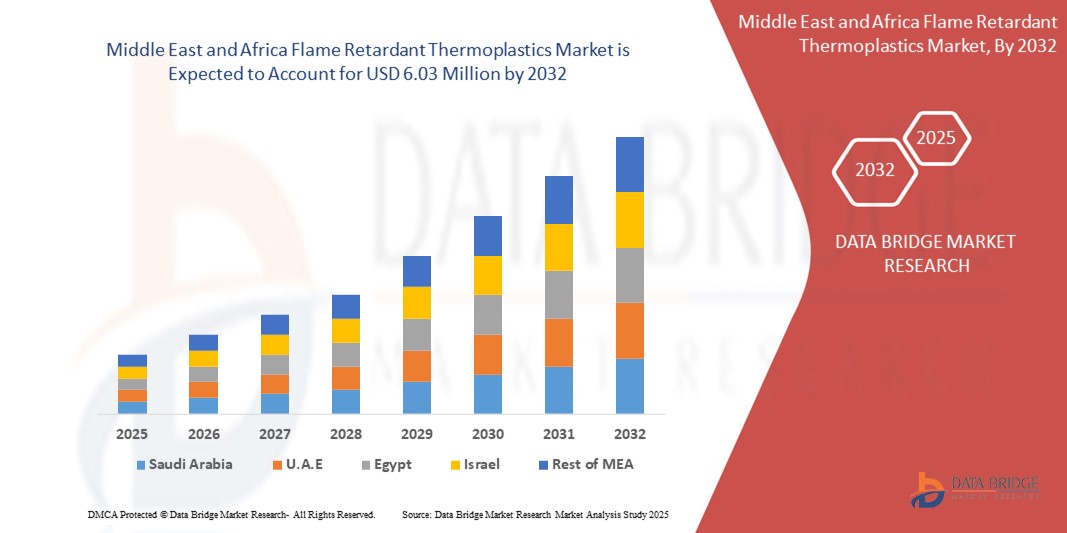
- The Middle East and Africa Flame Retardant Thermoplastics market size was valued at USD 1.26 billion in 2024 and is expected to reach USD 6.03 billion by 2032, at a CAGR of 5.0% during the forecast period
- The market growth is largely fueled by increasing fire safety regulations, demand for lightweight materials, and rising industrial and construction activities.
- Furthermore, expanding automotive and electronics sectors, growing awareness of fire hazards, rising investments in infrastructure, and increasing demand for eco-friendly, durable, and efficient flame retardant materials. These trends are accelerating the adoption of colorant solutions, thereby significantly boosting the industry's growth across Middle East and Africa.
Flame Retardant Thermoplastics Market Analysis
- Flame Retardant Thermoplastics are becoming essential in industries such as automotive, electronics, construction, and textiles across the Middle East and Africa due to their enhanced fire safety, durability, and regulatory compliance.
- The rising demand for Flame Retardant Thermoplastics is primarily driven by increased safety regulations, growing infrastructure development, and a shift towards sustainable and bio-based flame retardant materials.
- The GCC countries, particularly Saudi Arabia and the UAE, lead the Middle East and Africa market with an estimated revenue share of around 40% in 2024, owing to significant industrial growth, expanding construction projects, and increased adoption of advanced flame retardant technologies.
- South Africa is expected to be the fastest growing market in the region during the forecast period, with a CAGR of approximately 6.2%, supported by industrial diversification, expanding manufacturing sectors, and rising awareness of fire safety standards.
- The Polyamide segment is projected to hold a significant share of approximately 24% in 2024, driven by its excellent mechanical strength, high heat resistance, and widespread use in automotive and electrical applications.
Report Scope and Flame Retardant Thermoplastics Market Segmentation
|
Attributes |
Flame Retardant Thermoplastics Key Market Insights |
|
Segments Covered |
|
|
Countries Covered |
Middle East and Africa
|
|
Key Market Players |
|
|
Market Opportunities |
|
|
Value Added Data Infosets |
In addition to the insights on market scenarios such as market value, growth rate, segmentation, geographical coverage, and major players, the market reports curated by the Data Bridge Market Research also include in-depth expert analysis, pricing analysis, brand share analysis, consumer survey, demography analysis, supply chain analysis, value chain analysis, raw material/consumables overview, vendor selection criteria, PESTLE Analysis, Porter Analysis, and regulatory framework. |
Flame Retardant Thermoplastics Market Trends
“Sustainability and Advanced Formulations Transforming Flame Retardant Thermoplastics Market in Middle East and Africa”
- A prominent trend shaping the Middle East and Africa Flame Retardant Thermoplastics market is the increasing emphasis on sustainability, fire safety, and performance enhancement across key sectors such as construction, automotive, electronics, and industrial manufacturing. Regulatory alignment with global fire safety norms and growing pressure to reduce environmental impact are driving demand for innovative, eco-conscious flame retardant solutions.
- For example, SABIC and BASF are investing in halogen-free and recyclable flame retardant thermoplastics that comply with stringent safety and environmental standards. These innovations are particularly gaining traction in infrastructure and electrical applications where non-toxic, thermally stable materials are critical.
- Leading manufacturers such as LANXESS and DSM are developing next-generation flame retardant technologies incorporating renewable raw materials, advanced polymer blends, and energy-efficient manufacturing techniques. These solutions not only enhance fire resistance but also lower carbon footprints—key for markets adopting green building codes and ESG frameworks.
- Increasing consumer and industrial preference for low-emission, recyclable materials is pushing companies to eliminate harmful additives like brominated and chlorinated flame retardants. This shift is opening new avenues for safer alternatives such as phosphorus-based and nitrogen-based compounds, which are being widely adopted across electrical and automotive components.
- The rise of regional R&D hubs and government-backed innovation programs in the UAE, Saudi Arabia, and South Africa is fostering collaboration between academia and industry to develop locally adapted flame retardant technologies. These partnerships aim to reduce import dependency while creating high-performance, cost-effective, and regulatory-compliant thermoplastics tailored for the Middle Eastern and African climates and applications.
- With rising safety standards, infrastructure spending, and environmental consciousness, demand for flame retardant thermoplastics that balance durability, safety, and sustainability is set to accelerate. Companies that lead in sustainable innovation and regional customization are likely to gain a strong competitive edge in this evolving market.
Flame Retardant Thermoplastics Market Dynamics
Driver
“Rising Demand for Fire-Safe and Environmentally Compliant Thermoplastic Solutions”
- The increasing focus on fire safety standards, coupled with growing environmental and regulatory pressures across the Middle East and Africa, is a key driver accelerating the demand for sustainable and compliant Flame Retardant Thermoplastics across multiple sectors such as construction, automotive, and electronics.
- For instance, in 2024, SABIC launched a new portfolio of halogen-free, recyclable flame retardant thermoplastics designed to meet updated fire safety regulations and environmental standards in Gulf Cooperation Council (GCC) countries. This move underscores the industry's shift toward safer and greener materials.
- With rising incidents of fire-related hazards and an increase in high-rise buildings and industrial installations, governments are introducing stricter regulations that mandate the use of flame-retardant components in infrastructure and electrical systems.
- Moreover, corporate sustainability goals and national visions—like Saudi Arabia’s Vision 2030 and the UAE’s Net Zero 2050—are promoting the adoption of low-emission and eco-friendly materials in large-scale public and private sector projects.
- Manufacturers are responding by investing in phosphorus-based and other non-halogenated flame retardant additives, which provide the desired fire performance while ensuring compliance with evolving environmental laws. As a result, the market is witnessing a rapid shift toward advanced, regulatory-compliant flame retardant thermoplastics that align with global sustainability and safety trends..
Restraint/Challenge
“Regulatory Complexity and High Compliance Costs”
- The diverse and evolving regulatory environment across the Middle East and Africa presents a significant challenge for manufacturers of Flame Retardant Thermoplastics. Countries vary widely in their adoption of international fire safety standards, environmental laws, and material compliance frameworks, making standardization and regional alignment difficult.
- For example, w`hile some GCC nations have adopted stricter building codes aligned with European or U.S. standards, others lag in enforcement or lack unified flame retardant material regulations. This inconsistency creates confusion, compliance risk, and additional cost burdens for manufacturers seeking regional market access.
- Meeting regulatory requirements often necessitates expensive material testing, certifications, and reformulations—particularly as global pressure mounts to eliminate hazardous substances such as halogenated retardants. These reforms can significantly increase R&D and production costs, especially for exporters and SMEs trying to remain competitive.
- Leading firms like LANXESS and Solvay are heavily investing in robust compliance infrastructure and non-toxic formulations, but smaller players may struggle with the financial and technical resources needed to meet complex, multi-jurisdictional standards.
- These regulatory demands, while essential for safety and sustainability, can slow innovation cycles, extend time-to-market, and hinder regional expansion. Overcoming these challenges will require clearer policy frameworks, regional harmonization of standards, and increased support for technology transfer and compliance capacity-building in the industry.
Flame Retardant Thermoplastics Market Scope
The market is segmented on the basis of type, product, form, coating, and application.
- By Type
On the basis of type, the Middle East and Africa Flame Retardant Thermoplastics market is segmented into Polyamide, Acrylonitrile Butadiene Styrene (ABS), Polycarbonate, Polycarbonate/ABS Blends, Polypropylene, Polyphenylenoxide, and PBT/PET (Thermoplastic Polyesters). The Polyamide segment is projected to hold the largest market share of approximately 24% in 2025, driven by its excellent mechanical strength, heat resistance, and high demand in automotive and electronics industries.
The ABS segment follows with an estimated 18% market share, benefiting from its impact resistance and wide usage in consumer electronics and appliances.
- By Product
On the basis of product, the market is segmented into Halogenated and Non-Halogenated Flame Retardant Thermoplastics. The Non-Halogenated segment is expected to dominate the market with an estimated share of 57% in 2025, owing to growing regulatory restrictions on halogenated additives and rising environmental and health concerns.
The Halogenated segment, although declining, maintains a 43% share, primarily due to its cost-effectiveness and strong flame retardancy in legacy applications.
- By Form
On the basis of form, the market is segmented into Amorphous Polymers and Crystalline Polymers. Crystalline Polymers are projected to lead with a market share of approximately 60% in 2025, driven by superior structural rigidity and thermal performance, making them suitable for industrial, construction, and automotive applications.
Amorphous Polymers, which offer excellent clarity and impact resistance, hold the remaining 40% share and are preferred in electronics and consumer goods.
- By Coating
On the basis of coating, the market is segmented into Brominated Flame Retardants, Phosphorus Flame Retardants, Antimony Trioxide, and Alumina Trihydrate. Phosphorus Flame Retardants are anticipated to dominate with a market share of about 38% in 2025, driven by their effectiveness in non-halogenated systems and compliance with environmental regulations.
Brominated Flame Retardants follow with an estimated 30% share, supported by strong legacy demand in electronics despite environmental concerns.
- By Application
On the basis of application, the market is segmented into Construction, Electrical and Electronics, Industrial, Oil and Gas, Pharmaceutical, Agriculture, and Transportation. The Electrical and Electronics segment leads with an estimated market share of 32% in 2025, driven by the growing demand for fire-safe wiring, connectors, and housings.
Construction holds a substantial 26% share, owing to regional investments in infrastructure and urban development.
Flame Retardant Thermoplastics Market Country Analysis
U.A.E Flame Retardant Thermoplastics Market Insight
The UAE is a key market in the Middle East, driven by robust investments in construction, infrastructure, and renewable energy projects under national visions like “UAE Vision 2050.” Flame Retardant Thermoplastics are increasingly used in building materials, electrical components, and transport systems to meet stringent fire safety standards. The adoption of green building codes and increased demand for high-performance, sustainable materials are accelerating market growth.
Saudi Arabia Flame Retardant Thermoplastics Market Insight
Saudi Arabia’s Flame Retardant Thermoplastics market is expanding due to mega-projects under “Vision 2030,” including NEOM, The Line, and industrial cities. The government's strong regulatory push for fire safety in construction and transport infrastructure is creating high demand for thermoplastics with advanced flame-retardant properties. The growing focus on local manufacturing and downstream petrochemical diversification is also driving domestic production and innovation in flame-retardant materials.
South Africa Flame Retardant Thermoplastics Market Insight
South Africa represents one of Africa’s most mature markets for Flame Retardant Thermoplastics, supported by its well-established automotive, construction, and industrial sectors. Increasing enforcement of fire safety codes in public buildings and transport networks is boosting demand. Moreover, the country’s participation in global sustainability initiatives is encouraging a gradual transition toward halogen-free, environmentally compliant thermoplastic solutions in both commercial and residential applications.
Flame Retardant Thermoplastics Market Share
The Flame Retardant Thermoplastics industry is primarily led by well-established companies, including:
- SABIC (Saudi Arabia)
- Covestro AG (Germany)
- LyondellBasell Industries Holdings B.V. (Netherlands)
- Solvay (Belgium)
- EMS-CHEMIE HOLDING AG (Switzerland)
- Mitsubishi Engineering-Plastics Corporation (Japan)
- LOTTE Chemical CORPORATION (South Korea)
- LATI Industria Termoplastici S.p.A. (Italy)
- Idemitsu Kosan Co.,Ltd. (Japan)
- Radici Partecipazioni SpA (Italy)
- Trinseo (U.S.)
- LG Chem (South Korea)
- TORAY INDUSTRIES, INC. (Japan)
- LANXESS (Germany)
- RTP Company (U.S.)
- Dow (U.S.)
- BASF SE (Germany)
- PMC Group, Inc. (U.S.)
- DSM (Netherlands)
- DuPont (U.S.)
- Asahi Kasei Corporation (Japan)
Latest Developments in Middle East and Africa Flame Retardant Thermoplastics Market
- On January 14, 2021, BASF SE, in collaboration with CoHaMa Co., Ltd., introduced non-halogen flame-retardant TPU hand straps for use in rail transportation and aerospace applications.
- In October 2019, SONGWON unveiled a new line of flame retardants designed to be halogen-free, aligning with growing industry demand for safer, more environmentally friendly fire protection solutions
- In September 2019, ICL-IP announced plans to expand production capacity of FR1025, its eco-friendly polymeric flame retardant, by approximately 50% to meet growing demand from customers in Asia

- Interactive Data Analysis Dashboard
- Company Analysis Dashboard for high growth potential opportunities
- Research Analyst Access for customization & queries
- Competitor Analysis with Interactive dashboard
- Latest News, Updates & Trend analysis
- Harness the Power of Benchmark Analysis for Comprehensive Competitor Tracking
Middle East And Africa Flame Retardant Thermoplastics Market, Supply Chain Analysis and Ecosystem Framework
To support market growth and help clients navigate the impact of geopolitical shifts, DBMR has integrated in-depth supply chain analysis into its Middle East And Africa Flame Retardant Thermoplastics Market research reports. This addition empowers clients to respond effectively to global changes affecting their industries. The supply chain analysis section includes detailed insights such as Middle East And Africa Flame Retardant Thermoplastics Market consumption and production by country, price trend analysis, the impact of tariffs and geopolitical developments, and import and export trends by country and HSN code. It also highlights major suppliers with data on production capacity and company profiles, as well as key importers and exporters. In addition to research, DBMR offers specialized supply chain consulting services backed by over a decade of experience, providing solutions like supplier discovery, supplier risk assessment, price trend analysis, impact evaluation of inflation and trade route changes, and comprehensive market trend analysis.
Data collection and base year analysis are done using data collection modules with large sample sizes. The stage includes obtaining market information or related data through various sources and strategies. It includes examining and planning all the data acquired from the past in advance. It likewise envelops the examination of information inconsistencies seen across different information sources. The market data is analysed and estimated using market statistical and coherent models. Also, market share analysis and key trend analysis are the major success factors in the market report. To know more, please request an analyst call or drop down your inquiry.
The key research methodology used by DBMR research team is data triangulation which involves data mining, analysis of the impact of data variables on the market and primary (industry expert) validation. Data models include Vendor Positioning Grid, Market Time Line Analysis, Market Overview and Guide, Company Positioning Grid, Patent Analysis, Pricing Analysis, Company Market Share Analysis, Standards of Measurement, Global versus Regional and Vendor Share Analysis. To know more about the research methodology, drop in an inquiry to speak to our industry experts.
Data Bridge Market Research is a leader in advanced formative research. We take pride in servicing our existing and new customers with data and analysis that match and suits their goal. The report can be customized to include price trend analysis of target brands understanding the market for additional countries (ask for the list of countries), clinical trial results data, literature review, refurbished market and product base analysis. Market analysis of target competitors can be analyzed from technology-based analysis to market portfolio strategies. We can add as many competitors that you require data about in the format and data style you are looking for. Our team of analysts can also provide you data in crude raw excel files pivot tables (Fact book) or can assist you in creating presentations from the data sets available in the report.













