What is the Frozen Poultry Meat Market Size and Growth Rate?
- As per Data Bridge Market Research analysis, the Middle East and Africa Frozen Poultry Meat Market was valued at USD 22.50 billion in 2025 and is projected to reach USD 35.1 billion by 2033, growing at a CAGR of 5.70% from 2026 to 2033.
- The market is witnessing growth driven by increasing urbanization, changing dietary preferences, expanding supermarket and hypermarket networks, and rising demand for convenient, longer-shelf-life food products. Frozen poultry meat is increasingly purchased by households, restaurants, hotels, catering businesses, and food processing companies because it supports storage, transportation, and year-round product availability.
- Growing investments in cold-chain infrastructure, refrigerated transportation, and modern food distribution networks are further supporting market growth. In addition, demand for frozen chicken portions, nuggets, wings, and other poultry products is being supported by the expansion of quick-service restaurants and ready-to-cook food categories. International poultry trade and demand for halal-certified products also contribute to market development across the region.
Market Size & Forecast
- Market Value (2025): USD 22.50 billion
- Expected Market Value (2033): USD 35.1 billion
- Forecast CAGR (2026–2033): 5.70%
- Leading State in 2025: Iran
- Fastest Growing State: Turkey
What are the Major Takeaways of the Frozen Poultry Meat Market?
- Iran is considered the leading country in the Middle East and Africa frozen poultry meat market, with a market share of 18.5% in 2025. Demand is supported by poultry consumption, foodservice requirements, and established distribution networks.
- Turkey is considered a key growth market, with a CAGR of 6.8% from 2026 to 2033, supported by urbanization, retail expansion, and increasing demand for convenient frozen food products.
- Unprocessed chicken is projected to grow at a CAGR of 6.4% from 2026 to 2033, driven by demand for convenient, ready-to-cook poultry products.
- Conventional poultry is to account for 91.0% market share in 2025, supported by broad availability and affordability.
- With-bone poultry hold 56.0% market share in 2025, supported by traditional cooking preferences and household consumption.
- Unflavoured poultry is to account for 72.0% market share in 2025, owing to its versatility across cooking applications.
- Laminated films are to account for 38.0% market share in 2025, supported by product protection and storage requirements.
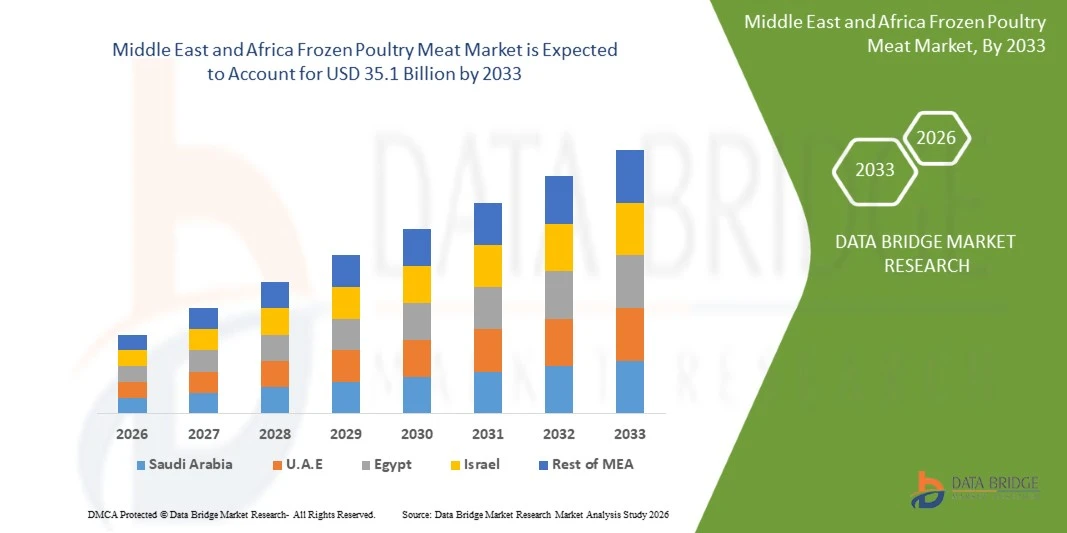
Report Scope Frozen Poultry Meat Market Segmentation
|
Attributes |
Frozen Poultry Meat Market Key Market Insights |
|
Segments Covered |
|
|
Countries Covered |
Middle East & Africa
|
|
Key Market Players |
|
|
Market Opportunities |
|
|
Value Added Data Infosets |
In addition to the insights on market scenarios such as market value, growth rate, segmentation, geographical coverage, and major players, the market reports curated by the Data Bridge Market Research also include in-depth expert analysis, pricing analysis, brand share analysis, consumer survey, demography analysis, supply chain analysis, value chain analysis, raw material/consumables overview, vendor selection criteria, PESTLE Analysis, Porter Analysis, and regulatory framework. |
What is the Key Trend in the Frozen Poultry Meat Market?
- Growing consumer demand for halal-certified poultry, reliable sourcing, and food safety assurance is emerging as a key trend in the Middle East and Africa Frozen Poultry Meat Market. Suppliers are focusing on halal certification, product traceability, and compliance with import regulations to strengthen consumer confidence and maintain access to regional markets. These requirements are particularly important in Gulf countries, where imported frozen poultry plays a significant role in food distribution.
- Expansion of Cold-Chain Infrastructure and Frozen Food Distribution: Increasing investment in temperature-controlled storage, refrigerated transportation, and modern retail infrastructure is supporting the distribution of frozen poultry across the Middle East and Africa. The expansion of supermarkets, hypermarkets, foodservice outlets, and online grocery platforms is improving product availability and storage efficiency.
- Governments and poultry producers are focusing on strengthening domestic production capacity to improve food security, reduce supply-chain vulnerabilities, and meet rising demand. Price sensitivity and changing household purchasing patterns are encouraging demand for frozen chicken, bulk packs, whole birds, and boneless portions. Frozen poultry provides consumers and foodservice businesses with storage flexibility and access to different product formats.
- For instance, on 27 May 2025, S&P Global reported a sharp increase in Chinese frozen chicken breast imports into the UAE, with imports reaching 2,500 metric tonnes per month at their peak. The report also highlighted concerns surrounding halal compliance, product traceability, and certification, reinforcing the importance of reliable sourcing and regulatory verification.
What are the Key Drivers of the Frozen Poultry Meat Market?
- Increasing demand for affordable animal protein is a major driver of the Middle East and Africa Frozen Poultry Meat Market. Frozen chicken offers convenient storage and distribution, supporting consumption among households, restaurants, hotels, and catering businesses. Population growth, urbanization, and changing dietary preferences are further contributing to market expansion.
- Growing Importance of Poultry Imports and Trade: International poultry trade is supporting frozen poultry availability in countries where domestic production does not fully meet demand. Importers depend on international suppliers to maintain product availability, manage procurement costs, and serve retail and foodservice customers.
- For instance, in July 2025, South Africa announced the resumption of imports of live poultry and poultry products from Brazil following the lifting of restrictions after the avian influenza outbreak was contained. This highlighted the importance of international supply chains in maintaining poultry availability.
- The growth of supermarkets, hypermarkets, quick-service restaurants, hotels, and catering businesses is increasing demand for frozen chicken products. Organized retailers offer a wider range of packaged poultry products, while foodservice operators require reliable supplies of standardized portions and bulk poultry products. The expansion of these channels is strengthening access to frozen poultry across urban and developing markets.
- Governments across the region are encouraging domestic poultry production to strengthen food security, reduce import dependence, and improve supply stability. Veterinary health requirements, traceability, and disease-control measures are influencing frozen poultry production and international trade.
Which Factors are Challenging the Growth of the Frozen Poultry Meat Market?
- High investment requirements for industrial freezers, refrigerated warehouses, temperature-controlled transportation, and backup power represent a key challenge in the Middle East and Africa Frozen Poultry Meat Market. In regions with unreliable electricity supplies, maintaining the required storage temperatures increases operating costs, creates product-quality risks, and limits distribution, particularly for small and medium-sized suppliers.
- Dependence on imported frozen poultry exposes regional buyers to fluctuations in international prices, freight costs, and supplier availability. Outbreaks of highly pathogenic avian influenza can disrupt international poultry trade, trigger import restrictions, and create uncertainty for frozen poultry importers.
- For instance, in May 2025, South Africa suspended imports of fresh and frozen poultry meat from Brazil following an H5N1 outbreak. Restrictions were partially lifted in June and trade resumed more broadly in July 2025 after further veterinary assessments. These developments highlight the vulnerability of regional supply chains to animal disease outbreaks.
- reliance on international suppliers exposes some Middle Eastern and African markets to trade restrictions, tariff changes, and shifts in exporter priorities. Changes in consumer purchasing power, seasonal consumption patterns, and competition among imported and locally produced poultry can create pricing pressure for suppliers.
How Is The Frozen Poultry Meat Market Segmented?
The market is segmented on the basis of product type, category, poultry type, flavour, packaging, end user
- By Product Type
On the basis of product type, the Middle East and Africa frozen poultry meat market is segmented into processed chicken and unprocessed chicken. The unprocessed chicken segment is accounted for a 64.00% market share in 2025, supported by demand for frozen whole chickens, cuts, and portions among households and foodservice providers.
The processed chicken segment is projected to witness significant growth, with a CAGR of 6.40% from 2026 to 2033, driven by rising demand for convenient, ready-to-cook poultry products, including nuggets, strips, and marinated chicken.
- By Category
On the basis of category, the Middle East and Africa frozen poultry meat market is segmented into organic and inorganic/conventional poultry. The inorganic/conventional poultry segment is accounted for a 91.00% market share in 2025, supported by broad product availability, established supply chains, and comparatively affordable pricing.
The organic poultry segment is projected to grow at a CAGR of 7.20% from 2026 to 2033, driven by increasing consumer interest in differentiated food products, production practices, and product quality.
- By Poultry Type
On the basis of poultry type, the Middle East and Africa frozen poultry meat market is segmented into boneless and with-bone poultry. The with-bone segment is accounted for a 56.00% market share in 2025, supported by traditional cooking preferences and demand for frozen chicken portions used in household meals.
The boneless segment is projected to grow at a CAGR of 6.50% from 2026 to 2033, driven by convenience, easier preparation, and increasing demand from restaurants, catering businesses, and processed food manufacturers.
- By Flavour
On the basis of flavour, the Middle East and Africa frozen poultry meat market is segmented into unflavoured and seasoned poultry. The unflavoured segment is accounted for a 72.00% market share in 2025, supported by its versatility across different cuisines, cooking methods, and foodservice applications.
The seasoned segment is projected to grow at a CAGR of 7.00% from 2026 to 2033, driven by demand for marinated, spiced, and ready-to-cook poultry products that reduce preparation time.
- By Packaging
On the basis of packaging, the Middle East and Africa frozen poultry meat market is segmented into pouches, cans, laminated films, and others. The laminated films segment is accounted for a 38.00% market share in 2025, supported by moisture protection, product preservation, and suitability for frozen storage and transportation.
The pouches segment is projected to grow at a CAGR of 6.60% from 2026 to 2033, driven by convenient handling, portion-based packaging, and demand for retail-friendly frozen poultry products.
- By End User
On the basis of end user, the Middle East and Africa frozen poultry meat market is segmented into foodservice providers, retail, industrial, and others. The retail segment is accounted for a 46.00% market share in 2025, supported by household consumption and the expansion of supermarkets, hypermarkets, and frozen food sections.
The foodservice providers segment is projected to grow at a CAGR of 6.70% from 2026 to 2033, driven by demand from restaurants, hotels, catering companies, and quick-service restaurants.
- By Distribution Channel
On the basis of distribution channel, the Middle East and Africa frozen poultry meat market is segmented into store-based retailers and non-store-based retailers. The store-based retailer segment is accounted for a 82.00% market share in 2025, supported by established supermarket and hypermarket networks, physical product availability, and consumer preference for purchasing frozen food through conventional retail outlets.
The non-store-based retailer segment is projected to grow at a CAGR of 9.00% from 2026 to 2033, driven by online grocery platforms, home-delivery services, and increasing consumer demand for convenient food purchasing.
Which Region Holds the Largest Share of the Frozen Poultry Meat Market?
- Iran dominated the Middle East and Africa frozen poultry meat market in 2025, accounting for a hypothetical 18.50% market share, supported by demand for affordable animal protein, poultry consumption, and distribution through retail and foodservice channels. Demand for frozen poultry is also influenced by storage requirements, product availability, and the need to maintain consistent supplies throughout the year.
- Increasing demand for convenient frozen food products. Improvements in cold-chain logistics, refrigerated storage, and poultry processing capabilities are also expected to support market development. Growing demand from restaurants, hotels, catering businesses, and household consumers is likely to contribute to the expansion of frozen poultry distribution across the country.
Iran Frozen Poultry Meat Market Insight
The Iran frozen poultry meat market is supported by rising demand for affordable protein sources, increasing urbanization, and the expanding availability of frozen food products through retail and foodservice channels. Chicken remains an important protein choice among consumers due to its versatility, accessibility, and comparatively affordable price. Demand is further supported by the growth of supermarkets, convenience stores, restaurants, and institutional catering services. However, market development may be influenced by inflation, currency fluctuations, import restrictions, feed cost volatility, and cold-chain infrastructure limitations. Improvements in storage, transportation, and domestic poultry processing are expected to support market growth.
Turkey Frozen Poultry Meat Market Insight
The Turkey frozen poultry meat market is expected to witness steady growth, supported by rising demand for convenient, affordable, and protein-rich food products. Increasing urbanization, changing dietary preferences, and the expansion of supermarkets, hypermarkets, and online grocery platforms are contributing to the consumption of frozen poultry meat across the country. Growth in the foodservice industry, including restaurants, hotels, and quick-service restaurants, is further supporting market demand. Improvements in cold-chain logistics, refrigerated storage, and packaging technologies are expected to enhance product availability, maintain quality, and strengthen the distribution of frozen poultry meat throughout Turkey.
Saudi Arabia Frozen Poultry Meat Market Insight
The Saudi Arabia frozen poultry meat market is witnessing growth due to rising demand for convenient, affordable, and protein-rich food products. Increasing urbanization, busy lifestyles, and the expansion of supermarkets, hypermarkets, and online grocery platforms are supporting the adoption of frozen poultry products across the country. Strong demand from restaurants, hotels, catering services, and quick-service restaurants is further contributing to market development. In addition, improvements in cold-chain logistics, refrigerated storage, and distribution infrastructure are enhancing product availability. However, dependence on poultry imports, fluctuations in international prices, and strict food safety requirements may influence market growth.
Which Are the Top Companies in Frozen Poultry Meat Market?
The frozen poultry meat market industry is primarily led by well-established companies, including:
- The Hain Celestial Company (U.S.)
- AGRARFROST GMBH & CO. K.G. (Germany)
- Agristo (Belgium)
- Bart’s Potato Company bvba (Belgium)
- Royal Cosun (Netherlands)
- Farm Frites (Netherlands)
- Greenyard (Belgium)
- Himalaya Food International Ltd. (India)
- J.R. Simplot Company (U.S.)
- McCain Foods Ltd. (U.K.)
- Lamb Weston Holdings, Inc. (U.K.)
- General Mills, Inc. (U.S.)
- Mondelez International, Inc. (U.S.)
- THE KRAFT HEINZ COMPANY (U.S.)
What Are Latest Developments in Frozen Poultry Meat Market?
- In February 2026, KRÜGER introduced a caramelised pistachio cappuccino in a 500 g pack and 3-in-1 pistachio coffee sticks to expand its flavoured instant beverage offerings. While relevant to the non-dairy creamer market due to demand for creamy instant coffee mixes, the announcement does not confirm a new B2B creamer ingredient launch.
- In May 2026, Kerry published a case study detailing the development of a vegan, gluten-free, nut-allergen-free oat creamer featuring no added sugar and frothing capabilities. Although supporting market trends toward functional plant-based creamers, so it serves as product supporting evidence rather than a dated news release.
- In February 2026, JDE Peet's reported FY2025 results showing organic sales growth of 15.3%, driven by pricing growth despite a volume/mix decline. The announcement highlighted its brand-led strategy and proposed acquisition by Keurig Dr Pepper. It reflects broader coffee market demand but does not detail a new branded non-dairy creamer product.
- In August 2026, Keurig Dr Pepper announced an agreement to acquire JDE Peet's to build a global coffee business with a wider portfolio and scale. The announcement impacts the broader coffee supply chain, though no specific non-dairy creamer launch was identified.
- In August 2026, JDE Peet's launched its “Grounded in Nature” Nature Transition Plan, which details actions to protect ecosystems, strengthen farmer resilience, and support deforestation-conscious coffee supply chains. While relevant to sustainability and sourcing trends, it is not a direct non-dairy creamer development.
- In August 2025, the Saudi Food and Drug Authority (SFDA) announced that the entry of 40 tonnes of frozen poultry products into Saudi Arabia had been prohibited after laboratory tests detected Salmonella contamination. The action highlights the importance of food safety compliance, quality testing, and stringent import inspections in the Middle East and Africa frozen poultry meat market. Such regulatory measures may influence importers, suppliers, and poultry processors by increasing the need for effective quality-control systems and traceability throughout the supply chain.

- Interactive Data Analysis Dashboard
- Company Analysis Dashboard for high growth potential opportunities
- Research Analyst Access for customization & queries
- Competitor Analysis with Interactive dashboard
- Latest News, Updates & Trend analysis
- Harness the Power of Benchmark Analysis for Comprehensive Competitor Tracking
Middle East And Africa Frozen Poultry Meat Market, Supply Chain Analysis and Ecosystem Framework
To support market growth and help clients navigate the impact of geopolitical shifts, DBMR has integrated in-depth supply chain analysis into its Middle East And Africa Frozen Poultry Meat Market research reports. This addition empowers clients to respond effectively to global changes affecting their industries. The supply chain analysis section includes detailed insights such as Middle East And Africa Frozen Poultry Meat Market consumption and production by country, price trend analysis, the impact of tariffs and geopolitical developments, and import and export trends by country and HSN code. It also highlights major suppliers with data on production capacity and company profiles, as well as key importers and exporters. In addition to research, DBMR offers specialized supply chain consulting services backed by over a decade of experience, providing solutions like supplier discovery, supplier risk assessment, price trend analysis, impact evaluation of inflation and trade route changes, and comprehensive market trend analysis.
Data collection and base year analysis are done using data collection modules with large sample sizes. The stage includes obtaining market information or related data through various sources and strategies. It includes examining and planning all the data acquired from the past in advance. It likewise envelops the examination of information inconsistencies seen across different information sources. The market data is analysed and estimated using market statistical and coherent models. Also, market share analysis and key trend analysis are the major success factors in the market report. To know more, please request an analyst call or drop down your inquiry.
The key research methodology used by DBMR research team is data triangulation which involves data mining, analysis of the impact of data variables on the market and primary (industry expert) validation. Data models include Vendor Positioning Grid, Market Time Line Analysis, Market Overview and Guide, Company Positioning Grid, Patent Analysis, Pricing Analysis, Company Market Share Analysis, Standards of Measurement, Global versus Regional and Vendor Share Analysis. To know more about the research methodology, drop in an inquiry to speak to our industry experts.
Data Bridge Market Research is a leader in advanced formative research. We take pride in servicing our existing and new customers with data and analysis that match and suits their goal. The report can be customized to include price trend analysis of target brands understanding the market for additional countries (ask for the list of countries), clinical trial results data, literature review, refurbished market and product base analysis. Market analysis of target competitors can be analyzed from technology-based analysis to market portfolio strategies. We can add as many competitors that you require data about in the format and data style you are looking for. Our team of analysts can also provide you data in crude raw excel files pivot tables (Fact book) or can assist you in creating presentations from the data sets available in the report.