


What is the Middle East and Africa Glyoxal Market Size and Overview?
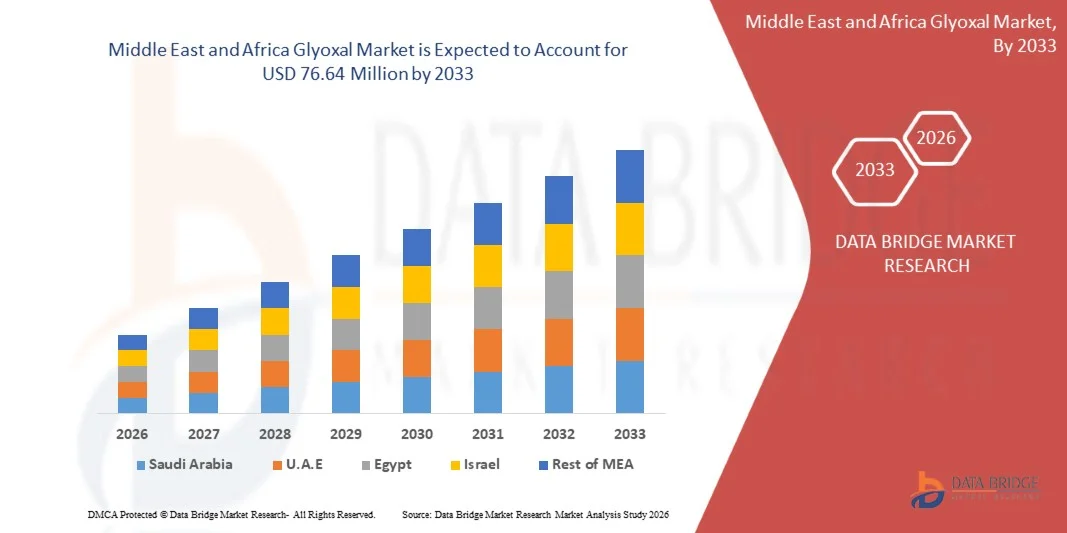
- As per Data Bridge Market Research Analysis the Middle East and Africa Glyoxal Market is expected to reach USD 76.64 million by 2033 from USD 54.00 million in 2025 growing with a CAGR of 4.5% in the forecast period of 2026 to 2033.
- The Middle East and Africa Glyoxal Market is witnessing steady growth driven by its expanding use across textiles, paper, leather, pharmaceuticals, agrochemicals, and oil & gas industries, where glyoxal is valued for its cross-linking, binding, and finishing properties.
- In addition, the growing demand for value-added chemical solutions, including customized glyoxal formulations for specific industrial processes and downstream integration within chemical supply chains, is reinforcing market maturity and supporting long-term growth across developed and emerging economies.
Market Size & Forecast
- Middle East and Africa Market Value (2033): USD 76.64 million
- Expected Market Value (2025): USD 54.00 million
- Forecast CAGR (2026–2033): 4.5%
Middle East and Africa Glyoxal Market Analysis
- The Middle East and Africa Glyoxal Market serves diverse industries including textiles, paper, resins, pharmaceuticals, cosmetics, and water treatment. Demand is driven by its strong crosslinking properties and role as a key intermediate in specialty and performance chemical formulations.
- Rising textile finishing activities, increasing paper packaging consumption, and growing use of eco-friendly resins are major demand drivers. Expansion of pharmaceutical manufacturing and stricter wastewater treatment regulations further support sustained glyoxal consumption worldwide.
- The market features a mix of multinational chemical producers and regional manufacturers. Competition is based on product purity, application-specific grades, pricing, supply reliability, and compliance with environmental and safety regulations across key end-use industries.
- Saudi Arabia dominates the Middle East and Africa Glyoxal Market, supported by large-scale manufacturing capacity, low production costs, and abundant raw material availability. Strong downstream demand from textiles, resins, paper, and leather industries, along with an extensive chemical supply chain, further reinforces its leadership.
- The U.A.E Middle East and Africa Glyoxal Market is expected to grow at a CAGR of around 5.4% from 2026 to 2033, driven by rising demand from the textile and agrochemical industries and increasing use in resins and coatings for industrial applications. Expanding industrialization and urbanization in the region further fuel market growth.
- In 2025, the Industrial Grade segment is expected to dominate the Middle East and Africa Glyoxal Market with an 82.37% share due to its widespread use in manufacturing resins, adhesives, and paper treatment chemicals. The segment benefits from high demand in large-scale industrial applications and cost-effectiveness for bulk production, making it the preferred choice over other grades.
Report Scope and Middle East and Africa Glyoxal Market Segmentation
|
Attributes |
Middle East and Africa Glyoxal Market Insights |
|
Segments Covered |
|
|
Countries Covered |
Middle East and Africa
|
|
Key Market Players |
|
|
Market Opportunities |
|
|
Value Added Data Infosets |
In addition to the market insights such as market value, growth rate, market segments, geographical coverage, market players, and market scenario, the market report curated by the Data Bridge Market Research team includes in-depth expert analysis, import/export analysis, pricing analysis, production consumption analysis, and pestle analysis. |
What is the Key Trend in the Middle East and Africa Glyoxal Market?
“Integration with smart manufacturing, warehouse processing, and e-commerce packaging ecosystems”
- Glyoxal is increasingly utilized in smart manufacturing environments for textile finishing, paper treatment, and resin applications, supporting consistent quality control, process optimization, and data-driven production decisions aligned with Industry 4.0 initiatives.
- In warehouse and processing facilities, glyoxal-based formulations aid in material stabilization, coating performance, and moisture resistance, improving handling efficiency, storage durability, and downstream processing reliability.
- The growing use of glyoxal in packaging adhesives, paper strengthening, and surface treatments supports the expansion of e-commerce by enhancing packaging integrity, load stability, and product protection across logistics networks.
For Instance,
- In January 2025, glyoxal-based chemical solutions were increasingly integrated into automated textile and paper processing lines, combined with advanced process controls and digital monitoring systems to improve efficiency, consistency, and sustainability across industrial operations, highlighting glyoxal’s role in next-generation manufacturing ecosystems.
- Recent industry developments indicate rising adoption of specialty aldehyde-based chemicals, including glyoxal, in high-performance packaging and industrial applications as e-commerce and logistics volumes grow, reinforcing its expanding role beyond traditional end-use sectors.
Middle East and Africa Glyoxal Market Dynamics
Driver
“Rising industrial modernization and performance-driven chemical application requirements”
- The Middle East and Africa industrial sector is witnessing accelerated adoption of glyoxal-based solutions driven by increasingly complex performance requirements across textiles, paper, resins, leather, and specialty chemical applications. Manufacturers are prioritizing glyoxal for its cross-linking, binding, and finishing properties that enhance product strength, durability, and functional performance. As industrial processes evolve toward higher efficiency and quality consistency, demand is growing for chemical formulations that support controlled reactions, reduced emissions, and improved end-product reliability.
- The expanding role of glyoxal within industrial modernization initiatives has created a dynamic environment for chemical producers to innovate, leading to advancements in formulation purity, application versatility, and process compatibility. In response to this demand-driven shift, manufacturers are investing in the development of customized glyoxal grades tailored for specific end-use requirements, including low-formaldehyde systems, specialty resins, and high-performance textile treatments.
- These innovations are largely driven by the operational needs of modern industries, which require adaptable chemical solutions capable of performing reliably under varied processing conditions and regulatory constraints. As industries continue to integrate glyoxal into advanced manufacturing and finishing workflows, this momentum not only influences supplier investment strategies but also reinforces glyoxal’s role as a critical intermediate in enhancing industrial productivity and material performance.
For Instances
- In September 2023, industry publications highlighted increased adoption of glyoxal in advanced textile finishing processes aimed at improving fabric strength and wrinkle resistance while meeting stricter environmental compliance standards.
- As of February 2024, chemical industry insights indicated that manufacturers across Middle East and Africa intensified the use of glyoxal-based resins and paper treatment solutions to support sustainable production practices and reduce reliance on higher-toxicity alternatives.
- In February 2025, regional industry developments across Asia-Pacific emphasized growing investments in specialty aldehyde production, including glyoxal, to meet rising demand from packaging, construction, and industrial manufacturing sectors focused on performance enhancement and regulatory alignment.
- The growing adoption of glyoxal across the global industrial sector underscores its increasing importance as a multifunctional chemical solution aligned with evolving performance, efficiency, and sustainability requirements. As industries continue to advance toward higher-quality outputs and more controlled manufacturing processes, glyoxal’s cross-linking, binding, and finishing capabilities position it as a critical enabler of enhanced material strength, durability, and functional consistency.
- Ongoing innovations in formulation purity and application-specific customization further reinforce its relevance across textiles, paper, resins, leather, and specialty chemicals. Supported by rising investments, regulatory alignment efforts, and expanding industrial use cases across major regions, glyoxal is expected to maintain a strategically significant role in driving industrial productivity and supporting the transition toward more sustainable and high-performance manufacturing practices.
Restraint/Challenge
“Lack of Harmonized Middle East and Africa Regulatory Frameworks for Chemical Manufacturing and Usage”
- The absence of harmonized Middle East and Africa regulations governing chemical manufacturing, handling, and end-use applications presents a notable challenge for the Middle East and Africa Glyoxal Market, as regulatory requirements differ significantly across countries and regions.
- Regulatory authorities apply varying standards related to chemical classification, permissible exposure limits, environmental compliance, labeling, transportation, and wastewater discharge. This regulatory fragmentation compels glyoxal manufacturers and downstream users to modify formulations, documentation, safety protocols, and compliance strategies for each market, increasing operational complexity, compliance costs, and time to market.
- As a result, companies face constraints in scaling glyoxal production and distribution Middle East and Africaly, particularly for cross-border trade and multinational supply chains serving textiles, paper, resins, and specialty chemical applications.
For Instances,
- In late 2025, regional environmental authorities in Asia and Middle East and Africa introduced differing compliance requirements for aldehyde-based chemicals, including glyoxal, with variations in emission thresholds and reporting obligations, illustrating regulatory inconsistencies that complicate standardized production and export strategies.
- In May 2025, national and local regulatory bodies in emerging markets enforced stricter chemical handling and transportation restrictions beyond existing central guidelines, creating temporary operational disruptions for glyoxal manufacturers and distributors who were required to obtain additional approvals and modify logistics workflows during the enforcement period.
- The lack of harmonized global regulatory frameworks continues to pose a structural challenge for the Global Middle East and Africa Glyoxal Market, limiting the ease of standardized production, distribution, and cross-border trade. Divergent regional requirements related to chemical classification, environmental compliance, handling, and transportation increase operational complexity and elevate compliance costs for manufacturers and downstream users.
- These regulatory inconsistencies not only slow market entry and scalability but also necessitate frequent adjustments to formulations, documentation, and logistics strategies across regions. As a result, regulatory fragmentation remains a key constraint on global market expansion, underscoring the need for greater alignment and transparency in chemical governance to support more efficient international supply chains and sustainable market growth.
Middle East and Africa Glyoxal Market Scope
The market is segmented on the basis of grade, purity, production process, packaging application, end-use chemicals and end-use industry
By Grade
Based on grade, the Middle East and Africa Glyoxal Market is primarily segmented into Industrial Grade and Pharmaceutical Grade.
By 2026, the Industrial Grade segment is projected to dominate the market, accounting for 82.29% of the total share. This dominance is attributed to its extensive applications across various industries, including textiles, paper processing, resins, leather treatment, and water treatment. The high-volume consumption of industrial-grade glyoxal is further supported by its cost-effectiveness and efficiency in large-scale operations. Additionally, the rapid expansion of industrial and manufacturing sectors in the Middle East and Africa region is driving strong and sustained demand. As a result, industrial-grade glyoxal is expected to remain the key growth driver within the regional market.
The Pharmaceutical Grade segment in the Middle East and Africa Glyoxal Market is expected to grow fastest from 2026 to 2033, driven by rising demand in pharmaceutical synthesis, stringent regulatory requirements for high-purity chemicals, and the expansion of advanced drug manufacturing and specialty applications. These factors boost the adoption of high-quality glyoxal in APIs and innovative drug formulations.
By Purity
On the basis of purity, the Middle East and Africa Glyoxal Market is segmented into 90%–99%, 40%–60%, and Others.
By 2026, the 40%–60% purity segment is expected to dominate the market, accounting for 73.25% of the total share. This segment’s prominence is attributed to its superior performance, higher reactivity, and suitability for advanced applications across pharmaceuticals, specialty resins, textiles, and cosmetics. Its consistent quality, along with adherence to stringent industry standards, further drives strong and sustained demand. Additionally, the balance between effectiveness and cost-efficiency makes this purity range highly preferred by manufacturers. As a result, the 40%–60% purity segment is projected to remain the primary contributor to growth in the Middle East and Africa Glyoxal Market.
The 90%-99% purity segment in the Middle East and Africa Glyoxal Market is expected to witness the fastest growth from 2026 to 2033, driven by its widespread use in pharmaceutical and specialty chemical applications that require high-purity glyoxal, along with increasing demand for advanced drug formulations and regulatory-compliant production processes.
By Production Process
On the basis of production process, the Middle East and Africa Glyoxal Market is segmented into Catalytic Oxidation of Ethylene Glycol, Oxidation of Acetylene, and Others.
By 2026, the Catalytic Oxidation of Ethylene Glycol segment is expected to dominate the market, accounting for 90.15% of the total share. This segment’s dominance is driven by its higher production efficiency, better yield control, and lower impurity levels compared to acetylene-based processes. Additionally, it offers improved safety and is more environmentally compliant, making it highly suitable for large-scale manufacturing. The cost-effectiveness and scalability of this method further reinforce its preference among manufacturers. As a result, the catalytic oxidation route is poised to remain the primary driver of growth in the Middle East and Africa Glyoxal Market.
The “Oxidation of Acetylene” production process segment in the Middle East and Africa Glyoxal Market is expected to witness the fastest growth from 2026 to 2033, driven by its ability to produce high-purity glyoxal suitable for pharmaceutical and specialty chemical applications, along with rising demand for advanced drug formulations and compliance with strict quality and regulatory standards.
By Packaging
On the basis of packaging, the Middle East and Africa Glyoxal Market is segmented into Drums, Composite IBC, Bulk, Jerrycans, and Bottles.
By 2026, the Drums segment is expected to dominate the market, accounting for 41.53% of the total share. This dominance is attributed to its versatility, ease of handling, and safe storage, particularly for small-quantity applications. Bottles are especially suitable for pharmaceuticals, cosmetics, and specialty chemical uses, where precision and safety are critical. Additionally, their wide availability and cost-effective production further drive strong adoption across industries. The convenience and reliability of bottle packaging make it a preferred choice for manufacturers and end-users alike.
The “Composite IBC” packaging segment in the Middle East and Africa Glyoxal Market is expected to witness the fastest growth from 2026 to 2033, driven by its efficiency in storing and transporting bulk chemicals, enhanced safety and chemical resistance, and increasing demand from pharmaceutical, specialty chemical, and industrial users who require reliable, large-capacity packaging solutions.
By Application
On the basis of packaging, the Middle East and Africa Glyoxal Market is segmented into Application Cross-Linking, Chemical Intermediates, Others.
By 2026, the Cross-Linking segment is expected to dominate the market, accounting for 66.19% of the total share. This dominance is attributed to its versatility, ease of handling, and safe storage, particularly for small-quantity applications. Bottles are especially suitable for pharmaceuticals, cosmetics, and specialty chemical uses, where precision and safety are critical. Additionally, their wide availability and cost-effective production further drive strong adoption across industries. The convenience and reliability of bottle packaging make it a preferred choice for manufacturers and end-users alike.
The Chemical Intermediates application segment in the Middle East and Africa Glyoxal Market is expected to be the fastest-growing segment from 2026 to 2033, driven by increasing demand for resins, polymers, and specialty chemicals, the expansion of the chemical manufacturing industry, and the use of glyoxal as a versatile cross-linking and reactive intermediate in industrial and specialty applications.
By End-Use Chemicals
On the basis of end-use chemicals, the Middle East and Africa Glyoxal Market is segmented into Dihydroxyethylene Urea (DHEU), 2-Imidazolidinone, Glyoxalated Polyacrylamide (GPAM), Glyoxylic Acid, Glyoxalated Starch, Glyoxal Phenol Resin, Glyoxal Urea Resin, Ethylene Glycol Diformate, Urea-Glyoxal Concentrate, Quinoxaline Derivatives, Methylol Glyoxal, Glyoxal-Bis(2-Hydroxyanil), Glyoxal Sodium Bisulfite, Quinoxaline, 2-Methylimidazole, Imidazole, Glycoluril, Allantoin, and Tetramethylol Acetylenediurea.
By 2026, the Dihydroxyethylene Urea (DHEU) segment is expected to dominate the market, accounting for 22.12% of the total share. Its dominance is driven by its wide applicability in textile finishing, paper treatment, and resin manufacturing. The segment benefits from high reactivity, consistent performance, and compatibility with various industrial processes. Additionally, growing demand for high-quality textiles and specialty chemical products in the Middle East and Africa region supports its strong market position. DHEU’s cost-effectiveness and efficiency further reinforce its preference among manufacturers and end-users.
The 2-Imidazolidinone end-use chemicals segment in the Middle East and Africa Glyoxal Market is expected to be the fastest-growing from 2026 to 2033, driven by its increasing use in pharmaceuticals, agrochemicals, and specialty chemical applications. Its growth is fueled by the rising demand for high-purity glyoxal as a key intermediate in synthesizing 2-Imidazolidinone for advanced formulations and regulatory-compliant chemical production.
By End-User
On the basis of end-user, the Middle East and Africa Glyoxal Market is segmented into Textile, Pulp and Paper, Leather, Paints and Coatings, Water Treatment, Pharmaceuticals, Household Products, Cosmetics and Personal Care, Packaging, Electrical and Electronics, Oil and Gas, and Others.
By 2026, the Textile segment is expected to dominate the market, accounting for 37.05% of the total share. This growth is driven by its widespread use in fabric finishing, wrinkle resistance, and crease-proof treatments. The increasing demand for durable and high-quality textiles, coupled with rapid expansion in the apparel and home furnishing industries, further supports market growth. Additionally, rising consumer preference for premium and long-lasting fabrics boosts the adoption of glyoxal-based solutions. As a result, the Textile segment is poised to remain the key contributor to the Middle East and Africa Glyoxal Market.
The Pulp and Paper end-user segment in the Middle East and Africa Glyoxal Market is expected to be the fastest-growing from 2026 to 2033, driven by the increasing demand for wet-strength resins and chemical additives that enhance paper durability and quality. Growth is supported by the expansion of the paper and packaging industry and the shift toward high-performance, sustainable paper products.
Middle East and Africa Glyoxal Market Insight
- Saudi Arabia dominates the regional market, driven by its robust petrochemical base, large-scale manufacturing capacity, and strong downstream demand. Ongoing investment in sustainable and high-purity chemical solutions underpins long-term regional market expansion.
- The Saudi Arabia Middle East and Africa Glyoxal Market is rapidly expanding, driven by large-scale chemical manufacturing capacity, strong demand from textiles, paper, construction chemicals, and agrochemicals, and supportive government policies. Technological advancements and cost-competitive production position China as a major Middle East and Africa glyoxal supplier with significant growth potential.
U.A.E Middle East and Africa Glyoxal Market Insight
The U.A.E Middle East and Africa Glyoxal Market is witnessing robust growth, supported by expanding textile and paper industries, rising chemical manufacturing activity, and increasing adoption of glyoxal in resins and specialty applications. Government initiatives promoting domestic chemical production and industrial growth continue to enhance market momentum.
Middle East and Africa Glyoxal Market Share
The Glyoxal is primarily led by well-established companies, including:
- Amzole India Pvt. Ltd (India)
- Asis Scientific Pty Ltd (Australia)
- Ataman Chemicals (India)
- BASF SE (Germany)
- Bidvest Chemical (South Africa)
- Bisley Asia (M) Sdn Bhd (Malaysia)
- Eastman Chemical Company (U.S.)
- Fluorochem Limited (U.K.)
- Fujifilm Wako Pure Chemical Corporation (Japan)
- Glentham Life Sciences Limited (U.K.)
- GetChem Co., Ltd. (China)
- Hanna Instruments Ltd (U.S.)
- Himedia Laboratories (India)
- Kanto Kagaku (Japan)
- Kemira Oyj (Finland)
- Merck KGaA (Germany)
- Meru Chem Pvt. Ltd (India)
- Muby Chemicals (India)
- Multichem Specialities Private Limited (India)
- Oakwood Products Inc. (U.S.)
- Otto Chemie Pvt. Ltd (India)
- Oxford Lab Fine Chem LLP (India)
- Santa Cruz Biotechnology Inc. (U.S.)
- Sasol (South Africa)
- Silver Fern Chemical, Inc. (U.S.)
- Thermo Fisher Scientific Inc. (U.S.)
- Univar Solutions LLC (U.S.)
- Weylchem International GmbH (Germany)
- Zhishang Chemical (China)
Latest Developments in Middle East and Africa Glyoxal Market
- In October 2025, Multichem Specialities Private Limited was recognized among the Top 10 Specialty Chemical Distributors 2025 by Industry Outlook Magazine, highlighting its quality, innovation, and dependable service in the specialty chemicals sector. In July 2025, the company also organized a successful blood donation drive in collaboration with Breach Candy Hospital Trust, engaging employees and community members to support healthcare needs.
- In February 2024, Multichem Specialities Private Limited participated in Vitafoods India, strengthening its presence in the nutraceuticals and specialty ingredients segment while engaging with customers and partners to showcase its expanding chemical portfolio.
- In October 2024, Otto Chemie Pvt. Ltd. expanded its portfolio of high-purity laboratory chemicals and reagents, enhancing its presence in pharmaceutical, research, and industrial sectors. The company also strengthened its distribution network and supply chain capabilities to meet growing demand across India and international markets.
- In July 2024, Otto Chemie Pvt. Ltd. organized a blood donation and health awareness drive in collaboration with local hospitals, reflecting the company’s commitment to community welfare and employee participation in social responsibility initiatives.
- In March 2025, Oxford Lab Fine Chem LLP implemented eco-friendly packaging solutions and optimized waste management practices in its production and distribution processes, reinforcing the company’s commitment to sustainable and responsible chemical manufacturing.

- Interactive Data Analysis Dashboard
- Company Analysis Dashboard for high growth potential opportunities
- Research Analyst Access for customization & queries
- Competitor Analysis with Interactive dashboard
- Latest News, Updates & Trend analysis
- Harness the Power of Benchmark Analysis for Comprehensive Competitor Tracking
Table of Content
1 INTRODUCTION
1.1 OBJECTIVES OF THE STUDY
1.2 MARKET DEFINITION
1.3 OVERVIEW OF MIDDLE EAST AND AFRICA GLYOXAL MARKET
1.4 LIMITATIONS
1.5 MARKETS COVERED
2 MARKET SEGMENTATION
2.1 MARKETS COVERED
2.2 GEOGRAPHICAL SCOPE
2.3 YEARS CONSIDERED FOR THE STUDY
2.4 CURRENCY AND PRICING
2.5 DBMR TRIPOD DATA VALIDATION MODEL
2.6 MULTIVARIATE MODELLING
2.7 PRODUCT TYPE LIFELINE CURVE
2.8 PRIMARY INTERVIEWS WITH KEY OPINION LEADERS
2.9 DBMR MARKET POSITION GRID
2.1 MARKET END USER COVERAGE GRID
2.11 SECONDARY SOURCES
2.12 ASSUMPTIONS
3 EXECUTIVE SUMMARY
4 PREMIUM INSIGHTS
4.1 MIDDLE EAST AND AFRICA GLYOXAL MARKET: VALUE CHAIN ANALYSIS
4.1.1 RAW MATERIAL & FEEDSTOCK SUPPLY (5%–10% VALUE SHARE)
4.1.2 MANUFACTURING & PROCESSING (15%–25% VALUE SHARE)
4.1.3 DISTRIBUTION & LOGISTICS (30%–40% VALUE SHARE)
4.1.4 END-USE INDUSTRIES & SALES CHANNELS (10%–20% VALUE SHARE)
4.2 SUPPLY CHAIN ANALYSIS
4.2.1 RAW MATERIAL SOURCING & PROCUREMENT
4.2.2 PROCESSING & PRODUCT MANUFACTURING (PRODUCTION)
4.2.3 SUPPLY CHAIN & DISTRIBUTION LOGISTICS (TRANSPORTATION)
4.2.4 RETAIL & COMMERCIAL BUYER CHANNELS (DISTRIBUTION & SALES)
4.3 PORTER’S FIVE FORCES ANALYSIS
4.3.1 BARGAINING POWER OF BUYERS / CONSUMERS – HIGH
4.3.2 THREAT OF NEW ENTRANTS – LOW TO MODERATE
4.3.3 THREAT OF SUBSTITUTE PRODUCTS – MODERATE TO HIGH
4.3.4 BARGAINING POWER OF SUPPLIERS – MODERATE
4.3.5 INTENSITY OF COMPETITIVE RIVALRY – HIGH
5 MARKET OVERVIEW
5.1 DRIVERS
5.1.1 RISING UTILIZATION OF GLYOXAL AS A CROSSLINKING AGENT IN TEXTILE FINISHING.
5.1.2 GROWING ADOPTION IN PAPER & PACKAGING FOR WET-STRENGTH AND SURFACE TREATMENT APPLICATIONS.
5.1.3 EXPANSION OF INTERMEDIATE CHEMICAL DEMAND IN PHARMACEUTICALS AND AGROCHEMICALS.
5.1.4 INCREASING PREFERENCE FOR LOW-MOLECULAR-WEIGHT ALDEHYDES IN RESIN AND ADHESIVE SYSTEMS.
5.2 RESTRAINTS
5.2.1 HANDLING COMPLEXITY DUE TO HIGH REACTIVITY AND STABILITY SENSITIVITY
5.2.2 AVAILABILITY OF APPLICATION-SPECIFIC CHEMICAL SUBSTITUTES.
5.3 OPPORTUNITY
5.3.1 VOLATILITY IN FEEDSTOCK PRICING AFFECTING COST STRUCTURE
5.3.2 STRINGENT ENVIRONMENTAL AND OCCUPATIONAL SAFETY REGULATIONS.
5.3.3 LIMITED PRODUCT DIFFERENTIATION IN A PRICE-COMPETITIVE MARKET
5.4 CHALLENGES
5.4.1 DEVELOPMENT OF MODIFIED AND APPLICATION-SPECIFIC GLYOXAL GRADES.
5.4.2 RISING DEMAND FROM EMERGING INDUSTRIAL ECONOMIES
6 MIDDLE EAST AND AFRICA GLYOXAL MARKET, BY GRADE
6.1 OVERVIEW
6.2 INDUSTRIAL GRADE
6.3 PHARMACEUTICAL GRADE
6.4 MIDDLE EAST AND AFRICA GLYOXAL MARKET, BY GRADE, 2018-2033 (THOUSAND TONS
6.4.1 INDUSTRIAL GRADE
6.4.2 PHARMACEUTICAL GRADE
6.5 MIDDLE EAST AND AFRICA INDUSTRIAL GRADE IN GLYOXAL MARKET, BY REGION, 2018-2033 (USD THOUSAND)
6.5.1 ASIA-PACIFIC
6.5.2 NORTH AMERICA
6.5.3 EUROPE
6.5.4 MIDDLE EAST & AFRICA
6.5.5 SOUTH AMERICA
6.6 MIDDLE EAST AND AFRICA PHARMACEUTICAL GRADE IN GLYOXAL MARKET, BY REGION, 2018-2033 (USD THOUSAND)
6.6.1 ASIA-PACIFIC
6.6.2 NORTH AMERICA
6.6.3 EUROPE
6.6.4 MIDDLE EAST & AFRICA
6.6.5 SOUTH AMERICA
7 MIDDLE EAST AND AFRICA GLYOXAL MARKET, BY PURITY
7.1 OVERVIEW
7.1.1 40%-60%
7.1.2 90%-99%
7.1.3 OTHERS
7.2 MIDDLE EAST AND AFRICA 40%-60% IN GLYOXAL MARKET, BY REGION, 2018-2033 (USD THOUSAND)
7.2.1 ASIA-PACIFIC
7.2.2 NORTH AMERICA
7.2.3 EUROPE
7.2.4 MIDDLE EAST & AFRICA
7.2.5 SOUTH AMERICA
7.3 MIDDLE EAST AND AFRICA 90%-99% IN GLYOXAL MARKET, BY REGION, 2018-2033 (USD THOUSAND)
7.3.1 ASIA-PACIFIC
7.3.2 NORTH AMERICA
7.3.3 EUROPE
7.3.4 MIDDLE EAST & AFRICA
7.3.5 SOUTH AMERICA
7.4 MIDDLE EAST AND AFRICA OTHERS IN GLYOXAL MARKET, BY REGION, 2018-2033 (USD THOUSAND)
7.4.1 ASIA-PACIFIC
7.4.2 NORTH AMERICA
7.4.3 EUROPE
7.4.4 MIDDLE EAST & AFRICA
7.4.5 SOUTH AMERICA
8 MIDDLE EAST AND AFRICA GLYOXAL MARKET, BY PRODUCTION PROCESS
8.1 OVERVIEW
8.1.1 CATALYTIC OXIDATION OF ETHYLENE GLYCOL
8.1.2 OXIDATION OF ACETYLENE
8.1.3 OTHERS
8.2 MIDDLE EAST AND AFRICA CATALYTIC OXIDATION OF ETHYLENE GLYCOL IN GLYOXAL MARKET, BY REGION, 2018-2033 (USD THOUSAND)
8.2.1 ASIA-PACIFIC
8.2.2 NORTH AMERICA
8.2.3 EUROPE
8.2.4 MIDDLE EAST & AFRICA
8.2.5 SOUTH AMERICA
8.3 MIDDLE EAST AND AFRICA OXIDATION OF ACETYLENE IN GLYOXAL MARKET, BY REGION, 2018-2033 (USD THOUSAND)
8.3.1 ASIA-PACIFIC
8.3.2 NORTH AMERICA
8.3.3 EUROPE
8.3.4 MIDDLE EAST & AFRICA
8.3.5 SOUTH AMERICA
8.4 MIDDLE EAST AND AFRICA OTHERS IN GLYOXAL MARKET, BY REGION, 2018-2033 (USD THOUSAND)
8.4.1 ASIA-PACIFIC
8.4.2 NORTH AMERICA
8.4.3 EUROPE
8.4.4 MIDDLE EAST & AFRICA
8.4.5 SOUTH AMERICA
9 MIDDLE EAST AND AFRICA GLYOXAL MARKET, BY PACKAGING
9.1 OVERVIEW
9.2 DRUMS
9.3 COMPOSITE IBC
9.4 BULK
9.5 JERRYCANS
9.6 BOTTLES
9.7 MIDDLE EAST AND AFRICA DRUMS IN GLYOXAL MARKET, BY TYPE, 2018-2033 (USD THOUSAND)
9.7.1 PLASTIC DRUMS (HDPE)
9.7.2 TIGHT-HEAD DRUMS
9.7.3 LINERS INSIDE DRUMS
9.7.4 DRUMS WITH CHEMICAL COMPATIBILITY COATINGS
9.7.5 OPEN-TOP DRUMS
9.8 MIDDLE EAST AND AFRICA DRUMS IN GLYOXAL MARKET, BY REGION, 2018-2033 (USD THOUSAND)
9.8.1 ASIA-PACIFIC
9.8.2 NORTH AMERICA
9.8.3 EUROPE
9.8.4 MIDDLE EAST & AFRICA
9.8.5 SOUTH AMERICA
9.9 MIDDLE EAST AND AFRICA COMPOSITE IBC IN GLYOXAL MARKET, BY TYPE, 2018-2033 (USD THOUSAND)
9.9.1 COMPOSITE IBCS
9.9.2 RIGID IBCS
9.9.3 IBCS WITH INSULATION
9.9.4 OTHERS
9.1 MIDDLE EAST AND AFRICA COMPOSITE IBC IN GLYOXAL MARKET, BY REGION, 2018-2033 (USD THOUSAND)
9.10.1 ASIA-PACIFIC
9.10.2 NORTH AMERICA
9.10.3 EUROPE
9.10.4 MIDDLE EAST & AFRICA
9.10.5 SOUTH AMERICA
9.11 MIDDLE EAST AND AFRICA BULK IN GLYOXAL MARKET, BY REGION, 2018-2033 (USD THOUSAND)
9.11.1 ASIA-PACIFIC
9.11.2 NORTH AMERICA
9.11.3 EUROPE
9.11.4 MIDDLE EAST & AFRICA
9.11.5 SOUTH AMERICA
9.12 MIDDLE EAST AND AFRICA JERRYCANS IN GLYOXAL MARKET, BY TYPE, 2018-2033 (USD THOUSAND)
9.12.1 PLASTIC JERRYCANS
9.12.2 STACKABLE JERRYCANS
9.12.3 METAL JERRYCANS
9.12.4 OTHER JERRYCANS
9.13 MIDDLE EAST AND AFRICA JERRYCANS IN GLYOXAL MARKET, BY REGION, 2018-2033 (USD THOUSAND)
9.13.1 ASIA-PACIFIC
9.13.2 NORTH AMERICA
9.13.3 EUROPE
9.13.4 MIDDLE EAST & AFRICA
9.13.5 SOUTH AMERICA
9.14 MIDDLE EAST AND AFRICA BOTTLES IN GLYOXAL MARKET, BY TYPE, 2018-2033 (USD THOUSAND)
9.14.1 SMALL LABORATORY BOTTLES
9.14.2 COSMETIC / PERSONAL CARE USE BOTTLES
9.14.3 SPECIAL FEATURE BOTTLES
9.14.4 OTHER BOTTLES
9.15 MIDDLE EAST AND AFRICA BOTTLES IN GLYOXAL MARKET, BY REGION, 2018-2033 (USD THOUSAND)
9.15.1 ASIA-PACIFIC
9.15.2 NORTH AMERICA
9.15.3 EUROPE
9.15.4 MIDDLE EAST & AFRICA
9.15.5 SOUTH AMERICA
10 MIDDLE EAST AND AFRICA GLYOXAL MARKET, BY APPLICATION
10.1 OVERVIEW
10.2 CROSS-LINKING
10.3 CHEMICAL INTERMEDIATES
10.4 OTHERS
10.5 MIDDLE EAST AND AFRICA CROSS-LINKING IN GLYOXAL MARKET, BY TYPE, 2018-2033 (USD THOUSAND)
10.5.1 GLYOXALATED POLYACRYLAMIDE (GPAM)
10.5.2 GLYOXALATED STARCH
10.6 MIDDLE EAST AND AFRICA CROSS-LINKING IN GLYOXAL MARKET, BY REGION, 2018-2033 (USD THOUSAND)
10.6.1 ASIA-PACIFIC
10.6.2 NORTH AMERICA
10.6.3 EUROPE
10.6.4 MIDDLE EAST & AFRICA
10.6.5 SOUTH AMERICA
10.7 MIDDLE EAST AND AFRICA CHEMICAL INTERMEDIATES, IN GLYOXAL MARKET, BY TYPE, 2018-2033 (USD THOUSAND)
10.7.1 BULK CHEMICALS MANUFACTURING
10.7.2 POLYMER PROCESSING
10.8 MIDDLE EAST AND AFRICA BULK CHEMICALS MANUFACTURING IN GLYOXAL MARKET, BY TYPE, 2018-2033 (USD THOUSAND)
10.8.1 2-IMIDAZOLIDINONE
10.8.2 ETHYLENE GLYCOL DIFORMATE
10.8.3 QUINOXALINE DERIVATIVES
10.9 MIDDLE EAST AND AFRICA POLYMER PROCESSING IN GLYOXAL MARKET, BY TYPE, 2018-2033 (USD THOUSAND)
10.9.1 GLYOXAL UREA RESIN
10.9.2 GLYOXAL PHENOL RESIN
10.9.3 GLYOXAL-BIS(2-HYDROXYANIL)
10.1 MIDDLE EAST AND AFRICA CHEMICAL INTERMEDIATES IN GLYOXAL MARKET, BY REGION, 2018-2033 (USD THOUSAND)
10.10.1 ASIA-PACIFIC
10.10.2 NORTH AMERICA
10.10.3 EUROPE
10.10.4 MIDDLE EAST & AFRICA
10.10.5 SOUTH AMERICA
10.11 MIDDLE EAST AND AFRICA OTHERS IN GLYOXAL MARKET, BY TYPE, 2018-2033 (USD THOUSAND)
10.11.1 DIHYDROXYETHYLENE UREA (DHEU)
10.11.2 METHYLOL GLYOXAL
10.12 MIDDLE EAST AND AFRICA OTHERS IN GLYOXAL MARKET, BY REGION, 2018-2033 (USD THOUSAND)
10.12.1 ASIA-PACIFIC
10.12.2 NORTH AMERICA
10.12.3 EUROPE
10.12.4 MIDDLE EAST & AFRICA
10.12.5 SOUTH AMERICA
11 MIDDLE EAST AND AFRICA GLYOXAL MARKET, BY END-USE CHEMICALS
11.1 OVERVIEW
11.2 DIHYDROXYETHYLENE UREA (DHEU)
11.3 2-IMIDAZOLIDINONE
11.4 GLYOXALATED POLYACRYLAMIDE (GPAM)
11.5 GLYOXYLIC ACID
11.6 GLYOXALATED STARCH
11.7 GLYOXAL PHENOL RESIN
11.8 GLYOXAL UREA RESIN
11.9 ETHYLENE GLYCOL DIFORMATE
11.1 UREA-GLYOXAL CONCENTRATE
11.11 QUINOXALINE DERIVATIVES
11.12 METHYLOL GLYOXAL
11.13 GLYOXAL-BIS(2-HYDROXYANIL)
11.14 GLYOXAL SODIUM BISULFITE
11.15 QUINOXALINE
11.16 2-METHYLIMIDAZOLE
11.17 IMIDAZOLE
11.18 GLYCOLURIL
11.19 ALLANTOIN
11.2 TETRAMETHYLOL ACETYLENEDIUREA
11.21 MIDDLE EAST AND AFRICA DIHYDROXYETHYLENE UREA (DHEU) IN GLYOXAL MARKET, BY REGION, 2018-2033 (USD THOUSAND)
11.21.1 ASIA-PACIFIC
11.21.2 NORTH AMERICA
11.21.3 EUROPE
11.21.4 MIDDLE EAST & AFRICA
11.21.5 SOUTH AMERICA
11.22 MIDDLE EAST AND AFRICA 2-IMIDAZOLIDINONE IN GLYOXAL MARKET, BY REGION, 2018-2033 (USD THOUSAND)
11.22.1 ASIA-PACIFIC
11.22.2 NORTH AMERICA
11.22.3 EUROPE
11.22.4 MIDDLE EAST & AFRICA
11.22.5 SOUTH AMERICA
11.23 MIDDLE EAST AND AFRICA GLYOXALATED POLYACRYLAMIDE (GPAM) IN GLYOXAL MARKET, BY REGION, 2018-2033 (USD THOUSAND)
11.23.1 ASIA-PACIFIC
11.23.2 NORTH AMERICA
11.23.3 EUROPE
11.23.4 MIDDLE EAST & AFRICA
11.23.5 SOUTH AMERICA
11.24 MIDDLE EAST AND AFRICA GLYOXYLIC ACID IN GLYOXAL MARKET, BY REGION, 2018-2033 (USD THOUSAND)
11.24.1 ASIA-PACIFIC
11.24.2 NORTH AMERICA
11.24.3 EUROPE
11.24.4 MIDDLE EAST & AFRICA
11.24.5 SOUTH AMERICA
11.25 MIDDLE EAST AND AFRICA GLYOXALATED STARCH IN GLYOXAL MARKET, BY REGION, 2018-2033 (USD THOUSAND)
11.25.1 ASIA-PACIFIC
11.25.2 NORTH AMERICA
11.25.3 EUROPE
11.25.4 MIDDLE EAST & AFRICA
11.25.5 SOUTH AMERICA
11.26 MIDDLE EAST AND AFRICA GLYOXAL PHENOL RESIN IN GLYOXAL MARKET, BY REGION, 2018-2033 (USD THOUSAND)
11.26.1 ASIA-PACIFIC
11.26.2 NORTH AMERICA
11.26.3 EUROPE
11.26.4 MIDDLE EAST & AFRICA
11.26.5 SOUTH AMERICA
11.27 MIDDLE EAST AND AFRICA GLYOXAL UREA RESIN IN GLYOXAL MARKET, BY REGION, 2018-2033 (USD THOUSAND)
11.27.1 ASIA-PACIFIC
11.27.2 NORTH AMERICA
11.27.3 EUROPE
11.27.4 MIDDLE EAST & AFRICA
11.27.5 SOUTH AMERICA
11.28 MIDDLE EAST AND AFRICA ETHYLENE GLYCOL DIFORMATE IN GLYOXAL MARKET, BY REGION, 2018-2033 (USD THOUSAND)
11.28.1 ASIA-PACIFIC
11.28.2 NORTH AMERICA
11.28.3 EUROPE
11.28.4 MIDDLE EAST & AFRICA
11.28.5 SOUTH AMERICA
11.29 MIDDLE EAST AND AFRICA UREA-GLYOXAL CONCENTRATE IN GLYOXAL MARKET, BY REGION, 2018-2033 (USD THOUSAND)
11.29.1 ASIA-PACIFIC
11.29.2 NORTH AMERICA
11.29.3 EUROPE
11.29.4 MIDDLE EAST & AFRICA
11.29.5 SOUTH AMERICA
11.3 MIDDLE EAST AND AFRICA QUINOXALINE DERIVATIVES IN GLYOXAL MARKET, BY REGION, 2018-2033 (USD THOUSAND)
11.30.1 ASIA-PACIFIC
11.30.2 NORTH AMERICA
11.30.3 EUROPE
11.30.4 MIDDLE EAST & AFRICA
11.30.5 SOUTH AMERICA
11.31 MIDDLE EAST AND AFRICA METHYLOL GLYOXAL IN GLYOXAL MARKET, BY REGION, 2018-2033 (USD THOUSAND)
11.31.1 ASIA-PACIFIC
11.31.2 NORTH AMERICA
11.31.3 EUROPE
11.31.4 MIDDLE EAST & AFRICA
11.31.5 SOUTH AMERICA
11.32 MIDDLE EAST AND AFRICA GLYOXAL-BIS(2-HYDROXYANIL) IN GLYOXAL MARKET, BY REGION, 2018-2033 (USD THOUSAND)
11.32.1 ASIA-PACIFIC
11.32.2 NORTH AMERICA
11.32.3 EUROPE
11.32.4 MIDDLE EAST & AFRICA
11.32.5 SOUTH AMERICA
11.33 MIDDLE EAST AND AFRICA GLYOXAL SODIUM BISULFITE IN GLYOXAL MARKET, BY REGION, 2018-2033 (USD THOUSAND)
11.33.1 ASIA-PACIFIC
11.33.2 NORTH AMERICA
11.33.3 EUROPE
11.33.4 MIDDLE EAST & AFRICA
11.33.5 SOUTH AMERICA
11.34 MIDDLE EAST AND AFRICA QUINOXALINE IN GLYOXAL MARKET, BY REGION, 2018-2033 (USD THOUSAND)
11.34.1 ASIA-PACIFIC
11.34.2 NORTH AMERICA
11.34.3 EUROPE
11.34.4 MIDDLE EAST & AFRICA
11.34.5 SOUTH AMERICA
11.35 MIDDLE EAST AND AFRICA 2-METHYLIMIDAZOLE IN GLYOXAL MARKET, BY REGION, 2018-2033 (USD THOUSAND)
11.35.1 ASIA-PACIFIC
11.35.2 NORTH AMERICA
11.35.3 EUROPE
11.35.4 MIDDLE EAST & AFRICA
11.35.5 SOUTH AMERICA
11.36 MIDDLE EAST AND AFRICA IMIDAZOLE IN GLYOXAL MARKET, BY REGION, 2018-2033 (USD THOUSAND)
11.36.1 ASIA-PACIFIC
11.36.2 NORTH AMERICA
11.36.3 EUROPE
11.36.4 MIDDLE EAST & AFRICA
11.36.5 SOUTH AMERICA
11.37 MIDDLE EAST AND AFRICA GLYCOLURIL IN GLYOXAL MARKET, BY REGION, 2018-2033 (USD THOUSAND)
11.37.1 ASIA-PACIFIC
11.37.2 NORTH AMERICA
11.37.3 EUROPE
11.37.4 MIDDLE EAST & AFRICA
11.37.5 SOUTH AMERICA
11.38 MIDDLE EAST AND AFRICA ALLANTOIN IN GLYOXAL MARKET, BY REGION, 2018-2033 (USD THOUSAND)
11.38.1 ASIA-PACIFIC
11.38.2 NORTH AMERICA
11.38.3 EUROPE
11.38.4 MIDDLE EAST & AFRICA
11.38.5 SOUTH AMERICA
11.39 MIDDLE EAST AND AFRICA TETRAMETHYLOL ACETYLENEDIUREA IN GLYOXAL MARKET, BY REGION, 2018-2033 (USD THOUSAND)
11.39.1 ASIA-PACIFIC
11.39.2 NORTH AMERICA
11.39.3 EUROPE
11.39.4 MIDDLE EAST & AFRICA
11.39.5 SOUTH AMERICA
12 MIDDLE EAST AND AFRICA GLYOXAL MARKET, BY END USER
12.1 OVERVIEW
12.2 TEXTILE
12.3 PULP AND PAPER
12.4 LEATHER
12.5 PAINTS AND COATINGS
12.6 WATER TREATMENT
12.7 PHARMACEUTICALS
12.8 HOUSEHOLD PRODUCTS
12.9 COSMETICS AND PERSONAL CARE
12.1 PACKAGING
12.11 ELECTRICAL AND ELECTRONICS
12.12 OIL AND GAS
12.13 OTHERS
12.14 MIDDLE EAST AND AFRICA TEXTILE IN GLYOXAL MARKET, BY REGION, 2018-2033 (USD THOUSAND)
12.14.1 ASIA-PACIFIC
12.14.2 NORTH AMERICA
12.14.3 EUROPE
12.14.4 MIDDLE EAST & AFRICA
12.14.5 SOUTH AMERICA
12.15 MIDDLE EAST AND AFRICA PULP AND PAPER IN GLYOXAL MARKET, BY REGION, 2018-2033 (USD THOUSAND)
12.15.1 ASIA-PACIFIC
12.15.2 NORTH AMERICA
12.15.3 EUROPE
12.15.4 MIDDLE EAST & AFRICA
12.15.5 SOUTH AMERICA
12.16 MIDDLE EAST AND AFRICA LEATHER IN GLYOXAL MARKET, BY REGION, 2018-2033 (USD THOUSAND)
12.16.1 ASIA-PACIFIC
12.16.2 NORTH AMERICA
12.16.3 EUROPE
12.16.4 MIDDLE EAST & AFRICA
12.16.5 SOUTH AMERICA
12.17 MIDDLE EAST AND AFRICA PAINTS AND COATINGS IN GLYOXAL MARKET, BY REGION, 2018-2033 (USD THOUSAND)
12.17.1 ASIA-PACIFIC
12.17.2 NORTH AMERICA
12.17.3 EUROPE
12.17.4 MIDDLE EAST & AFRICA
12.17.5 SOUTH AMERICA
12.18 MIDDLE EAST AND AFRICA WATER TREATMENT IN GLYOXAL MARKET, BY REGION, 2018-2033 (USD THOUSAND)
12.18.1 ASIA-PACIFIC
12.18.2 NORTH AMERICA
12.18.3 EUROPE
12.18.4 MIDDLE EAST & AFRICA
12.18.5 SOUTH AMERICA
12.19 MIDDLE EAST AND AFRICA PHARMACEUTICALS IN GLYOXAL MARKET, BY REGION, 2018-2033 (USD THOUSAND)
12.19.1 ASIA-PACIFIC
12.19.2 NORTH AMERICA
12.19.3 EUROPE
12.19.4 MIDDLE EAST & AFRICA
12.19.5 SOUTH AMERICA
12.2 MIDDLE EAST AND AFRICA HOUSEHOLD PRODUCTS IN GLYOXAL MARKET, BY REGION, 2018-2033 (USD THOUSAND)
12.20.1 ASIA-PACIFIC
12.20.2 NORTH AMERICA
12.20.3 EUROPE
12.20.4 MIDDLE EAST & AFRICA
12.20.5 SOUTH AMERICA
12.21 MIDDLE EAST AND AFRICA COSMETICS AND PERSONAL CARE IN GLYOXAL MARKET, BY TYPE, 2018-2033 (USD THOUSAND)
12.21.1 LOTIONS AND CREAMS
12.21.2 PERFUMES AND DEODORANTS
12.21.3 OTHERS
12.22 MIDDLE EAST AND AFRICA COSMETICS AND PERSONAL CARE IN GLYOXAL MARKET, BY REGION, 2018-2033 (USD THOUSAND)
12.22.1 ASIA-PACIFIC
12.22.2 NORTH AMERICA
12.22.3 EUROPE
12.22.4 MIDDLE EAST & AFRICA
12.22.5 SOUTH AMERICA
12.23 MIDDLE EAST AND AFRICA PACKAGING IN GLYOXAL MARKET, BY REGION, 2018-2033 (USD THOUSAND)
12.23.1 ASIA-PACIFIC
12.23.2 NORTH AMERICA
12.23.3 EUROPE
12.23.4 MIDDLE EAST & AFRICA
12.23.5 SOUTH AMERICA
12.24 MIDDLE EAST AND AFRICA ELECTRICAL AND ELECTRONICS IN GLYOXAL MARKET, BY REGION, 2018-2033 (USD THOUSAND)
12.24.1 ASIA-PACIFIC
12.24.2 NORTH AMERICA
12.24.3 EUROPE
12.24.4 MIDDLE EAST & AFRICA
12.24.5 SOUTH AMERICA
12.25 MIDDLE EAST AND AFRICA OIL AND GAS IN GLYOXAL MARKET, BY REGION, 2018-2033 (USD THOUSAND)
12.25.1 ASIA-PACIFIC
12.25.2 NORTH AMERICA
12.25.3 EUROPE
12.25.4 MIDDLE EAST & AFRICA
12.25.5 SOUTH AMERICA
12.26 MIDDLE EAST AND AFRICA OTHERS IN GLYOXAL MARKET, BY REGION, 2018-2033 (USD THOUSAND)
12.26.1 ASIA-PACIFIC
12.26.2 NORTH AMERICA
12.26.3 EUROPE
12.26.4 MIDDLE EAST & AFRICA
12.26.5 SOUTH AMERICA
13 MIDDLE EAST AND AFRICA GLYOXAL MARKET, BY REGION
13.1 MIDDLE EAST AND AFRICA
13.1.1 SAUDI ARABIA
13.1.2 U.A.E
13.1.3 EGYPT
13.1.4 IRAN
13.1.5 SOUTH AFRICA
13.1.6 KUWAIT
13.1.7 QATAR
13.1.8 REST OF MIDDLE EAST & AFRICA
14 MIDDLE EAST AND AFRICA GLYOXAL MARKET, COMPANY LANDSCAPE
14.1 COMPANY SHARE ANALYSIS: GLOBAL
15 SWOT ANALYSIS
16 COMPANY PROFILE
16.1 BASF
16.1.1 COMPANY SNAPSHOT
16.1.2 REVENUE ANALYSIS
16.1.3 PRODUCT PORTFOLIO
16.1.4 RECENT DEVELOPMENT
16.2 MERCK KGAA
16.2.1 COMPANY SNAPSHOT
16.2.2 REVENUE ANALYSIS
16.2.3 PRODUCT PORTFOLIO
16.2.4 RECENT DEVELOPMENT
16.3 THERMO FISHER SCIENTIFIC INC.
16.3.1 COMPANY SNAPSHOT
16.3.2 REVENUE ANALYSIS
16.3.3 PRODUCT PORTFOLIO
16.3.4 RECENT DEVELOPMENT
16.4 WEYLCHEM INTERNATIONAL GMBH
16.4.1 COMPANY SNAPSHOT
16.4.2 PRODUCT PORTFOLIO
16.4.3 RECENT DEVELOPMENT
16.5 ALPHA CHEMIKA.
16.5.1 COMPANY SNAPSHOT
16.5.2 PRODUCT PORTFOLIO
16.5.3 RECENT DEVELOPMENT
16.6 AMZOLE INDIA PVT. LTD
16.6.1 COMPANY SNAPSHOT
16.6.2 PRODUCT PORTFOLIO
16.6.3 RECENT DEVELOPMENT
16.7 EMCO DYESTUFF
16.7.1 COMPANY SNAPSHOT
16.7.2 PRODUCT PORTFOLIO
16.7.3 RECENT DEVELOPMENT
16.8 FLUOROCHEM LIMITED
16.8.1 COMPANY SNAPSHOT
16.8.2 PRODUCT PORTFOLIO
16.8.3 RECENT DEVELOPMENT
16.9 FUJIFILM WAKO PURE CHEMICAL CORPORATION
16.9.1 COMPANY SNAPSHOT
16.9.2 PRODUCT PORTFOLIO
16.9.3 RECENT DEVELOPMENT
16.1 GETCHEM CO., LTD.
16.10.1 COMPANY SNAPSHOT
16.10.2 PRODUCT PORTFOLIO
16.10.3 RECENT DEVELOPMENT
16.11 GLENTHAM LIFE SCIENCES LIMITED
16.11.1 COMPANY SNAPSHOT
16.11.2 PRODUCT PORTFOLIO
16.11.3 RECENT DEVELOPMENT
16.12 HANNA EQUIPMENTS (INDIA) PVT. LTD.
16.12.1 COMPANY SNAPSHOT
16.12.2 PRODUCT PORTFOLIO
16.12.3 RECENT DEVELOPMENT
16.13 HEZE RUNQUAN CHEMICAL CO., LTD.
16.13.1 COMPANY SNAPSHOT
16.13.2 PRODUCT PORTFOLIO
16.13.3 RECENT DEVELOPMENT
16.14 HIMEDIA LABORATORIES
16.14.1 COMPANY SNAPSHOT
16.14.2 PRODUCT PORTFOLIO
16.14.3 RECENT DEVELOPMENT
16.15 HUBEI SHUNHUI BIO-TECHNOLOGY CO., LTD.
16.15.1 COMPANY SNAPSHOT
16.15.2 PRODUCT PORTFOLIO
16.15.3 RECENT DEVELOPMENT
16.16 KANTO KAGAKU
16.16.1 COMPANY SNAPSHOT
16.16.2 PRODUCT PORTFOLIO
16.16.3 RECENT DEVELOPMENT
16.17 KEMIRA
16.17.1 COMPANY SNAPSHOT
16.17.2 REVENUE ANALYSIS
16.17.3 PRODUCT PORTFOLIO
16.17.4 RECENT DEVELOPMENT
16.18 LOBACHEMIE PVT. LTD.
16.18.1 COMPANY SNAPSHOT
16.18.2 PRODUCT PORTFOLIO
16.18.3 RECENT DEVELOPMENT
16.19 MERU CHEM PVT.LTD.
16.19.1 COMPANY SNAPSHOT
16.19.2 PRODUCT PORTFOLIO
16.19.3 RECENT DEVELOPMENT
16.2 MULTICHEM SPECIALITIES PRIVATE LIMITED
16.20.1 COMPANY SNAPSHOT
16.20.2 PRODUCT PORTFOLIO
16.20.3 RECENT DEVELOPMENT
16.21 OTTO CHEMIE PVT. LTD
16.21.1 COMPANY SNAPSHOT
16.21.2 PRODUCT PORTFOLIO
16.21.3 RECENT DEVELOPMENT
16.22 OXFORD LAB FINE CHEM LLP.
16.22.1 COMPANY SNAPSHOT
16.22.2 PRODUCT PORTFOLIO
16.22.3 RECENT DEVELOPMENT
16.23 SANTA CRUZ BIOTECHNOLOGY INC.
16.23.1 COMPANY SNAPSHOT
16.23.2 PRODUCT PORTFOLIO
16.23.3 RECENT DEVELOPMENT
16.24 SHANDONG ZHISHANG CHEMICAL CO.LTD,
16.24.1 COMPANY SNAPSHOT
16.24.2 PRODUCT PORTFOLIO
16.24.3 RECENT DEVELOPMENT
16.25 SIHAULI CHEMICALS PRIVATE LIMITED
16.25.1 COMPANY SNAPSHOT
16.25.2 PRODUCT PORTFOLIO
16.25.3 RECENT DEVELOPMENT
16.26 SILVER FERN CHEMICAL LLC
16.26.1 COMPANY SNAPSHOT
16.26.2 PRODUCT PORTFOLIO
16.26.3 RECENT DEVELOPMENT
16.27 SIMSON PHARMA LIMITED
16.27.1 COMPANY SNAPSHOT
16.27.2 PRODUCT PORTFOLIO
16.27.3 RECENT DEVELOPMENT
16.28 TOKYO CHEMICAL INDUSTRY UK LTD.
16.28.1 COMPANY SNAPSHOT
16.28.2 PRODUCT PORTFOLIO
16.28.3 RECENT DEVELOPMENT
16.29 UNIVAR SOLUTIONS LLC
16.29.1 COMPANY SNAPSHOT
16.29.2 PRODUCT PORTFOLIO
16.29.3 RECENT DEVELOPMENT
16.3 WUXI LANSEN CHEMICALS CO., LTD.
16.30.1 COMPANY SNAPSHOT
16.30.2 PRODUCT PORTFOLIO
16.30.3 RECENT DEVELOPMENT
17 QUESTIONNAIRE
18 RELATED REPORTS
List of Table
TABLE 1 MAJOR END USE PRODUCTS FOR GLYOXAL
TABLE 2 MIDDLE EAST AND AFRICA GLYOXAL MARKET, BY GRADE, 2018-2033 (USD THOUSAND)
TABLE 3 MIDDLE EAST AND AFRICA GLYOXAL MARKET, BY GRADE, 2018-2033 (THOUSAND TONS )
TABLE 4 MIDDLE EAST AND AFRICA INDUSTRIAL GRADE IN GLYOXAL MARKET, BY REGION, 2018-2033 (USD THOUSAND)
TABLE 5 MIDDLE EAST AND AFRICA PHARMACEUTICAL GRADE IN GLYOXAL MARKET, BY REGION, 2018-2033 (USD THOUSAND)
TABLE 6 MIDDLE EAST AND AFRICA GLYOXAL MARKET, BY PURITY, 2018-2033 (USD THOUSAND)
TABLE 7 MIDDLE EAST AND AFRICA 40%-60% IN GLYOXAL MARKET, BY REGION, 2018-2033 (USD THOUSAND)
TABLE 8 MIDDLE EAST AND AFRICA 90%-99% IN GLYOXAL MARKET, BY REGION, 2018-2033 (USD THOUSAND)
TABLE 9 MIDDLE EAST AND AFRICA OTHERS IN GLYOXAL MARKET, BY REGION, 2018-2033 (USD THOUSAND)
TABLE 10 MIDDLE EAST AND AFRICA GLYOXAL MARKET, BY PRODUCTION PROCESS, 2018-2033 (USD THOUSAND)
TABLE 11 MIDDLE EAST AND AFRICA CATALYTIC OXIDATION OF ETHYLENE GLYCOL IN GLYOXAL MARKET, BY REGION, 2018-2033 (USD THOUSAND)
TABLE 12 MIDDLE EAST AND AFRICA OXIDATION OF ACETYLENE IN GLYOXAL MARKET, BY REGION, 2018-2033 (USD THOUSAND)
TABLE 13 MIDDLE EAST AND AFRICA OTHERS IN GLYOXAL MARKET, BY REGION, 2018-2033 (USD THOUSAND)
TABLE 14 MIDDLE EAST AND AFRICA GLYOXAL MARKET, BY PACKAGING, 2018-2033 (USD THOUSAND)
TABLE 15 MIDDLE EAST AND AFRICA DRUMS IN GLYOXAL MARKET, BY TYPE, 2018-2033 (USD THOUSAND)
TABLE 16 MIDDLE EAST AND AFRICA DRUMS IN GLYOXAL MARKET, BY REGION, 2018-2033 (USD THOUSAND)
TABLE 17 MIDDLE EAST AND AFRICA COMPOSITE IBC IN GLYOXAL MARKET, BY TYPE, 2018-2033 (USD THOUSAND)
TABLE 18 MIDDLE EAST AND AFRICA COMPOSITE IBC IN GLYOXAL MARKET, BY REGION, 2018-2033 (USD THOUSAND)
TABLE 19 MIDDLE EAST AND AFRICA BULK IN GLYOXAL MARKET, BY REGION, 2018-2033 (USD THOUSAND)
TABLE 20 MIDDLE EAST AND AFRICA JERRYCANS IN GLYOXAL MARKET, BY TYPE, 2018-2033 (USD THOUSAND)
TABLE 21 MIDDLE EAST AND AFRICA JERRYCANS IN GLYOXAL MARKET, BY REGION, 2018-2033 (USD THOUSAND)
TABLE 22 MIDDLE EAST AND AFRICA BOTTLES IN GLYOXAL MARKET, BY TYPE, 2018-2033 (USD THOUSAND)
TABLE 23 MIDDLE EAST AND AFRICA BOTTLES IN GLYOXAL MARKET, BY REGION, 2018-2033 (USD THOUSAND)
TABLE 24 MIDDLE EAST AND AFRICA GLYOXAL MARKET, BY APPLICATION, 2018-2033 (USD THOUSAND)
TABLE 25 MIDDLE EAST AND AFRICA CROSS-LINKING IN GLYOXAL MARKET, BY TYPE, 2018-2033 (USD THOUSAND)
TABLE 26 MIDDLE EAST AND AFRICA CROSS-LINKING IN GLYOXAL MARKET, BY REGION, 2018-2033 (USD THOUSAND)
TABLE 27 MIDDLE EAST AND AFRICA CHEMICAL INTERMEDIATES, IN GLYOXAL MARKET, BY TYPE, 2018-2033 (USD THOUSAND)
TABLE 28 MIDDLE EAST AND AFRICA BULK CHEMICALS MANUFACTURING IN GLYOXAL MARKET, BY TYPE, 2018-2033 (USD THOUSAND)
TABLE 29 MIDDLE EAST AND AFRICA POLYMER PROCESSING IN GLYOXAL MARKET, BY TYPE, 2018-2033 (USD THOUSAND)
TABLE 30 MIDDLE EAST AND AFRICA CHEMICAL INTERMEDIATES IN GLYOXAL MARKET, BY REGION, 2018-2033 (USD THOUSAND)
TABLE 31 MIDDLE EAST AND AFRICA OTHERS IN GLYOXAL MARKET, BY TYPE, 2018-2033 (USD THOUSAND)
TABLE 32 MIDDLE EAST AND AFRICA OTHERS IN GLYOXAL MARKET, BY REGION, 2018-2033 (USD THOUSAND)
TABLE 33 MIDDLE EAST AND AFRICA GLYOXAL MARKET, BY END-USE CHEMICALS, 2018-2033 (USD THOUSAND)
TABLE 34 MIDDLE EAST AND AFRICA DIHYDROXYETHYLENE UREA (DHEU) IN GLYOXAL MARKET, BY REGION, 2018-2033 (USD THOUSAND)
TABLE 35 MIDDLE EAST AND AFRICA 2-IMIDAZOLIDINONE IN GLYOXAL MARKET, BY REGION, 2018-2033 (USD THOUSAND)
TABLE 36 MIDDLE EAST AND AFRICA GLYOXALATED POLYACRYLAMIDE (GPAM) IN GLYOXAL MARKET, BY REGION, 2018-2033 (USD THOUSAND)
TABLE 37 MIDDLE EAST AND AFRICA GLYOXYLIC ACID IN GLYOXAL MARKET, BY REGION, 2018-2033 (USD THOUSAND)
TABLE 38 MIDDLE EAST AND AFRICA GLYOXALATED STARCH IN GLYOXAL MARKET, BY REGION, 2018-2033 (USD THOUSAND)
TABLE 39 MIDDLE EAST AND AFRICA GLYOXAL PHENOL RESIN IN GLYOXAL MARKET, BY REGION, 2018-2033 (USD THOUSAND)
TABLE 40 MIDDLE EAST AND AFRICA GLYOXAL UREA RESIN IN GLYOXAL MARKET, BY REGION, 2018-2033 (USD THOUSAND)
TABLE 41 MIDDLE EAST AND AFRICA ETHYLENE GLYCOL DIFORMATE IN GLYOXAL MARKET, BY REGION, 2018-2033 (USD THOUSAND)
TABLE 42 MIDDLE EAST AND AFRICA UREA-GLYOXAL CONCENTRATE IN GLYOXAL MARKET, BY REGION, 2018-2033 (USD THOUSAND)
TABLE 43 MIDDLE EAST AND AFRICA QUINOXALINE DERIVATIVES IN GLYOXAL MARKET, BY REGION, 2018-2033 (USD THOUSAND)
TABLE 44 MIDDLE EAST AND AFRICA METHYLOL GLYOXAL IN GLYOXAL MARKET, BY REGION, 2018-2033 (USD THOUSAND)
TABLE 45 MIDDLE EAST AND AFRICA GLYOXAL-BIS(2-HYDROXYANIL) IN GLYOXAL MARKET, BY REGION, 2018-2033 (USD THOUSAND)
TABLE 46 MIDDLE EAST AND AFRICA GLYOXAL SODIUM BISULFITE IN GLYOXAL MARKET, BY REGION, 2018-2033 (USD THOUSAND)
TABLE 47 MIDDLE EAST AND AFRICA QUINOXALINE IN GLYOXAL MARKET, BY REGION, 2018-2033 (USD THOUSAND)
TABLE 48 MIDDLE EAST AND AFRICA 2-METHYLIMIDAZOLE IN GLYOXAL MARKET, BY REGION, 2018-2033 (USD THOUSAND)
TABLE 49 MIDDLE EAST AND AFRICA IMIDAZOLE IN GLYOXAL MARKET, BY REGION, 2018-2033 (USD THOUSAND)
TABLE 50 MIDDLE EAST AND AFRICA GLYCOLURIL IN GLYOXAL MARKET, BY REGION, 2018-2033 (USD THOUSAND)
TABLE 51 MIDDLE EAST AND AFRICA ALLANTOIN IN GLYOXAL MARKET, BY REGION, 2018-2033 (USD THOUSAND)
TABLE 52 MIDDLE EAST AND AFRICA TETRAMETHYLOL ACETYLENEDIUREA IN GLYOXAL MARKET, BY REGION, 2018-2033 (USD THOUSAND)
TABLE 53 MIDDLE EAST AND AFRICA GLYOXAL MARKET, BY END USER, 2018-2033 (USD THOUSAND)
TABLE 54 MIDDLE EAST AND AFRICA TEXTILE IN GLYOXAL MARKET, BY REGION, 2018-2033 (USD THOUSAND)
TABLE 55 MIDDLE EAST AND AFRICA PULP AND PAPER IN GLYOXAL MARKET, BY REGION, 2018-2033 (USD THOUSAND)
TABLE 56 MIDDLE EAST AND AFRICA LEATHER IN GLYOXAL MARKET, BY REGION, 2018-2033 (USD THOUSAND)
TABLE 57 MIDDLE EAST AND AFRICA PAINTS AND COATINGS IN GLYOXAL MARKET, BY REGION, 2018-2033 (USD THOUSAND)
TABLE 58 MIDDLE EAST AND AFRICA WATER TREATMENT IN GLYOXAL MARKET, BY REGION, 2018-2033 (USD THOUSAND)
TABLE 59 MIDDLE EAST AND AFRICA PHARMACEUTICALS IN GLYOXAL MARKET, BY REGION, 2018-2033 (USD THOUSAND)
TABLE 60 MIDDLE EAST AND AFRICA HOUSEHOLD PRODUCTS IN GLYOXAL MARKET, BY REGION, 2018-2033 (USD THOUSAND)
TABLE 61 MIDDLE EAST AND AFRICA COSMETICS AND PERSONAL CARE IN GLYOXAL MARKET, BY TYPE, 2018-2033 (USD THOUSAND)
TABLE 62 MIDDLE EAST AND AFRICA COSMETICS AND PERSONAL CARE IN GLYOXAL MARKET, BY REGION, 2018-2033 (USD THOUSAND)
TABLE 63 MIDDLE EAST AND AFRICA PACKAGING IN GLYOXAL MARKET, BY REGION, 2018-2033 (USD THOUSAND)
TABLE 64 MIDDLE EAST AND AFRICA ELECTRICAL AND ELECTRONICS IN GLYOXAL MARKET, BY REGION, 2018-2033 (USD THOUSAND)
TABLE 65 MIDDLE EAST AND AFRICA OIL AND GAS IN GLYOXAL MARKET, BY REGION, 2018-2033 (USD THOUSAND)
TABLE 66 MIDDLE EAST AND AFRICA OTHERS IN GLYOXAL MARKET, BY REGION, 2018-2033 (USD THOUSAND)
TABLE 67 MIDDLE EAST & AFRICA GLYOXAL MARKET, BY COUNTRY, 2018-2033 (USD THOUSAND)
TABLE 68 MIDDLE EAST & AFRICA GLYOXAL MARKET, BY COUNTRY, 2018-2033 (THOUSAND TONS)
TABLE 69 USD THOUSAND
TABLE 70 MIDDLE EAST AND AFRICA GLYOXAL MARKET, BY GRADE, 2018-2033 (USD THOUSAND)
TABLE 71 MIDDLE EAST AND AFRICA GLYOXAL MARKET, BY GRADE, 2018-2033 (THOUSAND TONS )
TABLE 72 MIDDLE EAST AND AFRICA GLYOXAL MARKET, BY PURITY, 2018-2033 (USD THOUSAND)
TABLE 73 MIDDLE EAST AND AFRICA GLYOXAL MARKET, BY PRODUCTION PROCESS, 2018-2033 (USD THOUSAND)
TABLE 74 MIDDLE EAST AND AFRICA GLYOXAL MARKET, BY PACKAGING, 2018-2033 (USD THOUSAND)
TABLE 75 MIDDLE EAST AND AFRICA DRUMS IN GLYOXAL MARKET, BY TYPE, 2018-2033 (USD THOUSAND)
TABLE 76 MIDDLE EAST AND AFRICA COMPOSITE IBC IN GLYOXAL MARKET, BY TYPE, 2018-2033 (USD THOUSAND)
TABLE 77 MIDDLE EAST AND AFRICA JERRYCANS IN GLYOXAL MARKET, BY TYPE, 2018-2033 (USD THOUSAND)
TABLE 78 MIDDLE EAST AND AFRICA BOTTLES IN GLYOXAL MARKET, BY TYPE, 2018-2033 (USD THOUSAND)
TABLE 79 MIDDLE EAST AND AFRICA GLYOXAL MARKET, BY APPLICATION, 2018-2033 (USD THOUSAND)
TABLE 80 MIDDLE EAST AND AFRICA CROSS-LINKING IN GLYOXAL MARKET, BY TYPE, 2018-2033 (USD THOUSAND)
TABLE 81 MIDDLE EAST AND AFRICA CHEMICAL INTERMEDIATES, IN GLYOXAL MARKET, BY TYPE, 2018-2033 (USD THOUSAND)
TABLE 82 MIDDLE EAST AND AFRICA BULK CHEMICALS MANUFACTURING IN GLYOXAL MARKET, BY TYPE, 2018-2033 (USD THOUSAND)
TABLE 83 MIDDLE EAST AND AFRICA POLYMER PROCESSING IN GLYOXAL MARKET, BY TYPE, 2018-2033 (USD THOUSAND)
TABLE 84 MIDDLE EAST AND AFRICA OTHERS IN GLYOXAL MARKET, BY TYPE, 2018-2033 (USD THOUSAND)
TABLE 85 MIDDLE EAST AND AFRICA GLYOXAL MARKET, BY END-USE CHEMICALS, 2018-2033 (USD THOUSAND)
TABLE 86 MIDDLE EAST AND AFRICA GLYOXAL MARKET, BY END USER, 2018-2033 (USD THOUSAND)
TABLE 87 MIDDLE EAST AND AFRICA COSMETICS AND PERSONAL CARE IN GLYOXAL MARKET, BY TYPE, 2018-2033 (USD THOUSAND)
TABLE 88 SAUDI ARABIA GLYOXAL MARKET, BY GRADE, 2018-2033 (USD THOUSAND)
TABLE 89 SAUDI ARABIA GLYOXAL MARKET, BY GRADE, 2018-2033 (THOUSAND TONS)
TABLE 90 SAUDI ARABIA GLYOXAL MARKET, BY PURITY, 2018-2033 (USD THOUSAND)
TABLE 91 SAUDI ARABIA GLYOXAL MARKET, BY PRODUCTION PROCESS, 2018-2033 (USD THOUSAND)
TABLE 92 SAUDI ARABIA GLYOXAL MARKET, BY PACKAGING, 2018-2033 (USD THOUSAND)
TABLE 93 SAUDI ARABIA DRUMS IN GLYOXAL MARKET, BY TYPE, 2018-2033 (USD THOUSAND)
TABLE 94 SAUDI ARABIA COMPOSITE IBC IN GLYOXAL MARKET, BY TYPE, 2018-2033 (USD THOUSAND)
TABLE 95 SAUDI ARABIA JERRYCANS IN GLYOXAL MARKET, BY TYPE, 2018-2033 (USD THOUSAND)
TABLE 96 SAUDI ARABIA BOTTLES IN GLYOXAL MARKET, BY TYPE, 2018-2033 (USD THOUSAND)
TABLE 97 SAUDI ARABIA GLYOXAL MARKET, BY APPLICATION, 2018-2033 (USD THOUSAND)
TABLE 98 SAUDI ARABIA CROSS-LINKING IN GLYOXAL MARKET, BY TYPE, 2018-2033 (USD THOUSAND)
TABLE 99 SAUDI ARABIA CHEMICAL INTERMEDIATES, IN GLYOXAL MARKET, BY TYPE, 2018-2033 (USD THOUSAND)
TABLE 100 SAUDI ARABIA BULK CHEMICALS MANUFACTURING IN GLYOXAL MARKET, BY TYPE, 2018-2033 (USD THOUSAND)
TABLE 101 SAUDI ARABIA POLYMER PROCESSING IN GLYOXAL MARKET, BY TYPE, 2018-2033 (USD THOUSAND)
TABLE 102 SAUDI ARABIA OTHERS IN GLYOXAL MARKET, BY TYPE, 2018-2033 (USD THOUSAND)
TABLE 103 SAUDI ARABIA GLYOXAL MARKET, BY END-USE CHEMICALS, 2018-2033 (USD THOUSAND)
TABLE 104 SAUDI ARABIA GLYOXAL MARKET, BY END USER, 2018-2033 (USD THOUSAND)
TABLE 105 SAUDI ARABIA COSMETICS AND PERSONAL CARE IN GLYOXAL MARKET, BY TYPE, 2018-2033 (USD THOUSAND)
TABLE 106 U.A.E GLYOXAL MARKET, BY GRADE, 2018-2033 (USD THOUSAND)
TABLE 107 U.A.E GLYOXAL MARKET, BY GRADE, 2018-2033 (THOUSAND TONS)
TABLE 108 U.A.E GLYOXAL MARKET, BY PURITY, 2018-2033 (USD THOUSAND)
TABLE 109 U.A.E GLYOXAL MARKET, BY PRODUCTION PROCESS, 2018-2033 (USD THOUSAND)
TABLE 110 U.A.E GLYOXAL MARKET, BY PACKAGING, 2018-2033 (USD THOUSAND)
TABLE 111 U.A.E DRUMS IN GLYOXAL MARKET, BY TYPE, 2018-2033 (USD THOUSAND)
TABLE 112 U.A.E COMPOSITE IBC IN GLYOXAL MARKET, BY TYPE, 2018-2033 (USD THOUSAND)
TABLE 113 U.A.E JERRYCANS IN GLYOXAL MARKET, BY TYPE, 2018-2033 (USD THOUSAND)
TABLE 114 U.A.E BOTTLES IN GLYOXAL MARKET, BY TYPE, 2018-2033 (USD THOUSAND)
TABLE 115 U.A.E GLYOXAL MARKET, BY APPLICATION, 2018-2033 (USD THOUSAND)
TABLE 116 U.A.E CROSS-LINKING IN GLYOXAL MARKET, BY TYPE, 2018-2033 (USD THOUSAND)
TABLE 117 U.A.E CHEMICAL INTERMEDIATES, IN GLYOXAL MARKET, BY TYPE, 2018-2033 (USD THOUSAND)
TABLE 118 U.A.E BULK CHEMICALS MANUFACTURING IN GLYOXAL MARKET, BY TYPE, 2018-2033 (USD THOUSAND)
TABLE 119 U.A.E POLYMER PROCESSING IN GLYOXAL MARKET, BY TYPE, 2018-2033 (USD THOUSAND)
TABLE 120 U.A.E OTHERS IN GLYOXAL MARKET, BY TYPE, 2018-2033 (USD THOUSAND)
TABLE 121 U.A.E GLYOXAL MARKET, BY END-USE CHEMICALS, 2018-2033 (USD THOUSAND)
TABLE 122 U.A.E GLYOXAL MARKET, BY END USER, 2018-2033 (USD THOUSAND)
TABLE 123 U.A.E COSMETICS AND PERSONAL CARE IN GLYOXAL MARKET, BY TYPE, 2018-2033 (USD THOUSAND)
TABLE 124 EGYPT GLYOXAL MARKET, BY GRADE, 2018-2033 (USD THOUSAND)
TABLE 125 EGYPT GLYOXAL MARKET, BY GRADE, 2018-2033 (THOUSAND TONS)
TABLE 126 EGYPT GLYOXAL MARKET, BY PURITY, 2018-2033 (USD THOUSAND)
TABLE 127 EGYPT GLYOXAL MARKET, BY PRODUCTION PROCESS, 2018-2033 (USD THOUSAND)
TABLE 128 EGYPT GLYOXAL MARKET, BY PACKAGING, 2018-2033 (USD THOUSAND)
TABLE 129 EGYPT DRUMS IN GLYOXAL MARKET, BY TYPE, 2018-2033 (USD THOUSAND)
TABLE 130 EGYPT COMPOSITE IBC IN GLYOXAL MARKET, BY TYPE, 2018-2033 (USD THOUSAND)
TABLE 131 EGYPT JERRYCANS IN GLYOXAL MARKET, BY TYPE, 2018-2033 (USD THOUSAND)
TABLE 132 EGYPT BOTTLES IN GLYOXAL MARKET, BY TYPE, 2018-2033 (USD THOUSAND)
TABLE 133 EGYPT GLYOXAL MARKET, BY APPLICATION, 2018-2033 (USD THOUSAND)
TABLE 134 EGYPT CROSS-LINKING IN GLYOXAL MARKET, BY TYPE, 2018-2033 (USD THOUSAND)
TABLE 135 EGYPT CHEMICAL INTERMEDIATES, IN GLYOXAL MARKET, BY TYPE, 2018-2033 (USD THOUSAND)
TABLE 136 EGYPT BULK CHEMICALS MANUFACTURING IN GLYOXAL MARKET, BY TYPE, 2018-2033 (USD THOUSAND)
TABLE 137 EGYPT POLYMER PROCESSING IN GLYOXAL MARKET, BY TYPE, 2018-2033 (USD THOUSAND)
TABLE 138 EGYPT OTHERS IN GLYOXAL MARKET, BY TYPE, 2018-2033 (USD THOUSAND)
TABLE 139 EGYPT GLYOXAL MARKET, BY END-USE CHEMICALS, 2018-2033 (USD THOUSAND)
TABLE 140 EGYPT GLYOXAL MARKET, BY END USER, 2018-2033 (USD THOUSAND)
TABLE 141 EGYPT COSMETICS AND PERSONAL CARE IN GLYOXAL MARKET, BY TYPE, 2018-2033 (USD THOUSAND)
TABLE 142 IRAN GLYOXAL MARKET, BY GRADE, 2018-2033 (USD THOUSAND)
TABLE 143 IRAN GLYOXAL MARKET, BY GRADE, 2018-2033 (THOUSAND TONS)
TABLE 144 IRAN GLYOXAL MARKET, BY PURITY, 2018-2033 (USD THOUSAND)
TABLE 145 IRAN GLYOXAL MARKET, BY PRODUCTION PROCESS, 2018-2033 (USD THOUSAND)
TABLE 146 IRAN GLYOXAL MARKET, BY PACKAGING, 2018-2033 (USD THOUSAND)
TABLE 147 IRAN DRUMS IN GLYOXAL MARKET, BY TYPE, 2018-2033 (USD THOUSAND)
TABLE 148 IRAN COMPOSITE IBC IN GLYOXAL MARKET, BY TYPE, 2018-2033 (USD THOUSAND)
TABLE 149 IRAN JERRYCANS IN GLYOXAL MARKET, BY TYPE, 2018-2033 (USD THOUSAND)
TABLE 150 IRAN BOTTLES IN GLYOXAL MARKET, BY TYPE, 2018-2033 (USD THOUSAND)
TABLE 151 IRAN GLYOXAL MARKET, BY APPLICATION, 2018-2033 (USD THOUSAND)
TABLE 152 IRAN CROSS-LINKING IN GLYOXAL MARKET, BY TYPE, 2018-2033 (USD THOUSAND)
TABLE 153 IRAN CHEMICAL INTERMEDIATES, IN GLYOXAL MARKET, BY TYPE, 2018-2033 (USD THOUSAND)
TABLE 154 IRAN BULK CHEMICALS MANUFACTURING IN GLYOXAL MARKET, BY TYPE, 2018-2033 (USD THOUSAND)
TABLE 155 IRAN POLYMER PROCESSING IN GLYOXAL MARKET, BY TYPE, 2018-2033 (USD THOUSAND)
TABLE 156 IRAN OTHERS IN GLYOXAL MARKET, BY TYPE, 2018-2033 (USD THOUSAND)
TABLE 157 IRAN GLYOXAL MARKET, BY END-USE CHEMICALS, 2018-2033 (USD THOUSAND)
TABLE 158 IRAN GLYOXAL MARKET, BY END USER, 2018-2033 (USD THOUSAND)
TABLE 159 IRAN COSMETICS AND PERSONAL CARE IN GLYOXAL MARKET, BY TYPE, 2018-2033 (USD THOUSAND)
TABLE 160 SOUTH AFRICA GLYOXAL MARKET, BY GRADE, 2018-2033 (USD THOUSAND)
TABLE 161 SOUTH AFRICA GLYOXAL MARKET, BY GRADE, 2018-2033 (THOUSAND TONS)
TABLE 162 SOUTH AFRICA GLYOXAL MARKET, BY PURITY, 2018-2033 (USD THOUSAND)
TABLE 163 SOUTH AFRICA GLYOXAL MARKET, BY PRODUCTION PROCESS, 2018-2033 (USD THOUSAND)
TABLE 164 SOUTH AFRICA GLYOXAL MARKET, BY PACKAGING, 2018-2033 (USD THOUSAND)
TABLE 165 SOUTH AFRICA DRUMS IN GLYOXAL MARKET, BY TYPE, 2018-2033 (USD THOUSAND)
TABLE 166 SOUTH AFRICA COMPOSITE IBC IN GLYOXAL MARKET, BY TYPE, 2018-2033 (USD THOUSAND)
TABLE 167 SOUTH AFRICA JERRYCANS IN GLYOXAL MARKET, BY TYPE, 2018-2033 (USD THOUSAND)
TABLE 168 SOUTH AFRICA BOTTLES IN GLYOXAL MARKET, BY TYPE, 2018-2033 (USD THOUSAND)
TABLE 169 SOUTH AFRICA GLYOXAL MARKET, BY APPLICATION, 2018-2033 (USD THOUSAND)
TABLE 170 SOUTH AFRICA CROSS-LINKING IN GLYOXAL MARKET, BY TYPE, 2018-2033 (USD THOUSAND)
TABLE 171 SOUTH AFRICA CHEMICAL INTERMEDIATES, IN GLYOXAL MARKET, BY TYPE, 2018-2033 (USD THOUSAND)
TABLE 172 SOUTH AFRICA BULK CHEMICALS MANUFACTURING IN GLYOXAL MARKET, BY TYPE, 2018-2033 (USD THOUSAND)
TABLE 173 SOUTH AFRICA POLYMER PROCESSING IN GLYOXAL MARKET, BY TYPE, 2018-2033 (USD THOUSAND)
TABLE 174 SOUTH AFRICA OTHERS IN GLYOXAL MARKET, BY TYPE, 2018-2033 (USD THOUSAND)
TABLE 175 SOUTH AFRICA GLYOXAL MARKET, BY END-USE CHEMICALS, 2018-2033 (USD THOUSAND)
TABLE 176 SOUTH AFRICA GLYOXAL MARKET, BY END USER, 2018-2033 (USD THOUSAND)
TABLE 177 SOUTH AFRICA COSMETICS AND PERSONAL CARE IN GLYOXAL MARKET, BY TYPE, 2018-2033 (USD THOUSAND)
TABLE 178 KUWAIT GLYOXAL MARKET, BY GRADE, 2018-2033 (USD THOUSAND)
TABLE 179 KUWAIT GLYOXAL MARKET, BY GRADE, 2018-2033 (THOUSAND TONS)
TABLE 180 KUWAIT GLYOXAL MARKET, BY PURITY, 2018-2033 (USD THOUSAND)
TABLE 181 KUWAIT GLYOXAL MARKET, BY PRODUCTION PROCESS, 2018-2033 (USD THOUSAND)
TABLE 182 KUWAIT GLYOXAL MARKET, BY PACKAGING, 2018-2033 (USD THOUSAND)
TABLE 183 KUWAIT DRUMS IN GLYOXAL MARKET, BY TYPE, 2018-2033 (USD THOUSAND)
TABLE 184 KUWAIT COMPOSITE IBC IN GLYOXAL MARKET, BY TYPE, 2018-2033 (USD THOUSAND)
TABLE 185 KUWAIT JERRYCANS IN GLYOXAL MARKET, BY TYPE, 2018-2033 (USD THOUSAND)
TABLE 186 KUWAIT BOTTLES IN GLYOXAL MARKET, BY TYPE, 2018-2033 (USD THOUSAND)
TABLE 187 KUWAIT GLYOXAL MARKET, BY APPLICATION, 2018-2033 (USD THOUSAND)
TABLE 188 KUWAIT CROSS-LINKING IN GLYOXAL MARKET, BY TYPE, 2018-2033 (USD THOUSAND)
TABLE 189 KUWAIT CHEMICAL INTERMEDIATES, IN GLYOXAL MARKET, BY TYPE, 2018-2033 (USD THOUSAND)
TABLE 190 KUWAIT BULK CHEMICALS MANUFACTURING IN GLYOXAL MARKET, BY TYPE, 2018-2033 (USD THOUSAND)
TABLE 191 KUWAIT POLYMER PROCESSING IN GLYOXAL MARKET, BY TYPE, 2018-2033 (USD THOUSAND)
TABLE 192 KUWAIT OTHERS IN GLYOXAL MARKET, BY TYPE, 2018-2033 (USD THOUSAND)
TABLE 193 KUWAIT GLYOXAL MARKET, BY END-USE CHEMICALS, 2018-2033 (USD THOUSAND)
TABLE 194 KUWAIT GLYOXAL MARKET, BY END USER, 2018-2033 (USD THOUSAND)
TABLE 195 KUWAIT COSMETICS AND PERSONAL CARE IN GLYOXAL MARKET, BY TYPE, 2018-2033 (USD THOUSAND)
TABLE 196 QATAR GLYOXAL MARKET, BY GRADE, 2018-2033 (USD THOUSAND)
TABLE 197 QATAR GLYOXAL MARKET, BY GRADE, 2018-2033 (THOUSAND TONS)
TABLE 198 QATAR GLYOXAL MARKET, BY PURITY, 2018-2033 (USD THOUSAND)
TABLE 199 QATAR GLYOXAL MARKET, BY PRODUCTION PROCESS, 2018-2033 (USD THOUSAND)
TABLE 200 QATAR GLYOXAL MARKET, BY PACKAGING, 2018-2033 (USD THOUSAND)
TABLE 201 QATAR DRUMS IN GLYOXAL MARKET, BY TYPE, 2018-2033 (USD THOUSAND)
TABLE 202 QATAR COMPOSITE IBC IN GLYOXAL MARKET, BY TYPE, 2018-2033 (USD THOUSAND)
TABLE 203 QATAR JERRYCANS IN GLYOXAL MARKET, BY TYPE, 2018-2033 (USD THOUSAND)
TABLE 204 QATAR BOTTLES IN GLYOXAL MARKET, BY TYPE, 2018-2033 (USD THOUSAND)
TABLE 205 QATAR GLYOXAL MARKET, BY APPLICATION, 2018-2033 (USD THOUSAND)
TABLE 206 QATAR CROSS-LINKING IN GLYOXAL MARKET, BY TYPE, 2018-2033 (USD THOUSAND)
TABLE 207 QATAR CHEMICAL INTERMEDIATES, IN GLYOXAL MARKET, BY TYPE, 2018-2033 (USD THOUSAND)
TABLE 208 QATAR BULK CHEMICALS MANUFACTURING IN GLYOXAL MARKET, BY TYPE, 2018-2033 (USD THOUSAND)
TABLE 209 QATAR POLYMER PROCESSING IN GLYOXAL MARKET, BY TYPE, 2018-2033 (USD THOUSAND)
TABLE 210 QATAR OTHERS IN GLYOXAL MARKET, BY TYPE, 2018-2033 (USD THOUSAND)
TABLE 211 QATAR GLYOXAL MARKET, BY END-USE CHEMICALS, 2018-2033 (USD THOUSAND)
TABLE 212 QATAR GLYOXAL MARKET, BY END USER, 2018-2033 (USD THOUSAND)
TABLE 213 QATAR COSMETICS AND PERSONAL CARE IN GLYOXAL MARKET, BY TYPE, 2018-2033 (USD THOUSAND)
TABLE 214 REST OF MIDDLE EAST AND AFRICA GLYOXAL MARKET, BY GRADE, 2018-2033 (USD THOUSAND)
TABLE 215 REST OF MIDDLE EAST AND AFRICA GLYOXAL MARKET, BY GRADE, 2018-2033 (THOUSAND TONS)
TABLE 216 REST OF MIDDLE EAST AND AFRICA GLYOXAL MARKET, BY PURITY, 2018-2033 (USD THOUSAND)
TABLE 217 REST OF MIDDLE EAST AND AFRICA GLYOXAL MARKET, BY PRODUCTION PROCESS, 2018-2033 (USD THOUSAND)
TABLE 218 REST OF MIDDLE EAST AND AFRICA GLYOXAL MARKET, BY PACKAGING, 2018-2033 (USD THOUSAND)
TABLE 219 REST OF MIDDLE EAST AND AFRICA DRUMS IN GLYOXAL MARKET, BY TYPE, 2018-2033 (USD THOUSAND)
TABLE 220 REST OF MIDDLE EAST AND AFRICA COMPOSITE IBC IN GLYOXAL MARKET, BY TYPE, 2018-2033 (USD THOUSAND)
TABLE 221 REST OF MIDDLE EAST AND AFRICA JERRYCANS IN GLYOXAL MARKET, BY TYPE, 2018-2033 (USD THOUSAND)
TABLE 222 REST OF MIDDLE EAST AND AFRICA BOTTLES IN GLYOXAL MARKET, BY TYPE, 2018-2033 (USD THOUSAND)
TABLE 223 REST OF MIDDLE EAST AND AFRICA GLYOXAL MARKET, BY APPLICATION, 2018-2033 (USD THOUSAND)
TABLE 224 REST OF MIDDLE EAST AND AFRICA CROSS-LINKING IN GLYOXAL MARKET, BY TYPE, 2018-2033 (USD THOUSAND)
TABLE 225 REST OF MIDDLE EAST AND AFRICA CHEMICAL INTERMEDIATES, IN GLYOXAL MARKET, BY TYPE, 2018-2033 (USD THOUSAND)
TABLE 226 REST OF MIDDLE EAST AND AFRICA BULK CHEMICALS MANUFACTURING IN GLYOXAL MARKET, BY TYPE, 2018-2033 (USD THOUSAND)
TABLE 227 REST OF MIDDLE EAST AND AFRICA POLYMER PROCESSING IN GLYOXAL MARKET, BY TYPE, 2018-2033 (USD THOUSAND)
TABLE 228 REST OF MIDDLE EAST AND AFRICA OTHERS IN GLYOXAL MARKET, BY TYPE, 2018-2033 (USD THOUSAND)
TABLE 229 REST OF MIDDLE EAST AND AFRICA GLYOXAL MARKET, BY END-USE CHEMICALS, 2018-2033 (USD THOUSAND)
TABLE 230 REST OF MIDDLE EAST AND AFRICA GLYOXAL MARKET, BY END USER, 2018-2033 (USD THOUSAND)
TABLE 231 REST OF MIDDLE EAST AND AFRICA COSMETICS AND PERSONAL CARE IN GLYOXAL MARKET, BY TYPE, 2018-2033 (USD THOUSAND)
List of Figure
FIGURE 1 MIDDLE EAST AND AFRICA GLYOXAL MARKET: SEGMENTATION
FIGURE 2 MIDDLE EAST AND AFRICA GLYOXAL MARKET: DATA TRIANGULATION
FIGURE 3 MIDDLE EAST AND AFRICA GLYOXAL MARKET: DROC ANALYSIS
FIGURE 4 MIDDLE EAST AND AFRICA GLYOXAL MARKET: PHILIPPINES VS REGIONAL ANALYSIS
FIGURE 5 MIDDLE EAST AND AFRICA GLYOXAL MARKET: COMPANY RESEARCH ANALYSIS
FIGURE 6 MIDDLE EAST AND AFRICA GLYOXAL MARKET: INTERVIEW DEMOGRAPHICS
FIGURE 7 MIDDLE EAST AND AFRICA GLYOXAL MARKET: DBMR MARKET POSITION GRID
FIGURE 8 DBMR VENDOR SHARE ANALYSIS
FIGURE 9 MIDDLE EAST AND AFRICA GLYOXAL MARKET: SEGMENTATION
FIGURE 10 EXECUTIVE SUMMARY
FIGURE 11 STRATEGIC DECISIONS
FIGURE 12 SIX SEGMENTS COMPRISE THE MIDDLE EAST AND AFRICA GLYOXAL MARKET, BY PRODUCT (2025)
FIGURE 13 RISING UTILIZATION OF GLYOXAL AS A CROSSLINKING AGENT IN TEXTILE FINISHING IS EXPECTED TO DRIVE THE MIDDLE EAST AND AFRICA GLYOXAL MARKET DURING THE FORECAST PERIOD OF 2026 TO 2033
FIGURE 14 INDUSTRIAL GRADE SEGMENT IS EXPECTED TO ACCOUNT FOR THE LARGEST SHARE OF THE MIDDLE EAST AND AFRICA GLYOXAL MARKET IN 2026 & 2033
FIGURE 15 VALUE CHAIN ANALYSIS
FIGURE 16 SUPPLY CHAIN ANALYSIS
FIGURE 17 PORTER’S FIVE FORCES ANALYSIS
FIGURE 18 DRIVERS, RESTRAINTS, OPPORTUNITIES AND CHALLENGES OF MIDDLE EAST AND AFRICA GLYOXAL MARKET
FIGURE 19 GLYOXAL MARKET: BY GRADE, 2025
FIGURE 20 GLYOXAL MARKET: BY PURITY, 2025
FIGURE 21 GLYOXAL MARKET: BY PRODUCTION PROCESS, 2025
FIGURE 22 MIDDLE EAST AND AFRICA GLYOXAL MARKET: BY PACKAGING, 2025
FIGURE 23 MIDDLE EAST AND AFRICA GLYOXAL MARKET: BY APPLICATION, 2025
FIGURE 24 MIDDLE EAST AND AFRICA GLYOXAL MARKET: BY END-USE CHEMICALS, 2025
FIGURE 25 MIDDLE EAST AND AFRICA GLYOXAL MARKET: BY END USER, 2025
FIGURE 26 MIDDLE EAST AND AFRICA GLYOXAL MARKET: GEOGRAPHICAL ANALYSIS
FIGURE 27 MIDDLE EAST AND AFRICA GLYOXAL MARKET: COMPANY SHARE 2025 (%)
FIGURE 28 MIDDLE EAST AND AFRICA GLYOXAL MARKET, SNAPSHOT (2025)

Middle East And Africa Glyoxal Market, Supply Chain Analysis and Ecosystem Framework
To support market growth and help clients navigate the impact of geopolitical shifts, DBMR has integrated in-depth supply chain analysis into its Middle East And Africa Glyoxal Market research reports. This addition empowers clients to respond effectively to global changes affecting their industries. The supply chain analysis section includes detailed insights such as Middle East And Africa Glyoxal Market consumption and production by country, price trend analysis, the impact of tariffs and geopolitical developments, and import and export trends by country and HSN code. It also highlights major suppliers with data on production capacity and company profiles, as well as key importers and exporters. In addition to research, DBMR offers specialized supply chain consulting services backed by over a decade of experience, providing solutions like supplier discovery, supplier risk assessment, price trend analysis, impact evaluation of inflation and trade route changes, and comprehensive market trend analysis.
Data collection and base year analysis are done using data collection modules with large sample sizes. The stage includes obtaining market information or related data through various sources and strategies. It includes examining and planning all the data acquired from the past in advance. It likewise envelops the examination of information inconsistencies seen across different information sources. The market data is analysed and estimated using market statistical and coherent models. Also, market share analysis and key trend analysis are the major success factors in the market report. To know more, please request an analyst call or drop down your inquiry.
The key research methodology used by DBMR research team is data triangulation which involves data mining, analysis of the impact of data variables on the market and primary (industry expert) validation. Data models include Vendor Positioning Grid, Market Time Line Analysis, Market Overview and Guide, Company Positioning Grid, Patent Analysis, Pricing Analysis, Company Market Share Analysis, Standards of Measurement, Global versus Regional and Vendor Share Analysis. To know more about the research methodology, drop in an inquiry to speak to our industry experts.
Data Bridge Market Research is a leader in advanced formative research. We take pride in servicing our existing and new customers with data and analysis that match and suits their goal. The report can be customized to include price trend analysis of target brands understanding the market for additional countries (ask for the list of countries), clinical trial results data, literature review, refurbished market and product base analysis. Market analysis of target competitors can be analyzed from technology-based analysis to market portfolio strategies. We can add as many competitors that you require data about in the format and data style you are looking for. Our team of analysts can also provide you data in crude raw excel files pivot tables (Fact book) or can assist you in creating presentations from the data sets available in the report.













