


What is the Middle East and Africa Industrial Enzymes Market Size and Growth Rate?
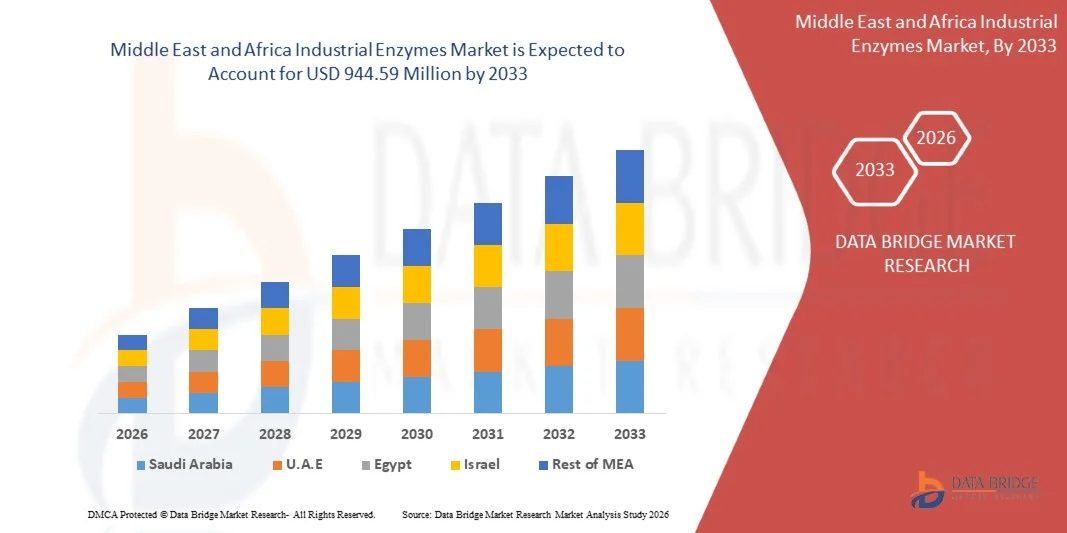
- As per Data Bridge Market Research Analysis the Middle East and Africa industrial enzymes market size was valued at USD 708.52 million in 2025 and is expected to reach USD 944.59 million by 2033, at a CAGR of 3.66% during the forecast period
- The growth in the demand for industrial enzymes especially in the emerging economies, and growing use of industrial enzymes for a wide range of end user applications such as in manufacturing of detergents, cleaners and emulsifiers will cushion the growth rate of industrial enzymes market
- Furthermore, the rising number of small and medium scale enterprises and surge in industrialization especially in the developing countries are the major factors attributable to the growth of the industrial enzymes market. Also, rise in demand for industrial enzymes by leather processing industry is the root cause for fuelling up the market growth rate
Market Size & Forecast
Global Market Value (2025):USD 708.52 million
Expected Market Value (2033): USD 944.59 million
Forecast CAGR (2026–2033): 3.66%
What are the Major Takeaways of Industrial Enzymes Market?
- Rising demand for industrial enzymes in the manufacturing of foaming agents and growth and expansion of various end user verticals in the emerging economies will also directly and positively impact the growth rate of the market. Rising awareness about the benefits of industrial enzymes in comparison to alternatives will further propel the market’s growth rate
- Moreover, the rising expenditure for research and development proficiencies by the major companies, upsurge in the rate of industrialization, and surging demand for industrial enzymes for in the food processing will further boost the beneficial opportunities for the growth rate of industrial enzymes market
- Saudi Arabia dominated the Industrial Enzymes market with a 34.12% revenue share in 2025, driven by diversification initiatives under Vision 2030, rising investments in food processing industries, and expanding biotechnology adoption
- The U.A.E. is projected to register the fastest CAGR of 6.9% from 2026 to 2033, due to its rapidly expanding food & beverage sector, strong logistics infrastructure, and rising adoption of advanced biotechnological solutions
- The Carbohydrases segment dominated the market with a 34.2% share in 2025, due to its extensive use in starch processing, baking, brewing, and food & beverage applications
Report Scope and Industrial Enzymes Market Segmentation
|
Attributes |
Industrial Enzymes Key Market Insights |
|
Segments Covered |
|
|
Countries Covered |
Middle East and Africa
|
|
Key Market Players |
|
|
Market Opportunities |
|
|
Value Added Data Infosets |
In addition to the insights on market scenarios such as market value, growth rate, segmentation, geographical coverage, and major players, the market reports curated by the Data Bridge Market Research also include in-depth expert analysis, pricing analysis, brand share analysis, consumer survey, demography analysis, supply chain analysis, value chain analysis, raw material/consumables overview, vendor selection criteria, PESTLE Analysis, Porter Analysis, and regulatory framework. |
What is the Key Trend in the Industrial Enzymes Market?
“Increasing Shift Toward Sustainable, High-Efficiency, and Bio-Optimized Industrial Enzyme Solutions”
- The Industrial Enzymes market is witnessing strong adoption of advanced bioengineered enzymes designed to improve process efficiency, reduce chemical usage, and enhance sustainability across food & beverage, detergents, biofuels, and pharmaceuticals industries
- Manufacturers are focusing on high-performance, thermostable, and genetically engineered enzymes that deliver improved specificity, faster reaction rates, and compatibility with modern industrial processes
- Growing demand for eco-friendly and cost-efficient biocatalysts is driving usage across food processing plants, textile industries, animal feed production, and biofuel manufacturing facilities
- For instance, companies such as Novozymes, DuPont, DSM, and BASF are introducing next-generation enzyme solutions with improved yield optimization, better stability, and application-specific formulations
- Increasing need for sustainable manufacturing, reduced carbon footprint, and green chemistry adoption is accelerating the shift toward industrial enzyme-based processes
- As industries move toward bio-based production systems, Industrial Enzymes will remain critical for improving efficiency, reducing waste, and enabling environmentally responsible manufacturing
What are the Key Drivers of Industrial Enzymes Market?
- Rising demand for sustainable and biodegradable alternatives to conventional chemical catalysts is driving adoption of industrial enzymes across multiple industries
- For instance, in 2025, leading companies such as Novozymes, BASF, and DSM expanded their enzyme portfolios to support food processing efficiency, biofuel conversion, and textile treatment applications
- Growing adoption of processed foods, clean-label products, and plant-based nutrition is boosting enzyme usage in the food and beverage sector globally
- Advancements in biotechnology, protein engineering, and fermentation technologies have significantly improved enzyme yield, stability, and cost-effectiveness
- Rising demand for biofuels and renewable energy sources is increasing the use of enzymes in biomass conversion and ethanol production processes
- Supported by strong investments in industrial biotechnology and sustainable manufacturing, the Industrial Enzymes market is expected to witness steady long-term growth
Which Factor is Challenging the Growth of the Industrial Enzymes Market?
- High production and R&D costs associated with enzyme development and large-scale fermentation processes restrict adoption among small and mid-sized manufacturers
- For instance, during 2024–2025, fluctuations in raw material prices and supply chain constraints impacted enzyme production costs across global biotechnology firms
- Limited enzyme stability under extreme industrial conditions such as high temperature, pH variations, and harsh chemical environments reduces application efficiency in certain sectors
- Lack of awareness and technical expertise in emerging markets slows down adoption of advanced enzyme-based solutions
- Strong dependency on specific substrates and sensitivity to process conditions creates challenges in standardization and large-scale deployment
- To address these issues, companies are investing in enzyme engineering, immobilization technologies, and customized formulations to improve performance, stability, and industrial adaptability
How is the Industrial Enzymes Market Segmented?
The market is segmented on the basis of type, form, source, and application.
• By Type
On the basis of type, the industrial enzymes market is segmented into Carbohydrases, Proteases, Phytases, Polymerases and Nucleases, Lipases, and Others. The Carbohydrases segment dominated the market with a 34.2% share in 2025, due to its extensive use in starch processing, baking, brewing, and food & beverage applications. These enzymes are widely preferred for their ability to break down complex carbohydrates into simpler sugars, improving yield, texture, and processing efficiency.
The Proteases segment is expected to grow at the fastest CAGR from 2026 to 2033, driven by rising demand in detergents, meat processing, and pharmaceuticals, where protein breakdown efficiency is critical.
• By Form
On the basis of form, the market is segmented into Liquid and Dry. The Liquid segment dominated the market with a 57.6% share in 2025, as it offers better solubility, faster reaction rates, and ease of integration in continuous industrial processes. Liquid enzymes are widely used in food processing, detergents, and biofuel applications.
The Dry segment is expected to grow at the fastest CAGR from 2026 to 2033, supported by longer shelf life, easier storage, and cost-effective transportation advantages, especially for export-driven enzyme manufacturers.
• By Source
On the basis of source, the market is segmented into Plant, Animal, and Micro-organism. The Micro-organism segment dominated the market with a 68.9% share in 2025, driven by large-scale microbial fermentation processes that ensure high yield, scalability, and consistent enzyme quality. These enzymes are widely used across food, detergent, and industrial biotechnology sectors.
The Plant-based segment is expected to grow at the fastest CAGR from 2026 to 2033, supported by rising demand for clean-label, vegan, and sustainable enzyme alternatives.
• By Application
On the basis of application, the industrial enzymes market is segmented into Food Processing, Animal Feed, Healthcare, Textiles, Leather Processing, Detergents and Cleaners, Bio-Fuel, and Others. The Food Processing segment dominated the market with a 29.8% share in 2025, driven by increasing demand for processed foods, bakery products, and dairy optimization solutions. Enzymes improve texture, flavor, shelf life, and production efficiency.
The Bio-Fuel segment is expected to grow at the fastest CAGR from 2026 to 2033, fueled by rising demand for renewable energy, biomass conversion, and sustainable fuel alternatives across global markets.
Which Region Holds the Largest Share of the Industrial Enzymes Market?
- Saudi Arabia dominated the Industrial Enzymes market with a 34.12% revenue share in 2025, driven by diversification initiatives under Vision 2030, rising investments in food processing industries, and expanding biotechnology adoption
- Growing demand for enzyme-based solutions in food, animal nutrition, and biofuel sectors is strengthening market growth, along with increasing industrial modernization and sustainability programs
U.A.E. Industrial Enzymes Market Insight
The U.A.E. is projected to register the fastest CAGR of 6.9% from 2026 to 2033, due to its rapidly expanding food & beverage sector, strong logistics infrastructure, and rising adoption of advanced biotechnological solutions. Increasing focus on sustainable manufacturing, clean-label food production, and industrial innovation is driving enzyme usage across multiple end-use industries
South Africa Industrial Enzymes Market Insight
South Africa leads enzyme adoption in Africa, driven by a well-established food processing industry, growing textile and detergent sectors, and rising demand for cost-effective industrial processing solutions. Expanding biotechnology research and increasing industrial modernization efforts are supporting steady market growth
Egypt Industrial Enzymes Market Insight
Egypt is emerging as a growing market, supported by increasing investments in food manufacturing, agriculture-based industries, and biofuel production. Rising focus on industrial efficiency, food security, and sustainable processing technologies is boosting enzyme adoption across key sectors in the country
Which are the Top Companies in Industrial Enzymes Market?
The industrial enzymes industry is primarily led by well-established companies, including:
- BASF SE (Germany)
- Novozymes (Denmark)
- Dow (U.S.)
- DuPont (U.S.)
- DSM (Netherlands)
- Dyadic International Inc. (U.S.)
- Advanced Enzyme Technologies (India)
- Chr. Hansen Holding A/S (Denmark)
- Amano Enzyme Inc. (Japan)
- Lesaffre (France)
- Associated British Foods plc (U.K.)
- Merck KGaA (Germany)
- NOVUS INTERNATIONAL (U.S.)
- F. Hoffmann-La Roche AG (Switzerland)
- Nature BioScience Pvt. L.T.D. (India)
- Biovet Private Ltd. (India)
- Adisseo (France)
- Codexis (U.S.)
- AB Enzymes (Germany)
- Cargill Incorporated (U.S.)
- BioResource International, Inc. (U.S.)
- Biocatalysts (U.K.)

- Interactive Data Analysis Dashboard
- Company Analysis Dashboard for high growth potential opportunities
- Research Analyst Access for customization & queries
- Competitor Analysis with Interactive dashboard
- Latest News, Updates & Trend analysis
- Harness the Power of Benchmark Analysis for Comprehensive Competitor Tracking
Middle East And Africa Industrial Enzymes Market, Supply Chain Analysis and Ecosystem Framework
To support market growth and help clients navigate the impact of geopolitical shifts, DBMR has integrated in-depth supply chain analysis into its Middle East And Africa Industrial Enzymes Market research reports. This addition empowers clients to respond effectively to global changes affecting their industries. The supply chain analysis section includes detailed insights such as Middle East And Africa Industrial Enzymes Market consumption and production by country, price trend analysis, the impact of tariffs and geopolitical developments, and import and export trends by country and HSN code. It also highlights major suppliers with data on production capacity and company profiles, as well as key importers and exporters. In addition to research, DBMR offers specialized supply chain consulting services backed by over a decade of experience, providing solutions like supplier discovery, supplier risk assessment, price trend analysis, impact evaluation of inflation and trade route changes, and comprehensive market trend analysis.
Data collection and base year analysis are done using data collection modules with large sample sizes. The stage includes obtaining market information or related data through various sources and strategies. It includes examining and planning all the data acquired from the past in advance. It likewise envelops the examination of information inconsistencies seen across different information sources. The market data is analysed and estimated using market statistical and coherent models. Also, market share analysis and key trend analysis are the major success factors in the market report. To know more, please request an analyst call or drop down your inquiry.
The key research methodology used by DBMR research team is data triangulation which involves data mining, analysis of the impact of data variables on the market and primary (industry expert) validation. Data models include Vendor Positioning Grid, Market Time Line Analysis, Market Overview and Guide, Company Positioning Grid, Patent Analysis, Pricing Analysis, Company Market Share Analysis, Standards of Measurement, Global versus Regional and Vendor Share Analysis. To know more about the research methodology, drop in an inquiry to speak to our industry experts.
Data Bridge Market Research is a leader in advanced formative research. We take pride in servicing our existing and new customers with data and analysis that match and suits their goal. The report can be customized to include price trend analysis of target brands understanding the market for additional countries (ask for the list of countries), clinical trial results data, literature review, refurbished market and product base analysis. Market analysis of target competitors can be analyzed from technology-based analysis to market portfolio strategies. We can add as many competitors that you require data about in the format and data style you are looking for. Our team of analysts can also provide you data in crude raw excel files pivot tables (Fact book) or can assist you in creating presentations from the data sets available in the report.













