


Middle East and Africa Interventional Cardiology and Peripheral Vascular Devices Market Size
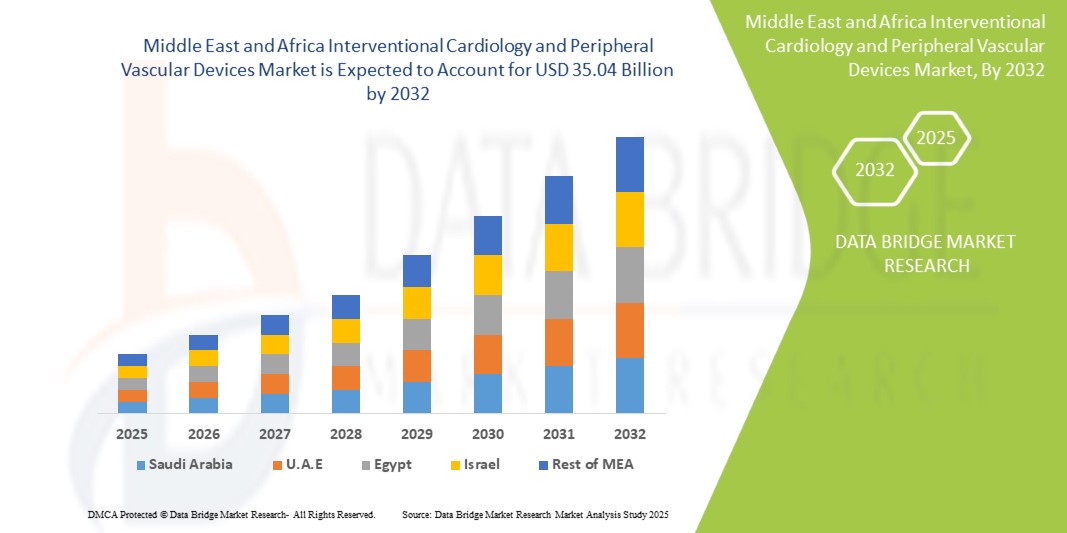
- The Middle East and Africa Interventional Cardiology and Peripheral Vascular Devices Market size was valued at USD 18.24 billion in 2024 and is expected to reach USD 35.04 billion by 2032, at a CAGR of 8.50% during the forecast period
- The market growth is largely fueled by the growing adoption of advanced interventional cardiology and peripheral vascular procedures, along with continuous technological progress in minimally invasive devices and imaging systems. This is driving increased utilization of these solutions in hospitals and specialized clinics
- Furthermore, rising patient demand for safer, more effective, and minimally invasive treatment options is establishing interventional cardiology and peripheral vascular devices as the preferred choice for cardiovascular interventions. These converging factors are accelerating the uptake of such devices, thereby significantly boosting the industry’s growth
Middle East and Africa Interventional Cardiology and Peripheral Vascular Devices Market Analysis
- Interventional Cardiology and Peripheral Vascular Devices, including imaging systems, catheters, stents, and related instruments, are increasingly vital components of modern cardiovascular care in hospitals and clinics across Middle East & Africa. These devices support minimally invasive procedures, precision diagnostics, and improved patient outcomes, making them essential in both public and private healthcare settings
- The escalating demand for interventional cardiology and peripheral vascular devices is primarily driven by the expansion of tertiary hospitals, government-led healthcare initiatives, and the growing awareness of cardiovascular health among patients in the region
- Saudi Arabia dominated the Middle East & Africa Middle East and Africa Interventional Cardiology and Peripheral Vascular Devices Market with the largest revenue share of 38% in 2024, supported by advanced cardiac centers, strong government healthcare spending, and collaborations with global medical device manufacturers to introduce state-of-the-art technologies
- The United Arab Emirates is expected to be the fastest-growing country in the Middle East & Africa Middle East and Africa Interventional Cardiology and Peripheral Vascular Devices Market during the forecast period due to rising medical tourism, increasing hospital modernization projects, and the adoption of AI-powered interventional imaging systems
- The Adults segment dominated the Middle East & Africa Middle East and Africa Interventional Cardiology and Peripheral Vascular Devices Market with 46.2% revenue share in 2024, driven by the high prevalence of cardiovascular diseases, peripheral artery disease, and related comorbidities in the adult population of the Middle East & Africa
Report Scope and Middle East and Africa Interventional Cardiology and Peripheral Vascular Devices Market Segmentation
|
Attributes |
Interventional Cardiology and Peripheral Vascular Devices Key Market Insights |
|
Segments Covered |
|
|
Countries Covered |
Middle East and Africa
|
|
Key Market Players |
|
|
Market Opportunities |
|
|
Value Added Data Infosets |
In addition to the insights on market scenarios such as market value, growth rate, segmentation, geographical coverage, and major players, the market reports curated by the Data Bridge Market Research also include in-depth expert analysis, pricing analysis, brand share analysis, consumer survey, demography analysis, supply chain analysis, value chain analysis, raw material/consumables overview, vendor selection criteria, PESTLE Analysis, Porter Analysis, and regulatory framework. |
Middle East and Africa Interventional Cardiology and Peripheral Vascular Devices Market Trends
Enhanced Precision and Workflow Integration
- A significant and accelerating trend in the Middle East and Africa Interventional Cardiology and Peripheral Vascular Devices Market is the increasing adoption of advanced imaging and navigation-assisted systems to enhance procedural precision and improve patient outcomes. These technologies are streamlining complex cardiovascular interventions and supporting minimally invasive procedures
- For instance, hospitals in Saudi Arabia are integrating high-resolution intravascular imaging and robotic-assisted devices, allowing cardiologists to perform complex interventions with greater accuracy and reduced procedural risks. Similarly, UAE-based cardiac centers are adopting 3D mapping and real-time imaging systems for improved procedural guidance
- Advanced systems now provide enhanced visualization of vascular structures, aiding in accurate stent placement, lesion assessment, and identification of complications. This integration of imaging with interventional devices significantly improves clinical decision-making and procedural efficiency
- Healthcare providers across the region are focusing on interoperability between diagnostic imaging, catheter-based interventions, and robotic support platforms, enabling seamless workflow from pre-procedural planning to post-procedural evaluation
- This trend towards more integrated and precise interventional solutions is reshaping treatment standards, reducing procedure times, and improving patient recovery rates. Leading medtech companies are continuously innovating to provide modular and scalable solutions tailored for both large hospitals and specialty clinics
- The demand for interventional cardiology and peripheral vascular devices with advanced imaging and navigation capabilities is growing rapidly across hospitals and specialized cardiac centers, driven by the need for precision, safety, and improved procedural outcomes
Middle East and Africa Interventional Cardiology and Peripheral Vascular Devices Market Dynamics
Driver
Growing Need Due to Rising Cardiovascular Disease Burden and Technological Adoption
- The increasing prevalence of cardiovascular diseases, including coronary artery disease, peripheral artery disease, and other vascular conditions, is a major factor driving the heightened demand for interventional cardiology and peripheral vascular devices across the Middle East and Africa. The growing patient population, coupled with lifestyle changes, aging demographics, and rising incidence of comorbidities such as diabetes and hypertension, is contributing to an urgent need for minimally invasive cardiovascular interventions
- For instance, in April 2024, Medtronic announced the launch of an advanced drug-eluting stent system designed to improve procedural success rates and long-term patient outcomes in complex coronary interventions. Such technological innovations and product enhancements by leading companies are expected to propel the growth of the Middle East and Africa Interventional Cardiology and Peripheral Vascular Devices Market over the forecast period
- As patients and healthcare providers increasingly prioritize safer, less invasive treatment options, interventional cardiology and peripheral vascular devices offer highly advanced features such as precise device deployment, imaging-guided navigation, and enhanced hemodynamic support. These capabilities significantly improve procedural accuracy, reduce complications, and offer a tangible advantage over conventional surgical methods
- In addition, the rising adoption of image-guided and catheter-based interventional systems is making these devices a critical component of modern cardiovascular care. Their seamless integration with complementary diagnostic and therapeutic platforms allows for more efficient workflow in hospitals, specialized cardiac centers, and ambulatory surgical facilities.
- The advantages of minimally invasive interventions—including reduced patient recovery times, shorter hospital stays, and improved overall outcomes—are key factors driving adoption in both public and private healthcare sectors across the region. This trend is further supported by increasing healthcare infrastructure investments and growing awareness among clinicians and patients regarding the benefits of advanced interventional devices
Restraint/Challenge
High Costs and Regulatory Considerations
- One of the key challenges limiting the widespread adoption of interventional cardiology and peripheral vascular devices is the relatively high initial cost of advanced technologies. Devices such as bioresorbable stents, robotic-assisted catheters, and integrated imaging systems often carry a premium price, making them less accessible to smaller hospitals, clinics, and healthcare facilities in developing markets
- Regulatory complexities and stringent approval processes for new devices can also slow market entry, particularly in the Middle East and Africa, where approval timelines and clinical validation requirements may vary across countries. Delays in regulatory clearances for innovative stent, balloon, or catheter technologies can impact product availability and adoption rates
- Ensuring robust clinical evidence, adhering to regional regulatory standards, and obtaining necessary certifications are crucial steps for companies to establish credibility and foster trust among healthcare providers and patients
- While more affordable options for basic interventional devices are becoming available, premium devices that feature advanced functionalities—such as integrated imaging guidance, drug-eluting coatings, and robotic-assisted deployment—remain costly. This pricing gap can be a barrier to adoption, especially for budget-conscious hospitals and healthcare systems with constrained funding
- Overcoming these barriers requires a combination of cost-effective manufacturing strategies, clinician and patient education on clinical benefits, and strengthened regulatory support. By addressing these challenges, the market for interventional cardiology and peripheral vascular devices can sustain long-term growth and continue to expand access to innovative, minimally invasive cardiovascular therapies in the region
Middle East and Africa Interventional Cardiology and Peripheral Vascular Devices Market Scope
The market is segmented on the basis of type, procedure, application, age group, end user, and distribution channel.
• By Type
On the basis of type, the Middle East & Africa Middle East and Africa Interventional Cardiology and Peripheral Vascular Devices Market is segmented into inferior vena cava (IVC) filters, plaque modification devices, hemodynamic flow alteration devices, accessories, angioplasty balloons, angioplasty stents, angioplasty catheters, and endovascular aneurysm repair stent grafts. The angioplasty stents segment dominated the market with the largest revenue share of 39.8% in 2024. This dominance is due to their extensive use in coronary and peripheral interventions across major hospitals in Saudi Arabia and the UAE. Stents are preferred by clinicians for their high success rates in maintaining vessel patency and preventing restenosis. The devices are widely integrated into minimally invasive procedures, reducing patient recovery time and hospital stay duration. Furthermore, consistent technological improvements and the availability of drug-eluting stents have reinforced their adoption. The segment benefits from government initiatives aimed at expanding access to advanced cardiovascular interventions.
The angioplasty balloons segment is expected to witness the fastest CAGR of 12.4% from 2025 to 2032. The rapid growth is supported by increasing adoption of drug-coated balloons that improve procedural outcomes and reduce complications. These devices are widely utilized for precise vessel dilation in both coronary and peripheral arteries, enhancing procedural efficacy. Expansion of specialized interventional cardiology centers across the UAE and Saudi Arabia accelerates their adoption. Continuous product innovation, including smaller-profile and high-compliance balloons, meets the growing demand for safer and more effective interventions. In addition, rising awareness among healthcare providers regarding the benefits of advanced balloon technology is fueling market expansion.
• By Procedure
On the basis of procedure, the Middle East & Africa Middle East and Africa Interventional Cardiology and Peripheral Vascular Devices Market is segmented into Iliac intervention, femoropopliteal interventions, tibial (below-the-knee) interventions, peripheral angioplasty, arterial thrombectomy, and peripheral atherectomy. The femoropopliteal interventions segment dominated the market with a revenue share of 35.6% in 2024, owing to the high prevalence of peripheral arterial disease in the adult and geriatric populations across Saudi Arabia and the UAE. Hospitals extensively adopt femoropopliteal interventions due to their proven efficacy in restoring blood flow and improving limb function. Advanced stents and balloons tailored for femoropopliteal arteries further reinforce their preference among clinicians. Government-supported cardiovascular programs and increased accessibility to catheterization labs drive usage.
The peripheral atherectomy segment is projected to register the fastest CAGR of 11.8% from 2025 to 2032. Growing awareness of atherectomy’s ability to treat complex arterial blockages, especially in patients with diabetes and PAD, is driving adoption. Specialized centers in the UAE and Saudi Arabia are increasingly offering this therapy due to its precision and minimally invasive nature. Technological advancements, such as laser and orbital atherectomy devices, enhance procedural safety and effectiveness. Training programs for interventional cardiologists further facilitate uptake. The procedure’s compatibility with existing stents and balloons also increases clinical confidence. Rising healthcare expenditure and investments in advanced cath labs support growth.
• By Application
On the basis of application, the Middle East & Africa Middle East and Africa Interventional Cardiology and Peripheral Vascular Devices Market is segmented into congenital heart defect correction, coronary thrombectomy, angioplasty, valvuloplasty, percutaneous valve repair, and others. The Angioplasty segment dominated with a market share of 42.3% in 2024, driven by its widespread use in both coronary and peripheral vascular procedures in the Middle East & Africa. Hospitals in Saudi Arabia and UAE have integrated angioplasty into standard care protocols for cardiac and peripheral interventions. The procedure is preferred for its minimally invasive nature, reduced patient recovery time, and proven efficacy in restoring vessel patency. Availability of advanced angioplasty balloons and stents has further cemented its position. Clinicians rely on angioplasty for its predictable outcomes and procedural efficiency. Government initiatives to reduce cardiovascular disease burden support this segment.
The Percutaneous Valve Repair segment is expected to witness the fastest CAGR of 10.9% from 2025 to 2032. Rising prevalence of valvular heart diseases, coupled with minimally invasive treatment preferences, is driving market growth. Adoption of transcatheter valve technologies in advanced hospitals across the UAE and Saudi Arabia is accelerating. The procedure reduces recovery time and hospitalization costs compared to traditional open-heart surgery. Continuous device innovations, including next-generation catheters and imaging guidance, enhance precision and safety. Government support for advanced cardiac procedures boosts accessibility. Training programs and clinical trials increase physician confidence and adoption rates.
• By Age Group
On the basis of age group, the Middle East & Africa Middle East and Africa Interventional Cardiology and Peripheral Vascular Devices Market is segmented into geriatric, adults, and pediatric. The adults segment dominated with a 46.2% revenue share in 2024, driven by the high prevalence of cardiovascular diseases, peripheral artery disease, and related comorbidities in the adult population of the Middle East & Africa. Hospitals focus on adult interventions due to higher patient volumes and a well-established interventional cardiology infrastructure. Device manufacturers cater specifically to adult anatomies with advanced stents, catheters, and balloons. Government awareness campaigns on heart disease prevention further support the market. Clinicians rely on robust procedural outcomes in adults to standardize treatment protocols.
The geriatric segment is projected to witness the fastest CAGR of 11.4% from 2025 to 2032. Increasing aging populations in Saudi Arabia and the UAE face higher incidences of peripheral vascular disease and coronary conditions, driving demand for minimally invasive therapies. Hospitals and clinics are expanding geriatric-focused cardiac programs. Device innovations tailored to fragile vasculature and reduced procedural risks accelerate adoption. Government initiatives to improve elderly healthcare access also support this trend. Physicians are increasingly adopting advanced imaging and guidance technologies for geriatric patients. Awareness of improved outcomes and shorter recovery times promotes patient acceptance. Growth in geriatric interventions reflects the region’s demographic shift and healthcare modernization.
• By End User
On the basis of end user, the Middle East & Africa Middle East and Africa Interventional Cardiology and Peripheral Vascular Devices Market is segmented into hospitals, ambulatory surgery centers, nursing facilities, clinics, and others. The Hospitals segment dominated with a 51.3% revenue share in 2024, driven by the concentration of advanced cardiac and vascular intervention facilities in tertiary care hospitals across Saudi Arabia and UAE. Hospitals offer comprehensive interventional cardiology services including stents, balloons, atherectomy, and valve repair procedures. They maintain well-equipped catheterization labs and surgical suites, ensuring wide adoption of these devices. Physician expertise, patient volume, and hospital infrastructure favor this segment’s dominance. Government initiatives supporting advanced cardiovascular care reinforce hospital-based usage. In addition, hospitals are preferred for high-risk and complex interventions, boosting device penetration. Access to specialized training and clinical support further strengthens this segment.
The ambulatory surgery centers segment is expected to register the fastest CAGR of 12.6% from 2025 to 2032. Rising preference for outpatient procedures in UAE and Saudi Arabia, supported by minimally invasive devices and improved patient safety, is driving growth. Centers offer convenience, shorter recovery periods, and reduced hospital stays. Partnerships with manufacturers for device supply and training facilitate adoption. Increasing insurance coverage for outpatient procedures encourages patients. Technology-enabled monitoring systems further enhance procedural safety. Centers are expanding capacities to cater to growing demand for elective and lower-risk interventions. The combination of convenience, efficiency, and cost-effectiveness underpins rapid growth in this segment.
• By Distribution Channel
On the basis of distribution channel, the Middle East & Africa Middle East and Africa Interventional Cardiology and Peripheral Vascular Devices Market is segmented into direct tender, third party distributors, and others. The Direct Tender segment dominated with a 47.1% revenue share in 2024, owing to direct procurement of high-value cardiovascular devices by hospitals and government healthcare programs in Saudi Arabia and UAE. Direct tenders ensure timely supply, competitive pricing, and access to the latest technologies. Manufacturers often engage directly with hospital procurement teams to provide training and technical support. Regulatory compliance and bulk purchasing advantages reinforce the segment’s dominance. Key interventional cardiology centers rely on direct procurement for critical devices. Strategic partnerships with healthcare authorities also bolster adoption. High-value equipment such as stents, balloons, and atherectomy systems are primarily distributed this way to maintain quality and reliability.
The Third Party Distributors segment is projected to witness the fastest CAGR of 11.8% from 2025 to 2032. Expansion of distributor networks in remote and underserved regions in the Middle East & Africa is driving adoption. Distributors facilitate access to hospitals, clinics, and ambulatory centers lacking direct procurement capabilities. Collaboration with manufacturers ensures availability of advanced devices and ongoing technical support. Growth in regional healthcare infrastructure and rising cardiovascular patient load contributes to the segment’s rapid expansion. Distributors also offer flexible delivery schedules and after-sales service. Training programs and workshops provided through distributors increase clinician confidence. These factors collectively make third-party distribution the fastest-growing channel.
Middle East and Africa Interventional Cardiology and Peripheral Vascular Devices Market Regional Analysis
- The Middle East & Africa Middle East and Africa Interventional Cardiology and Peripheral Vascular Devices Market is largely dominated by Saudi Arabia, which held the largest revenue share in 2024. This growth is driven by substantial government healthcare investments under Vision 2030, the establishment of advanced cardiac and specialty vascular centers, and collaborations with leading global medtech companies
- Increasingly adopting advanced interventional cardiology and peripheral vascular devices, particularly in procedures such as coronary interventions, peripheral angioplasty, and endovascular aneurysm repairs, where precision and minimally invasive techniques are prioritized
- Strong demand is further supported by rising healthcare expenditure, expansion of high-end cardiac hospitals, and strategic partnerships that facilitate faster deployment of next-generation cardiovascular devices
Saudi Arabia Middle East and Africa Interventional Cardiology and Peripheral Vascular Devices Market Insight
The Saudi Arabia Middle East and Africa Interventional Cardiology and Peripheral Vascular Devices Market dominated the Middle East & Africa region with the largest revenue share of 38% in 2024, fueled by government spending, state-of-the-art cardiac centers, and collaborations with global medical device manufacturers. Adoption is highest in high-risk cardiovascular procedures and complex interventions, emphasizing minimally invasive, catheter-based technologies. Public and private hospitals are rapidly deploying these devices to enhance patient outcomes, and Vision 2030 initiatives continue to support expansion across tertiary care and specialty cardiac facilities.
UAE Middle East and Africa Interventional Cardiology and Peripheral Vascular Devices Market Insight
The United Arab Emirates Middle East and Africa Interventional Cardiology and Peripheral Vascular Devices Market is expected to be the fastest-growing country in the Middle East & Africa Middle East and Africa Interventional Cardiology and Peripheral Vascular Devices Market during the forecast period, supported by rising healthcare expenditure, rapid expansion of specialty cardiac clinics, and adoption of AI-powered imaging and interventional systems. Growth is driven by strong investments in medical tourism, hospital modernization projects, and advanced cardiovascular infrastructure, particularly in cardiology and peripheral vascular interventions. Collaborative initiatives with international device providers and patient inflow from neighboring countries further accelerate market expansion in the UAE.
Middle East and Africa Interventional Cardiology and Peripheral Vascular Devices Market Share
The interventional cardiology and peripheral vascular devices industry is primarily led by well-established companies, including:
- Abbott (U.S.)
- B. Braun SE (Germany)
- Boston Scientific Corporation (U.S.)
- BD (U.S.)
- Cardinal Health Inc. (U.S.)
- Cook (U.S.)
- Medtronic (Ireland)
- Terumo Corporation (Japan)
- Koninklijke Philips N.V. (Netherlands)
- Biotronik SE & Co. KG (Germany)
- ENDOCOR GmbH (Germany)
- Andramed GmbH (Germany)
- BrosMed Medical Co., Ltd. (China)
Latest Developments in Middle East and Africa Interventional Cardiology and Peripheral Vascular Devices Market
- In March 2023, Philips partnered with Al Qassimi Hospital in the UAE to launch a new Ultra-Low Contrast Percutaneous Coronary Intervention (ULC-PCI) training course. This initiative aims to enhance the adoption of low-contrast, minimally invasive treatments for coronary artery disease across the Middle East, Turkey, and Africa. The program is part of Philips' global education efforts to improve patient outcomes through advanced interventional cardiology techniques
- In April 2023, Boston Scientific announced a 14.0% reported and 11.6% operational net sales growth in the Middle East and Africa (EMEA) region for the fourth quarter and full year 2023. The company's cardiovascular segment achieved a 13.9% reported, 13.8% operational, and 13.3% organic growth, reflecting strong demand for its interventional cardiology and peripheral vascular devices in the region
- In January 2025, Philips unveiled AI-driven innovations in diagnostics, patient monitoring, and treatment at Arab Health 2025. These industry-leading solutions, including cloud-based data management, advanced visualization, automation, and AI, aim to reduce administrative burdens, optimize workflows, and empower clinicians with insights to enhance experiences and improve patient outcomes
- In March 2023, Philips partnered with Al Qassimi Hospital in the UAE to launch a new Ultra-Low Contrast Percutaneous Coronary Intervention (ULC-PCI) training course. This initiative aims to enhance the adoption of low-contrast, minimally invasive treatments for coronary artery disease across the Middle East, Turkey, and Africa. The program is part of Philips' global education efforts to improve patient outcomes through advanced interventional cardiology techniques
- In April 2023, Boston Scientific announced a 14.0% reported and 11.6% operational net sales growth in the Middle East and Africa (EMEA) region for the fourth quarter and full year 2023. The company's cardiovascular segment achieved a 13.9% reported, 13.8% operational, and 13.3% organic growth, reflecting strong demand for its interventional cardiology and peripheral vascular devices in the region
- In January 2025, Philips unveiled AI-driven innovations in diagnostics, patient monitoring, and treatment at Arab Health 2025. These industry-leading solutions, including cloud-based data management, advanced visualization, automation, and AI, aim to reduce administrative burdens, optimize workflows, and empower clinicians with insights to enhance experiences and improve patient outcomes

- Interactive Data Analysis Dashboard
- Company Analysis Dashboard for high growth potential opportunities
- Research Analyst Access for customization & queries
- Competitor Analysis with Interactive dashboard
- Latest News, Updates & Trend analysis
- Harness the Power of Benchmark Analysis for Comprehensive Competitor Tracking
Data collection and base year analysis are done using data collection modules with large sample sizes. The stage includes obtaining market information or related data through various sources and strategies. It includes examining and planning all the data acquired from the past in advance. It likewise envelops the examination of information inconsistencies seen across different information sources. The market data is analysed and estimated using market statistical and coherent models. Also, market share analysis and key trend analysis are the major success factors in the market report. To know more, please request an analyst call or drop down your inquiry.
The key research methodology used by DBMR research team is data triangulation which involves data mining, analysis of the impact of data variables on the market and primary (industry expert) validation. Data models include Vendor Positioning Grid, Market Time Line Analysis, Market Overview and Guide, Company Positioning Grid, Patent Analysis, Pricing Analysis, Company Market Share Analysis, Standards of Measurement, Global versus Regional and Vendor Share Analysis. To know more about the research methodology, drop in an inquiry to speak to our industry experts.
Data Bridge Market Research is a leader in advanced formative research. We take pride in servicing our existing and new customers with data and analysis that match and suits their goal. The report can be customized to include price trend analysis of target brands understanding the market for additional countries (ask for the list of countries), clinical trial results data, literature review, refurbished market and product base analysis. Market analysis of target competitors can be analyzed from technology-based analysis to market portfolio strategies. We can add as many competitors that you require data about in the format and data style you are looking for. Our team of analysts can also provide you data in crude raw excel files pivot tables (Fact book) or can assist you in creating presentations from the data sets available in the report.













