


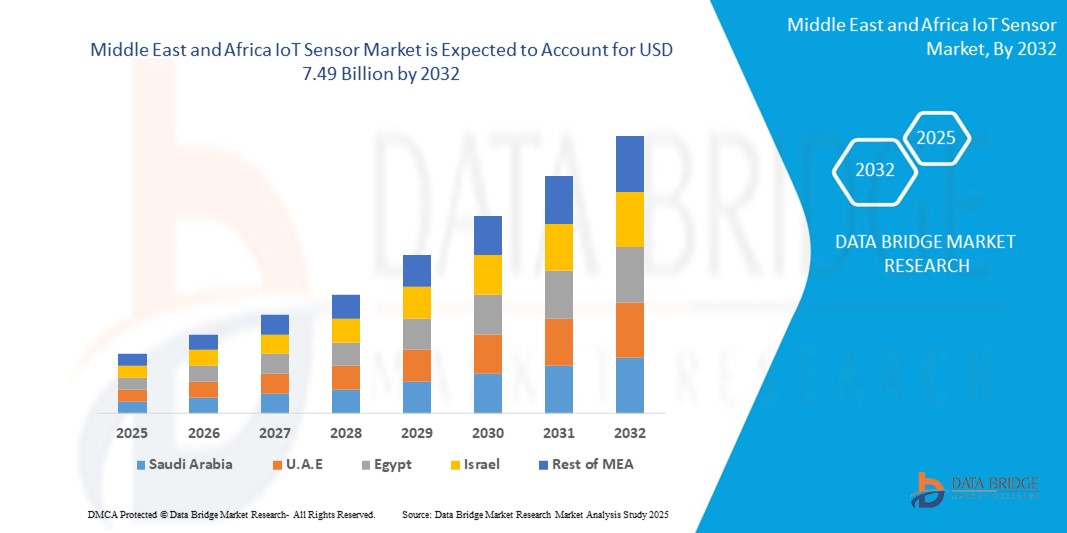
IoT Sensor Market Size
- The Middle East and Africa IoT Sensor Market size was valued at USD 1.1 billion in 2024 and is expected to reach USD 7.49 billion by 2032, at a CAGR of 31.5% during the forecast period
- This growth is driven by factors such as the Rising demand for smart infrastructure, industrial automation, and supportive government initiatives
IoT Sensor Market Analysis
- The IoT sensors are considered to be one of the most vital and prepared with IoT cloud based applications. It is connected wirelessly to the mainframe system that is utilized for identification. The key purpose is to collect data and control the immediate environments through its several sensors including humidity sensors, temperature sensors and others.
- Saudi Arabia is expected to dominate the IoT Sensors market due to rise in the demand for connected and wearables devices
- UAE is expected to be the fastest growing region in the IoT Sensor Market during the forecast period due to rising awareness about eye health
- Temperature Sensors segment is expected to dominate the market with a market share of 48.31% due to its widespread use in industrial automation, smart homes, and healthcare applications
Report Scope and IoT Sensor Market Segmentation
|
Attributes |
IoT Sensor Key Market Insights |
|
Segments Covered |
|
|
Countries Covered |
Middle East and Africa
|
|
Key Market Players |
|
|
Market Opportunities |
|
|
Value Added Data Infosets |
In addition to the insights on market scenarios such as market value, growth rate, segmentation, geographical coverage, and major players, the market reports curated by the Data Bridge Market Research also include import export analysis, production capacity overview, production consumption analysis, price trend analysis, climate change scenario, supply chain analysis, value chain analysis, raw material/consumables overview, vendor selection criteria, PESTLE Analysis, Porter Analysis, and regulatory framework. |
IoT Sensor Market Trends
“Increased Adoption of Smart Cities and Infrastructure”
- The Middle East and Africa (MEA) region is experiencing a significant surge in the adoption of IoT sensors within smart city and infrastructure projects, driven by rapid urbanization, government initiatives, and technological advancements. Cities across MEA are increasingly integrating IoT solutions to enhance urban living, optimize resource management, and promote sustainability
- MEA countries to leverage IoT technologies in building sustainable, efficient, and resilient urban infrastructures. The integration of IoT sensors is pivotal in transforming cities into smart environments that enhance the quality of life for residents and contribute to economic growth
- For instance, In March 2023, Dubai and Abu Dhabi ramped up their smart city initiatives by implementing advanced IoT solutions for traffic management and environmental monitoring, aiming to improve urban living and public services.
IoT Sensor Market Dynamics
Driver
“Rising Demand for Energy Efficiency and Sustainability”
- The Middle East and Africa (MEA) region is experiencing significant growth in the adoption of Internet of Things (IoT) sensors, driven by the increasing demand for energy efficiency and sustainability. This trend is particularly evident in sectors such as energy, utilities, and infrastructure, where IoT technologies are being leveraged to optimize resource use, reduce waste, and lower carbon footprints.
- These initiatives underscore the growing commitment in the MEA region to harness IoT technologies for achieving energy efficiency and sustainability goals. The integration of IoT sensors is playing a pivotal role in transforming industries and urban infrastructures towards more sustainable practices.
For instance,
- In 2022, the Dubai Electricity and Water Authority (DEWA) initiated a project to install smart meters across the city, enabling real-time monitoring of energy consumption and facilitating more efficient energy distribution
Opportunity
“Expansion of Industrial IoT (IIoT) Applications”
- The industrial sector is increasingly adopting IoT sensors to improve operational efficiency, predictive maintenance, and asset management. One of the main opportunities is the expansion of Industrial IoT (IIoT) applications, particularly in industries like manufacturing, logistics, and energy.
- Governments across the MEA region are actively promoting industrial diversification to reduce reliance on oil and gas exports. Initiatives focused on developing smart manufacturing capabilities, modernizing infrastructure, and fostering technological innovation are pivotal in driving IIoT adoption. Industries such as oil and gas, manufacturing, logistics, and utilities are increasingly adopting IIoT technologies for real-time monitoring, predictive maintenance, and process optimization. These applications are enhancing productivity and reducing operational costs.
For instance,
- In May 2024, Dubai's Jumeirah Lakes Towers, developed by DMCC, implemented over 100 connected buildings, 1,800 smart lighting systems, and 370 smart bins, generating more than 25,000 data points to optimize urban management. MEA region's commitment to embracing IIoT technologies to foster industrial growth, enhance operational efficiency, and position itself as a leader in the global digital transformation landscape.
Restraint/Challenge
“Data Privacy and Security Concerns”
- In the Middle East and Africa (MEA) region, data privacy and security concerns are a major obstacle to the broader adoption of IoT sensors across industries. These devices, including temperature sensors, collect large volumes of sensitive data from environments such as smart cities, healthcare systems, and industrial settings.
- As device connectivity increases, so does the vulnerability to cyber threats, making robust cybersecurity measures essential. Additionally, MEA countries are introducing their own data protection laws, mirroring frameworks like GDPR, which further complicates compliance for businesses. Without advanced encryption, secure data storage solutions, and constant system monitoring, the risk of breaches remains high. These privacy concerns could restrain IoT sensor expansion, especially in sectors where safeguarding information is critical to operations and trust.
For instance,
- In June 2025, IBM collaborated with regional stakeholders to enhance IoT sensor security features in MEA, but data breach concerns remain. As temperature sensors collect critical data in healthcare and urban monitoring, the risk of misuse or cyberattack grows. Regional data privacy laws are evolving, creating more compliance challenges. Without targeted cybersecurity strategies, MEA’s IoT sensor growth may be hindered, especially in data-sensitive sectors like finance and public infrastructure.
IoT Sensor Market Scope
The market is segmented on the basis sensor type, technology and vertical.
|
Segmentation |
Sub-Segmentation |
|
Sensor type |
|
|
Technology |
|
|
Vertical |
|
In 2025, the Temperature Sensors is projected to dominate the market with a largest share in segment
In 2025, the Temperature Sensors segment is projected to dominate the market, holding the largest share of 48.31%. This dominance is driven by the widespread application of temperature sensors in industries such as automotive, healthcare, and manufacturing. Temperature monitoring plays a crucial role in optimizing energy efficiency, improving system reliability, and ensuring safety across various sectors.
The Pressure Sensors is expected to account for the largest share during the forecast period in market
The Pressure Sensors segment is expected to account for the largest share of 44.57% during the forecast period in the IoT sensor market. This growth is mainly driven by their critical role in applications such as industrial automation, automotive systems, and environmental monitoring. Pressure sensors are essential for detecting fluid and gas pressure, ensuring equipment safety and operational efficiency. Their integration into smart devices and systems enhances real-time monitoring capabilities. As industries continue to automate processes, the demand for reliable pressure sensing technology is expected to rise significantly.
IoT Sensor Market Regional Analysis
“Saudi Arabia Holds the Largest Share in the IoT Sensor Market”
- Saudi Arabia holds the largest share in the IoT sensor market within the Middle East and Africa region, driven by its aggressive push toward smart infrastructure and digital transformation. The Kingdom’s Vision 2030 initiative has prioritized investments in smart cities, energy efficiency, and connected healthcare systems. Major projects like NEOM are heavily reliant on advanced sensor technologies for automation, monitoring, and data analytics. Saudi Arabia’s strong government backing and partnerships with global tech firms have accelerated the adoption of IoT sensors across sectors. The industrial sector, particularly oil and gas, is also integrating IoT for real-time monitoring and predictive maintenance.
- Expanding 5G networks and increased R&D activities are supporting IoT sensor deployment. The country’s commitment to innovation and smart governance is positioning it as a regional hub for IoT technology. As a result, Saudi Arabia continues to lead the MEA IoT sensor market in terms of both deployment and innovation.
“UAE is Projected to Register the Highest CAGR in the IoT Sensor Market”
- The UAE is expected to witness the fastest growth in the IoT sensor market across the Middle East and Africa region. This surge is driven by the government’s strong focus on smart city initiatives like Smart Dubai and Smart Abu Dhabi. These programs are transforming infrastructure, making heavy use of IoT sensors to manage traffic, energy, and public services efficiently. The country’s push for digital transformation across healthcare, logistics, and manufacturing is also increasing demand for connected technologies.
- Rapid advancements in network connectivity, especially 5G, are further enabling real-time data exchange and sensor integration. The UAE's supportive regulatory environment and partnerships with global tech companies are fueling innovation. Growing public and private investments in automation and smart technologies are accelerating IoT adoption. Together, these efforts are positioning the UAE as a regional leader in smart and connected solutions.
IoT Sensor Market Share
The market competitive landscape provides details by competitor. Details included are company overview, company financials, revenue generated, market potential, investment in research and development, new market initiatives, Middle East and Africa presence, production sites and facilities, production capacities, company strengths and weaknesses, product launch, product width and breadth, application dominance. The above data points provided are only related to the companies' focus related to market.
The Major Market Leaders Operating in the Market Are:
- Sierra Wireless, Inc.,
- Moxa Inc.,
- GENERAL ELECTRIC,
- Skyworks Solution Inc.,
- Infineon Technologies AG,
- Honeywell International Inc.,
- Texas Instruments Incorporated,
- Siemens Healthcare GmbH,
- CANON MEDICAL SYSTEMS CORPORATION,
- NXP Semiconductors,
- STMicroelectronics,
- IBM,
- Sensata Technologies, Inc,
- Robert Bosch GmbH,
- TE Connectivity
- Qualcomm Technologies, Inc.
Latest Developments in Middle East and Africa IoT Sensor Market
- In March 2025, Infineon Technologies announced the launch of its PSOC™ 4 microcontroller family featuring Multi-Sense capabilities. This new offering expands Infineon's capacitive sensing technology, CAPSENSE™, by introducing proprietary inductive sensing and non-invasive liquid sensing solutions. The PSOC 4 enables innovative human-machine interface (HMI) designs, such as touch-over-metal buttons and waterproof touch sensors, catering to applications in consumer electronics and industrial automation. The PSOC 4000T series, including the PSOC 4000T and the upcoming PSOC 4100T Plus, are now available, with the latter expected to launch in Q2 2025.
- In January 2025, Honeywell and NXP Semiconductors announced an expanded collaboration to enhance building energy management. By integrating NXP's neural network-enabled processors into Honeywell's building management systems, the partnership aims to optimize energy consumption and improve sustainability in commercial buildings. The collaboration focuses on leveraging AI and machine learning to enable real-time, autonomous decision-making for energy efficiency. This initiative aligns with the growing demand for smart building solutions and supports Honeywell's commitment to advancing building automation technologies.
- In December 2024, NXP Semiconductors partnered with geo (Green Energy Options Ltd.) to launch the SeeZero home energy management system, a Matter-certified solution designed for mass-market adoption. The SeeZero system allows consumers to monitor and control their energy consumption, integrating with smart home devices to enhance energy efficiency. NXP's integrated system solutions provide the necessary connectivity, processing, and security features to support this innovative energy management platform. This collaboration underscores NXP's commitment to advancing smart energy solutions in the residential sector.
- In January 2025, GE Appliances, a Haier company, was named "Smart Appliance Company of the Year" at the IoT Breakthrough Awards. The company was recognized for integrating advanced technologies, including Generative AI, into their connected home appliances. Notably, GE Appliances introduced the CookCam™ AI, an in-oven camera that identifies the food being cooked and recommends optimal cooking settings. This innovation exemplifies GE Appliances' leadership in smart home technology and its commitment to enhancing consumer experiences through IoT-enabled solutions.
- In March 2025, Canon Medical Systems announced regulatory clearance for major AI enhancements to its Aquilion ONE / INSIGHT Edition CT scanner. The updates include the new PIQE 1024 matrix and SilverBeam technologies, expanding the device's capabilities across a broader range of clinical applications. These advancements enable high-resolution imaging and improved diagnostic accuracy, reinforcing Canon Medical Systems' position at the forefront of medical imaging technology. The cleared enhancements are now available for deployment in healthcare facilities.

- Interactive Data Analysis Dashboard
- Company Analysis Dashboard for high growth potential opportunities
- Research Analyst Access for customization & queries
- Competitor Analysis with Interactive dashboard
- Latest News, Updates & Trend analysis
- Harness the Power of Benchmark Analysis for Comprehensive Competitor Tracking
Middle East And Africa Iot Sensor Market, Supply Chain Analysis and Ecosystem Framework
To support market growth and help clients navigate the impact of geopolitical shifts, DBMR has integrated in-depth supply chain analysis into its Middle East And Africa Iot Sensor Market research reports. This addition empowers clients to respond effectively to global changes affecting their industries. The supply chain analysis section includes detailed insights such as Middle East And Africa Iot Sensor Market consumption and production by country, price trend analysis, the impact of tariffs and geopolitical developments, and import and export trends by country and HSN code. It also highlights major suppliers with data on production capacity and company profiles, as well as key importers and exporters. In addition to research, DBMR offers specialized supply chain consulting services backed by over a decade of experience, providing solutions like supplier discovery, supplier risk assessment, price trend analysis, impact evaluation of inflation and trade route changes, and comprehensive market trend analysis.
Data collection and base year analysis are done using data collection modules with large sample sizes. The stage includes obtaining market information or related data through various sources and strategies. It includes examining and planning all the data acquired from the past in advance. It likewise envelops the examination of information inconsistencies seen across different information sources. The market data is analysed and estimated using market statistical and coherent models. Also, market share analysis and key trend analysis are the major success factors in the market report. To know more, please request an analyst call or drop down your inquiry.
The key research methodology used by DBMR research team is data triangulation which involves data mining, analysis of the impact of data variables on the market and primary (industry expert) validation. Data models include Vendor Positioning Grid, Market Time Line Analysis, Market Overview and Guide, Company Positioning Grid, Patent Analysis, Pricing Analysis, Company Market Share Analysis, Standards of Measurement, Global versus Regional and Vendor Share Analysis. To know more about the research methodology, drop in an inquiry to speak to our industry experts.
Data Bridge Market Research is a leader in advanced formative research. We take pride in servicing our existing and new customers with data and analysis that match and suits their goal. The report can be customized to include price trend analysis of target brands understanding the market for additional countries (ask for the list of countries), clinical trial results data, literature review, refurbished market and product base analysis. Market analysis of target competitors can be analyzed from technology-based analysis to market portfolio strategies. We can add as many competitors that you require data about in the format and data style you are looking for. Our team of analysts can also provide you data in crude raw excel files pivot tables (Fact book) or can assist you in creating presentations from the data sets available in the report.













