


Middle East and Africa Lab Automation Market Size
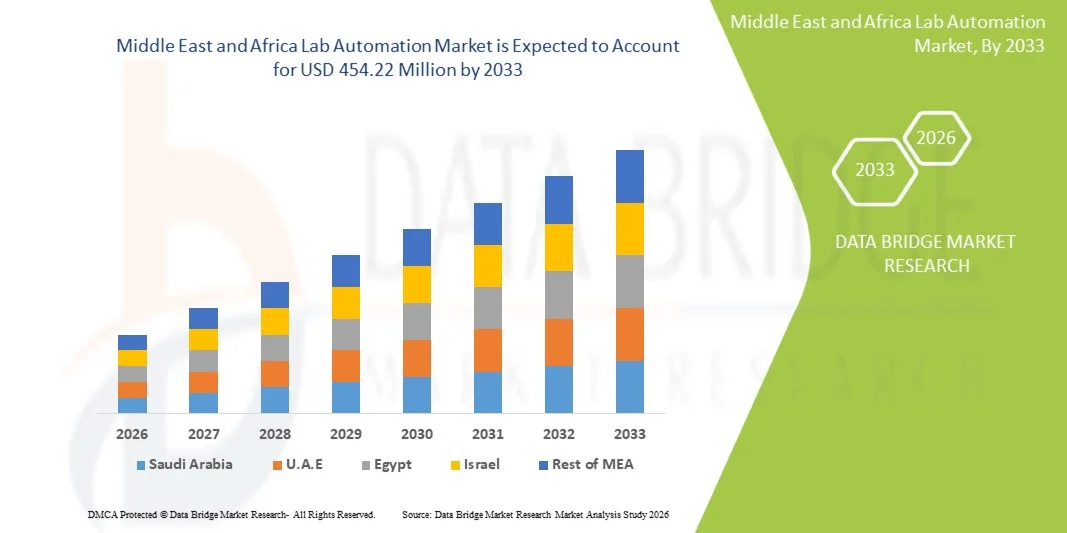
- The Middle East and Africa lab automation market size was valued at USD 312.16 million in 2025 and is expected to reach USD 454.22 million by 2033, at a CAGR of 4.8% during the forecast period
- The market growth is largely fueled by the increasing adoption of advanced laboratory technologies and automation systems, along with ongoing digital transformation across healthcare, pharmaceutical, and research laboratories, leading to improved efficiency and accuracy in operations
- Furthermore, rising demand for high-throughput testing, improved laboratory productivity, and reduced human error is driving the adoption of automated workflows and integrated laboratory solutions. These converging factors are accelerating the uptake of lab automation systems, thereby significantly boosting the industry's growth
Middle East and Africa Lab Automation Market Analysis
- Lab automation solutions, encompassing equipment, software & informatics, and analyzers, are increasingly becoming integral to modern laboratories across healthcare, pharmaceutical, and research institutions in the Middle East and Africa due to their ability to streamline workflows, enhance data accuracy, and improve operational efficiency through integrated and automated processes
- The escalating demand for lab automation is primarily fueled by rising investments in healthcare infrastructure, growing focus on advanced diagnostics and research activities, and increasing adoption of digital laboratory systems to reduce manual errors and improve turnaround time
- South Africa dominated the Middle East and Africa lab automation market with the largest revenue share of 32.5% in 2025, supported by relatively advanced healthcare infrastructure, established research institutions, and higher adoption of automated laboratory technologies across clinical diagnostics and academic research centers
- Saudi Arabia is expected to be the fastest growing country in the Middle East and Africa lab automation market during the forecast period due to strong government-led healthcare modernization initiatives, increasing investments in laboratory infrastructure, and rising emphasis on precision medicine and high-throughput diagnostic capabilities
- Equipment segment dominated the Middle East and Africa lab automation market with a significant market share of 46.8% in 2025, driven by the widespread use of automated instruments and systems that enable high-throughput processing, improved reproducibility, and reduced manual intervention across laboratory workflows
Report Scope and Middle East and Africa Lab Automation Market Segmentation
|
Attributes |
Middle East and Africa Lab Automation Key Market Insights |
|
Segments Covered |
|
|
Countries Covered |
Middle East and Africa
|
|
Key Market Players |
|
|
Market Opportunities |
|
|
Value Added Data Infosets |
In addition to the insights on market scenarios such as market value, growth rate, segmentation, geographical coverage, and major players, the market reports curated by the Data Bridge Market Research also include in-depth expert analysis, patient epidemiology, pipeline analysis, pricing analysis, and regulatory framework |
Middle East and Africa Lab Automation Market Trends
“Integration of AI and Digital Laboratory Informatics”
- A significant and accelerating trend in the Middle East and Africa lab automation market is the growing integration of artificial intelligence (AI) and advanced laboratory informatics platforms such as LIMS and ELN systems, enhancing data management, workflow optimization, and decision-making capabilities in laboratories
- For instance, AI-enabled laboratory platforms are being increasingly adopted in clinical diagnostics and research laboratories to automate data analysis, improve pattern recognition, and enable predictive insights for faster and more accurate outcomes
- AI integration in lab automation enables features such as automated sample tracking, intelligent data interpretation, and anomaly detection, improving accuracy and reducing manual intervention across complex laboratory workflows. Furthermore, advanced informatics solutions allow centralized data access, enabling seamless coordination between instruments, workflows, and personnel
- The seamless integration of lab automation systems with digital platforms facilitates unified laboratory operations, allowing researchers and technicians to manage instruments, workflows, and datasets through a single interface, thereby improving productivity and operational efficiency
- This trend towards intelligent, connected, and data-driven laboratory environments is fundamentally reshaping expectations in the region. Consequently, companies are increasingly developing AI-enabled automation solutions with enhanced analytics, interoperability, and real-time monitoring capabilities to support evolving laboratory demands
- The demand for lab automation solutions with integrated AI and informatics capabilities is growing steadily across healthcare, pharmaceutical, and research sectors in the Middle East and Africa, as organizations prioritize efficiency, scalability, and improved laboratory performance
Middle East and Africa Lab Automation Market Dynamics
Driver
“Rising Demand Driven by Healthcare Expansion and Advanced Diagnostics Adoption”
- The increasing investments in healthcare infrastructure and the growing adoption of advanced diagnostic technologies across Middle East and Africa countries are significant drivers for the heightened demand for lab automation systems
- For instance, in April 2025, several regional healthcare initiatives and laboratory modernization programs have emphasized the deployment of automated diagnostic platforms and integrated laboratory systems to enhance testing capacity and operational efficiency
- As governments and private institutions expand healthcare services and research capabilities, lab automation solutions offer improved throughput, accuracy, and standardization, making them essential for modern laboratories
- Furthermore, the rising focus on precision medicine, genomics, and high-throughput testing is accelerating the need for automated workflows that can handle large volumes of samples with minimal human error
- The convenience of automated sample processing, reduced turnaround time, and improved reproducibility are key factors propelling the adoption of lab automation across clinical, pharmaceutical, and academic research settings in the region
- In addition, increasing collaborations between international technology providers and regional healthcare institutions are accelerating technology transfer and the deployment of advanced automation systems in laboratories across the region.
Restraint/Challenge
“High Implementation Costs and Limited Technical Expertise Constraints”
- Concerns surrounding the high initial investment and maintenance costs of advanced lab automation systems, along with limited availability of skilled personnel to operate and manage these technologies, pose a significant challenge to broader market penetration
- For instance, many laboratories in developing economies across the region face budget constraints that limit their ability to invest in fully automated and integrated laboratory infrastructure
- Addressing cost-related barriers through scalable solutions, modular automation systems, and flexible financing options is crucial for encouraging adoption among smaller laboratories and institutions. Additionally, companies are focusing on providing training programs and technical support to bridge the skills gap
- While automation technologies are becoming more accessible over time, the perceived complexity of implementation and integration with existing laboratory setups can still hinder widespread adoption, particularly in resource-limited settings
- Overcoming these challenges through cost-effective solutions, workforce training initiatives, and the development of user-friendly automation platforms will be vital for sustained market growth in the Middle East and Africa lab automation market
- Moreover, interoperability issues between legacy laboratory systems and modern automation platforms can create integration challenges, requiring additional customization and investment, which may further slow adoption rates in certain facilities
Middle East and Africa Lab Automation Market Scope
The market is segmented on the basis of product type, automation type, application, and end users.
- By Product Type
On the basis of product type, the lab automation market is segmented into equipment, software & informatics, and analyzers. The equipment segment dominated the market with the largest market revenue share of 46.8% in 2025, driven by the widespread deployment of automated instruments such as robotic systems, liquid handling workstations, and integrated laboratory devices across clinical and research laboratories. Laboratories in the region increasingly rely on equipment to improve throughput, reduce manual intervention, and enhance reproducibility of results. The growing need for high-precision testing and standardized workflows further strengthens demand for automation equipment. Additionally, ongoing investments in healthcare infrastructure and laboratory modernization are accelerating the adoption of advanced equipment solutions. Compatibility with existing laboratory setups and the ability to scale operations also contribute to the dominance of this segment.
The software & informatics segment is anticipated to witness the fastest growth rate from 2026 to 2033, fueled by increasing adoption of Laboratory Information Management Systems (LIMS), Electronic Lab Notebooks (ELN), and AI-driven analytics platforms. These solutions enable centralized data management, real-time monitoring, and seamless integration across laboratory instruments and workflows. Rising demand for data-driven decision-making and improved laboratory efficiency is pushing organizations to adopt advanced informatics solutions. Furthermore, the growing emphasis on digital transformation and interoperability across laboratory systems is accelerating the uptake of software solutions.
- By Automation Type
On the basis of automation type, the lab automation market is segmented into modular automation and total lab automation. The modular automation segment dominated the market with the largest market revenue share of 58.3% in 2025, driven by its flexibility, scalability, and cost-effectiveness, allowing laboratories to automate specific processes without overhauling entire systems. Many laboratories in the region prefer modular systems as they can be gradually integrated into existing workflows, minimizing disruption and capital expenditure. This approach is particularly suitable for mid-sized laboratories and institutions with budget constraints. Modular automation also supports customization based on specific application needs, making it highly adaptable across different laboratory environments. Its ease of implementation and incremental upgrade capability further reinforce its dominance in the market.
The total lab automation segment is anticipated to witness the fastest growth rate from 2026 to 2033, driven by increasing demand for fully integrated and end-to-end automated laboratory environments. Large healthcare institutions, pharmaceutical companies, and advanced research centers are increasingly adopting total lab automation to achieve maximum efficiency, minimize human error, and handle high sample volumes. The rising focus on precision medicine, genomics, and high-throughput testing is further encouraging the adoption of fully automated systems. Additionally, advancements in robotics, AI integration, and system interoperability are making total lab automation more feasible and attractive for large-scale operations.
- By Application
On the basis of application, the lab automation market is segmented into drug discovery, clinical diagnostics, genomics solutions, proteomics solutions, bio analysis, protein engineering, lyophilization, system biology, analytical chemistry, and others. The clinical diagnostics segment dominated the market with the largest market revenue share of 34.6% in 2025, driven by the increasing demand for accurate, rapid, and high-throughput diagnostic testing across hospitals and diagnostic laboratories. The rising prevalence of chronic and infectious diseases in the region is further boosting the need for automated diagnostic workflows. Automation helps laboratories improve turnaround time, reduce manual errors, and handle large volumes of patient samples efficiently. Government initiatives to strengthen healthcare infrastructure and expand diagnostic capabilities are also supporting the dominance of this segment. The integration of automation with advanced diagnostic technologies enhances efficiency and reliability in clinical settings.
The genomics solutions segment is anticipated to witness the fastest growth rate from 2026 to 2033, driven by increasing adoption of genetic testing, precision medicine, and next-generation sequencing (NGS) technologies. Research institutions and biotechnology companies are investing heavily in genomics to better understand diseases and develop targeted therapies. Automation plays a critical role in handling complex genomic workflows, including sample preparation, sequencing, and data analysis. The growing focus on personalized medicine and rising collaborations in genomic research are further accelerating demand for automation in this segment. Additionally, advancements in bioinformatics and AI-driven genomic analysis are enhancing the scalability and efficiency of genomics laboratories.
- By End Users
On the basis of end users, the lab automation market is segmented into biotechnology & pharmaceuticals, hospitals & laboratories, research and academic institutions, and others. The biotechnology & pharmaceuticals segment dominated the market with the largest market revenue share of 41.2% in 2025, driven by extensive use of automation in drug development, clinical trials, quality control, and manufacturing processes. These organizations require high-throughput systems to manage large-scale experiments and ensure accuracy and compliance with regulatory standards. Increasing R&D investments and the need for faster drug discovery processes are further supporting the dominance of this segment. Automation helps reduce time-to-market for new drugs while improving reproducibility and operational efficiency. The presence of global pharmaceutical collaborations and expansion of biotech activities in the region also contributes to this segment’s leading position.
The research and academic institutions segment is anticipated to witness the fastest growth rate from 2026 to 2033, driven by increasing government funding, international collaborations, and growing focus on scientific research and innovation. Universities and research centers are adopting lab automation to enhance experimental accuracy, streamline workflows, and support complex research activities in fields such as genomics, proteomics, and systems biology. The rising emphasis on advanced research infrastructure and digital laboratories is accelerating adoption in this segment. Additionally, partnerships with global technology providers are enabling access to advanced automation tools, further driving growth in academic and research environments.
Middle East and Africa Lab Automation Market Regional Analysis
- South Africa dominated the Middle East and Africa lab automation market with the largest revenue share of 32.5% in 2025, supported by relatively advanced healthcare infrastructure, established research institutions, and higher adoption of automated laboratory technologies across clinical diagnostics and academic research centers
- Laboratories and healthcare institutions in the country highly value the efficiency, accuracy, and scalability offered by lab automation systems, along with their ability to integrate with diagnostic platforms and digital laboratory workflows
- This widespread adoption is further supported by expanding healthcare infrastructure, rising investments in diagnostic capabilities, and the growing preference for high-throughput and standardized laboratory processes, establishing lab automation as a key enabler across clinical diagnostics, pharmaceutical research, and academic institutions in the region
The South Africa Lab Automation Market Insight
South Africa captured the largest revenue share of 32.5% in 2025 within the Middle East and Africa region, fueled by the relatively advanced healthcare infrastructure and growing adoption of automated laboratory technologies across clinical diagnostics and research facilities. Laboratories are increasingly prioritizing efficiency, accuracy, and high-throughput capabilities through the use of integrated automation systems. The growing demand for standardized testing processes and improved turnaround times is further accelerating adoption. Moreover, the presence of established research institutions and increasing investments in healthcare modernization are contributing to the market’s expansion. The integration of automation with digital laboratory systems is also enhancing workflow coordination and data management across end users.
Saudi Arabia Lab Automation Market Insight
The Saudi Arabia lab automation market is anticipated to grow at a noteworthy CAGR during the forecast period, driven by strong government initiatives focused on healthcare transformation and digitalization under national development programs. The country is witnessing increasing investments in laboratory infrastructure, diagnostics, and research capabilities. Rising demand for precision medicine and advanced clinical testing is encouraging the adoption of automated systems. Additionally, the expansion of hospitals, diagnostic centers, and research institutes is boosting the need for efficient and scalable laboratory solutions. The integration of advanced technologies such as AI and informatics into laboratory workflows is further supporting market growth.
United Arab Emirates Lab Automation Market Insight
The United Arab Emirates lab automation market is expected to expand at a considerable CAGR during the forecast period, fueled by rapid healthcare modernization and strong emphasis on adopting advanced technologies in medical and research laboratories. The UAE’s well-developed healthcare ecosystem and focus on innovation are driving the implementation of automated laboratory systems. Increasing demand for high-quality diagnostics, coupled with a growing number of private healthcare facilities, is supporting market expansion. Additionally, government-led initiatives promoting smart healthcare infrastructure and digital transformation are encouraging laboratories to adopt integrated automation solutions. The use of advanced informatics platforms and connected laboratory systems is becoming increasingly prevalent.
Israel Lab Automation Market Insight
The Israel lab automation market is gaining momentum due to the country’s strong focus on research, innovation, and biotechnology development. Israel’s advanced R&D ecosystem and high investment in life sciences are driving the adoption of sophisticated laboratory automation systems. Laboratories are increasingly leveraging automation to support genomics, proteomics, and drug discovery applications. The integration of AI-driven analytics and data management solutions is further enhancing laboratory efficiency and research outcomes. Moreover, collaborations between academic institutions, startups, and global technology providers are accelerating the deployment of cutting-edge automation technologies across the country.
Middle East and Africa Lab Automation Market Share
The Middle East and Africa Lab Automation industry is primarily led by well-established companies, including:
- Thermo Fisher Scientific Inc. (U.S.)
- Siemens Healthineers AG (Germany)
- ABB Ltd (Switzerland)
- Agilent Technologies Inc. (U.S.)
- BIOMÉRIEUX (France)
- Danaher (U.S.)
- F. Hoffmann-La Roche Ltd (Switzerland)
- Tecan Group Ltd (Switzerland)
- PerkinElmer Inc. (U.S.)
- Abbott (U.S.)
- BD (U.S.)
- QIAGEN (Netherlands)
- Sysmex Corporation (Japan)
- Eppendorf SE (Germany)
- LECO Corporation (U.S.)
- Hamilton Company (U.S.)
- Ortho Clinical Diagnostics (U.S.)
- Pall Corporation (U.S.)
- Lab Technologies Group (UAE)
What are the Recent Developments in Middle East and Africa Lab Automation Market?
- In December 2025, PureHealth launched the UAE’s largest AI-powered diagnostic laboratory in Abu Dhabi a 70,000-square-foot facility integrating advanced automation, AI-driven quality control, robotics, and high-throughput systems capable of processing over 30 million samples annually, significantly boosting automated diagnostics in the region
- In December 2025, news outlets reported on the opening of the UAE’s largest AI-powered standalone diagnostic lab in Abu Dhabi, emphasizing its role in enhancing precision diagnostics, accelerating turnaround times, and integrating automated sample transport and testing across a nationwide network of laboratories
- In February 2025, Medlab Middle East 2025 featured a dedicated lab automation track exploring the latest advancements in automation, robotics, and IT workflows in laboratory operations, helping regional labs stay at the forefront of innovation and digital transformation
- In February 2025, a session at Medlab Middle East highlighted how AI and automation technologies are transforming diagnostic business models in Africa, with industry leaders discussing strategies to leverage automation and data-driven solutions to expand access and improve healthcare outcomes
- In January 2025, Medlab Middle East announced it would showcase the future of laboratory automation technologies including digitalisation, robotics, and integrated systems at its Dubai event, signalling rising regional interest and adoption of automated lab solutions

- Interactive Data Analysis Dashboard
- Company Analysis Dashboard for high growth potential opportunities
- Research Analyst Access for customization & queries
- Competitor Analysis with Interactive dashboard
- Latest News, Updates & Trend analysis
- Harness the Power of Benchmark Analysis for Comprehensive Competitor Tracking
Data collection and base year analysis are done using data collection modules with large sample sizes. The stage includes obtaining market information or related data through various sources and strategies. It includes examining and planning all the data acquired from the past in advance. It likewise envelops the examination of information inconsistencies seen across different information sources. The market data is analysed and estimated using market statistical and coherent models. Also, market share analysis and key trend analysis are the major success factors in the market report. To know more, please request an analyst call or drop down your inquiry.
The key research methodology used by DBMR research team is data triangulation which involves data mining, analysis of the impact of data variables on the market and primary (industry expert) validation. Data models include Vendor Positioning Grid, Market Time Line Analysis, Market Overview and Guide, Company Positioning Grid, Patent Analysis, Pricing Analysis, Company Market Share Analysis, Standards of Measurement, Global versus Regional and Vendor Share Analysis. To know more about the research methodology, drop in an inquiry to speak to our industry experts.
Data Bridge Market Research is a leader in advanced formative research. We take pride in servicing our existing and new customers with data and analysis that match and suits their goal. The report can be customized to include price trend analysis of target brands understanding the market for additional countries (ask for the list of countries), clinical trial results data, literature review, refurbished market and product base analysis. Market analysis of target competitors can be analyzed from technology-based analysis to market portfolio strategies. We can add as many competitors that you require data about in the format and data style you are looking for. Our team of analysts can also provide you data in crude raw excel files pivot tables (Fact book) or can assist you in creating presentations from the data sets available in the report.













