


Middle East and Africa Low Noise Amplifier Market Size
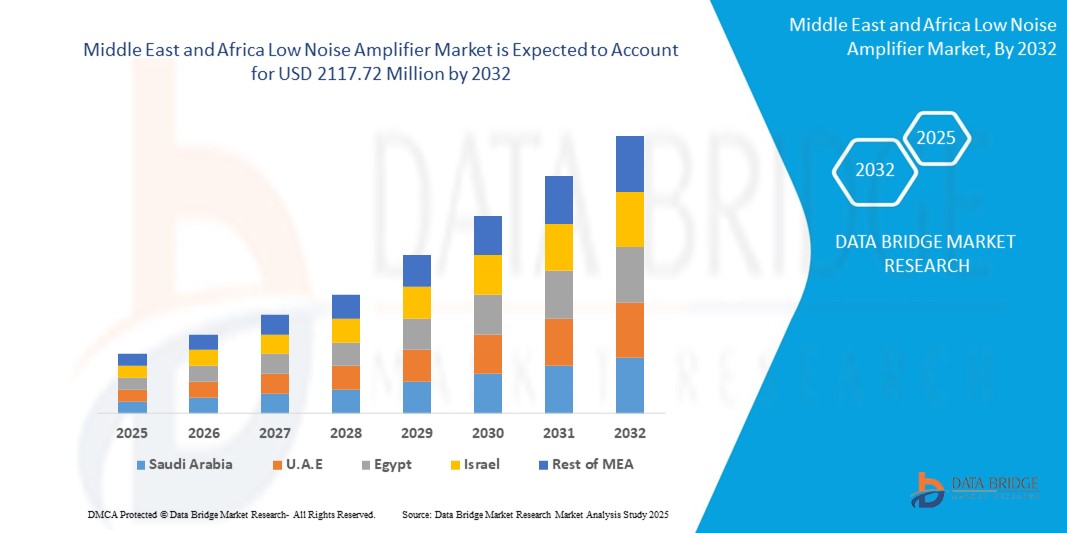
- The Middle East and Africa Low Noise Amplifier market size was valued at USD 728.98 Million in 2024 and is expected to reach USD 2,117.72 Million by 2032, at a CAGR of 16.5% during the forecast period
- The Middle East and Africa Low Noise Amplifier market is the increase in technological evolution, huge demand from the smartphones market and manufacturers and to meet the rising demand of bandwidths. Additionally increase in the investment in defense sector also drives the market growth.
Middle East and Africa Low Noise Amplifier Market Analysis
- The Middle East and Africa Low Noise Amplifier (LNA) Market is experiencing significant growth driven by the increasing demand for high-performance communication systems, particularly in the telecom and defense sectors. As the region embraces digital transformation, there is a rising need for LNAs in applications such as satellite communications, wireless infrastructure, and radar systems. The need for clearer signal amplification with minimal distortion is a crucial driver for the growth of the LNA market.
- The Middle East and Africa Low Noise Amplifier Market is driven by the growth of telecommunications infrastructure, the rise of 5G networks, and innovations in satellite communication technologies. As the demand for faster and more reliable wireless services escalates, the need for advanced LNAs to reduce signal interference and noise becomes increasingly critical. Moreover, the region's growing defense sector and increased government spending on radar and communication systems are propelling the market forward. Additionally, advancements in LNA technology, including the integration of gallium arsenide (GaAs), are enhancing the efficiency and application of LNAs in complex environments.
- Saudi Arabia is expected to emerge as a dominant player in the Middle East and Africa Low Noise Amplifier market. The country’s substantial investments in telecommunications infrastructure and defense technologies are propelling demand for high-performance amplification solutions. The Saudi government’s vision to modernize its communication systems and strengthen national security initiatives is fostering growth in the LNA sector, with a significant focus on radar systems and wireless communication solutions.
- U.A.E. is predicted to be the fastest-growing market in the region for Low Noise Amplifiers. The country’s rapidly expanding telecommunications industry, bolstered by government initiatives to implement 5G and advanced communication technologies, is driving the demand for LNAs. Additionally, the U.A.E. growing aerospace and defense sectors are fueling the need for high-quality communication systems and radar equipment, further expanding the market for LNAs.
- The Gallium Arsenide (GaAs) segment is expected to dominate the Middle East and Africa Low Noise Amplifier market with a market share of 44.1% during the forecast period. GaAs-based LNAs are preferred for their superior performance in terms of efficiency, reduced noise, and ability to operate at high frequencies. These amplifiers are essential for applications in satellite communications, wireless networks, and defense radar systems, offering enhanced reliability and accuracy in signal processing.
Report Scope and Middle East and Africa Low Noise Amplifier Market Segmentation
|
Attributes |
Middle East and Africa Low Noise Amplifier Key Market Insights |
|
Segments Covered |
|
|
Countries Covered |
Middle East and Africa
|
|
Key Market Players |
|
|
Market Opportunities |
|
|
Value Added Data Infosets |
In addition to the insights on market scenarios such as market value, growth rate, segmentation, geographical coverage, and major players, the market reports curated by the Data Bridge Market Research also include import export analysis, production capacity overview, production consumption analysis, price trend analysis, climate change scenario, supply chain analysis, value chain analysis, raw material/consumables overview, vendor selection criteria, PESTLE Analysis, Porter Analysis, and regulatory framework. |
Middle East and Africa Low Noise Amplifier Market Trends
“Adoption of Gallium Arsenide (GaAs) for Enhanced Performance”
- The Middle East and Africa Low Noise Amplifier market is increasingly shifting toward Gallium Arsenide (GaAs) materials due to their superior performance in high-frequency applications. GaAs-based LNAs offer improved efficiency, lower noise, and greater reliability, particularly for communication and radar systems.
- GaAs technology is particularly beneficial for telecommunications, aerospace, and defense applications, providing clear signals and high performance across a range of frequencies. This material is also ideal for satellite communication systems and military radar technologies that demand high-performance amplification.
- For instance, in March 2025, a major telecom operator in the Middle East adopted GaAs-based LNAs to enhance its satellite communication systems, improving both signal quality and system reliability.
- The shift toward GaAs-based Low Noise Amplifiers in the region is improving signal clarity and expanding the use of high-performance communication systems in critical sectors like defense and telecommunications.
Middle East and Africa Low Noise Amplifier Market Dynamics
Driver
“Growing Demand for High-Performance Communication Systems”
- The demand for high-performance communication systems is driving the Middle East and Africa Low Noise Amplifier market. As the region expands its 5G and satellite communication networks, the need for low-noise amplifiers that ensure high signal quality in challenging environments is increasing.
- The region’s increasing focus on modernizing telecom infrastructure, bolstered by government initiatives, is further driving this demand. Low Noise Amplifiers are vital for the development of 5G networks, satellite communications, and defense radar systems.
For instance,
- In January 2025, a leading Middle Eastern telecom provider deployed high-performance LNAs to support the rollout of 5G services, ensuring signal integrity and efficient coverage.
- The growing focus on 5G infrastructure and satellite communication solutions is a key driver for LNAs, as these technologies require low-noise amplifiers to optimize performance and extend network coverage.
Opportunity
“Increasing Use of LNAs in Defense and Aerospace Applications”
- The defense and aerospace sectors in the Middle East and Africa are fueling the demand for Low Noise Amplifiers due to the growing need for reliable communication and radar systems. The use of LNAs in these sectors ensures enhanced detection and clear communication in high-risk environments.
- As nations in the region increase their investments in military technologies and satellite systems, the demand for LNAs to enhance radar, communication, and satellite surveillance systems will rise.
For instance,
- In February 2025, the UAE defense ministry adopted LNAs for satellite communication systems, significantly improving performance in national security and surveillance operations.
- The rising investments in aerospace technologies and defense applications present significant opportunities for LNAs, particularly in enhancing radar and communication systems used in military and defense operations.
Restraint/Challenge
“Supply Chain Disruptions and Component Shortages”
- The Middle East and Africa Low Noise Amplifier market faces challenges related to supply chain disruptions and shortages of key components such as gallium arsenide (GaAs), which are essential for manufacturing high-performance LNAs. These disruptions can lead to delays in the production and deployment of communication and defense systems.
- The ongoing global semiconductor shortage is exacerbating these challenges, making it difficult for manufacturers to meet the growing demand for LNAs across industries like telecommunications and defense.
For instance,
- In March 2025, a major defense contractor in Saudi Arabia faced delays in the deployment of advanced radar systems due to the shortage of GaAs components for Low Noise Amplifiers.
- The supply chain challenges in procuring high-quality materials like GaAs and other essential semiconductor components are hindering the timely rollout of Low Noise Amplifiers and impacting project timelines in critical industries such as defense and telecommunications.
Middle East and Africa Low Noise Amplifier Market Scope
The market is segmented on the basis of frequency, material, application and vertical.
|
Segmentation |
Sub-Segmentation |
|
By Frequency |
|
|
By Material |
|
|
By Application |
|
|
By Vertical |
|
In 2025, the gallium arsenide is projected to dominate the market with a largest share in by component segment
The gallium arsenide segment is expected to dominate the Middle East and Africa Low Noise Amplifier market, with a market share of 44.1% during the forecast period. The gallium arsenide segment is driving the Middle East and Africa Low Noise Amplifier market due to its superior high-frequency performance, energy efficiency, and reliability. Its widespread use in satellite communication, radar systems, and 5G infrastructure enhances signal clarity and system responsiveness.
The cellular infrastructure is expected to account for the largest share during the forecast period in Middle East and Africa Low Noise Amplifier market
In 2025, the cellular infrastructure segment in the Middle East and Africa Low Noise Amplifier Market is projected to hold the largest share of approximately 52.1%. The cellular infrastructure segment leads the market, driven by rapid 4G and 5G expansion across the region. Low noise amplifiers enhance network performance by minimizing signal distortion, ensuring reliable communication, and supporting increasing data traffic in mobile and wireless communication networks.
Middle East and Africa Low Noise Amplifier Market Regional Analysis
“Saudi Arabia Holds the Largest Share in the Middle East and Africa Low Noise Amplifier Market ”
- Saudi Arabia dominates the Middle East and Africa Low Noise Amplifier market due to its robust investments in defense, aerospace, and telecommunications infrastructure. The country’s focus on modernizing radar and satellite communication systems drives high demand for GaAs-based LNAs.
- Government-backed initiatives, such as Vision 2030, are accelerating the deployment of advanced communication technologies, reinforcing the need for efficient, high-frequency signal amplification across military and telecom applications.
- Saudi Arabia’s strategic partnerships with international technology firms and increased spending on secure, high-performance communication networks further solidify its leading position in the regional LNA market.
“U.A.E. is Projected to Register the Highest CAGR in the Middle East and Africa Low Noise Amplifier Market”
- The United Arab Emirates (U.A.E.) is expected to register the highest CAGR in the Middle East and Africa Low Noise Amplifier market, driven by aggressive 5G deployment, expanding satellite services, and rapid digital transformation across critical sectors.
- The country's initiatives in smart cities, space technology, and AI integration into telecom infrastructure create rising demand for LNAs that offer low signal distortion and high efficiency.
- The U.A.E.’s increasing investment in aerospace and defense applications, supported by a pro-innovation regulatory environment, contributes to its rapid growth and adoption of advanced LNA technologies.
Middle East and Africa Low Noise Amplifier Market Share
The market competitive landscape provides details by competitor. Details included are company overview, company financials, revenue generated, market potential, investment in research and development, new market initiatives, global presence, production sites and facilities, production capacities, company strengths and weaknesses, product launch, product width and breadth, application dominance. The above data points provided are only related to the companies' focus related to market.
The Major Market Leaders Operating in the Market Are:
- NXP Semiconductors N.V.
- Analog Devices, Inc.
- Infineon Technologies AG
- L3 Narda-MITEQ
- Qorvo, Inc.
- Skyworks Solutions, Inc.
- On Semiconductor Corp.
- Panasonic Corporation
- Texas Instruments Inc.
- Teledyne Microwave Solutions
- Custom MMIC Design Services, Inc.
- Macom Technology Solutions Holdings, Inc.
- Sage Millimeter, Inc.
- WanTcom Inc.
- Qotana Technologies Co., Ltd.
- Norsat International Inc.
- PSEMI Corporation
- Broadcom Inc.
- Callisto Space
Latest Developments in Middle East and Africa Low Noise Amplifier Market
- In March 2023, Sage Millimeter accelerated R&D on LNAs to meet growing regional demand in defense and telecommunications. Their innovation emphasizes compact, high-performance designs for integration into satellite, radar, and wireless systems across Middle Eastern and African markets.
- In November 2020, Qorvo introduced the CMD328K3, a broadband GaAs low noise amplifier targeting radar and defense applications. The product delivers high gain and low noise across 6–18 GHz, enhancing signal clarity for advanced communications and electronic warfare systems.

- Interactive Data Analysis Dashboard
- Company Analysis Dashboard for high growth potential opportunities
- Research Analyst Access for customization & queries
- Competitor Analysis with Interactive dashboard
- Latest News, Updates & Trend analysis
- Harness the Power of Benchmark Analysis for Comprehensive Competitor Tracking
Middle East And Africa Low Noise Amplifier Market, Supply Chain Analysis and Ecosystem Framework
To support market growth and help clients navigate the impact of geopolitical shifts, DBMR has integrated in-depth supply chain analysis into its Middle East And Africa Low Noise Amplifier Market research reports. This addition empowers clients to respond effectively to global changes affecting their industries. The supply chain analysis section includes detailed insights such as Middle East And Africa Low Noise Amplifier Market consumption and production by country, price trend analysis, the impact of tariffs and geopolitical developments, and import and export trends by country and HSN code. It also highlights major suppliers with data on production capacity and company profiles, as well as key importers and exporters. In addition to research, DBMR offers specialized supply chain consulting services backed by over a decade of experience, providing solutions like supplier discovery, supplier risk assessment, price trend analysis, impact evaluation of inflation and trade route changes, and comprehensive market trend analysis.
Data collection and base year analysis are done using data collection modules with large sample sizes. The stage includes obtaining market information or related data through various sources and strategies. It includes examining and planning all the data acquired from the past in advance. It likewise envelops the examination of information inconsistencies seen across different information sources. The market data is analysed and estimated using market statistical and coherent models. Also, market share analysis and key trend analysis are the major success factors in the market report. To know more, please request an analyst call or drop down your inquiry.
The key research methodology used by DBMR research team is data triangulation which involves data mining, analysis of the impact of data variables on the market and primary (industry expert) validation. Data models include Vendor Positioning Grid, Market Time Line Analysis, Market Overview and Guide, Company Positioning Grid, Patent Analysis, Pricing Analysis, Company Market Share Analysis, Standards of Measurement, Global versus Regional and Vendor Share Analysis. To know more about the research methodology, drop in an inquiry to speak to our industry experts.
Data Bridge Market Research is a leader in advanced formative research. We take pride in servicing our existing and new customers with data and analysis that match and suits their goal. The report can be customized to include price trend analysis of target brands understanding the market for additional countries (ask for the list of countries), clinical trial results data, literature review, refurbished market and product base analysis. Market analysis of target competitors can be analyzed from technology-based analysis to market portfolio strategies. We can add as many competitors that you require data about in the format and data style you are looking for. Our team of analysts can also provide you data in crude raw excel files pivot tables (Fact book) or can assist you in creating presentations from the data sets available in the report.













