


Middle East and Africa Radiotherapy Market Size
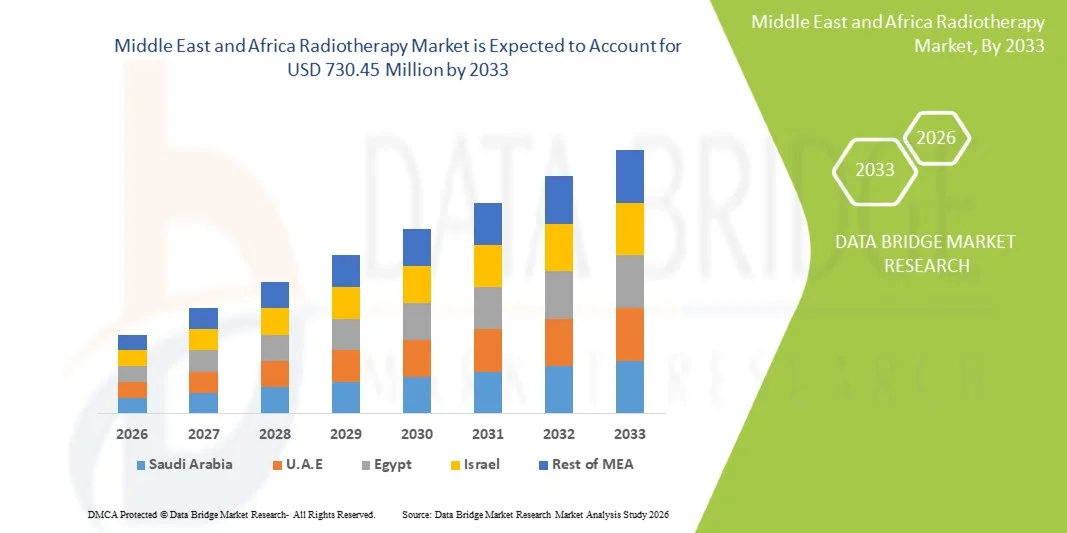
- The Middle East and Africa Radiotherapy Market size was valued at USD 391.73 million in 2025 and is expected to reach USD 730.45 million by 2033, at a CAGR of 8.1% during the forecast period
- The Middle East and Africa Radiotherapy Market growth is largely driven by the increasing global burden of cancer, leading to higher demand for advanced and effective cancer treatment modalities across hospitals and specialized oncology centers
- Furthermore, continuous technological advancements in radiotherapy systems such as image-guided radiotherapy, intensity-modulated radiotherapy, and proton therapy are improving treatment precision and patient outcomes, thereby supporting wider clinical adoption
Middle East and Africa Radiotherapy Market Analysis
- Radiotherapy involves the use of high-energy radiation to target and destroy cancer cells while minimizing damage to surrounding healthy tissues, making it a critical component of modern oncology treatment protocols across curative and palliative care settings
- The growing preference for non-invasive and targeted cancer treatment approaches, along with expanding healthcare infrastructure and increasing investments in oncology care, is driving the sustained adoption of radiotherapy systems in both developed and emerging healthcare markets
- South Africa dominated the Middle East and Africa Radiotherapy Market due to the presence of well-established oncology hospitals, higher adoption of advanced radiotherapy systems, and increasing cancer treatment demand across the population
- Saudi Arabia is expected to be the fastest growing country in the Middle East and Africa Radiotherapy Market during the forecast period due to rapid healthcare infrastructure expansion, increasing government investment in cancer care facilities, and rising adoption of advanced radiotherapy technologies
- External-beam radiation therapy segment dominated the market with a market share of 52.8% due to its widespread use in treating multiple cancer types with high precision and non-invasive procedures. It remains the standard treatment approach in hospitals due to technological advancements such as image-guided and intensity-modulated radiation therapy. Increasing cancer prevalence and improved accessibility to advanced radiotherapy systems further support its dominance
Report Scope and Middle East and Africa Radiotherapy Market Segmentation
|
Attributes |
Radiotherapy Key Market Insights |
|
Segments Covered |
|
|
Countries Covered |
Middle East and Africa
|
|
Key Market Players |
|
|
Market Opportunities |
|
|
Value Added Data Infosets |
In addition to the insights on market scenarios such as market value, growth rate, segmentation, geographical coverage, and major players, the market reports curated by the Data Bridge Market Research also include depth expert analysis, patient epidemiology, pipeline analysis, pricing analysis, and regulatory framework. |
Middle East and Africa Radiotherapy Market Trends
“Increasing Adoption of Advanced Precision Radiotherapy Techniques”
- A significant trend in the Middle East and Africa Radiotherapy Market is the increasing shift toward advanced precision-based treatment modalities that enhance tumor targeting accuracy while minimizing radiation exposure to surrounding healthy tissues. This trend is being driven by continuous improvements in imaging integration, treatment planning software, and delivery systems across oncology care settings
- For instance, Varian Medical Systems, a Siemens Healthineers company, provides advanced image-guided and intensity-modulated radiotherapy systems that are widely used in oncology hospitals for precise tumor targeting. Such systems enhance treatment accuracy and improve clinical outcomes in complex cancer cases
- The growing adoption of adaptive radiotherapy is enabling clinicians to modify treatment plans in real time based on tumor response and patient anatomy changes. This is improving treatment efficiency and supporting more personalized cancer care approaches in radiation oncology departments
- The integration of MRI-guided and CT-based radiotherapy systems is expanding, allowing improved visualization of tumors during treatment delivery. This advancement is strengthening clinical confidence in high-precision radiation procedures and reducing treatment-related complications
- The use of stereotactic body radiotherapy is increasing for early-stage cancers, enabling high-dose radiation delivery with minimal treatment sessions. This is contributing to higher patient convenience and improved hospital workflow efficiency in oncology units
- The overall trend toward technologically advanced radiotherapy platforms is reinforcing the shift toward minimally invasive, highly targeted cancer treatment solutions that improve survival rates and enhance patient quality of life
Middle East and Africa Radiotherapy Market Dynamics
Driver
“Rising Global Cancer Prevalence Driving Demand for Effective Treatment Solutions”
- The increasing global incidence of cancer is significantly driving demand for radiotherapy as a core treatment modality across both curative and palliative care pathways. Growing aging populations, lifestyle changes, and environmental risk factors are contributing to a higher patient burden requiring radiation-based interventions
- For instance, the World Health Organization reports that cancer cases are rising globally, leading to expanded utilization of radiotherapy services in major oncology centers such as those operated by Memorial Sloan Kettering Cancer Center. These institutions rely heavily on radiotherapy systems for treating a wide range of cancer types with improved precision
- The growing need for cost-effective and widely accessible cancer treatment is strengthening the adoption of radiotherapy in both developed and emerging healthcare systems. Radiotherapy is increasingly being integrated into standard oncology protocols due to its effectiveness in localized tumor control
- Government healthcare programs and national cancer control initiatives are expanding access to radiation therapy infrastructure in public hospitals. This is improving treatment availability and supporting early-stage cancer management across diverse patient populations
- The continuous rise in cancer prevalence is reinforcing radiotherapy as an essential pillar of oncology care, sustaining long-term demand for advanced treatment systems globally
Restraint/Challenge
“High Cost of Radiotherapy Equipment and Limited Accessibility”
- The Middle East and Africa Radiotherapy Market faces significant challenges due to the high capital investment required for advanced radiation therapy systems, including linear accelerators, proton therapy units, and associated imaging technologies. These costs limit adoption, particularly in low- and middle-income healthcare systems
- For instance, Elekta AB provides advanced radiotherapy solutions that require substantial infrastructure investment, making deployment challenging for smaller hospitals and healthcare facilities with constrained budgets. The high installation and maintenance costs further restrict widespread accessibility
- The requirement for highly specialized infrastructure such as shielded treatment rooms and advanced imaging integration increases overall setup complexity and cost burden. This limits the number of facilities capable of offering advanced radiotherapy services
- Shortage of trained radiation oncologists and medical physicists further restricts the effective utilization of installed radiotherapy systems. This creates operational bottlenecks and reduces treatment availability in underserved regions
- The combination of high equipment costs and infrastructure limitations continues to constrain market penetration, making affordability and accessibility key challenges for the long-term expansion of radiotherapy services globally
Middle East and Africa Radiotherapy Market Scope
The market is segmented on the basis of product and services, type, application, end user, and distribution channel.
• By Product and Services
On the basis of product and services, the Middle East and Africa Radiotherapy Market is segmented into services, products, and software. The products segment dominated the largest market revenue share in 2025, driven by strong demand for advanced radiotherapy equipment such as linear accelerators, treatment planning systems, and imaging devices. Healthcare providers continue to prioritize equipment upgrades to improve treatment precision, reduce side effects, and enhance patient outcomes. Rising investments in cancer treatment infrastructure across hospitals and oncology centers further strengthen the dominance of the products segment.
The services segment is anticipated to witness the fastest growth rate from 2026 to 2033, supported by increasing demand for maintenance, calibration, treatment planning support, and outsourcing of radiotherapy operations. Service providers are playing a crucial role in ensuring optimal equipment performance and reducing downtime in high-volume cancer treatment facilities. Growing adoption of managed services and clinical support programs is further accelerating segment growth.
• By Type
On the basis of type, the Middle East and Africa Radiotherapy Market is segmented into external-beam radiation therapy, internal radiation therapy, systemic radiotherapy/radiopharmaceuticals, and others. The external-beam radiation therapy segment dominated the largest market revenue share of 52.8% in 2025, driven by its widespread use in treating multiple cancer types with high precision and non-invasive procedures. It remains the standard treatment approach in hospitals due to technological advancements such as image-guided and intensity-modulated radiation therapy. Increasing cancer prevalence and improved accessibility to advanced radiotherapy systems further support its dominance.
The systemic radiotherapy/radiopharmaceuticals segment is expected to witness the fastest growth rate from 2026 to 2033, driven by rising adoption of targeted cancer therapies that deliver radiation directly to cancer cells. Increasing research in precision oncology and radiopharmaceutical innovation is expanding treatment options for complex and metastatic cancers. Growing clinical success in reducing damage to healthy tissues is further boosting segment adoption.
• By Application
On the basis of application, the Middle East and Africa Radiotherapy Market is segmented into breast cancer, lung cancer, prostate cancer, colorectal cancer, lymphoma, liver cancer, thyroid cancer, brain cancer, cervical cancer, spine cancer, and others. The breast cancer segment dominated the largest market revenue share in 2025, driven by its high global incidence and strong reliance on radiotherapy as a key part of post-surgical treatment. Early detection programs and improved screening rates are increasing the number of patients receiving radiotherapy. Technological advancements in dose precision and tumor targeting further strengthen its market leadership.
The lung cancer segment is anticipated to witness the fastest growth rate from 2026 to 2033, driven by rising smoking prevalence, environmental pollution, and improved diagnostic capabilities. Increasing adoption of advanced radiotherapy techniques for inoperable lung tumors is further supporting growth. Expanding healthcare access in emerging economies is also contributing to higher treatment volumes.
• By End User
On the basis of end user, the Middle East and Africa Radiotherapy Market is segmented into hospitals, radiation therapy centers, specialty clinics, academic & research institutes, and others. The hospitals segment dominated the largest market revenue share in 2025, driven by the availability of advanced oncology departments, skilled professionals, and integrated treatment facilities. Hospitals serve as primary centers for cancer diagnosis and multi-modal treatment, ensuring high patient inflow. Strong investments in upgrading radiotherapy infrastructure further reinforce their dominance.
The radiation therapy centers segment is expected to witness the fastest growth rate from 2026 to 2033, driven by the increasing establishment of specialized cancer treatment facilities. These centers offer focused radiotherapy services with shorter waiting times and advanced technology adoption. Rising preference for outpatient-based cancer care is further accelerating segment growth.
• By Distribution Channel
On the basis of distribution channel, the Middle East and Africa Radiotherapy Market is segmented into direct tenders, third-party distributors, online platforms, and others. The direct tenders segment dominated the largest market revenue share in 2025, driven by large-scale procurement of radiotherapy systems by hospitals and government healthcare institutions. Direct agreements with manufacturers ensure cost efficiency, customization, and long-term service support. Increasing public healthcare investments further support segment dominance.
The third-party distributors segment is anticipated to witness the fastest growth rate from 2026 to 2033, driven by expanding market reach in emerging regions and simplified procurement processes. Distributors play a key role in supplying equipment to smaller healthcare facilities lacking direct manufacturer access. Growing demand for faster delivery and localized support is further boosting segment expansion.
Middle East and Africa Radiotherapy Market Regional Analysis
- South Africa dominated the Middle East and Africa Radiotherapy Market with the largest revenue share in 2025, driven by the presence of well-established oncology hospitals, higher adoption of advanced radiotherapy systems, and increasing cancer treatment demand across the population
- The country benefits from comparatively stronger healthcare infrastructure, supporting wider availability of external-beam radiation therapy and modern treatment planning systems
- Rising cancer prevalence and growing awareness regarding early diagnosis and treatment are further strengthening radiotherapy adoption in both public and private healthcare facilities. Continuous upgrades in oncology departments and increasing investments in medical technology are reinforcing South Africa’s leadership position in the regional market
Saudi Arabia Middle East and Africa Radiotherapy Market Insight
Saudi Arabia is projected to register the fastest CAGR in the Middle East and Africa Radiotherapy Market from 2026 to 2033, supported by rapid healthcare infrastructure expansion, increasing government investment in cancer care facilities, and rising adoption of advanced radiotherapy technologies. The country is witnessing strong growth in specialized oncology centers equipped with high-precision radiation therapy systems. Increasing prevalence of cancer cases and growing focus on early and effective treatment are driving demand for radiotherapy services. Expansion of public healthcare initiatives and integration of modern medical technologies are further accelerating market growth in Saudi Arabia.
U.A.E. Middle East and Africa Radiotherapy Market Insight
The U.A.E. is witnessing strong growth in the Middle East and Africa Radiotherapy Market, driven by rapid expansion of advanced healthcare infrastructure and increasing focus on cancer care modernization. Rising investment in state-of-the-art oncology centers and adoption of high-precision radiotherapy systems are strengthening treatment capabilities across the country. Growing medical tourism and demand for minimally invasive cancer treatments are further supporting the uptake of radiotherapy solutions. The presence of globally accredited hospitals and continuous technology upgrades are reinforcing the U.A.E.’s position as a key contributor to regional market growth.
Middle East and Africa Radiotherapy Market Share
The radiotherapy industry is primarily led by well-established companies, including:
- Siemens Healthcare GmbH (Germany)
- Hitachi, Ltd. (Japan)
- Koninklijke Philips N.V. (Netherlands)
- Elekta (Sweden)
- ZEISS International (Germany)
- IBA Worldwide (Belgium)
- Canon Medical Systems Corporation (Japan)
- Accuray Incorporated (U.S.)
- Brainlab (Germany)
- United Imaging Healthcare Co., Ltd. (China)
- Eckert & Ziegler BEBIG (Germany)
- ViewRay Systems, Inc. (U.S.)
- P-Cure (Israel)
Latest Developments in Middle East and Africa Radiotherapy Market
- In May 2025, GE HealthCare is significantly expanding its radiation oncology portfolio at ESTRO 2025 with new AI-enabled solutions, including MR Contour DL for efficient organ segmentation. These advancements are designed to improve accuracy in tumor and organ delineation, enabling more precise radiation dose planning. The company is also strengthening its Intelligent Radiation Therapy (iRT) software by integrating MRI and AI-driven workflows, supporting faster clinical decision-making and improved treatment efficiency. This development reflects GE HealthCare’s focus on enhancing precision oncology and streamlining radiotherapy workflows for better patient outcomes
- In September 2024, Ballad Health entered a 10-year USD 260 million collaboration with Varian, a Siemens Healthineers company, aimed at transforming cancer care in the Appalachian Highlands. The partnership includes deployment of advanced oncology technologies such as linear accelerators and digital oncology management solutions across six cancer centers. This initiative is focused on improving treatment precision, expanding access to advanced radiotherapy in rural regions, and reducing healthcare disparities. It also strengthens long-term cancer care infrastructure through integrated digital and clinical systems
- In May 2024, Siemens Healthineers and Varian unveiled new advancements in radiation oncology at ESTRO 2024, introducing innovations such as HyperSight imaging, ARIA CORE oncology management, and more accessible MRI solutions for radiotherapy. These technologies are designed to enhance imaging clarity, improve treatment planning accuracy, and streamline oncology workflows. The developments aim to support more personalized and efficient cancer treatment by integrating imaging, planning, and delivery systems. This launch reinforces their leadership in advancing precision radiation therapy solutions globally
- In April 2024, GE HealthCare finalized its acquisition of MIM Software, a provider of medical imaging analysis and AI solutions, strengthening its radiation oncology capabilities. This acquisition enhances GE HealthCare’s precision care portfolio by integrating advanced tools for image analysis, workflow automation, and AI-powered segmentation. The integration supports improved efficiency in radiotherapy planning and execution, enabling clinicians to achieve higher accuracy in tumor targeting. It also accelerates the adoption of AI-driven oncology solutions across healthcare systems
- In 2023, Hitachi expanded its Digital Systems & Services (DSS) segment through increased focus on cloud, AI, and IoT-based solutions, strengthening its Lumada platform. The company further enhanced integration with South AmericaLogic, an IT services provider, to improve digital transformation capabilities across healthcare and industrial sectors. These advancements support data-driven decision-making and workflow optimization in complex environments, including healthcare applications. The expansion reflects Hitachi’s strategy to build stronger digital ecosystems that support advanced medical technologies and connected healthcare solutions

- Interactive Data Analysis Dashboard
- Company Analysis Dashboard for high growth potential opportunities
- Research Analyst Access for customization & queries
- Competitor Analysis with Interactive dashboard
- Latest News, Updates & Trend analysis
- Harness the Power of Benchmark Analysis for Comprehensive Competitor Tracking
Data collection and base year analysis are done using data collection modules with large sample sizes. The stage includes obtaining market information or related data through various sources and strategies. It includes examining and planning all the data acquired from the past in advance. It likewise envelops the examination of information inconsistencies seen across different information sources. The market data is analysed and estimated using market statistical and coherent models. Also, market share analysis and key trend analysis are the major success factors in the market report. To know more, please request an analyst call or drop down your inquiry.
The key research methodology used by DBMR research team is data triangulation which involves data mining, analysis of the impact of data variables on the market and primary (industry expert) validation. Data models include Vendor Positioning Grid, Market Time Line Analysis, Market Overview and Guide, Company Positioning Grid, Patent Analysis, Pricing Analysis, Company Market Share Analysis, Standards of Measurement, Global versus Regional and Vendor Share Analysis. To know more about the research methodology, drop in an inquiry to speak to our industry experts.
Data Bridge Market Research is a leader in advanced formative research. We take pride in servicing our existing and new customers with data and analysis that match and suits their goal. The report can be customized to include price trend analysis of target brands understanding the market for additional countries (ask for the list of countries), clinical trial results data, literature review, refurbished market and product base analysis. Market analysis of target competitors can be analyzed from technology-based analysis to market portfolio strategies. We can add as many competitors that you require data about in the format and data style you are looking for. Our team of analysts can also provide you data in crude raw excel files pivot tables (Fact book) or can assist you in creating presentations from the data sets available in the report.












